
How to Buy Cheap Rural Property in Kentucky: A Complete Guide
For many buyers searching for affordable real estate in the United States, Kentucky continues to stand out as one of the few places where cheap rural properties can still be found. While home prices have surged across much of the country, large parts of Kentucky remain surprisingly accessible for buyers looking for farmhouses, country homes, and land at relatively low prices.
In particular, rural areas across the state still offer opportunities to purchase older homes with acreage, small farms, or fixer-upper farmhouses at prices that would be almost impossible to find in more densely populated regions. For people interested in rural living, homesteading, or simply owning property with space and privacy, Kentucky has quietly become one of the most interesting real estate markets in the country.
However, buying cheap rural property is not always as straightforward as it might seem. Very low listing prices can sometimes reflect renovation needs, infrastructure limitations, or unique aspects of the local housing market. Understanding where these affordable properties are located, how much land typically costs, and what additional ownership expenses to expect can make a significant difference when evaluating a potential purchase.
In this guide, we’ll explore how to buy cheap rural property in Kentucky, including where affordable homes are most commonly found, what buyers typically pay for farmhouses and land, the real costs of ownership, and some of the most important things to consider before making a purchase.
If you’d also like to see real examples currently on the market, you can explore our guide featuring dirt-cheap farmhouses in Kentucky, where we highlight several rural homes available at remarkably low prices.
Why Kentucky Still Has Affordable Rural Properties
Despite rising housing prices across much of the United States, Kentucky continues to offer pockets of affordable rural real estate. The reasons behind these lower prices are largely tied to long-term demographic trends, regional economic differences, and the unique structure of rural housing markets. Understanding these factors can help buyers better evaluate why cheap homes still appear in certain parts of the state — and whether those opportunities may be worth exploring.
Rural Population Decline and Housing Inventory
One of the main reasons affordable rural properties still exist in Kentucky is the gradual population shift away from smaller towns and rural counties. Over the past several decades, many residents have moved toward larger cities in search of employment opportunities, leaving behind older housing stock and farm properties in less densely populated areas.
As a result, some rural counties now have more housing inventory than active local demand. This dynamic often leads to lower home prices, particularly for older properties that may require renovations or modernization.
Eastern Kentucky, especially in parts of the Appalachian region, has experienced some of the most noticeable population declines in the state. According to data from the U.S. Census Bureau, several counties in eastern Kentucky have seen long-term population decreases as younger residents relocate to urban areas for work and education.
When population declines but housing remains, prices often stay relatively low compared to national averages — creating opportunities for buyers who are open to rural living or property renovation projects.
Differences Between Urban and Rural Housing Markets
Another important factor is the difference between urban and rural real estate markets. In larger cities like Louisville or Lexington, housing demand tends to be stronger due to job growth, universities, healthcare systems, and transportation infrastructure. These factors generally push home prices higher.
Rural markets, on the other hand, operate under very different conditions. Many small towns have stable or slowly shrinking populations, meaning there is less pressure on housing supply. Properties may remain on the market longer, and sellers are sometimes more willing to accept lower offers, especially for older homes or properties that need repairs.
Statewide housing data shows a significant price gap between urban and rural areas. According to the Kentucky Housing Corporation, housing affordability in many rural counties remains well below national averages, particularly in communities with older housing stock and agricultural land.
For buyers who are flexible about location and willing to consider smaller towns, this difference between urban and rural markets is one of the main reasons Kentucky continues to appear on the radar for people searching for cheap farmhouses, country homes, and land.
Where Cheap Rural Properties Are Most Common in Kentucky
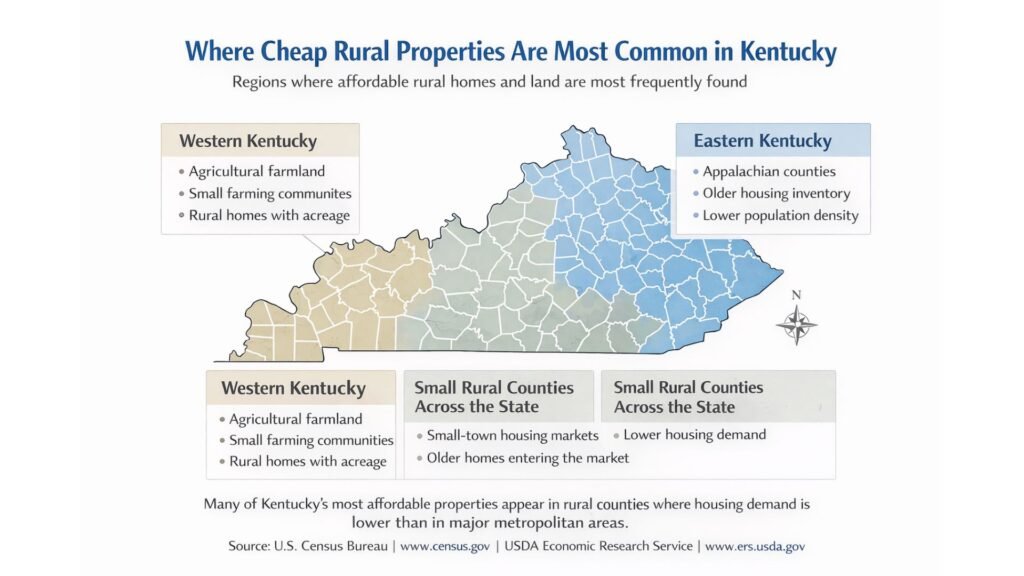
Although affordable homes can occasionally appear anywhere in the state, cheap rural properties in Kentucky tend to concentrate in specific regions where population density is lower and housing demand remains relatively modest. Buyers searching for farmhouses, small farms, or country homes with acreage will often notice that the most affordable listings appear in counties with strong agricultural traditions or long-standing rural communities.
Understanding where these markets are located can help buyers focus their search on areas where inexpensive properties are more likely to appear.
Eastern Kentucky and the Appalachian Region
Eastern Kentucky is one of the most well-known areas for affordable rural property in the state. This region, which forms part of the broader Appalachian Mountains, includes counties where historic farmhouses, small country homes, and rural land parcels occasionally appear at very low prices.
Several factors contribute to these lower property values. Many Appalachian counties have experienced long-term population decline, economic transitions, and limited housing demand compared to larger metropolitan areas. As a result, older homes and rural properties sometimes remain on the market longer and may be priced significantly below the national average.
The Appalachian region has a long history of coal mining and small agricultural communities, and many homes in the area were built decades ago. According to the Appalachian Regional Commission, parts of eastern Kentucky have faced persistent economic challenges tied to shifts in traditional industries, which has influenced local housing markets and property values.
For buyers interested in renovation projects or rural living, eastern Kentucky often represents one of the most affordable entry points into property ownership.
Western Kentucky Farming Areas
Western Kentucky offers a different type of rural real estate landscape. Instead of mountainous terrain, much of this region is characterized by farmland, open agricultural land, and small farming communities.
Counties in western Kentucky often feature farmhouses surrounded by crop fields, pastureland, and larger parcels of rural acreage. Because many of these areas remain heavily agricultural, property prices are sometimes influenced by farming demand rather than residential housing pressure.
The region is known for crops such as corn, soybeans, and tobacco, and farmland continues to play a major role in the local economy. According to the U.S. Department of Agriculture, Kentucky maintains thousands of active farms across the state, with a large concentration located in western counties.
For buyers interested in land, homesteading, or small agricultural operations, western Kentucky can offer opportunities to find properties that combine rural homes with usable acreage.
Small Town and County-Level Markets
Beyond the well-known rural regions, many of the most affordable properties in Kentucky are found in small towns and county-level markets that receive little national attention. These communities often have stable but relatively small populations, which keeps housing demand moderate.
In smaller county seats and rural towns, it is not unusual to find older homes that have been owned by the same families for decades. When these properties eventually enter the market, they may be priced attractively compared to similar homes in larger cities.
In many cases, buyers looking for cheap houses in Kentucky find the best opportunities by exploring listings in lesser-known counties rather than focusing exclusively on the state’s major urban centers. Local housing data consistently shows that property prices tend to decrease as distance from large metropolitan areas increases.
This is one of the reasons Kentucky continues to appear on lists of states where affordable rural housing can still be found, especially for buyers willing to consider smaller towns and quieter communities.
Typical Prices for Cheap Houses and Land in Kentucky
One of the main reasons buyers begin searching for property in Kentucky is the relatively low price of rural real estate compared to many other parts of the United States. While prices vary depending on location, condition, and acreage, the state still offers opportunities to find homes and land at levels that have largely disappeared in many housing markets.
Rural counties, especially outside major cities like Louisville and Lexington, often feature older housing inventory and farmland that can be purchased at significantly lower prices than comparable properties in suburban or metropolitan areas. For buyers willing to consider renovation projects or smaller communities, this price gap can create interesting opportunities.
According to housing data tracked by Zillow, the average home value in Kentucky remains well below the national average, reflecting the state’s relatively affordable housing market overall.
Farmhouses Under $100K
In certain rural parts of Kentucky, older farmhouses can sometimes be found for under $100,000. These properties are typically located in smaller towns or countryside areas where housing demand is relatively modest and many homes were built several decades ago.
Most farmhouses in this price range tend to fall into one of three categories: homes that require renovation, older properties that have been maintained but remain dated, or houses located in very small rural communities. Buyers considering these homes should always evaluate the condition of the structure, plumbing, electrical systems, and roofing before making a purchase decision.
Despite these considerations, affordable farmhouses remain one of the most recognizable types of cheap rural property in Kentucky. Listings occasionally appear featuring traditional farmhouse architecture, large porches, and surrounding land at prices that are difficult to find in many other states.
Rural Homes With Acreage
Another category that attracts buyers is rural homes with land. In Kentucky, it is not uncommon to find houses that include several acres of property, especially in agricultural regions where land parcels were historically divided into small farms.
The price of these properties depends heavily on location and land quality, but many rural homes with acreage remain within reach of buyers seeking space and privacy outside major metropolitan areas. Some listings feature five to ten acres of land alongside older homes, barns, or outbuildings that were once used for farming.
For people interested in homesteading, gardening, or small-scale agriculture, these types of properties offer a combination of housing and usable land. Kentucky’s long agricultural history means that many rural properties were originally designed to support small farms or family homesteads.
According to the USDA Economic Research Service, land use across Kentucky continues to be heavily influenced by agriculture, which helps explain the large number of rural properties that include farmland or open acreage.
Average Land Prices Per Acre
Land prices in Kentucky vary widely depending on location, soil quality, accessibility, and proximity to cities. Agricultural regions with productive farmland typically command higher prices, while more remote rural areas may offer lower-cost land parcels.
In many parts of the state, smaller tracts of rural land may range from a few thousand dollars per acre to significantly higher prices depending on infrastructure, road access, and development potential. Larger parcels used primarily for agriculture often follow different pricing patterns based on farming productivity.
The USDA National Agricultural Statistics Service regularly tracks farmland values across the United States, and Kentucky’s average farmland values remain lower than those in many major agricultural states, which contributes to the state’s reputation as an affordable place to purchase rural land.
For buyers looking to combine housing with land ownership, understanding these regional price differences can be an important part of evaluating potential opportunities in Kentucky’s rural real estate market.
Property Taxes and Ownership Costs in Kentucky
One of the reasons Kentucky continues to attract buyers searching for affordable rural property is the relatively low cost of ownership compared to many other states. Beyond the purchase price itself, ongoing expenses such as property taxes, utilities, and basic maintenance often remain significantly lower than in more expensive housing markets across the United States.
Understanding these ongoing costs is an important part of evaluating any rural property purchase. While cheap homes can offer appealing entry prices, buyers should always consider the long-term expenses associated with owning and maintaining rural land or older farmhouses.
Average Property Tax Rates
Kentucky is widely considered one of the more property-tax-friendly states in the country. According to data compiled by the Tax Foundation, Kentucky’s effective property tax rate averages around 0.72% of a property’s assessed value, which is below the national average of roughly 0.99%.
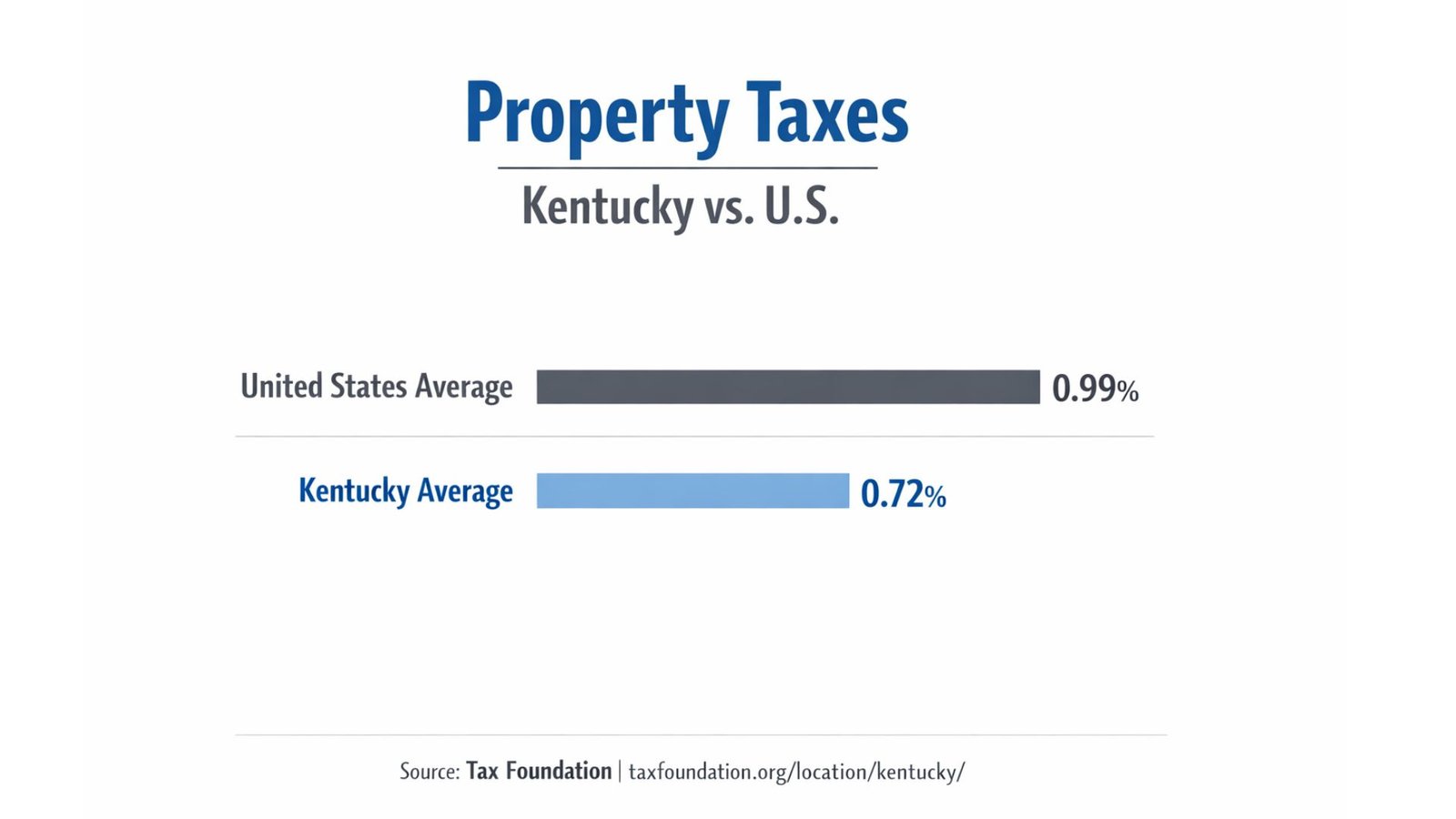
To put that into perspective, a rural property valued at $100,000 might carry an annual property tax bill of approximately $700 to $750, although the exact amount can vary depending on county tax rates and local school district levies.
Property taxes in Kentucky are assessed at both the state and local levels, with county governments responsible for collecting most property taxes. Detailed information about property tax assessments and rates can be found through the Kentucky Department of Revenue.
For buyers coming from states with higher property taxes, these relatively low rates can make Kentucky particularly attractive for long-term property ownership.
Utilities, Septic Systems, and Well Water
Many rural properties in Kentucky rely on infrastructure that differs from what buyers may be used to in suburban neighborhoods. Instead of municipal sewer systems or city water connections, rural homes often depend on private wells and septic systems.
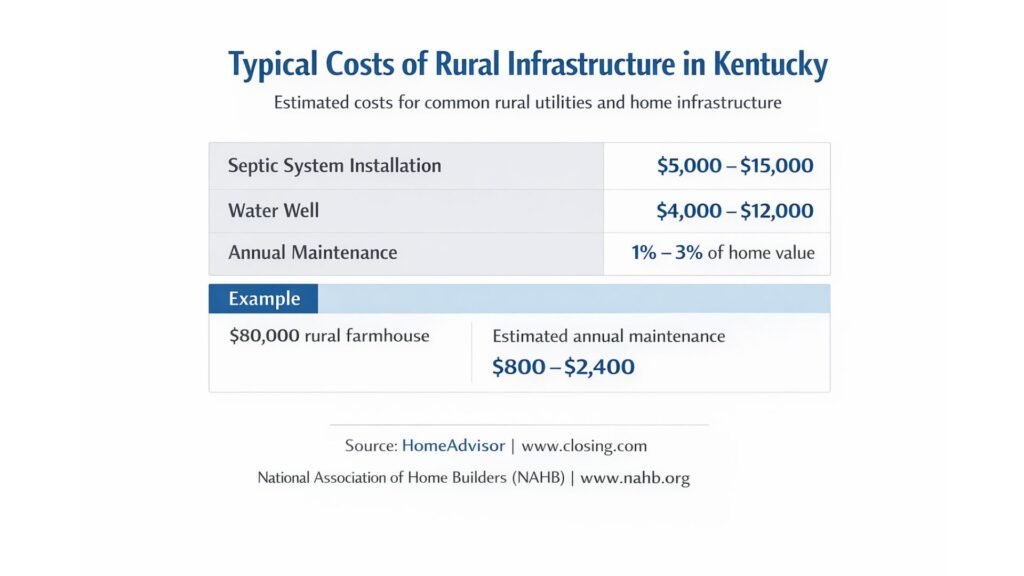
Installing a new septic system can cost anywhere from $5,000 to $15,000, depending on soil conditions and system type. Similarly, drilling a residential water well may cost between $4,000 and $12,000, depending on depth and geological conditions.
The Kentucky Division of Water oversees regulations related to private water wells and septic systems throughout the state.
Electricity is typically available even in remote areas, but internet service may vary depending on location. Some rural communities rely on satellite internet or expanding rural broadband programs.
Maintenance Costs for Rural Homes
Many of the cheapest properties in Kentucky tend to be older homes that may require ongoing maintenance or renovation. Farmhouses built decades ago often include structural features such as wood siding, metal roofs, and older plumbing systems that may need periodic repairs.
Buyers should budget for common maintenance expenses such as roofing repairs, HVAC updates, electrical improvements, and structural inspections. According to the National Association of Home Builders, homeowners in the United States typically spend between 1% and 3% of a home’s value per year on maintenance and repairs.
For example, a rural farmhouse purchased for $80,000 might require roughly $800 to $2,400 per year in ongoing maintenance costs, depending on its condition and age.
While these expenses are important to consider, many buyers still find that the overall cost of owning rural property in Kentucky remains relatively manageable compared to higher-priced housing markets in other regions of the country.
Closing Costs When Buying Property in Kentucky
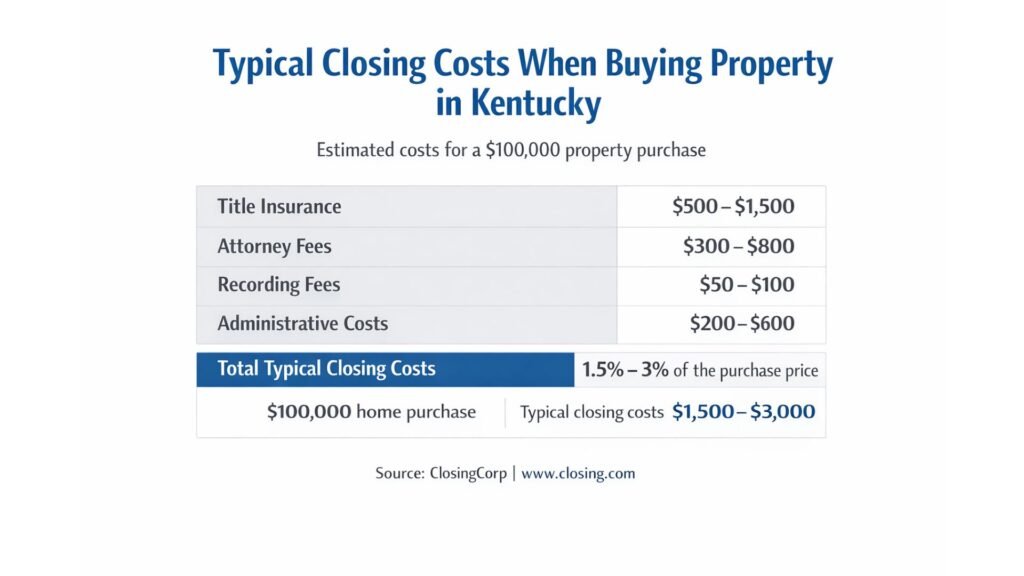
In addition to the purchase price, buyers should always factor in closing costs when purchasing property in Kentucky. These are the various administrative and legal expenses associated with transferring ownership of a property from the seller to the buyer.
Closing costs are typically paid at the time the transaction is finalized and can include fees for title services, legal documentation, property recording, and other administrative processes. While these costs are often lower than in many other states, they still represent an important part of the total investment when purchasing rural real estate.
According to real estate transaction data compiled by ClosingCorp, average closing costs for home purchases in Kentucky typically range between 1.5% and 3% of the purchase price, depending on the transaction and financing structure.
Typical Closing Costs for Buyers
The exact closing costs a buyer will pay can vary depending on the property price, financing arrangements, and the professionals involved in the transaction. However, for many buyers purchasing rural property in Kentucky, total closing costs often fall within a predictable range.
For example, on a property purchased for $100,000, total closing costs may range from approximately $1,500 to $3,000. Buyers paying cash may sometimes see slightly lower costs because certain lender-related fees are avoided.
Typical closing cost items may include:
- Title search and title services
- Title insurance
- Recording fees
- Legal document preparation
- Transfer-related administrative costs
These fees ensure that the property’s ownership history is verified and that the new ownership is legally recorded with the appropriate county offices.
Title Insurance and Legal Fees
One of the most important components of closing costs is title insurance. This insurance protects buyers against potential ownership disputes, undisclosed liens, or legal claims related to the property’s title.
Title insurance policies generally cost between $500 and $1,500, depending on the purchase price of the property and the coverage selected. Title companies also conduct a title search to confirm that the property has a clear legal ownership history before the transaction is finalized.
In Kentucky, real estate transactions often involve attorneys who prepare and review closing documents. Legal fees can vary depending on the complexity of the transaction but commonly range from $300 to $800 for straightforward property purchases.
The American Land Title Association provides detailed information about the role of title insurance in real estate transactions across the United States.
Recording Fees and Local Taxes
Once the property transaction is completed, the new ownership must be officially recorded with the county clerk’s office where the property is located. Recording fees are typically modest but vary slightly by county.
In Kentucky, recording a property deed generally costs around $50 to $100, depending on document length and county requirements. Buyers may also encounter small transfer-related taxes or administrative fees associated with the recording process.
More detailed information about deed recording requirements and fees can be found through the Kentucky Secretary of State’s Land Office.
Although closing costs add to the initial investment, they remain relatively manageable compared to many higher-priced real estate markets. For buyers considering affordable rural property in Kentucky, understanding these expenses in advance helps ensure that the purchase process remains smooth and financially predictable.
Common Issues With Very Cheap Rural Properties
While affordable rural properties in Kentucky can offer attractive opportunities for buyers, very low prices often come with certain trade-offs. Understanding the most common issues associated with older rural homes can help buyers avoid unexpected surprises and better evaluate whether a particular property is worth pursuing.
Many cheap farmhouses and rural homes were built several decades ago and may require repairs or modernization. Additionally, properties located in remote areas sometimes have limited infrastructure compared to homes in suburban or urban environments.
Taking the time to evaluate these factors before purchasing can help buyers make more informed decisions and budget appropriately for potential improvements.
Structural Problems in Older Farmhouses
Many of the cheapest properties in Kentucky are older homes built in the early or mid-20th century. While these houses often have strong traditional construction, they may also include aging structural components that require inspection.
Common structural issues in older farmhouses may include:
- Foundation settlement or cracking
- Outdated electrical wiring
- Aging plumbing systems
- Roof deterioration
- Wood rot or moisture damage
Because many rural homes were built long before modern building codes were standardized, buyers should strongly consider obtaining a professional home inspection before finalizing any purchase.
The U.S. Department of Housing and Urban Development (HUD) recommends thorough property inspections when purchasing older homes, particularly those requiring renovation or rehabilitation.
A qualified inspector can help identify structural problems and estimate the potential cost of repairs before the transaction is completed.
Limited Infrastructure in Remote Areas
Another factor buyers should consider when evaluating rural property is infrastructure availability. Homes located far from major towns may not have access to the same utilities and services commonly found in suburban areas.
For example, some rural properties rely on:
- private wells for drinking water
- septic systems instead of municipal sewer lines
- propane tanks instead of natural gas service
- satellite or limited broadband internet options
In recent years, expanding broadband access has become a priority in many rural communities. Programs supported by the Federal Communications Commission (FCC) aim to improve rural internet infrastructure across the United States, including parts of Kentucky.
However, internet availability and utility connections can still vary widely depending on location, so buyers should verify infrastructure access before purchasing a property in remote areas.
Renovation Costs Buyers Should Expect
Many cheap rural homes require at least some level of renovation. In some cases, these improvements may be cosmetic, such as updating kitchens, flooring, or bathrooms. In other cases, more substantial repairs may be necessary.
Typical renovation costs can vary significantly depending on the condition of the property and the type of work required. According to data from HomeAdvisor, the average cost of renovating a home in the United States can range between $15,000 and $50,000, though larger projects can exceed this range.
Buyers interested in fixer-upper farmhouses should evaluate the condition of major systems such as roofing, plumbing, electrical wiring, and HVAC equipment. Even when renovation costs are required, many buyers still find that the total investment remains relatively affordable compared to purchasing newer homes in higher-priced markets.
How Buyers Typically Find Cheap Properties in Kentucky
Finding cheap rural property in Kentucky often requires a slightly different approach than purchasing homes in more competitive urban markets. While traditional real estate platforms remain an important starting point, many affordable properties appear through local listings, small brokerages, or regional networks that may not receive widespread national attention.
Buyers who explore multiple search channels often increase their chances of discovering inexpensive homes, rural land, or farmhouses that might otherwise be overlooked.
Public Listings and Real Estate Platforms
Online real estate platforms remain one of the most common ways buyers discover affordable properties in Kentucky. Websites such as Zillow, Realtor.com, and Homes.com provide searchable databases of homes currently listed for sale across the state.
These platforms allow buyers to filter listings by price, property type, acreage, and location. This can be especially useful when searching for inexpensive homes in rural counties where properties may appear sporadically on the market.
Zillow, one of the largest real estate listing platforms in the United States, provides housing market data and property listings for nearly every county in Kentucky.
Regularly monitoring these platforms can help buyers identify newly listed properties before they attract broader attention.
Local Real Estate Agents and Small Brokerages
While national platforms are useful, many rural properties are still marketed through small local real estate agencies that specialize in specific counties or rural communities. These local brokerages often have deeper knowledge of regional markets and may learn about properties before they reach larger listing platforms.
Working with a local real estate agent can help buyers gain insight into pricing trends, property history, and local conditions that may not be obvious through online listings alone.
The National Association of Realtors emphasizes that local real estate professionals can provide valuable guidance when navigating unfamiliar housing markets or rural property transactions.
For buyers unfamiliar with Kentucky’s rural regions, local expertise can be especially helpful when evaluating potential property opportunities.
County Auctions and Off-Market Opportunities
Another way buyers sometimes discover inexpensive rural properties is through county auctions or off-market opportunities. These may include tax lien auctions, estate sales, or properties sold directly by owners without traditional real estate marketing.
County governments occasionally auction properties associated with delinquent taxes or other legal processes. These auctions can sometimes offer properties at prices below typical market levels, although buyers should carefully review the legal conditions of any auction sale.
Information about property auctions and county records can often be accessed through local county clerk offices or official government websites such as the Kentucky Department for Local Government.
While auction purchases require additional due diligence, they occasionally present opportunities for buyers seeking lower-cost rural properties in Kentucky.
Is Buying Cheap Rural Property in Kentucky Worth It?
For many buyers, the idea of purchasing affordable rural property in Kentucky is appealing for both lifestyle and financial reasons. While inexpensive homes often require careful evaluation and sometimes renovation, the state continues to offer opportunities that are increasingly rare in many other parts of the United States.
Compared to heavily populated housing markets where prices have risen dramatically, Kentucky still provides access to homes, farmland, and rural land at levels that remain within reach for many buyers. Whether someone is looking for a quieter lifestyle, a small homestead, or a long-term real estate investment, rural Kentucky continues to attract attention from buyers across the country.
Advantages of Rural Living
One of the main reasons people consider buying property in rural Kentucky is the lifestyle that comes with it. Many rural communities offer a slower pace of life, lower living costs, and access to open land that is difficult to find in suburban or urban environments.
Buyers often value the opportunity to own larger parcels of land, maintain gardens, raise small livestock, or simply enjoy the privacy that rural properties provide. In addition, smaller towns often have strong community ties and a lower overall cost of living compared to larger metropolitan areas.
According to cost-of-living data compiled by the Missouri Economic Research and Information Center, Kentucky consistently ranks among the states with the lowest overall living costs in the United States.
This affordability can make rural homeownership more attainable for buyers who are willing to consider properties outside major cities.
Long-Term Investment Potential
While many buyers pursue rural property for lifestyle reasons, others also view it as a long-term investment opportunity. Land, in particular, has historically been considered a relatively stable asset over long periods of time.
Agricultural land, recreational land, and rural housing can sometimes increase in value as nearby communities develop or infrastructure improves. Additionally, buyers who purchase inexpensive properties and renovate them may significantly increase the value of the property over time.
According to farmland value reports from the USDA National Agricultural Statistics Service, agricultural land values in Kentucky have gradually increased over the past several decades, reflecting ongoing demand for farmland and rural property.
While real estate markets always fluctuate, many buyers see rural property as both a lifestyle purchase and a long-term asset.
Final Thoughts on Buying Affordable Property in Kentucky
Kentucky remains one of the few states in the United States where buyers can still discover affordable rural homes, small farms, and properties with land at prices that are increasingly difficult to find elsewhere. From the Appalachian counties of eastern Kentucky to farming communities in the western part of the state, opportunities continue to appear for buyers willing to explore rural markets.
However, purchasing cheap rural property always requires careful evaluation. Buyers should consider factors such as property condition, infrastructure availability, renovation costs, and long-term ownership expenses before making a final decision.
For those willing to do their research, Kentucky’s rural real estate market can offer a unique combination of affordability, space, and potential.
If you’d like to see real examples currently on the market, you can explore our guide featuring dirt-cheap farmhouses in Kentucky, where we highlight several rural homes that recently appeared at surprisingly low prices.