How to Buy Cheap Rural Property in Florida (Complete Guide)
If you want to know how to buy cheap rural property in Florida, start here. It is not the same transaction as buying a house in a subdivision, and the differences are not obvious until one of them costs you money. Different way of searching, different vocabulary on the listing, different checks before you offer, different lenders, and a closing that runs through a title company instead of a lawyer. This guide walks the whole process in order.
It is the practical companion to our guide to buying rural property in Florida, which covers what land is worth county by county and the rules attached to it. This one covers what you actually do, from the first search to the first tax bill. Everything below is a description of how the process works, not advice about your purchase.
Last reviewed 4 September 2026.
Where is rural property in Florida still cheap?
Inland, in the north of the state. The cheapest farmland in Florida is in the western Panhandle and the Big Bend, where an acre averages between $4,146 and $4,800 by the 2022 USDA Census of Agriculture. Jackson, Gadsden, Calhoun, Holmes, Taylor, Madison and Dixie counties are the recurring names. None of them touches the tourist coast.
That is the short answer. The county-by-county numbers, and the reason the region matters much less in Florida than it does in Kentucky or Tennessee, are in the Florida pillar guide. If you want to see actual houses in those counties, the cheapest counties in Florida to buy land list and the ten cheap Florida farmhouses with land list are both built from them.
What does “cheap” actually buy in rural Florida?
Between roughly $45,000 and $250,000, a house on land. Across the twenty Florida properties we have covered, the median lot is 2 acres and the typical house is a block or frame home built between the 1960s and the 1990s. You are buying the building, not the acreage: at census values the land underneath those twenty homes accounts for about 8% of the asking price.
The four things you will see over and over:
- Concrete block or frame houses from the 1960s to the 1990s on 1 to 5 acres, usually on a well and a septic system.
- Manufactured and mobile homes on land. Very common in rural Florida and much cheaper, but they finance differently and insure differently, which is covered below.
- Fixer-uppers sold as-is. Often estate sales or foreclosures where nobody wants to manage a repair.
- Small working parcels with a pole barn, a pasture or a few acres of planted pine, sometimes carrying an agricultural classification the seller applied for.
What you will almost never see at these prices is acreage. If you want twenty acres rather than two, you are shopping a different market, in the cattle and timber counties, and usually without a house on it.
How do you find the listings?
Search by county, not by town. Rural Florida towns are small and inconsistently named in listing databases, and the county is the unit that actually controls zoning, septic permits and your tax bill. Set the filter to a minimum acreage, sort by price, and save the search so new listings reach you before they are picked over.
The free tool most buyers never open
Every Florida county has a property appraiser with a public parcel search on its own website. Type in the address or the parcel number and you can usually see, at no cost and without registering: the assessed and market value the county assigns, the current tax bill, the sales history with dates and prices, the building’s year and square footage, whether a homestead exemption or an agricultural classification is on the parcel, and an aerial photograph with the parcel boundary drawn on it.
That is the single most useful half hour you can spend on a Florida property, and it happens before you contact anybody. It tells you what the seller paid and when, whether the tax figure in the listing is a homesteaded owner’s number rather than yours, and roughly where the parcel lines fall.
How do you read a Florida rural listing?
Rural listings use a compressed vocabulary, and several of the phrases are warnings written politely. Learning six of them will save you more money than any negotiating tactic. Here is what they normally mean in Florida.
- “As-is” — the seller will not make repairs and will not negotiate over the inspection report. You can still inspect, and you should. It is not a warning about the house so much as about the seller’s appetite.
- “Cash only” — the property is unlikely to pass a lender’s condition standards. Missing kitchen, active roof leak, no working systems. Sometimes it just means the seller does not want a 45-day financing contingency.
- “Well and septic” — there is no municipal water or sewer. That is normal out here and not a defect, but it puts two systems on your side of the fence, and it is why the septic rules below matter.
- “Zoned AG” or “agricultural” — a zoning category, which is not the same thing as the agricultural tax classification. Zoning says what you may build and do. The classification is a tax status the owner applies for every year.
- “Mobile home” and “manufactured home” — check whether the home has been legally tied to the land. When it has, it is taxed and financed as real property; when it has not, it is titled like a vehicle and a normal mortgage will not cover it.
- Acreage figures — the number on the listing is the size of the parcel. It is not a statement that all of it is dry, buildable or usable, which in Florida is a real distinction.
What do you check before you make an offer, and in what order?
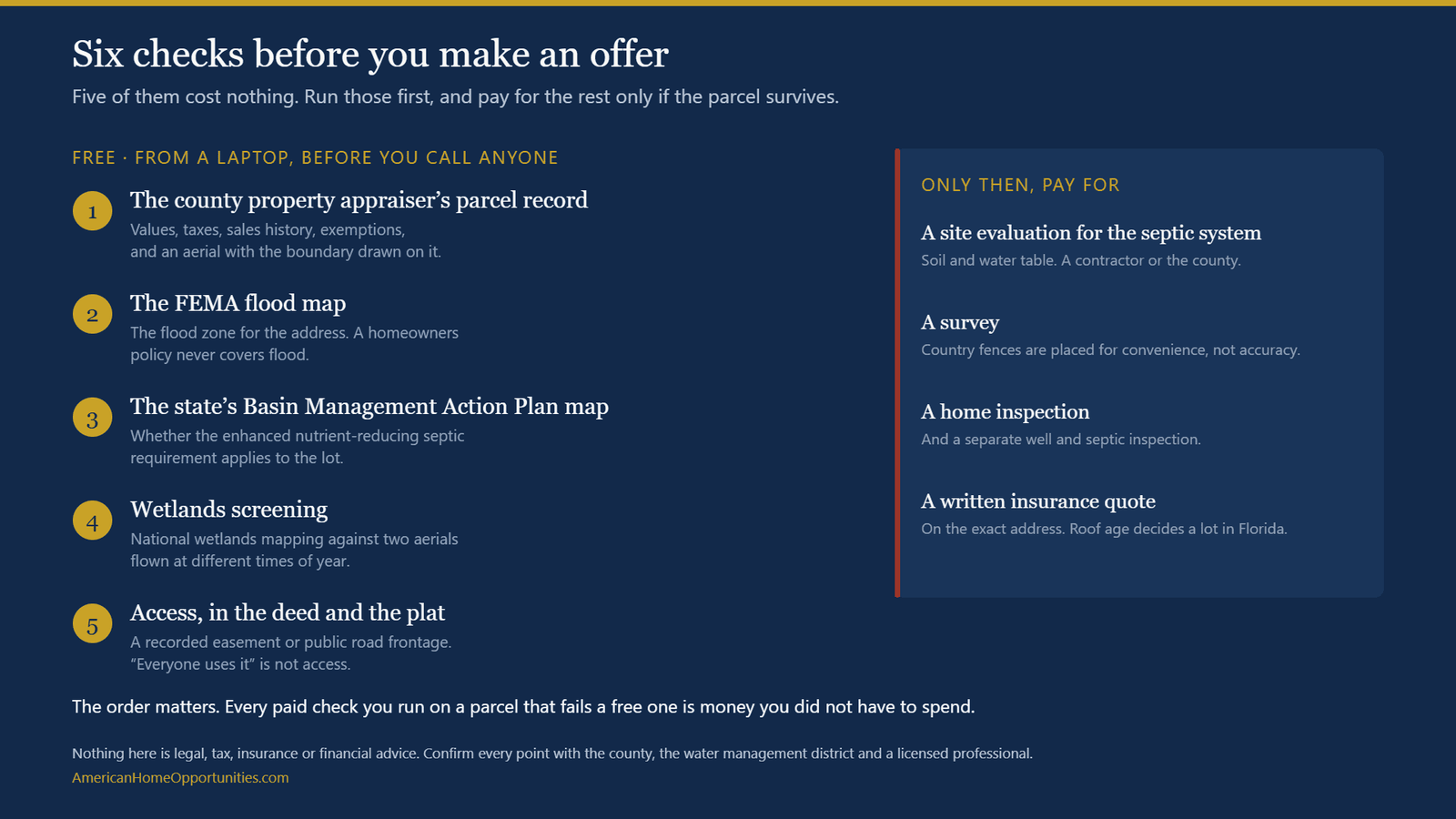
Cheapest checks first. Five of the six checks below are free and can be done from a laptop in an afternoon, before you have spent a dollar or spoken to anyone. Do those first, and only pay for a survey, an inspection and an insurance quote on a property that has already survived them.
- The county property appraiser’s parcel record. Free. Values, taxes, sales history, exemptions and an aerial with the boundary.
- The FEMA flood map. Free. Find the flood zone for the address. Remember that a homeowners policy does not cover flood, ever, and that Florida sellers of residential property must give you a flood disclosure at or before the contract under section 689.302 of the Florida Statutes.
- The state’s Basin Management Action Plan mapping. Free. If the parcel sits inside a plan for an Outstanding Florida Spring and the lot is one acre or less, a new onsite system has to be an enhanced nutrient-reducing one, which costs considerably more than a conventional tank.
- Wetlands. Free to a first approximation, using the national wetlands mapping and the aerial. Anything ambiguous needs a professional determination, because it decides how much of the parcel you can actually build on.
- Access. Read how the parcel is reached. A dirt road that crosses a neighbour’s land needs a recorded easement, and “we have always used it” is not one.
- Then, and only then, the paid checks: a survey, a home inspection, a well and septic inspection, and a written insurance quote on the actual address.
The detail behind each of those six, with the statute numbers, is in the Florida pillar guide. If the parcel has no house on it yet, or you are not sure how much of it you can build on, how to check if land in Florida is buildable goes through the wastewater, wetland and access questions in full. This is the order to run them in.
Get the insurance quote before the offer, not after
This is the single most common expensive surprise in Florida, and it is the easiest to avoid. A written quote on the exact address costs you nothing and takes a day. Roof age, roof material, the year the house was built and the distance to a fire station move the number enormously, and on some older rural houses the answer comes back as no offer at all. Find that out while you can still walk away.
How do people pay for a cheap rural house in Florida?
Often in cash, and that is not a coincidence. Below roughly $100,000 a conventional mortgage becomes hard to place, because the lender’s fixed cost of writing the loan barely changes while the interest it earns shrinks. That is a national pattern, not a Florida one, and it is the main reason these houses sit on the market.
The routes buyers actually use:
- Cash. The most common at the bottom of the range, and the reason “cash only” appears so often in the listings.
- USDA Rural Development loans. A federal programme aimed at exactly this kind of property, with no down payment for eligible buyers. Eligibility is drawn geographically and capped by household income, and the maps are redrawn periodically, so check the specific address on the USDA eligibility map rather than assuming a county qualifies.
- FHA. Lower down payment, but the property has to meet minimum condition standards, which is where many as-is rural houses fail.
- Renovation loans. Products that lend against the house as it will be after the work rather than as it is today. They are more paperwork and fewer lenders offer them.
- Manufactured home financing. Its own rulebook, and it depends heavily on whether the home is titled as real property, its age, and its foundation.
We are not a lender and this is a description of what exists, not a recommendation. Which of these is available on a given house depends on the house, on your finances and on the lender, and that conversation belongs with a licensed mortgage professional before you write an offer, not after.
What happens between the offer and the closing?
In Florida most residential deals run on the standard contract produced jointly by Florida Realtors and The Florida Bar, usually called the FAR/BAR contract. It gives you a defined inspection period, and what you do with that window is the whole game on a rural property.
The inspection period is short. Plan it before you sign.
Know in advance who is doing the home inspection, who is looking at the well and the septic, and whether you want a survey, because booking all three in a rural county takes longer than in a city and the clock does not stop for scheduling. A well and septic inspection is a separate appointment from the home inspection and a general inspector will usually not do it.
The flood disclosure is yours by law
Since 2024, section 689.302 of the Florida Statutes requires the seller of residential property to give you a flood disclosure at or before you sign the contract. It has to state whether flooding damaged the property while they owned it, whether they filed an insurance claim including with the National Flood Insurance Program, and whether they received federal disaster assistance for flood damage. Ask for it in writing even if the answer is that they have no knowledge.
How does closing work in Florida?
Through a title company, in most cases. Florida does not require an attorney at a residential closing the way North Carolina does, and the majority of transactions close at a title company or with a title agent. That keeps the transaction cost lower than in attorney states.
Two things worth paying for anyway on a rural parcel. A survey, because fences in the country are placed for convenience rather than accuracy and you want the corners marked before you own them. And title insurance, because rural chains of title are long, include estates and family transfers, and are where old easements and access questions surface. If the parcel has any complication around access, an easement or a boundary, hiring a Florida real estate attorney on top of the title company is money well spent.
What do you do in the first year?
Two deadlines, both on March 1, and both easy to miss because nobody chases you about them. If the house is your primary residence, apply for the homestead exemption with the county property appraiser. If the land is in genuine commercial agricultural use, apply separately for the agricultural classification under section 193.461 of the Florida Statutes. Neither is automatic and neither transfers from the previous owner.
Budget from market value, not from the seller’s tax bill
Florida’s Save Our Homes limitation caps the annual rise in assessed value at 3% or the change in the Consumer Price Index, whichever is lower, for as long as the same owner keeps the homestead exemption. Section 193.155 removes that cap when the property changes hands, and it is reassessed at full market value on the following January 1.
So a house that a long-time owner has held for twenty years may be carrying an assessment far below what it is worth, and the tax number on the listing is their history, not your future. Work out your own figure from market value at the county millage rate before you decide what you can afford.
See the Florida properties that survive these checks
We run this same sequence on every property before we publish it. Leave your email and the ones that come through it reach you before the video goes up.
Questions buyers ask about buying cheap rural property in Florida
What is the cheapest county in Florida to buy land?
Jackson County, in the western Panhandle, at $4,146 an acre in the 2022 USDA Census of Agriculture, followed by Gadsden at $4,409 and Taylor at $4,478. The full ranking, and what the census does and does not measure, is in the Florida pillar guide.
Can you get a mortgage on a $60,000 house in Florida?
It is harder than most buyers expect. Many lenders set a minimum loan amount, and below roughly $100,000 the economics of writing the loan stop working for them. USDA and FHA programmes exist and are used on properties like these, but each has conditions about the buyer and about the house. Ask a licensed lender about the specific property before you make an offer.
Do you need a lawyer to buy rural property in Florida?
Florida does not require one. Residential closings normally run through a title company, unlike North Carolina, where an attorney is required. On a rural parcel with questions about access, easements or wetlands, many buyers hire a Florida real estate attorney anyway. This is a description of how closings usually work, not legal advice.
How much land do you actually get at these prices?
Usually between one and five acres. Across the twenty Florida properties we have covered the median is 2 acres, and the land accounts for roughly 8% of the asking price at census values. If acreage is what you want rather than a cheap house, you are shopping the cattle and timber counties, and normally buying land without a house on it.
Keep reading
How to check if land in Florida is buildable is the companion to this one: it covers whether the ground itself works, which is the question that stops most rural parcels. The Florida pillar guide has the county land values, the six checks in full with their statute numbers, and what the property actually costs to own once you have it. The cheapest counties in Florida to buy land and ten cheap Florida farmhouses with land are the property lists built from those counties. And if you want the reasoning behind why houses like these sit unsold in the first place, why cheap rural homes do not sell works through the eight mechanics.
Disclaimer
American Home Opportunities is a publisher. We are not a brokerage, a lender, a lawyer, an insurance agent or a financial adviser, we do not represent buyers or sellers, and nothing on this page is legal, tax, insurance or financial advice. Land values are from the USDA 2022 Census of Agriculture; the statutes cited are sections 193.155, 193.461 and 689.302 of the Florida Statutes, summarised here in plain language, and the statute governs rather than our summary. Programmes, prices and rules change. Verify everything that matters with the county, the water management district, a licensed lender, a licensed inspector and a licensed professional in the relevant field before you buy. Last reviewed 4 September 2026.