
Buying Rural Property in North Carolina
What land actually costs region by region, why the cheapest counties are cheap, and the tax rule that can hand you four years of back taxes after you close.
$5,482
per acre of farmland
USDA 2022 census
0.66%
effective property tax
national range 0.29–1.88%
3.9x
cheapest to priciest
Martin County to Buncombe
$378,655
state median home price
we feature $45,000–$250,000
The cheapest land in North Carolina is not where you think it is
Farmland in Martin County, out on the flat coastal plain, is worth about $3,011 an acre. In Buncombe County, where Asheville sits, the same measure comes to $11,802. Nearly four times the price, and both are rural counties in the same state.
Most people have this backwards. Ask where the cheap land in North Carolina is and almost everyone points west, at the mountains. The federal census of agriculture says the opposite. The Mountains are the most expensive of the state’s three regions. The Coastal Plain is the cheapest, and it is not close.
The reason is not complicated. Mountain parcels are small, they sit within reach of Asheville and Boone, and they compete with second-home and short-term-rental money. Coastal Plain counties have large flat tracts, thin and falling population, and a farm economy that needs fewer people every year. Price follows demand, not scenery.
This page breaks North Carolina into the three markets that actually exist, shows what the properties we have featured here have really cost, and walks through what you have to verify in this state — including a tax rule that can hand you four years of back taxes on a property you have just bought.
What rural land costs, region by region
The benchmark worth using is the USDA Census of Agriculture, taken every five years. It is a census rather than a survey — every farm, in every county — and the 2022 edition values North Carolina farmland and the buildings on it at an average of $5,482 an acre across 8,128,136 acres.
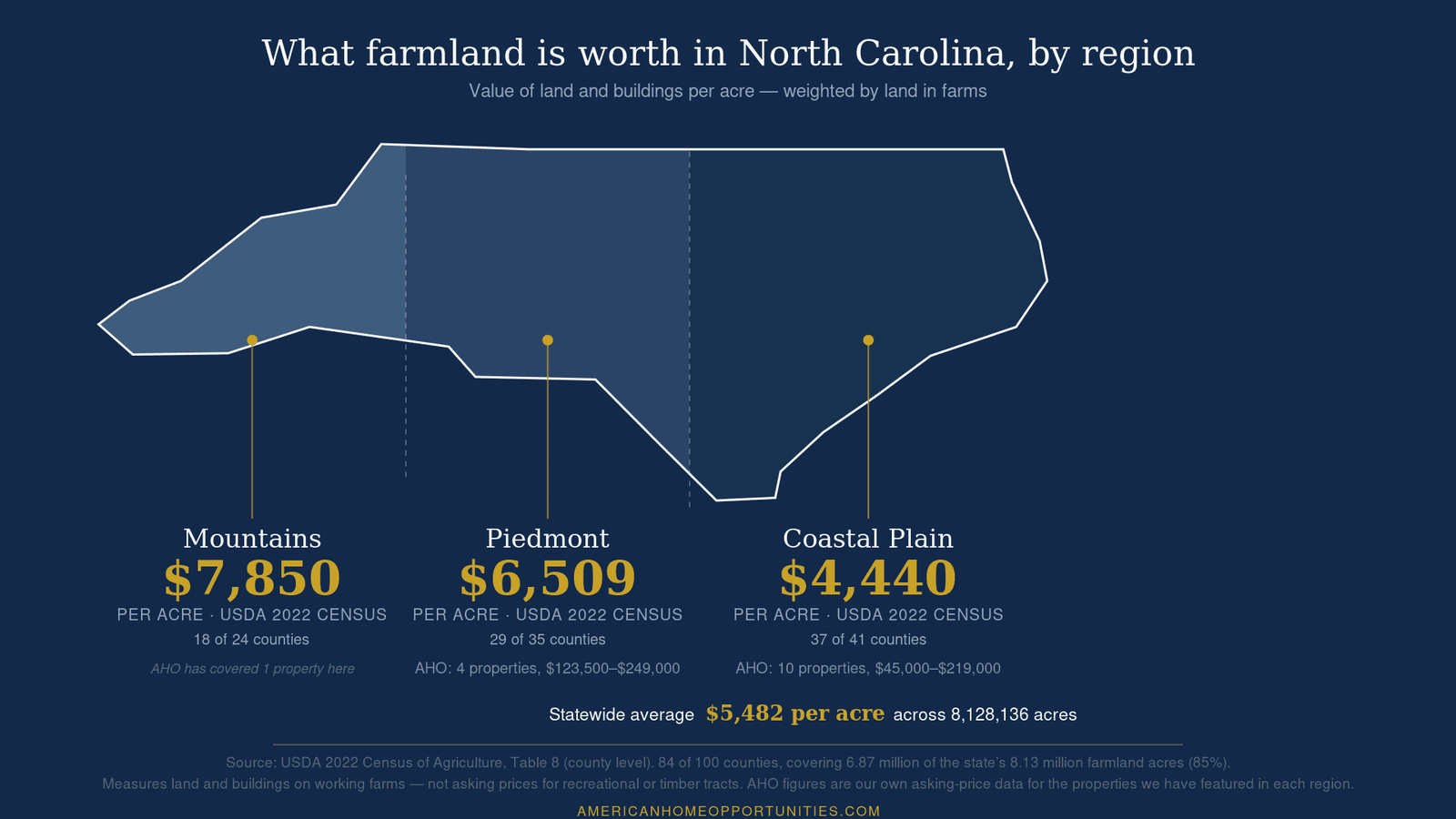
| Region | Farmland value per acre USDA, 2022 census | Cheapest county we can name | What we have covered there |
|---|---|---|---|
| Mountains Ashe, Buncombe, Haywood, Jackson, Macon, Madison, Watauga and their neighbours | $7,850 18 of 24 counties | Caldwell, $5,873 | 1 property, $249,900 on 5.4 acres |
| Piedmont Alamance, Catawba, Chatham, Franklin, Randolph, Rockingham, Warren | $6,509 29 of 35 counties | Caswell, $4,006 | 4 properties, $123,500–$249,000 |
| Coastal Plain Bertie, Bladen, Duplin, Hyde, Martin, Northampton, Pamlico, Robeson | $4,440 37 of 41 counties | Carteret, $2,231 | 10 properties, $45,000–$219,000 |
| North Carolina | $5,482 all 100 counties, 8,128,136 acres | Carteret, $2,231 | 15 properties across two reports |
Two things in that table are worth slowing down for. Before either, one note on the numbers: the regional averages are built from 84 of the state’s 100 counties, which is 85% of North Carolina’s farmland acreage. We checked whether the missing counties could change the ranking. For the Mountains to fall to the Piedmont’s level, the six mountain counties we are missing would have to average somewhere between $3,000 and $4,000 an acre. The cheapest mountain county in the data is Caldwell at $5,873. The ordering holds.
The first is the direction of the numbers, which we have already covered: the mountains cost more, not less. The second is what our own properties reveal about the shape of a cheap North Carolina listing. Across both reports, the fifteen properties we have featured average 1.9 acres. Not one of them is a twenty, thirty or fifty-acre parcel of the kind that shows up routinely in Kentucky or Tennessee at the same price.
Put the two datasets against each other and it becomes concrete. We featured a house on one acre in Jamesville, Martin County, at $89,900. The census values farmland in Martin County at $3,011 an acre. So roughly three per cent of that price is the ground, and the other ninety-seven per cent is the house standing on it.
That is the honest summary of the affordable end of this state: in North Carolina what is cheap is the house, not the land. It is the opposite of eastern Kentucky, where large parcels come with a house almost thrown in. If your goal is acreage, North Carolina is not the most efficient place to buy it. If your goal is a solid house in the country for well under $150,000, it is one of the best.
One warning about numbers you will meet elsewhere. Listing sites publish North Carolina “average price per acre” figures running from about $3,000 in the east to over $200,000 near Raleigh. Those are averages of what is currently for sale, not of what sells. Overpriced parcels sit for months while fairly priced ones move in weeks, so the expensive listings accumulate and drag the average upward. Any site quoting active-listing averages as market value is showing you the wrong number.
Where the cheap land is, and why it is cheap
The least expensive ground in the state runs across the northeastern and central coastal plain: Martin, Craven, Pamlico, Edgecombe, Northampton, Jones, Hertford, Hyde, Bertie, Robeson. Farmland in each of those counties is valued between $3,011 and $3,897 an acre by the 2022 census. Carteret, on the coast, comes in lowest of all at $2,231, though a good share of that county is marsh and sound rather than workable ground.
This is quiet country rather than dramatic country. Blackwater rivers, cypress, soybeans and tobacco, long straight roads, towns of two and three thousand people with a courthouse square. If what you picture when you think of rural North Carolina is a mountain view, this is not that. If what you picture is a porch, a garden and no neighbours in sight, this is exactly that, at a third of the mountain price.
It is cheap for reasons you should hear from us rather than discover afterwards. These counties have been losing population for decades. Mechanised agriculture needs a fraction of the workers it once did, the manufacturing that replaced some of those jobs largely left, and young people have gone to Raleigh, Charlotte and Wilmington. Land is inexpensive because demand is thin, not because the market has overlooked it.
None of that makes it a bad buy. If you are retired, working remotely, homesteading, or simply want a house with land around it, thin local demand is the entire reason you can afford it. What it does mean is that you should not count on finding work locally, that resale can be slow, and that services are further away than the map suggests.
The cheapest counties charge the highest tax rates
Here is something no listing page will tell you, and it comes straight out of putting two official datasets side by side.
The three highest county property tax rates in North Carolina for 2025–2026 belong to Northampton ($1.206 per $100 of value), Edgecombe ($1.17) and Martin ($1.15). Those are also three of the six counties with the cheapest farmland in the state. That is not a coincidence: where the taxable base is small, the rate has to be high to pay for the same schools, the same deputies and the same roads.
The practical effect is worth doing on paper. An $89,900 house in Martin County works out at roughly $1,034 a year in county tax. The same house in Jackson County, up in the mountains at $0.37 per $100, comes to about $333. Cheaper to buy does not mean cheaper to keep.
There is a middle tier worth knowing too. The Sandhills counties — Scotland, Hoke, Moore, Richmond — sit between Fayetteville and the Piedmont with sandy soil, pine, and prices well below the metro belt. The foothill counties on the eastern edge of the mountains, Rutherford, Burke, Caldwell and McDowell, put you within an hour of real mountains at a fraction of what Buncombe asks. And the corridor counties along US 64 and I-95, Halifax, Nash, Franklin and Johnston, trade a little of the isolation for a genuine commute to Raleigh.
What to check before buying rural property in North Carolina
Every state has its own traps. These are North Carolina’s, and a listing page will not mention a single one of them.
The tax bill that arrives after you close
This is the one that catches out-of-state buyers, and it is specific enough that most agents will not raise it unprompted. North Carolina lets qualifying farmland, forestland and horticultural land be taxed on its present-use value rather than its market value, under G.S. 105-277.2. On a working parcel the saving is substantial.
The catch is what happens when the land stops qualifying. When a tract is disqualified — because the use changed, or because the new owner does not meet the requirements — the county bills the rollback: the deferred tax for the current year and the three preceding years, plus interest. Buy twelve acres enrolled in present-use value, put a house on part of it, and a bill covering four years of somebody else’s deferral can land on your first statement.
What to do: ask the county tax office, in writing, whether the parcel is enrolled in present-use value, how much deferred tax has accumulated on it, and whether it keeps qualifying under the use you intend. Then settle in the contract who pays the rollback if it is triggered at closing. “The seller has always had it” is not an answer.
No septic permit, no house
Almost every rural parcel in North Carolina is off the sewer system, and the state issues three separate permits in a fixed order. The first one decides whether the land is worth anything to you.
The Improvement Permit comes after a soil evaluation. An environmental health specialist walks the site and assesses soil texture and depth, topography and the size of the usable area — and the law requires that there also be room for a full replacement system in case the first one fails. If the soil does not pass, there is no permit, and without a permit there is no house. Only then come the Construction Authorization, which approves the specific system for the house you intend to build, and the Operation Permit, issued after installation and inspection.
What to do: ask whether an active Improvement Permit already exists. If it does, it is one of the most valuable documents a seller can hand you, and it stays valid for five years. If it does not, make your offer contingent on obtaining one. You can go through the county health department, which typically runs $200 to $400 in fees and four to eight weeks where demand is heavy, or hire a private Authorized On-Site Wastewater Evaluator for roughly $300 to $800, usually on site within a week or two.
Helene proved the flood map was not the whole story
Between 25 and 28 September 2024 the remnants of Hurricane Helene dropped more than twelve inches of rain on western North Carolina. The state recorded 107 storm-related deaths and put damage and recovery needs at at least $53 billion. The storm set off around 1,400 landslides and damaged more than 160 water and sewer systems, some 6,000 miles of road, over a thousand bridges and culverts, and an estimated 126,000 homes. Chimney Rock, Lake Lure and Swannanoa were largely destroyed.
The lesson for a buyer is not “avoid the coast”. It is that this happened three hundred miles inland, in the mountains, in narrow valleys that mostly were not mapped as flood-prone. A creek that has behaved for forty years is not a guarantee, and neither is a clean FEMA panel.
Landslide risk carries the same warning. When Helene hit, most western counties had never been mapped for landslide hazard, Avery among them. The General Assembly has since put $3 million toward mapping the affected area, and the North Carolina Geological Survey now publishes a Landslide Hazards in Western North Carolina viewer built with UNC Asheville. The new model treats five inches of rain in twenty-four hours as the threshold that triggers a fast-moving slide.
What to do: run the address through the North Carolina Flood Risk Information System at fris.nc.gov, one of the better state flood-mapping tools in the country, and check the NCGS landslide viewer if the property is west of Morganton. Then ask the neighbours and the county road department what the water has actually done. Get a flood insurance quote before you budget, not after.
You cannot close without a North Carolina attorney
North Carolina is an attorney-closing state. A licensed North Carolina attorney has to handle the deed and conduct the closing. This is not optional and a title company from another state cannot substitute for it.
For a buyer coming from Texas, Florida or Arizona, where closings routinely run through a title agency, this changes both the budget and the calendar. It is also, in practice, a protection: someone qualified reads the title before you own the problem.
What to do: line up a closing attorney in the county where the property sits, not in the city you live in, before you make an offer. Ask what the fee covers, whether a full title search back through the chain is included, and how long they need. A local attorney will also know which surveyors and soil evaluators the county actually accepts.
“There is a hospital in town” is not the question
Between 2013 and 2023, nine hospitals in mostly rural North Carolina counties eliminated labour and delivery entirely, and the majority of those closures were in the west. Researchers now identify four distinct maternity care deserts in the state: the far west, the northwest, the northeast and the south.
It is not only a North Carolina problem. Since the end of 2020, 139 rural hospitals nationally have stopped delivering babies or announced they will before the end of 2026, a thirteen per cent reduction, and the pace increased in 2025. In rural areas the drive to a hospital with a delivery unit is typically at least thirty minutes and often fifty or more.
The point that matters is that services get cut long before a building closes. A hospital can stay open while the maternity ward, the intensive care beds or the overnight admissions quietly go.
What to do: do not look up “nearest hospital”. Check three things separately and write down the drive time for each: the nearest emergency room, the nearest hospital that actually admits inpatients, and, if it applies to you, the nearest labour and delivery unit. Then phone and confirm the service is still running.
Broadband, and the question that actually gets an answer
North Carolina is spending real money on this. In March 2026 the state announced almost $26 million through its Stop-Gap Solutions programme to connect 5,161 homes, businesses and community anchor institutions by the end of the year. The detail worth noticing is that those connections are spread across 66 of the state’s 100 counties. The gap is not confined to one corner of the state.
Coverage maps are drawn at census-block level and routinely show a county in green when service stops half a mile short of the last few addresses on a gravel road.
What to do: if you work remotely this is a deal-breaker item, not a detail. Call the provider with the exact street address, ask whether they will connect that specific service point and what it costs to run the line to it, and get the answer before you make an offer. Ask the neighbours what they actually get, not what they are sold.
We run these checks before we feature a property
Every week we go through North Carolina listings and publish only the ones that hold up. Join the list and you will see them as they go out.
What it costs to own it once you have it
North Carolina is a comparatively cheap state to hold property in. The effective property tax rate on owner-occupied housing is 0.66%. Nationally the range runs from 0.29% in Hawaii to 1.88% in New Jersey and Illinois, so North Carolina sits in the lower third. On a $140,000 rural home that is roughly $924 a year.
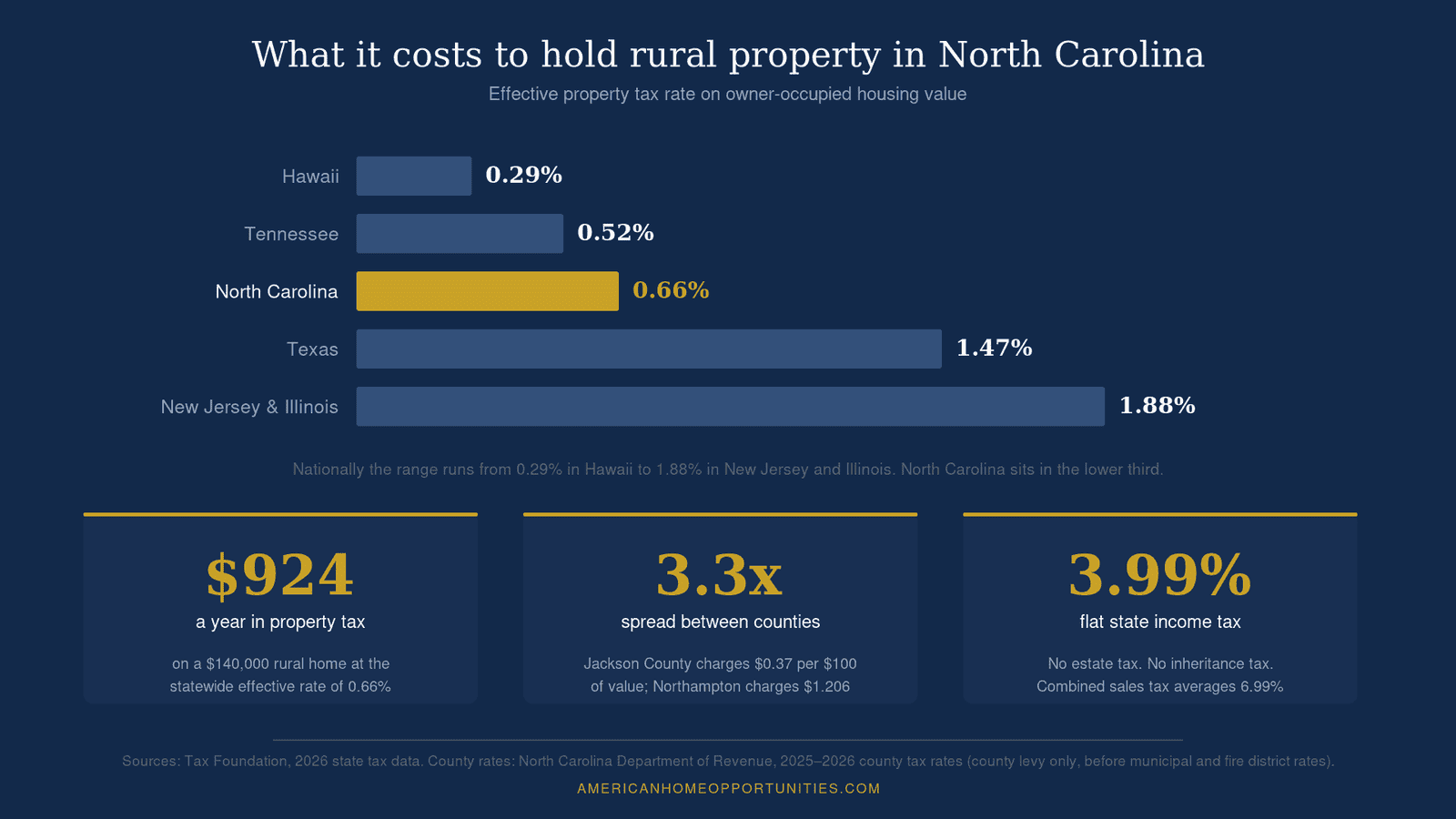
The statewide average is not what you will pay. Property tax is levied by the county and funds schools, sheriff, fire and roads, so it moves a long way from one line on the map to the next. For 2025–2026, county rates run from $0.37 per $100 of value in Jackson County to $1.206 in Northampton — more than three times — with Clay and Macon at $0.44 and Edgecombe and Martin above $1.15.
Those are county rates before any municipal or fire district levy is added on top, so a house inside town limits pays more than the county figure suggests. Look up the county, and then the district, rather than the state.
Two relief programmes are worth knowing about before you budget, and both are commonly misunderstood.
The Homestead Exclusion removes the greater of $25,000 or half the appraised value of a permanent residence from taxation — but only for owners who are 65 or older, or totally and permanently disabled, and whose income falls under $38,800. It is not a general homeowner benefit. Applications close on 1 June, and once approved it carries forward without reapplying.
The Circuit Breaker caps the bill at 4% of household income up to that same $38,800 threshold, or 5% for income between $38,801 and $58,200. Read the mechanism carefully: the amount above the cap is deferred, not forgiven. It accrues as a lien on the property at 6% interest and comes due when the property is sold or the owner stops qualifying. It has to be applied for every single year.
Beyond property tax, North Carolina charges a flat 3.99% state income tax, has no estate tax and no inheritance tax, and combined state and local sales tax averages 6.99%. For context on the buying side rather than the holding side: the statewide median sale price was $378,655 in May 2026, but that figure is carried by Charlotte at $435,000, Raleigh at $425,000 and Asheville at $507,000 — precisely the North Carolina this site does not cover. The rural properties we feature run from $45,000 to about $250,000.
Water and waste: the cost most buyers forget
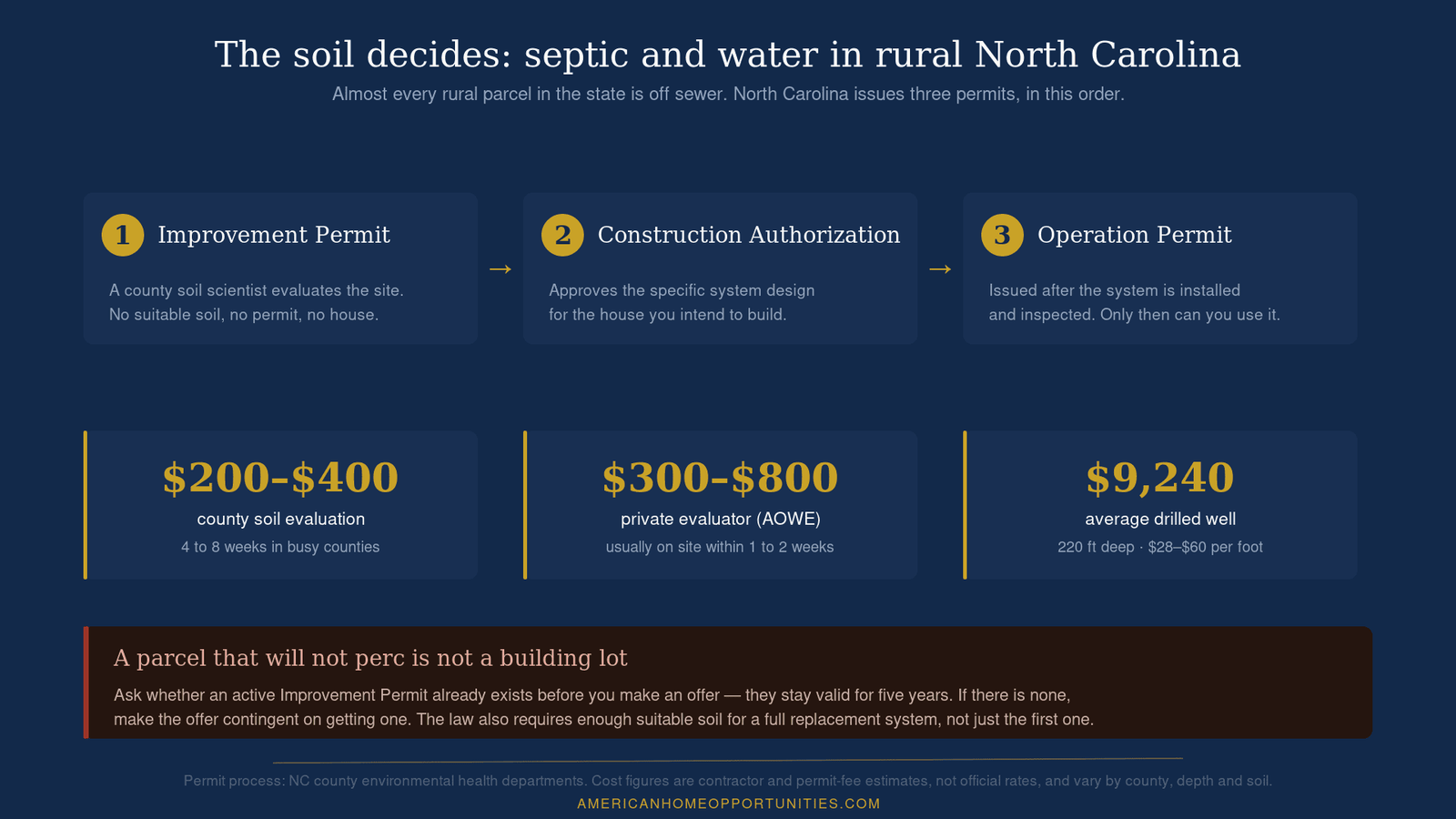
If the property has no well, contractor estimates put the average drilled well in North Carolina at about $9,240 for roughly 220 feet, with drilling priced between $28 and $60 a foot and shallower, softer ground in the western mountains sometimes closer to $15 to $25. A complete well and septic installation together generally lands somewhere between $6,600 and $21,500. Treat all of that as a planning range: it comes from contractor cost aggregators, not from an official schedule.
The risk nobody advertises is a dry hole. If the drill does not find water, you pay for that hole and then you pay again to drill somewhere else. Budget for the possibility, not for the average. On an existing system, have the septic inspected and the well tested for both flow rate and water quality before closing, and make both a contingency in the offer.
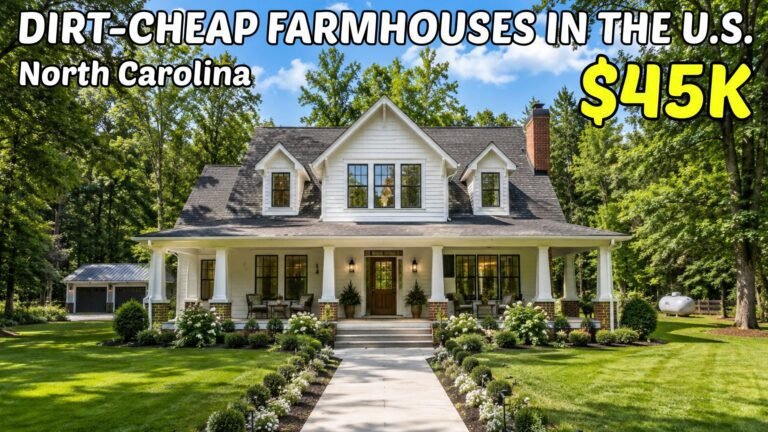
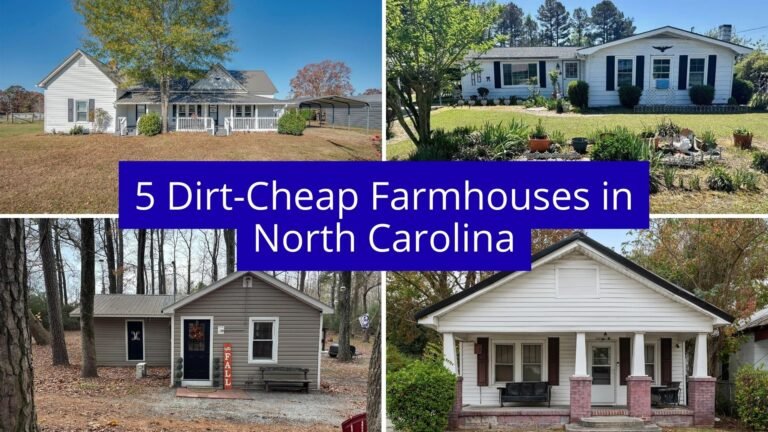
North Carolina properties we have featured
Everything above is the background. These are the actual listings, with the walkthroughs, our scoring and direct links to each one.
More North Carolina guides
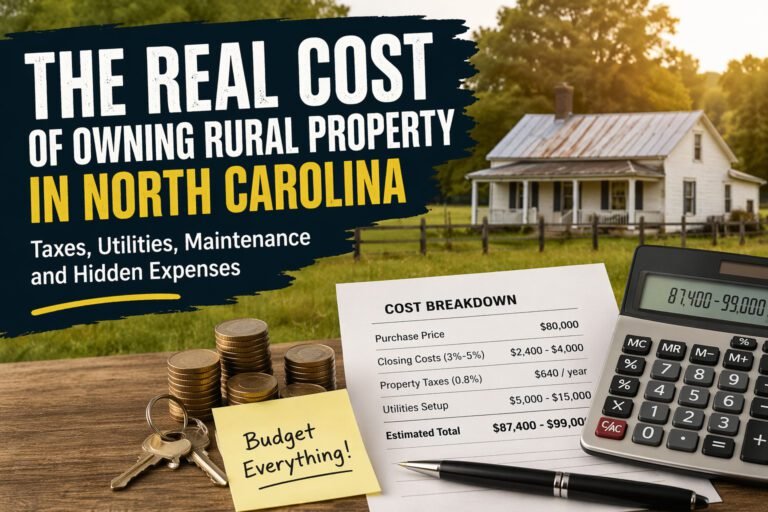
Deeper on the parts of this that deserve their own page.
Keep exploring
Everything above is North Carolina. What comes next travels with you, whichever state you buy in.
The guides library is the index to all of it, state by state and rule by rule. Why cheap rural homes do not sell explains the mechanics behind the prices on this page, how we score a property explains what earns a place on it, and the Rural Property Field Guide puts the checks on paper you can carry.
Get the next batch of North Carolina listings first
New properties go out to the list before they go anywhere else. One email, no noise.
Common questions about buying rural property in North Carolina
Where is the cheapest land in North Carolina?
The coastal plain in the east, not the mountains. The 2022 USDA census values farmland at $3,011 an acre in Martin County, $3,063 in Craven, $3,222 in Pamlico and $3,445 in Edgecombe, against $11,802 in Buncombe County where Asheville is. As a region the Coastal Plain averages $4,440 an acre and the Mountains $7,850. It is cheap because those counties have been losing population for decades, not because the market has missed them.
What are rollback taxes when buying rural property in North Carolina?
If a parcel is enrolled in the present-use value programme, its tax is based on agricultural rather than market value. When it stops qualifying — often because a buyer changes the use — the county bills the deferred tax for the current year plus the three preceding years, with interest. Ask the county tax office how much deferred tax has accumulated and settle in the contract who pays it.
How much is property tax on a rural North Carolina home?
At the statewide effective rate of 0.66%, about $924 a year on a $140,000 home. County rates for 2025–2026 range from $0.37 per $100 of value in Jackson County to $1.206 in Northampton, so the same $89,900 house costs roughly $333 a year in Jackson and about $1,034 in Martin. Check the county, and then the fire and municipal district, before budgeting.
Is North Carolina or Tennessee better for rural property?
Tennessee is cheaper to hold: a 0.52% effective property tax rate against North Carolina’s 0.66%, and no state income tax against North Carolina’s flat 3.99%. North Carolina gives you a wider spread of country to choose from — mountains, piedmont and coast in one state — and no estate or inheritance tax. On acreage per dollar, though, neither beats eastern Kentucky: the affordable North Carolina listings tend to be houses on one to three acres rather than real land.
Get North Carolina listings before they are gone
Tell us your price range and how soon you are planning to buy, and we will email you when we feature North Carolina properties that fit. You will also get our free Rural Property Buyer’s Guide, the checklist we run through before featuring any listing.
One question before you go
What is the biggest thing standing between you and a rural property in North Carolina? One click, and it tells us what to write next.
Figures on this page come from the USDA 2022 Census of Agriculture (Table 8, county level), the Tax Foundation 2026 state tax data, the North Carolina Department of Revenue 2025–2026 county tax rates, N.C. General Statutes 105-277.1 and 105-277.2 and NC State Extension, county environmental health departments, the North Carolina Department of Health and Human Services and the state’s Helene damage assessment, the North Carolina Geological Survey, Carolina Public Press and North Carolina Health News, the N.C. Department of Information Technology Division of Broadband and Digital Opportunity, contractor cost aggregators for well and septic estimates, and Redfin (May 2026). They were current as of July 2026. Regional farmland figures are weighted averages built from 84 of the state’s 100 counties, covering 85% of North Carolina’s farmland acreage, with the county count shown in the table. Figures attributed to American Home Opportunities are our own, calculated from the fifteen North Carolina properties we have featured, and represent asking prices divided by acreage with the house included — they are not land valuations and are not sale prices. Land prices move, county rules differ and services change. Nothing here is legal, tax or financial advice, and every buyer should verify these details with the relevant county office and their own professionals before making an offer.