
The AHO Score: How We Rate Every Property We Publish
Every property featured by American Home Opportunities gets a number out of one hundred. This page explains exactly how that number is built, what each point is for, and where the system stops. If you have ever wondered why one cheap farmhouse scored an 87 and another scored a 55, everything you need to check our work is on this page.
Why the AHO Score Exists
Search for cheap rural property and you will find hundreds of lists telling you that every single entry is an incredible opportunity. None of them tell you how they decided that. The word “deal” does all the work, and it means nothing.
We had a practical problem too. We publish ten properties a week from a different state each time, and we needed a way to compare a house in eastern Kentucky against a house in the Arizona desert without our own mood on the day deciding the outcome. A score is only useful if it means the same thing in every state, every week.
So we wrote the rules down first, then applied them. The AHO Score is the result: a 100-point editorial rating with fixed weights, fixed scoring bands, and a short set of rules designed to stop us from being generous when we like a property.
How the 100 Points Are Distributed
Six criteria, each with a fixed maximum. The weights never change between properties or states.
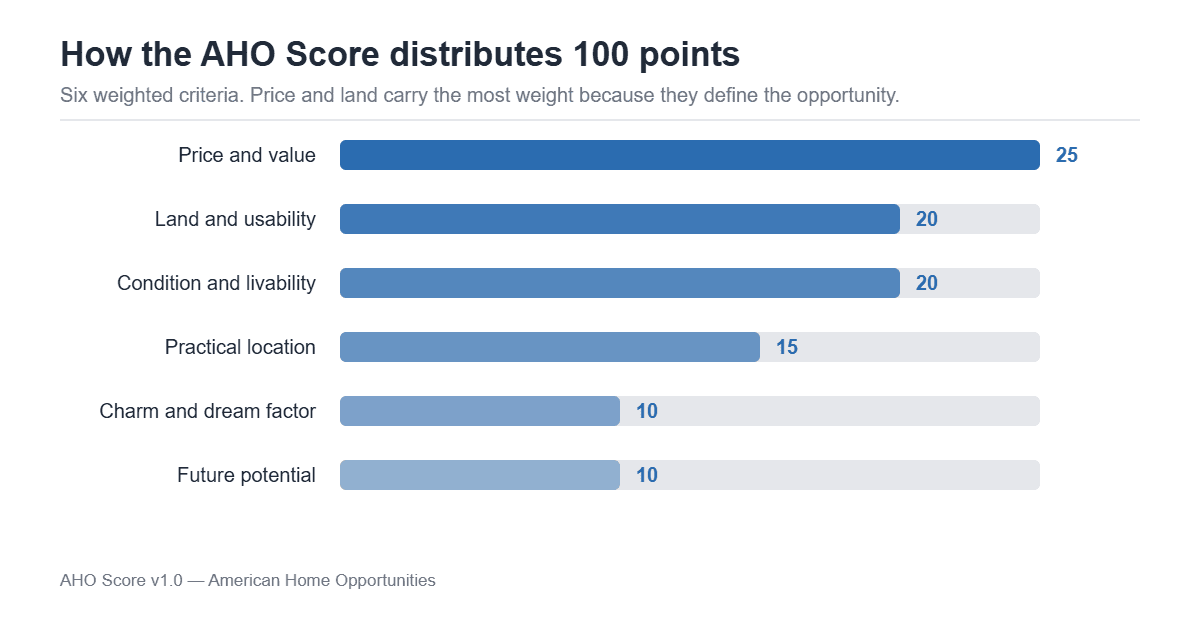
Price and land carry the most weight because together they define whether a property is the kind of opportunity this publication exists to find. Charm and potential are capped at ten points each on purpose: they are the most subjective categories, and we did not want a pretty porch to rescue a property with serious problems.
The Six Criteria, and the Bands We Score Them Against
Each criterion has written bands. When we score a property, we decide which band it falls into and take a number from inside that band. These are the actual bands we work from.
1. Price and value — 25 points
How good the offer is against the promise of a genuinely cheap house with land. We look at total price, what house you get, and how many acres come with it, then compare price per acre against what is typical for rural land in that state.
- 22–25 — A deal that makes you look twice. A lot of house and land for very little money.
- 18–21 — Strong value. Clearly delivers on the promise.
- 14–17 — Fair. Reasonable for what it is, but nothing striking.
- 8–13 — Only moderately attractive. You are paying for location or condition more than for the bargain.
- 0–7 — Does not deliver on cheap land and a house.
2. Land and usability — 20 points
Anchored on verifiable acreage, then adjusted for how usable that land actually looks in the listing photographs. Twenty steep, flooded acres are not twenty acres of opportunity.
- 18–20 — Ten acres or more, or five-plus that are clearly usable and attractive: pasture, a mix of open ground and woodland, a creek or pond.
- 14–17 — Roughly three to ten acres with clear lifestyle value.
- 10–13 — Roughly one to three acres, or more land whose use is limited or uncertain.
- 5–9 — Under an acre, or a small lot.
- 0–4 — Minimal or unusable land.
3. Condition and livability — 20 points
Judged only from the photographs and what the listing states. We are not inspectors and we say so: this category measures how much work stands between you and living there, as far as the listing reveals it.
- 18–20 — Move-in ready or clearly livable now.
- 14–17 — Old but usable. Cosmetic work only.
- 10–13 — Needs real work but appears structurally sound. A project with potential.
- 5–9 — Major renovation likely. Visible damage or questionable systems.
- 0–4 — Severe condition, or livability is not clear at all.
4. Practical location — 15 points
Rural is the point, but there is a difference between peaceful and stranded. We check the nearest towns, where you would buy groceries, where the nearest hospital is, and how hard the property is to reach.
- 13–15 — Rural but roughly fifteen to twenty-five minutes from a town with services, with good access.
- 10–12 — Services around thirty to forty-five minutes away. Some trade-offs.
- 7–9 — Fairly remote. Limited services, roughly forty-five to sixty minutes out.
- 4–6 — Very remote, or difficult access for most buyers.
- 0–3 — A serious access or practicality problem.
5. Charm and dream factor — 10 points
We count features rather than react to a feeling: farmhouse character, a real porch, a barn or outbuildings, mature trees, views, water, privacy, original period detail.
- 9–10 — Several strong features. Memorable.
- 7–8 — Appealing, with a couple of standouts.
- 5–6 — Some charm.
- 3–4 — Limited.
- 0–2 — Little to speak of.
6. Future potential — 10 points
What the property could become: renovation equity, homesteading, a rental or guest cabin, splitting land, running livestock.
- 9–10 — Several clear paths of upside.
- 7–8 — One clear upside.
- 5–6 — Some.
- 3–4 — Limited.
- 0–2 — Little.
What the Total Score Means
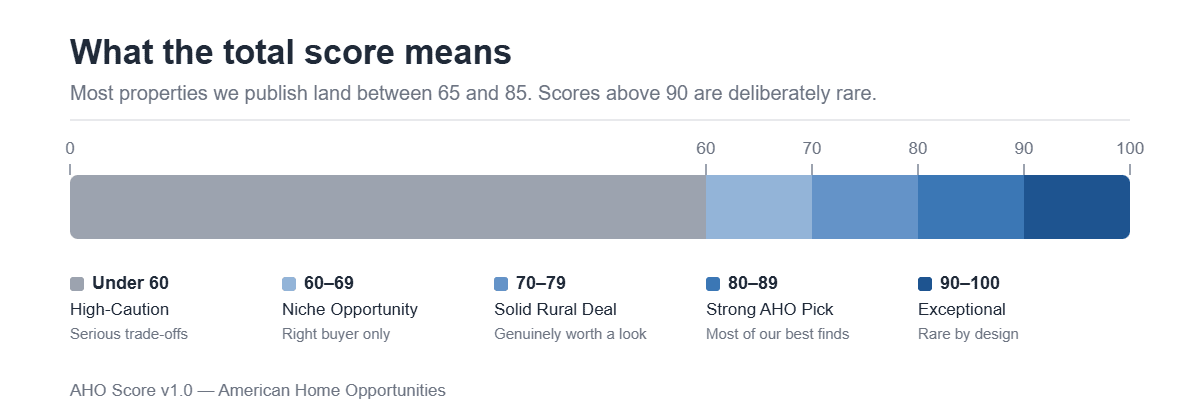
A property in the seventies is not a bad property. It is a solid rural deal with something to weigh up, and it may be exactly right for you. The bands describe the strength of the opportunity as we see it, not a pass or fail.
The Rules That Keep the AHO Score Honest
Weights and bands are the easy part. What actually makes a scoring system credible is the discipline around it, so these are the rules we hold ourselves to.
- Score only what can be verified or seen. If a listing does not specify something, we score the midpoint of the band and say the listing does not specify it. We never assume the generous version.
- A missing photo earns no points. Condition and land usability are judged from what the photographs actually show. An absent photo is not the benefit of the doubt.
- Whole numbers only, and the total is the exact sum of the six criteria. No rounding up to a friendlier number.
- Ninety and above is reserved for genuinely rare finds. At most one per video, and usually none at all.
- When a property sits between two bands, we take the lower one. This single rule costs properties points every week, and it is the one that protects the score’s credibility.
- The same anchors apply everywhere. The score describes the opportunity as editorial content. It never becomes a valuation.
A Worked Example: Woollum, Kentucky — 87 out of 100
The highest-scoring property in our Kentucky roundup was a two-bedroom house on twenty-five wooded acres at $169,000, with mountain views on both sides of the road. Here is how those eighty-seven points were built.
| Criterion | Score | Reasoning |
|---|---|---|
| Price and value | 22 / 25 | $6,760 per acre with a livable house included, against a Kentucky farm real estate average near $5,480 per acre for bare land. Top band, scored at its floor. |
| Land and usability | 19 / 20 | Twenty-five acres, comfortably in the top band. Not a full 20 because it is wooded and sloping rather than open pasture. |
| Condition and livability | 18 / 20 | New roof, new water heater, new flooring, updated bathroom. Move-in ready, but compact at 1,120 sq ft with an unfinished basement. |
| Practical location | 10 / 15 | Southeastern Kentucky. Genuinely rural, with services a real drive away. The weakest category. |
| Charm and dream factor | 9 / 10 | Mountain views in two directions, privacy, wood stove, land on both sides of the road. |
| Future potential | 9 / 10 | Unfinished basement to convert, acreage for homesteading, and room to build. |
| Total | 87 / 100 | Strong AHO Pick |
Notice where it loses points. Location costs it five, because being an hour from a supermarket is a real cost even when the views are exceptional. That is the system working as intended: the number should tell you what the trade-off is, not just that we liked the place.
You can read the full write-up in our Kentucky roundup, alongside the other nine properties.
The Same Rules, Ten Different Answers
A scoring system that gives everything an 85 is not a scoring system. Here is every property from that same Kentucky article, scored against the same anchors on the same day.
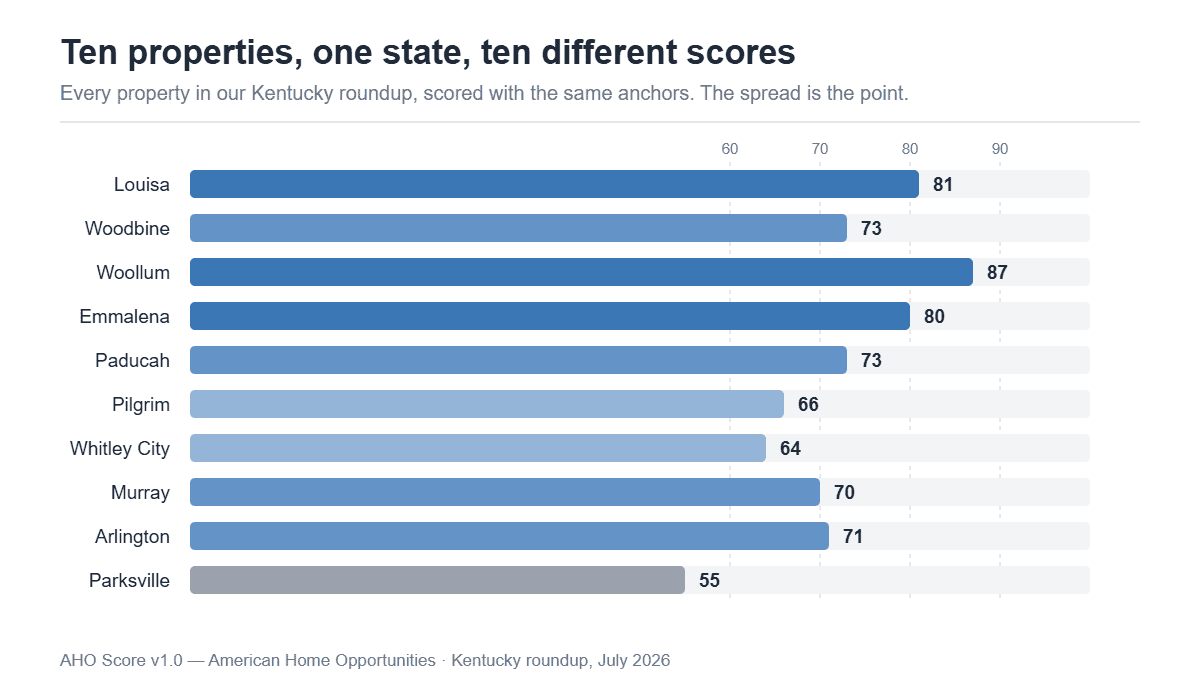
Thirty-two points separate the top from the bottom, and the cheapest property on the list scored the lowest. That is worth sitting with: at $35,000, Parksville was the headline price of the whole article, and it still scored a 55. Price is only twenty-five of the hundred points, and a low price cannot buy its way past a small lot and a house that needs work.
What the AHO Score Is Not
- It is not an appraisal. We are not licensed appraisers and the score has no bearing on market value.
- It is not an inspection. We have never set foot on these properties. Condition is scored from photographs and listing text, nothing more.
- It is not investment advice. A high score is not a recommendation to buy, and a low score is not a warning to stay away.
- It does not replace your own checks. Septic and well, easements, flood zones, road access, back taxes and structural condition all sit outside what any listing can tell us. Those are yours to verify with a licensed professional.
The score is an editorial tool for comparison, built to be consistent and published so you can disagree with it. Our full terms are set out in the Legal Notice.
Version and Revisions
AHO Score v1.0 — in use since July 2026. Weights, bands and rules as published on this page.
If we change the weights or the bands, we will publish the change here with a date rather than quietly rescoring. Scores from earlier articles stay as they were, under the version that was current when they were written.
If you think we scored something wrong, tell us. Write to contact@americanhomeopportunities.com and make your case — that is the most useful email we can get.
More about who is behind this publication and how we choose properties in the first place is on our About page.