How to Check If Land in Florida Is Buildable (Septic, Wetlands and Access)
The acreage on a Florida land listing is the size of the parcel. It is not a statement that you can put a house on it. Between the two sits a set of questions about wastewater, wetlands and legal access that decide whether the lot is buildable at all, and none of them are answered in the listing.
The good news is that most of the checking is free and you can do it from a laptop before you contact anybody. This guide sets out how to check if land in Florida is buildable, what each answer costs you if it comes back wrong, and the order to run the checks in.
Last reviewed 4 September 2026.
What makes a lot in Florida buildable?
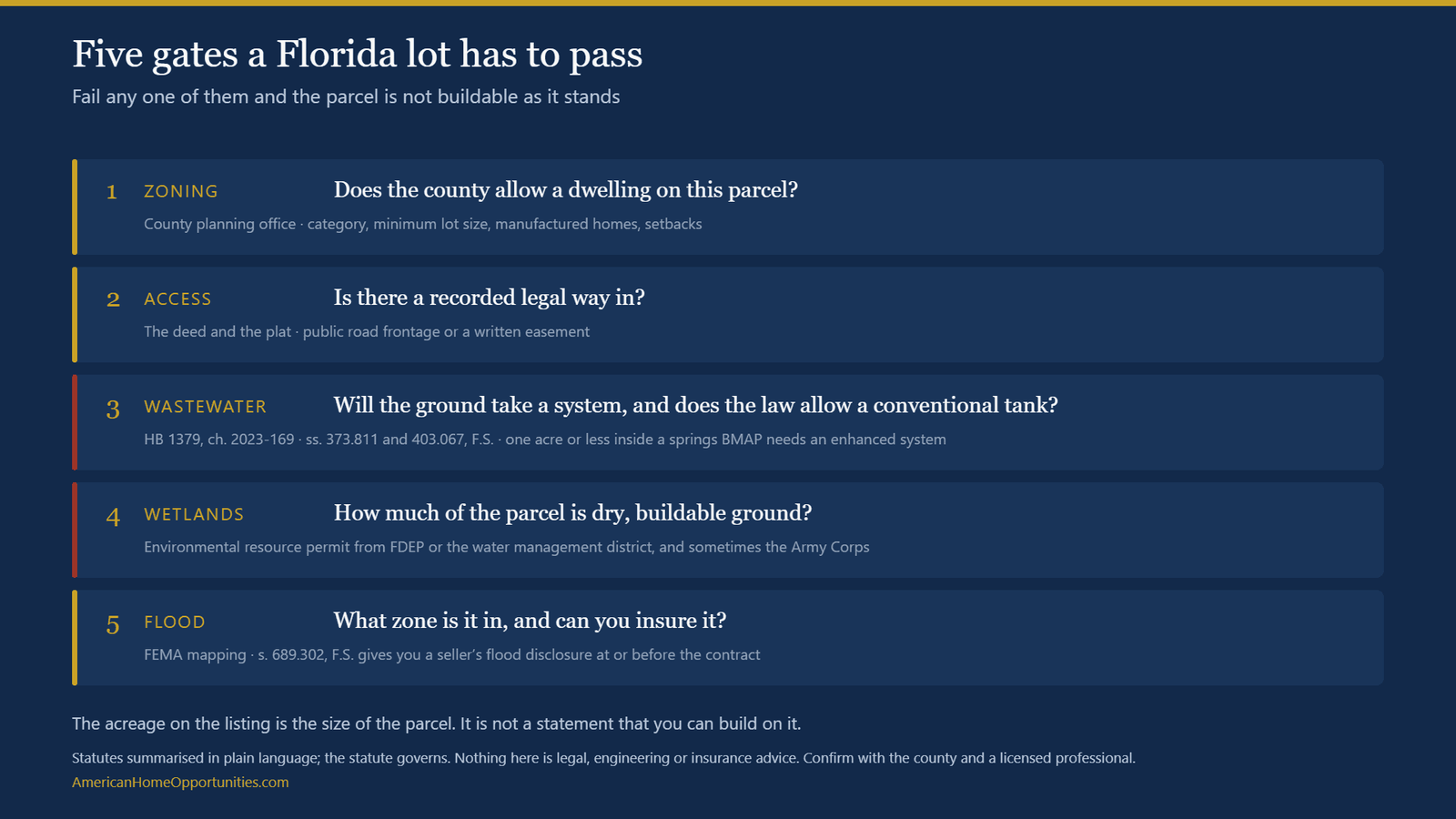
Five things have to line up: the county’s zoning has to allow the house you want, there has to be a legal way to reach the parcel, there has to be somewhere to put a septic system and a well, enough of the ground has to be dry and outside jurisdictional wetlands, and the flood zone has to be one you can build in and insure. A parcel can fail on any single one of them.
Two of those five are where Florida differs most from other states, and they are the two this guide spends the most time on: wastewater, because parts of Florida now require a system that costs considerably more than a conventional tank, and wetlands, because a great deal of rural Florida is wet ground that looks perfectly ordinary in a listing photograph taken in April.
Can you put a septic system on it?
That is the question that decides most rural Florida lots, and it has two parts: whether the ground will take a system at all, and whether the law will let you install the cheap kind. Onsite sewage treatment and disposal systems, which is what the state calls septic, are permitted through the Florida Department of Environmental Protection and the county health department.
Will the ground take a system?
A site evaluation looks at the soil and, in Florida above all, at the water table. Sandy soil drains well, which is why so much of the state works on septic in the first place, but a high seasonal water table forces a mounded system that sits above natural grade and costs more. The evaluation also has to find room for the drainfield and its setbacks from the well, the property lines and any surface water.
This is not a check you can do from a laptop. It is done by a licensed contractor or the county health department, and on a parcel with no existing system it is worth paying for before you close rather than after.
And whether the law lets you install a conventional tank
This is the part almost nobody tells rural buyers about. Under HB 1379 of 2023, Chapter 2023-169 of the Laws of Florida, which amended sections 373.811 and 403.067 of the Florida Statutes and created section 373.469:
- Since 1 July 2023, a new onsite system on a lot of one acre or less inside a Basin Management Action Plan for an Outstanding Florida Spring must be an enhanced nutrient-reducing system when no sewer is available.
- Since 1 January 2024, the same requirement applies at any lot size inside the Indian River Lagoon Protection Program area, which covers parts of St. Lucie, Indian River, Brevard and Volusia counties.
- Existing systems in the Indian River Lagoon area must connect to sewer or reach at least 65% nitrogen reduction by 1 July 2030.
An enhanced nutrient-reducing system costs considerably more than a conventional tank and drainfield. We do not publish a price range for either, because we could not find an official Florida source for one and a made-up figure is worse than none. Ask the county health department and two local installers, and treat the higher number as the real one.
The awkward part: the cheapest counties overlap the strictest rule
Several of the cheapest counties in Florida sit inside those spring basins — Jackson, Suwannee, Lafayette, Union, Alachua, Marion and Citrus among them. The land that looks like the best value on a price-per-acre basis is often the land carrying the most expensive wastewater requirement. Check the parcel against the state’s Basin Management Action Plan mapping before you make an offer, not after.
How much of the parcel is actually dry ground?
Less than the listing suggests, on a surprising number of Florida parcels. Wetlands are regulated ground, and building on them means an environmental resource permit from the Department of Environmental Protection or the local water management district, and sometimes a federal permit from the Army Corps of Engineers as well. A ten-acre parcel with six acres of wetland is a four-acre parcel with a longer permitting story.
The free first look
Start with the national wetlands mapping and a satellite view of the parcel. Look for standing water, cypress, the darker vegetation that follows wet ground, and the way water leaves the property. Then look at the same parcel on the county property appraiser’s aerial, which is usually flown at a different time of year and will often show you a completely different picture.
That comparison is the cheapest wetland check there is. A parcel that looks dry in one aerial and holds water in the other is telling you something.
When you need a real determination
Mapping is a screening tool and it is not the legal answer. If the parcel matters to you and there is any doubt, a formal wetland determination by a qualified consultant is what tells you where the line falls and how much usable ground you are buying. On a cheap parcel that cost can feel disproportionate, which is exactly why it is worth deciding in advance what the answer would change.
Is there a legal way in?
A track that everyone has always used is not the same as a right to use it. Access has to be recorded: either the parcel fronts a public road, or there is a written easement in the chain of title that gives you a right of way across someone else’s land. If neither is true the parcel is landlocked, and a landlocked parcel is very hard to build on, very hard to finance and very hard to sell again.
- Read the deed and the plat, not the listing. The words “easement” or “right of way” should appear, with a description of where it runs.
- Check who maintains the road. On a private road the answer is the owners, and a road maintenance agreement, or the absence of one, is a real cost and a real source of neighbour disputes.
- Ask how a fire truck gets there. Some counties have access and width standards for a building permit, and a track that is fine for a pickup is not always fine for the county.
- Assume a lender will care. Access is one of the first things that stops a rural loan, whoever the lender is.
What does the county actually allow?
Zoning is county business in rural Florida, and it decides what may be built rather than whether the ground will hold it. Before you make an offer, call the county planning or zoning office with the parcel number and ask four questions: what the zoning category is, what the minimum lot size is for a dwelling, whether a manufactured home is permitted on that parcel, and what the setbacks are.
That call is free, it takes ten minutes, and the person on the other end answers this question all day. It is also the only authoritative answer: zoning maps circulate online in outdated versions, and a category that allows a house in one county does not necessarily allow one in the next.
Zoning is not the same as the agricultural tax classification
“Zoned AG” on a listing tells you what the county permits on the land. The agricultural classification under section 193.461 of the Florida Statutes is a separate tax status that the owner applies for with the property appraiser, every year, by 1 March, and it does not transfer to you when you buy. Two different things, often confused, and only one of them affects your tax bill.
What flood zone is it in?
Find the parcel on the FEMA flood mapping before anything else, because the answer changes the cost of owning the property permanently, not just the cost of building on it. A homeowners policy does not cover flood, in Florida or anywhere else, and in a mapped high-risk zone a lender will require separate flood insurance.
You also have a statutory right to ask. Since 2024, section 689.302 of the Florida Statutes requires the seller of residential property to give you a flood disclosure at or before the contract, stating whether flooding damaged the property while they owned it, whether they filed an insurance claim including with the National Flood Insurance Program, and whether they received federal disaster assistance. The statute’s definition of flooding is broad enough to include standing water from sustained rainfall, not just a river coming over its banks.
The order to check them in
Free first, paid last. Five of these cost nothing and can be done in an afternoon before you speak to anyone. Only spend money on a parcel that has already survived them.
- County property appraiser parcel record. Free. Values, taxes, sales history, exemptions, and an aerial with the boundary drawn on it.
- FEMA flood map. Free. The flood zone for the address.
- Basin Management Action Plan mapping. Free. Whether the enhanced septic requirement applies.
- Wetlands screening. Free. National wetlands mapping against two aerials flown at different times of year.
- Zoning call to the county. Free. Category, minimum lot size, manufactured homes, setbacks.
- The deed and the plat, for access. Cheap. A recorded easement or public road frontage.
- Then the paid work: a site evaluation for the septic system, a survey, and a written insurance quote on the exact address.
What if the answer comes back no?
It does not automatically make the parcel worthless, but it does change what it is worth to you. A lot that cannot take a house can still be worth owning for timber, hunting, grazing or simply as land next to land you already own, and it should be priced accordingly. What you must not do is pay a buildable price for a parcel that is not buildable.
Two honest observations from the properties we cover. Cheap parcels are cheap for reasons, and wetness, access and wastewater are three of the most common. And a seller is rarely hiding any of it: more often nobody has ever checked, the land has been in the family for decades, and the questions above have simply never come up.
We run these checks before we publish a property
Flood zone, septic rules, wetlands and access, on every Florida property that makes our lists. Leave your email and the ones that survive reach you first.
Questions buyers ask about buildable land in Florida
Can you build a house on any land in Florida?
No. Zoning has to allow a dwelling, there has to be recorded legal access, the ground has to take a septic system and a well where no sewer exists, enough of the parcel has to be outside jurisdictional wetlands, and the flood zone has to be one you can build in and insure. Each of those is checked separately and any one of them can stop the project.
How do you find out if land has wetlands on it in Florida?
Start free, with the national wetlands mapping and two aerial photographs of the parcel flown at different times of year. That screening tells you whether to worry. It is not the legal answer: for that you need a formal wetland determination by a qualified consultant, and permitting runs through the Department of Environmental Protection or the water management district, and sometimes the Army Corps of Engineers.
Does every rural lot in Florida need the expensive septic system?
No, only lots inside the affected areas. The enhanced nutrient-reducing requirement applies to new systems on lots of one acre or less inside a Basin Management Action Plan for an Outstanding Florida Spring, and at any lot size inside the Indian River Lagoon Protection Program area. Outside those, a conventional tank and drainfield is still permitted where the site evaluation supports it.
What is a landlocked parcel worth?
Substantially less than the same parcel with recorded access, because it cannot readily be built on, financed or resold. Access can sometimes be obtained afterwards by negotiating an easement with a neighbour, but that is a negotiation you would be entering from the weakest possible position, and it is not something to assume when you make the offer.
Keep reading
This guide covers whether the ground works. How to buy cheap rural property in Florida covers the rest of the process, from finding the listings to the closing. The Florida pillar guide has county land values from the census and what the property costs to own once you have it, and the cheapest counties in Florida to buy land shows what the numbers look like on real properties. If you want the reasoning behind why land like this sits unsold, why cheap rural homes do not sell works through the eight mechanics.
Disclaimer
American Home Opportunities is a publisher. We are not a brokerage, a lender, a lawyer, an engineer, a surveyor, an insurance agent or an environmental consultant, and nothing on this page is legal, engineering, insurance or financial advice. The rules described here come from Chapter 2023-169, Laws of Florida (HB 1379), which amended sections 373.811 and 403.067 and created section 373.469, and from sections 193.461 and 689.302 of the Florida Statutes; they are summarised in plain language and the statute governs rather than our summary. Rules, maps and programme boundaries change. Confirm every point with the county, the county health department, the water management district, the Florida Department of Environmental Protection and a licensed professional before you buy. Last reviewed 4 September 2026.