
The Cheapest States to Buy Land in 2026
New Mexico is the cheapest, at $735 an acre. Here is the full USDA ranking of 48 states, and why the top of the list is a trap.
New Mexico is the cheapest state to buy land in 2026, at $735 an acre. Wyoming follows at $1,030, then Nevada at $1,230 and Montana at $1,260. The national average is $4,500 an acre, and the most expensive state, Rhode Island, runs $23,600. Those figures come from the USDA, released at the end of July 2026.
That ranking is the one every land site publishes, and it is accurate. It is also the reason a lot of people end up owning forty acres they cannot do anything with. The four cheapest states in the country share something the table never shows: they are four of the driest. In New Mexico, cropland with irrigation is worth 11.3 times cropland without it — $7,600 an acre against $670, from the same USDA report. The cheap number at the top of the ranking is the dry number.
So this guide does two jobs. First, it gives you the complete 2026 picture: land prices per acre by state for all 48 states the USDA surveys, with cropland, pasture and the effective property tax rate lined up in a single table. Second, it shows you what the ranking hides — the water premium, the distance between asking prices and land value, and the annual cost of holding a property, which is where a cheap purchase quietly turns into an expensive decade.
By the end of this page you will know which of the cheapest states to buy land are cheap on paper, which ones are cheap in practice, and which ones are cheap for a reason.
The four numbers that run this page
| Number | What it is |
|---|---|
| $735 | Cost of an acre in New Mexico, the cheapest state in the country. The national average is $4,500. |
| 32x | The spread between the cheapest state and the most expensive one, Rhode Island. |
| 11.3x | What irrigated cropland is worth against dryland cropland in New Mexico. Water, not land, is what is being priced. |
| 4.3x | How much higher the average asking price per acre runs than the USDA land value, nationally. In some cheap states the multiple is over ten. |
The cheapest states to buy land in 2026: the full ranking
Every summer, the USDA’s National Agricultural Statistics Service publishes what it calls farm real estate value — the value of land and the buildings on it, per acre, state by state. It is the closest thing the United States has to an official land price, it is free, and almost nobody in the rural property world quotes it directly. Here is the map.
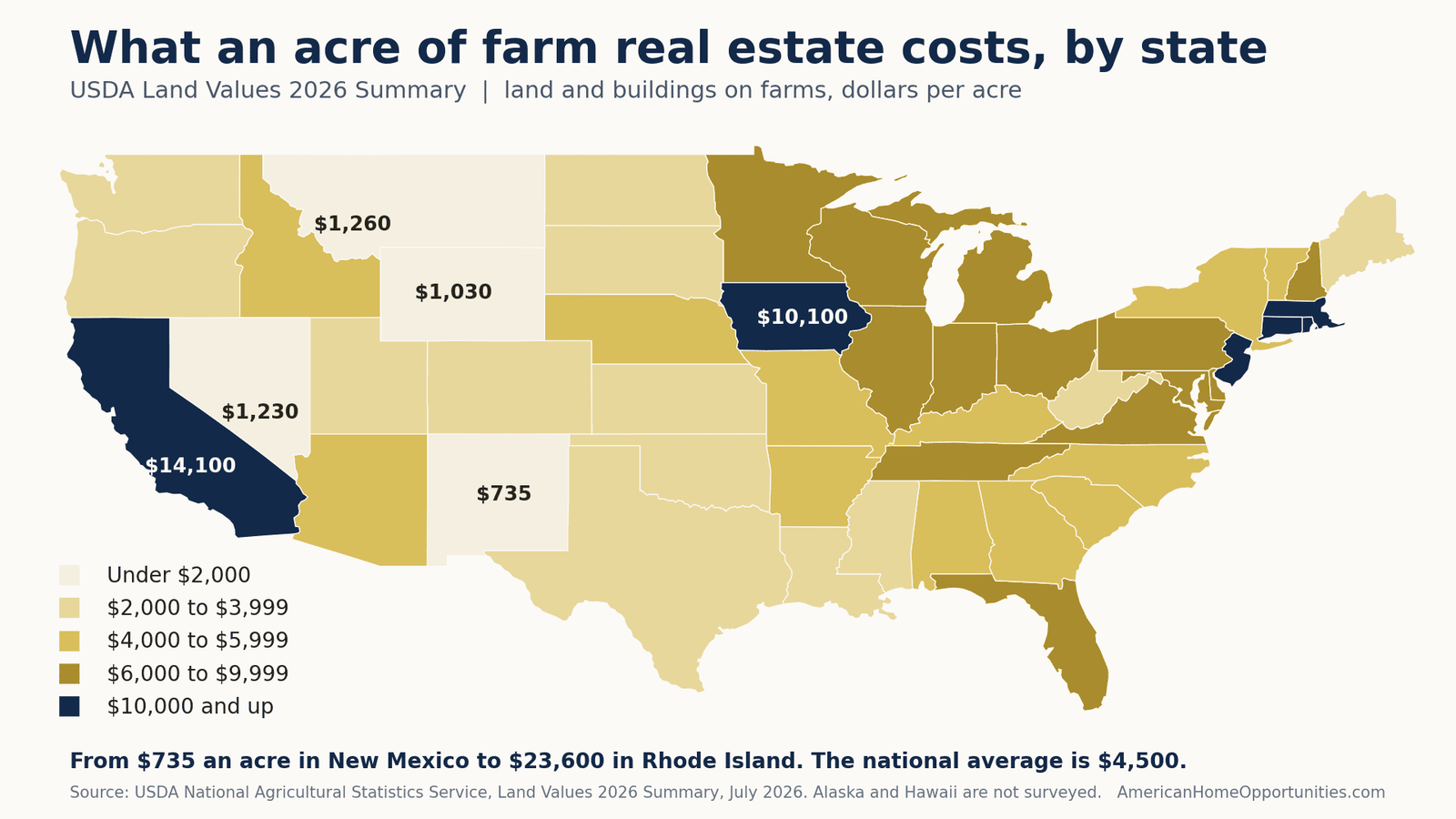
Read that map west to east and the pattern is hard to miss. The cheap band runs down the Rocky Mountain West and the northern Plains. The expensive band is the Corn Belt and the Northeast corridor. And the South — Mississippi, Alabama, Arkansas, West Virginia — sits in a middle range that almost never gets talked about, which turns out to matter later on this page.
Two things to keep straight before you use these numbers. This is farmland, measured across working farms, so it is not the sticker price of a five-acre residential parcel with a driveway and a well already in. And it is an average across an entire state, which in a place like Texas or California covers wildly different worlds. Treat it as the floor the market builds on, not as a quote.
The table below is the full 2026 ranking, cheapest to most expensive. Alongside all farmland it gives you cropland and pasture separately — pasture is the column most people looking for acreage should be reading — plus the effective property tax rate in that state, so you can see the buying price and the holding cost at the same time.
| # | State | All farmland $ per acre | Cropland $ per acre | Pasture $ per acre | Property tax effective rate |
|---|---|---|---|---|---|
| 1 | New Mexico | $735 | $2,090 | $650 | 0.63% |
| 2 | Wyoming | $1,030 | $2,080 | $770 | 0.53% |
| 3 | Nevada | $1,230 | $3,090 | $870 | 0.50% |
| 4 | Montana | $1,260 | $1,350 | $940 | 0.61% |
| 5 | Colorado | $2,360 | $2,960 | $1,200 | 0.50% |
| 6 | North Dakota | $2,450 | $2,800 | $1,200 | 0.92% |
| 7 | Oklahoma | $2,620 | $2,560 | $2,200 | 0.79% |
| 8 | South Dakota | $3,100 | $4,770 | $1,400 | 1.00% |
| 9 | Texas | $3,100 | $2,790 | $2,420 | 1.40% |
| 10 | Kansas | $3,200 | $3,540 | $2,400 | 1.21% |
| 11 | Maine | $3,400 | $4,700 | $2,700 | 0.98% |
| 12 | West Virginia | $3,640 | $4,400 | $2,400 | 0.51% |
| 13 | Mississippi | $3,650 | $4,060 | $3,310 | 0.58% |
| 14 | Utah | $3,650 | $6,040 | $2,000 | 0.48% |
| 15 | Washington | $3,800 | $3,540 | $980 | 0.75% |
| 16 | Oregon | $3,880 | $4,540 | $1,120 | 0.81% |
| 17 | Louisiana | $3,950 | $3,660 | $3,600 | 0.55% |
| 18 | Alabama | $4,250 | $4,650 | $3,500 | 0.37% |
| 19 | Arizona | $4,300 | $8,300 | $980 | 0.48% |
| 20 | Arkansas | $4,350 | $3,850 | $3,500 | 0.56% |
| 21 | Nebraska | $4,400 | $6,960 | $1,590 | 1.44% |
| 22 | Vermont | $4,490 | $4,450 | $2,920 | 1.51% |
| 23 | New York | $4,500 | $4,150 | $2,040 | 1.30% |
| 24 | Idaho | $4,750 | $6,170 | $2,500 | 0.50% |
| 25 | South Carolina | $4,900 | $4,100 | $4,500 | 0.49% |
| 26 | Georgia | $4,950 | $4,670 | $5,100 | 0.79% |
| 27 | Missouri | $5,200 | $5,310 | $2,850 | 0.89% |
| 28 | Kentucky | $5,600 | $6,630 | $4,050 | 0.74% |
| 29 | North Carolina | $5,750 | $5,580 | $6,380 | 0.66% |
| 30 | Virginia | $6,300 | $6,400 | $5,430 | 0.78% |
| 31 | Tennessee | $6,500 | $6,400 | $5,910 | 0.52% |
| 32 | New Hampshire | $6,670 | $10,100 | $8,120 | 1.50% |
| 33 | Wisconsin | $6,700 | $7,600 | $3,500 | 1.32% |
| 34 | Minnesota | $6,950 | $7,300 | $2,400 | 1.00% |
| 35 | Michigan | $7,000 | $6,600 | $3,200 | 1.19% |
| 36 | Pennsylvania | $8,700 | $9,800 | $4,350 | 1.26% |
| 37 | Florida | $9,150 | $11,100 | $7,650 | 0.78% |
| 38 | Indiana | $9,150 | $8,600 | $2,850 | 0.76% |
| 39 | Illinois | $9,250 | $10,200 | $4,300 | 1.88% |
| 40 | Ohio | $9,650 | $10,100 | $4,250 | 1.36% |
| 41 | Delaware | $9,700 | $9,550 | $7,800 | 0.54% |
| 42 | Maryland | $9,950 | $9,250 | $8,300 | 0.92% |
| 43 | Iowa | $10,100 | $10,700 | $3,800 | 1.33% |
| 44 | California | $14,100 | $18,430 | $4,250 | 0.70% |
| 45 | Connecticut | $14,600 | $23,200 | $13,000 | 1.54% |
| 46 | Massachusetts | $15,200 | $26,600 | $15,400 | 1.00% |
| 47 | New Jersey | $17,000 | $17,100 | $15,600 | 1.88% |
| 48 | Rhode Island | $23,600 | $34,300 | $17,500 | 1.12% |
| United States | $4,500 | $6,020 | $2,000 | — |
A note on the last column: the Tax Foundation rate is measured on owner-occupied housing, not on bare land, and every state assesses farm and forest acreage under its own rules. Use it to compare states against each other, not to predict your own bill. What it tells you reliably is the direction — whether a state leans cheap or expensive when it comes to holding property year after year.
Why the cheapest states to buy land are cheap
Here is the question nobody in this niche asks out loud: if New Mexico land is worth one sixth of the national average, what exactly is missing from it?
The USDA answers it in the same report, in a table most people skip. For eighteen states it splits cropland into irrigated and dryland, and the gap between those two numbers is the price of water.
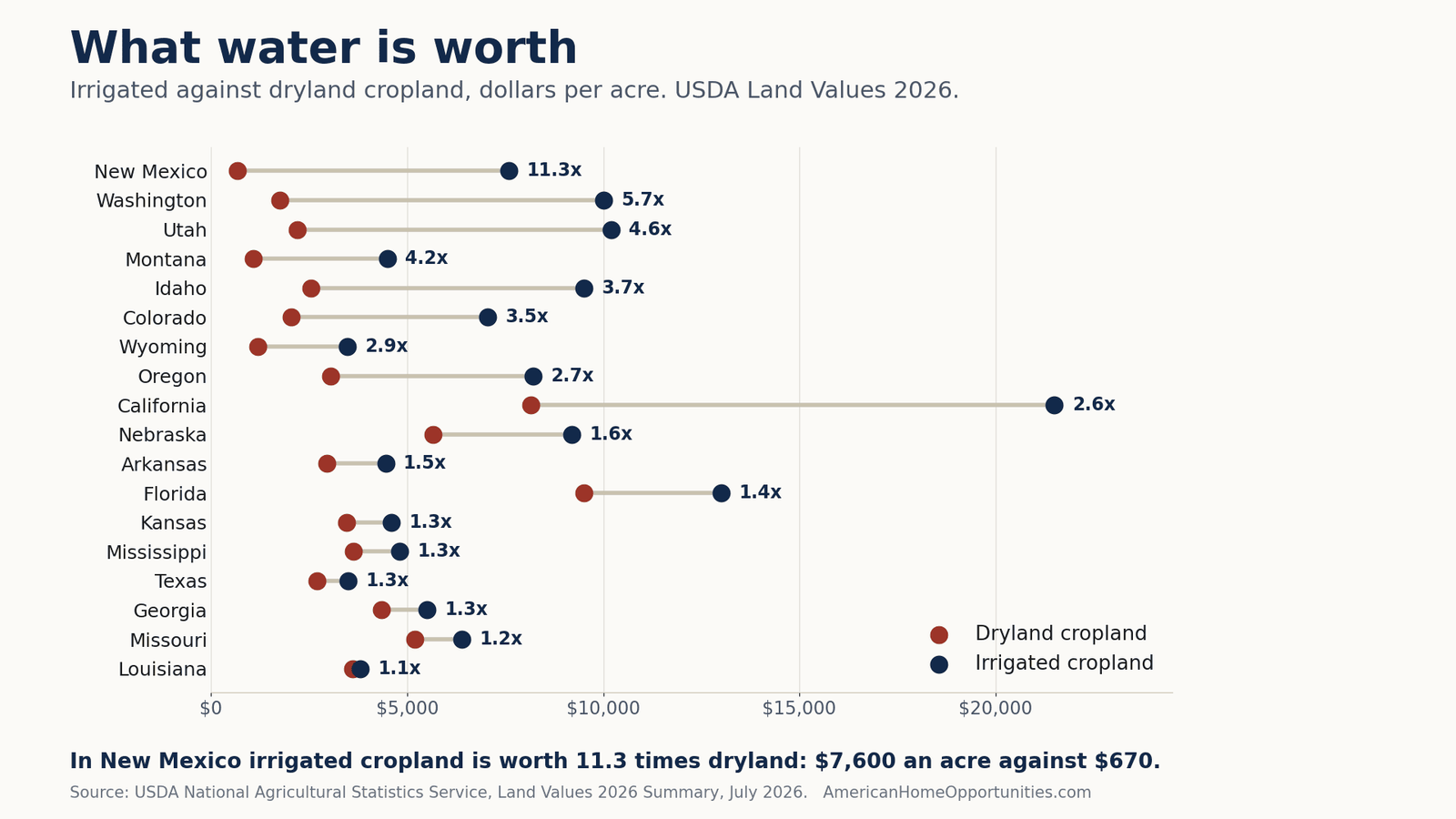
In New Mexico, irrigated cropland is worth $7,600 an acre. Dryland cropland in the same state is worth $670. The land is identical. What separates the two figures is whether water reaches it.
And the premium scales almost perfectly with how dry the state is. Washington runs 5.7 times, Utah 4.6, Montana 4.2, Idaho 3.7, Colorado 3.5, Wyoming 2.9. Then cross into country where it rains and the premium collapses: Missouri 1.2 times, Louisiana 1.1. In Louisiana, irrigation adds almost nothing to what an acre is worth, because the sky already handles it.
Put those two facts together and the cheapest states to buy land stop looking like bargains and start looking like a straightforward trade. You are not buying discounted land. You are buying land without water rights, and in most of the West water is a separate legal asset with its own history, its own priority date and its own price. A parcel in Nevada at $900 an acre and a parcel in Nevada at $9,000 an acre can sit on the same road.
None of which makes the arid West a bad place to buy. Off-grid homesteads, hunting ground, solar exposure, low tax rates, enormous privacy — plenty of people want exactly what those acres offer, and they are getting a real price for it. What matters is knowing which thing you are actually paying for. If you go looking in New Mexico, Nevada, Wyoming or Montana, water is the first question, not the last one, and the answer comes from the state engineer’s office and a water rights attorney — not from a listing page.
Cheap to buy is not cheap to own
Almost every list of the cheapest states to buy land stops at the purchase price, and that is where the real cost starts hiding. The purchase is one number, paid once. The property tax is a smaller number, paid every year for as long as you own the place, and over a normal holding period it can easily outrun whatever you saved at closing.
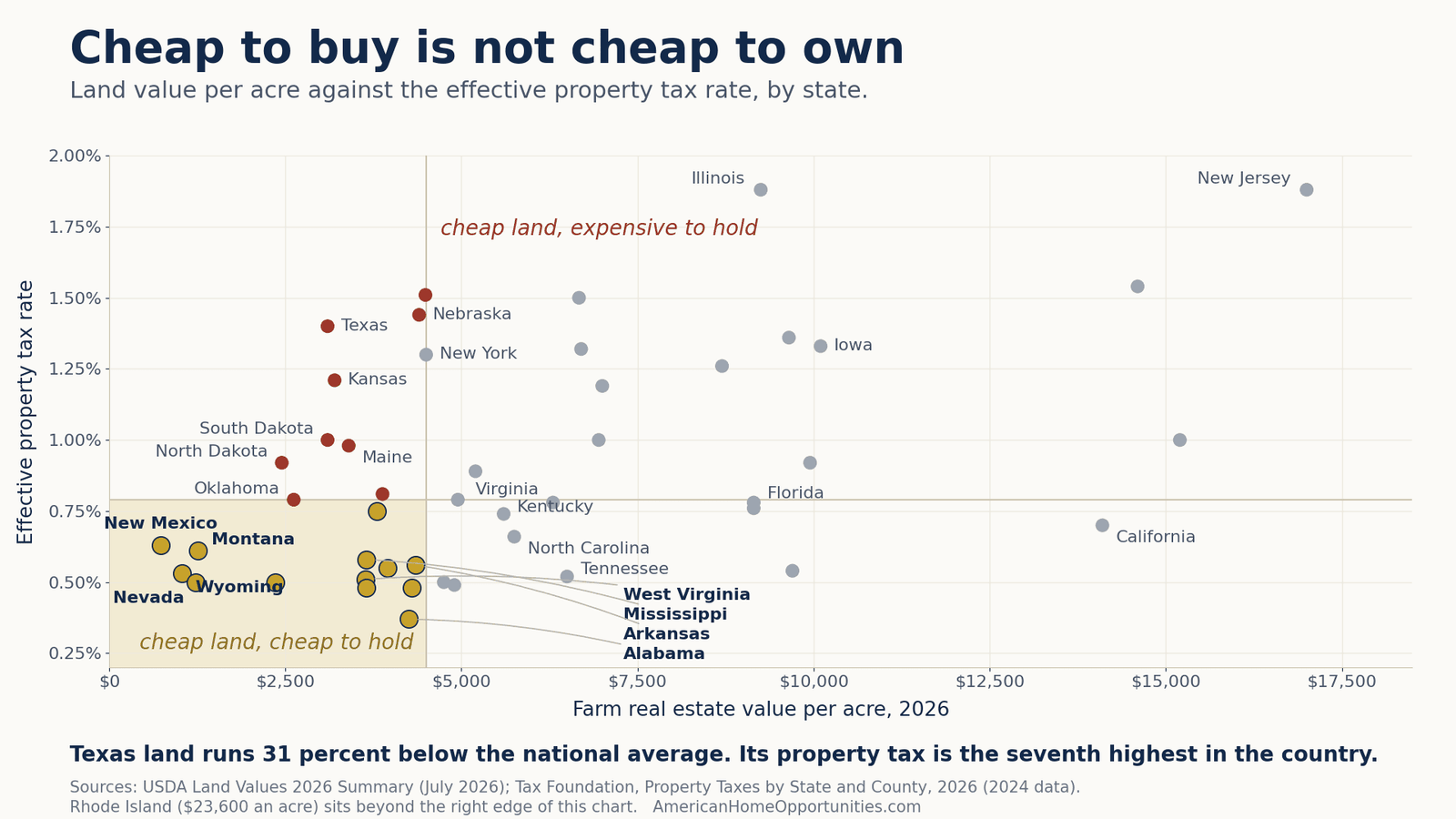
Texas is the clearest case in the country. Texas land runs 31 percent below the national average, which is why it shows up on every affordable-land list ever written. Texas also has the seventh highest effective property tax rate in the United States, at 1.40 percent, because the state collects no income tax and has to fund itself somewhere. Nebraska is higher still at 1.44 percent, and Kansas sits at 1.21 percent — three states people reach for precisely because the land looks inexpensive.
Run it on a $150,000 rural property. In Alabama, at 0.37 percent, that is roughly $555 a year. In Texas, at 1.40 percent, it is about $2,100. The difference is $1,545 every year, or $15,450 over a decade — real money, on the same property, decided entirely by which side of a state line it sits on.
Now look at the bottom left corner of that chart, where land is cheap and holding it is cheap too. Alabama sits at 0.37 percent, the lowest rate in the continental United States. West Virginia is at 0.51 percent, Arkansas 0.56, Mississippi 0.58, Louisiana 0.55. Those five states are inexpensive to buy into and inexpensive to keep, and none of them ever make the top of a cheapest-states ranking.
One honest caveat, because it is the sort of thing that ruins a budget: a low rate is not a low bill everywhere within a state. Counties, school districts and municipalities all layer on top, agricultural and timber exemptions can cut an assessment dramatically where the parcel qualifies, and a change of use can trigger a rollback of the taxes you were exempted from. The county assessor holds the real number for the specific parcel, and it is worth a phone call before you make an offer, not after.
What sellers ask is not what the land is worth
Everything above is value. What you actually meet online is asking price, and the two are not the same thing at all. Across roughly 291,000 active land listings nationally, the average asking price works out to about $19,499 an acre against a USDA value of $4,500 — a multiple of 4.3 times.
Some of that gap is legitimate. Listed parcels are smaller than farms, they are often already subdivided, surveyed and roaded, and a five-acre lot with an approved driveway permit is genuinely worth more per acre than the middle of a section. But the size of the gap varies enormously by state, and the pattern is the interesting part.
| State | USDA value $ per acre | Average asking price $ per acre | Gap |
|---|---|---|---|
| Nevada | $1,230 | $20,607 | 16.8x |
| Utah | $3,650 | $41,930 | 11.5x |
| Wyoming | $1,030 | $10,795 | 10.5x |
| Montana | $1,260 | $12,159 | 9.7x |
| New Mexico | $735 | $6,892 | 9.4x |
| United States | $4,500 | $19,499 | 4.3x |
| Michigan | $7,000 | $17,374 | 2.5x |
| Wisconsin | $6,700 | $16,782 | 2.5x |
| Kentucky | $5,600 | $12,379 | 2.2x |
| Oregon | $3,880 | $5,648 | 1.5x |
The five states with the widest gaps are five of the six cheapest states in the country. That is not a coincidence and it is not evidence that anyone is being cheated. It means something more useful: in Nevada, the retail market for small parcels has essentially no relationship to the agricultural value of the ground underneath it. Almost everything for sale there is a recreational or speculative lot, priced on desire rather than on productivity, and the USDA number tells you nothing about what you will be quoted.
In Kentucky, Oregon, Michigan and Wisconsin the opposite holds. Asking prices sit close enough to land values that a listing price is a meaningful signal, and a parcel priced well above the state pattern stands out for a reason worth investigating. Where the multiple is small, comparing prices works. Where it is enormous, comparing prices only tells you what other sellers are hoping for.
Where the numbers actually point
Line up the three filters — cheap to buy, cheap to hold, and enough rainfall that water is not a separate purchase — and a different, much shorter list of cheapest states to buy land falls out. It is not the list the rankings give you, and it is not glamorous.
| State | All farmland $ per acre | Pasture $ per acre | Property tax | Why it clears all three filters |
|---|---|---|---|---|
| West Virginia | $3,640 | $2,400 | 0.51% | 12th cheapest land in the country and 9th cheapest to hold. Steep ground is the trade-off. |
| Mississippi | $3,650 | $3,310 | 0.58% | Cheap, wet and flat, with a water premium of only 1.3 times. |
| Louisiana | $3,950 | $3,600 | 0.55% | The cheapest water in the country — but elevation, flood zone and insurance decide everything here. |
| Alabama | $4,250 | $3,500 | 0.37% | The lowest effective property tax rate in the continental United States. |
| Arkansas | $4,350 | $3,500 | 0.56% | Ozark acreage with rain, priced below the national average. |
| Maine | $3,400 | $2,700 | 0.98% | Genuinely cheap land, and the one state on this list where the tax rate works against you. |
Louisiana carries a warning we are not going to soften. The land is cheap and the rainfall is free, but flood zone designation, elevation and the cost and availability of insurance vary parish by parish and have moved sharply in recent years. Nothing on this page is a reason to buy there without pulling the flood map and getting a live insurance quote on the specific address first.
The column almost nobody reads: pasture
If you are buying acreage to live on rather than to farm commercially, the headline farmland number is the wrong column. Pasture is the one that matches what you are actually looking at, and it reorders the map completely.
New York pasture is $2,040 an acre. That is cheaper than pasture in Oklahoma ($2,200), Texas ($2,420) and Kansas ($2,400) — in a state that gets around forty inches of rain a year and never appears on a single cheap-land list. West Virginia and Minnesota pasture both run $2,400. Missouri is $2,850.
The counterweight belongs in the same breath, though: New York’s effective property tax rate is 1.30 percent, the eleventh highest in the country. Cheap to buy, expensive to keep — the exact trap this page has been describing, just running in the other direction. It still makes upstate New York worth a serious look for anyone who assumed the Northeast was priced out of reach, as long as the annual bill goes into the math from the start.
State averages hide the counties
Ranking the cheapest states to buy land is only ever a first pass, because everything on this page is a state average, and a state average is a blunt instrument. Kentucky comes in at $5,600 an acre, but the Bluegrass horse country around Lexington and the eastern coalfield counties are not remotely the same market. Texas at $3,100 folds the Hill Country and the Panhandle into one figure. Florida at $9,150 hides the fact that inland north Florida and the Gulf coast might as well be different countries.
The county-level data exists — it comes out of the USDA Census of Agriculture, which runs every five years — and it is where the actual opportunities live. We have already built that layer for seven states, each with the county breakdown, the local traps, and what a realistic budget looks like on the ground:
- Buying rural property in Tennessee
- Buying rural property in Kentucky
- Buying rural property in North Carolina
- Buying rural land in upstate New York
- Buying rural land in Virginia
- Buying rural land in Pennsylvania
- Buying rural property in Florida
If the state you care about is not on that list yet, the rural property guides hub is where every new one lands as it is published.
How we use these numbers
A ranking of the cheapest states to buy land is a tool, not a conclusion, and this is how we use it. We publish a lot of cheap rural listings, and the first thing we do with any of them is check the asking price against the USDA value for that state and, where we have it, that county. A property priced near the state pattern is normal. A property priced far below it always has a reason attached, and the reason is usually access, water, title, or a structure that is further gone than the photographs suggest — which is the entire subject of why cheap rural homes don’t sell.
That check is one input into the AHO Score, the rating we put on the properties we feature, alongside access, utilities, structure condition and how far the nearest town actually is. And if you are working through a specific parcel right now, the free Field Guide is the checklist version of all of it — water, septic, legal access, zoning, title, financing and insurance, in the order you should be asking about them.
Frequently asked questions
What is the cheapest state to buy land in 2026?
New Mexico, at $735 an acre for farm real estate, according to the USDA’s Land Values 2026 Summary. Wyoming is second at $1,030, Nevada third at $1,230 and Montana fourth at $1,260. All four are arid states, and in all four the price reflects the absence of water as much as the land itself.
How much does an acre of land cost in the United States?
The national average for farm real estate is $4,500 an acre in 2026. Cropland averages $6,020 and pasture $2,000. Actual asking prices on active listings average far higher — around $19,499 an acre — because listed parcels are smaller, more developed and priced retail.
What is the cheapest state to buy land for homesteading?
It depends on whether you need rainfall. If you do, the states that combine low land prices, low property taxes and natural precipitation are West Virginia, Mississippi, Alabama and Arkansas. If you are planning an off-grid or arid setup and have resolved the water question, New Mexico, Wyoming and Montana are dramatically cheaper per acre. The mistake is picking from a price ranking without deciding which of those two situations you are in.
Which states have the lowest property taxes on land?
By effective rate, Alabama is lowest in the continental United States at 0.37 percent, followed by Utah and Arizona at 0.48 percent, then South Carolina at 0.49 percent and Nevada, Colorado and Idaho at 0.50 percent. Rates on bare or agricultural land are assessed under separate state rules, so the county assessor is the only source for a specific parcel.
Why are asking prices so much higher than USDA land values?
Because they measure different things. The USDA measures the value of working farmland across a whole state. Listings are smaller parcels, often already subdivided, surveyed and roaded, and they are priced retail. Nationally the multiple is 4.3 times. Where it is much larger — Nevada at 16.8 times, Utah at 11.5 — the retail lot market has drifted away from the underlying value of the ground.
Is cheap land in Nevada or New Mexico a bad buy?
Not at all — but you have to know what you are buying. Land in those states is inexpensive largely because water is scarce and, in most of the West, water rights are a separate legal asset from the land. For hunting ground, solar exposure, privacy or an off-grid build with a resolved water plan, the value can be excellent. Verify water rights with the state engineer’s office and a water rights attorney before you commit to anything.
Where does this data come from?
Three sources, all public. Every figure behind our ranking of the cheapest states to buy land comes from the USDA’s Land Values 2026 Summary for land values and the irrigated-versus-dryland split, the Tax Foundation for effective property tax rates, and active land listing data for asking prices. Full citations are at the bottom of this page.
One data guide a week, in your inbox
State averages are where we start. Every week we publish one guide that goes county by county, plus the properties that clear our own checks. Leave your email and you will get each one as it goes up.
Sources
- USDA National Agricultural Statistics Service, Land Values 2026 Summary, released July 31, 2026. Farm real estate, cropland and pasture values per acre by state, and irrigated against dryland cropland for 18 states. Alaska and Hawaii are not surveyed.
- USDA National Agricultural Statistics Service, Census of Agriculture 2022. County-level land values, used in our state guides.
- Tax Foundation, Property Taxes by State and County, 2026, using 2024 data. Effective property tax rate on owner-occupied housing.
- Active land listing data, September 2026: approximately 291,000 listings nationally, average parcel size 20 acres. Asking prices, not transaction prices.
Before you act on any of this
American Home Opportunities is a publisher. We are not a real estate broker, agent, lender, appraiser, attorney, tax professional or financial advisor, and nothing on this page is investment, legal, tax or financial advice. The figures here are state-level averages drawn from public data sources and are published for general information only. They are not a valuation of any specific property and they will not predict what any specific parcel costs or what it will be taxed.
Land values, tax rates and listing prices change, and the sources above are updated on their own schedules. Rural property in particular carries issues that no state average can capture: water rights and well capacity, septic feasibility and perc testing, legal access and easements, survey and boundary questions, flood zone and insurance availability, zoning and permitted use, mineral rights, and financing that works differently from a conventional mortgage. Verify everything that matters with the county assessor, the county planning or building department, the state agency that governs water where you are buying, a licensed local agent, a title company, a surveyor and an attorney licensed in that state before you commit money to anything.