How to Buy Land in Arizona, Step by Step
Arizona is one of the few states where you can still buy several acres for the price of a used car. It is also a state where the same parcel can be worthless to build on, and nothing on the listing will tell you which one you are looking at. This is how to buy land in Arizona step by step, in the order that protects your money: what the ground is really worth, what kind of parcel you are being sold, whether it has water and a legal way in, and only then, how the deal closes.
Every figure here comes from a federal or state source, and every one of them is named. If you want the county-by-county numbers first, they live on our Arizona land guide. Work through it in order and you will know more about the parcel than the person selling it.
The ten steps, in order
Buying land in Arizona step by step means doing these ten things in this sequence. The order is the point: four of them can kill a deal, and all four come before you write an offer.
Step 1: Find out what the ground is actually worth
Start here, because it is the step almost everyone skips. The USDA’s 2022 Census of Agriculture measures farmland and its buildings in every county in the country using the same method. In Arizona the state average is $883 an acre, and the counties run from $325 in Navajo to $8,662 in Yuma. That is a spread of 26.7 times inside one state.
Now compare that with what the listing sites publish. LandSearch averages its current Arizona inventory at about $12,223 an acre. The two numbers are 13.8 times apart, and neither of them is a price. The census includes millions of acres of tribal trust rangeland that will never be sold, which drags the county figures down. The listing average is built from what is currently for sale, which skews small and close to towns, and it prices asking, not selling. LandSearch says so itself under its own table.
Use both as bookends. Where the census and the market measure similar ground, the gap collapses: Yavapai runs 2.3 times, Cochise 2.0. Where it explodes, as in Apache at 17.7 times, that is a warning that the cheap acreage in the county is not the acreage being sold to you.
Step 2: Understand why Arizona land is priced the way it is
Every summer the USDA publishes what cropland is worth in states with significant irrigation, split into irrigated and dryland. Twenty-two states appear in the 2026 edition. Twenty get both lines. Two get only one, and Arizona is one of them, alongside Nevada. Colorado, Idaho, Montana, New Mexico, Utah and Wyoming all farm dry country and all six have a published dryland value.
The reason is not an oversight. Arizona’s all-cropland figure is $8,300 an acre and its irrigated figure is $8,400, almost the same number, because there is barely any Arizona cropland that is not irrigated. Set that against pasture at $980 and you get a ratio of 8.5 to 1. The next widest spread in the country is Nebraska at 4.4 to 1.
In practice that means one thing. In Arizona you are not buying land, you are buying the water assigned to it, and a parcel with no path to water is priced like pasture no matter how good the view is. Every step that follows is a way of finding out which one you are being offered.
Step 3: Work out what kind of parcel it is
Arizona draws its line at six. Divide land into six or more lots and it is a subdivision: a recorded plat, a state public report, verified legal access, a water finding, roads and utilities all settled on paper before a single lot is sold. Divide it into five or fewer and it is a lot split, and almost none of that applies. Parcels of 36 acres and up can change hands with only minimal public report requirements at all.
According to the University of Arizona Cooperative Extension, a lot split buyer gets no public report listing schools, medical services, liens, taxes and restrictions; no verification of legal access; no assessment of water adequacy; no utility planning; no guarantee that anyone maintains the road; and no pre-approved septic. Every one of those becomes your problem after closing rather than the seller’s before it.
You are entitled to one document, and you should demand it: a seller in an unincorporated area has to complete an Affidavit of Disclosure under A.R.S. 33-422, twenty questions covering access, utilities, flooding and the legal status of the road. Read every answer. The Extension also notes that many Arizona counties do not have the capacity to enforce the requirement, so treat the affidavit as the start of your homework rather than the end of it.
The one that catches everyone: state trust land is not for sale
Arizona holds roughly nine million acres in State Trust land, and buyers see it on a map, notice there is no price on it, and assume it is available. It is not sold over the counter. The Arizona State Land Department disposes of trust land ready for development only through public auction, live or by sealed bid, with a minimum bid set at the appraised value. You can lease trust land for grazing or agriculture, but you cannot walk in and buy the forty acres next to your parcel because it looks empty.
This matters beyond the purchase. If the only route to your land crosses state trust land, that route is not automatically yours either.
Step 4: Check the water before you check anything else
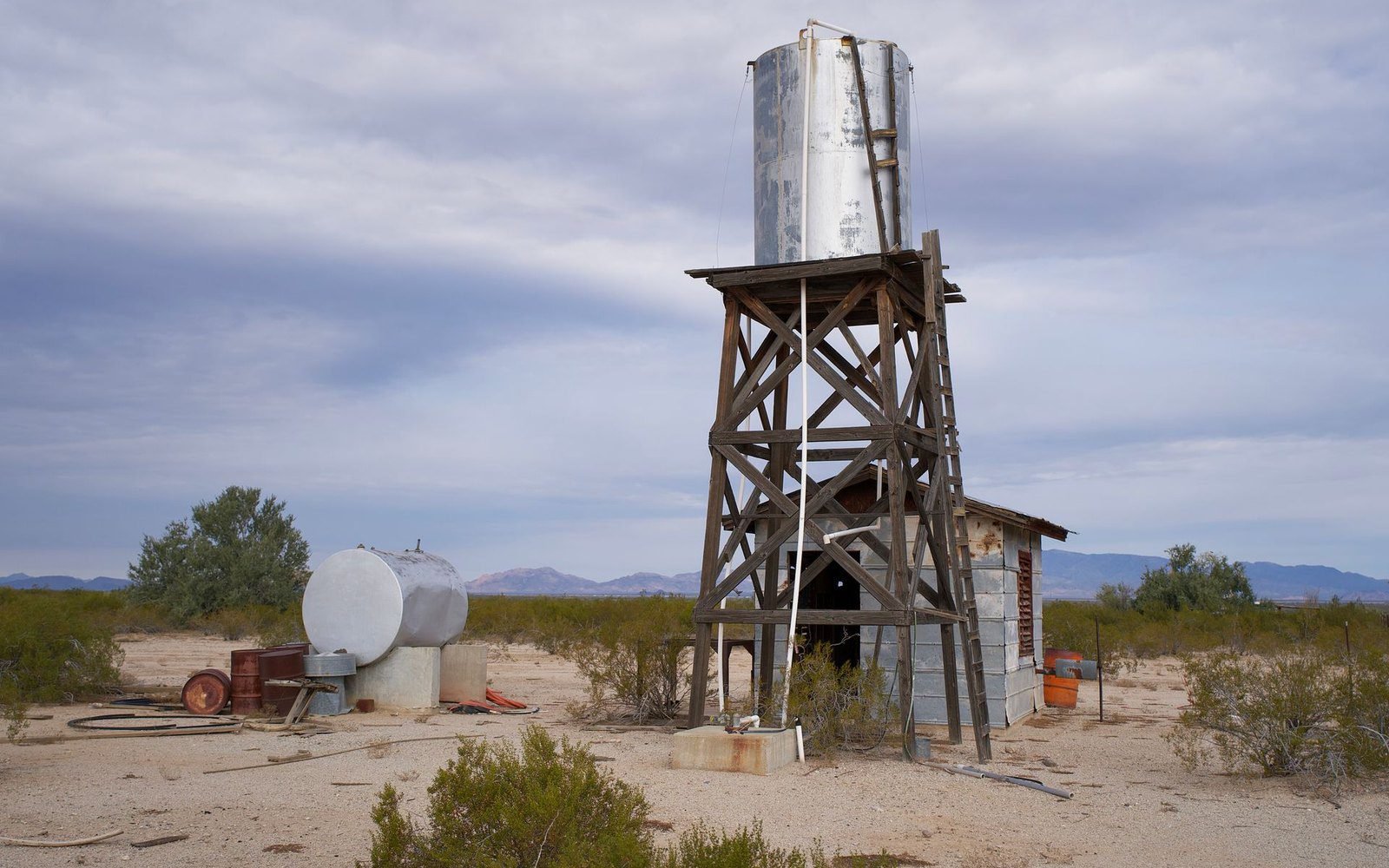
Arizona regulates groundwater by geography, and the map has grown recently enough that most of the buyer guides online are out of date. There are now eight Active Management Areas: Prescott, Phoenix, Pinal, Tucson, Santa Cruz, Douglas, Willcox and Ranegras Plain. There are also four Irrigation Non-Expansion Areas, where no new acreage can be brought under irrigation: Harquahala, Joseph City, Douglas and Hualapai Valley.
Inside an AMA, a developer has to prove an Assured Water Supply against seven criteria, including a supply that holds for one hundred years, before lots can be sold at all. Outside an AMA the standard is Adequate Water Supply, five criteria, and unless the county or town has passed its own ordinance requiring it, the finding is a disclosure rather than a condition of sale.
Read that again, because it is the single most expensive sentence on this page. Outside an AMA, a seller can legally sell you a parcel while disclosing that the water supply is not adequate. The disclosure is your protection, and it only protects you if you read it. Willcox covers ground in Cochise and Graham; Hualapai Valley sits in Mohave. Those are two of the places where Arizona land is cheapest.
Then price the well, because the answer is not the same across the state. The two cheapest counties by farmland value are also the two most expensive places in Arizona to drill: on the Colorado Plateau you are cutting through sandstone, basalt, limestone and shale instead of soft basin fill, and both the depth and the price per foot roughly double.
| County | Typical depth | Typical installed cost |
|---|---|---|
| Cochise, San Pedro Valley | 200 to 350 ft | about $12,600 |
| Mohave, Kingman area | about 300 ft | about $13,200 |
| Yavapai, Prescott and Verde Valley | 260 to 450 ft | $11,440 to $15,360 |
| Navajo, Show Low and White Mountains | 320 to 500 ft | $14,080 to $16,100 |
| Coconino, Flagstaff area | 500 to 800 ft | $27,500 and up |
| Apache, Colorado Plateau | 400 to 1,500 ft | $55 to $95 per foot in hard rock |
Run the arithmetic on the parcel in front of you. A 1,200-foot hard-rock well in Apache County at $75 a foot is $90,000 before the pump, the tank and the trench, on land the census values at $329 an acre. That is not an argument against the plateau. It is an argument for pricing the well before you price the land.
Step 5: Prove there is legal access, not just a road
A track you can drive is physical access. It is not legal access, and in rural Arizona the two come apart constantly, because the route often crosses federal land, state trust land or a neighbor’s parcel. Owning land you have no right to reach is, as the Arizona School of Real Estate and Business puts it, like owning a car without the keys.
If the parcel does not front a public road, there are three ways in, and they are not equally useful.
- An express easement — a recorded grant from the neighboring owner. This is the one you want, and the only one you can verify in an afternoon at the county recorder.
- A prescriptive easement — Arizona requires clear and convincing evidence that the route has been actually and visibly used, under a claim of right, for at least ten consecutive years, in a way hostile to the other owner’s title. That is a lawsuit, not a checkbox.
- An easement by necessity — available only when the parcel is genuinely landlocked. If any alternative route exists, even an inconvenient and expensive one, this does not apply.
Ask the title company to show you the recorded easement in the commitment. If nobody can produce a document, assume there is no legal access and price the parcel accordingly, or walk.
Step 6: Price the utilities and the build, in writing
Rural Arizona runs largely on electric cooperatives, and none of them publishes a cost per mile, because there is no such thing. What they publish is a process. Sulphur Springs Valley Electric Cooperative, which serves much of Cochise and Santa Cruz, charges a design fee of nothing to $150 for a residential extension up to 400 feet and $0.20 a foot beyond that. You pay the design fee, an engineer produces the real estimate, you pay that as an Aid-to-Construction charge, and further invoices can follow for anything unforeseen. Ask about a line extension credit by name.
The number that matters is the engineer’s estimate for your parcel, and you can usually get it before you close. Any per-mile figure you read on a land sales blog is a guess. Price off-grid solar the same way, as a real alternative rather than a fallback.
Then the build. Cochise County runs an Owner-Builder Amendment with no real equivalent elsewhere in the country: on rural unincorporated property zoned at one dwelling per four acres or larger, an owner building for themselves can choose plan review plus limited inspections, which can end in a conditioned Certificate of Occupancy, or no plan review and no building inspections at all, which does not. Zoning, floodplain, septic and well approvals still apply either way, the codes still apply, and the owner-builder carries the responsibility whether anyone inspects or not. You can use it once every five years. It is a genuine opportunity for someone building to live in the house, and a problem for someone building to sell it, because no Certificate of Occupancy narrows both your lender pool and your buyer pool.
Two more line items belong here. Floodplain authority in unincorporated Arizona sits with the county flood control district under A.R.S. 48-3610, not with the seller and not with FEMA, so ask the county early whether your building envelope or your access road crosses a wash. And in the north, budget for snow: the National Weather Service records an average of 90.1 inches at Flagstaff between October and May, and a private mile of road does not plow itself.
Step 7: Decide how you are paying
Raw land is the hardest thing in American real estate to finance, and Arizona is no exception. Most cheap parcels change hands for cash or on terms from the seller, and the reason is simple: a bank cannot foreclose its way out of a lot with no water, no power and no legal access, so it does not lend on one.
If the seller carries the paper, know what secures it. Arizona lenders use a deed of trust rather than a mortgage, defined at A.R.S. 33-801. A third-party trustee holds title until the debt is paid, and if you default the trustee can sell the property outside of court. That is faster and cheaper for the seller than a judicial foreclosure, and it means your cure window is shorter than most buyers assume. Read the default and reinstatement terms before you sign, not after you miss a payment.
What about the February tax lien sales?
Every Arizona county holds a tax lien sale in February for taxes delinquent two or more years, under A.R.S. 42-18112. It is worth understanding precisely, because it is sold online as a way to pick up desert acreage for a few hundred dollars, and that is not what happens.
What you buy is a Certificate of Purchase, a lien against the property, not the property itself (A.R.S. 42-18118). Bidding starts at 16 percent and goes down in one-percent steps, and bids of zero are allowed, so you are competing on the interest rate you will accept rather than on price. The owner can redeem at any time by paying you back with interest, which is the normal outcome. To get anywhere near a deed you must hold the certificate for a minimum of three years and then file a foreclosure action in Superior Court (A.R.S. 42-18201). The right to foreclose expires ten years after purchase, and the lien becomes void (A.R.S. 42-18151).
It is a real investment vehicle, and it can pay a decent return. It is not a way to buy land this year.
Step 8: Make the offer, and use the inspection window
By the time you write an offer you should already have four numbers, not one: the well quote for that section, the co-op’s engineering estimate for power, the septic design and percolation test, and the cost of a legal, maintained way in. A parcel that is $12,000 cheaper than the one next to it is not cheaper if the well is $40,000 deeper.
Order the title commitment as soon as escrow opens and read Schedule B, the exceptions, before you read anything else. That is where the easements, the mineral reservations and the access problems live. Ask for the Affidavit of Disclosure in the same breath. Then confirm with the county assessor whether the parcel currently carries the agricultural classification and what its production history looks like, because the classification does not travel with the deed.
Step 9: How closing actually works in Arizona
Arizona is a title and escrow state, not an attorney state. A licensed title company, not a lawyer, opens escrow, holds the earnest money, runs the title search, issues the preliminary report and the policies, prepares the settlement statement and records the deed with the county recorder.
Arizona is also a dry funding state, which is worth understanding before your moving day depends on it. Signing is not closing. Recording is closing. The order is: both sides sign, the buyer wires funds, the lender wires loan proceeds, the title company submits the deed, the county records it, and only then does the property change hands. A cash purchase typically runs seven to fourteen days, a financed one thirty to forty-five, and the delay is almost always underwriting rather than escrow.
On costs, Arizona has no real estate transfer tax at all, which saves thousands against California or New York. By long-standing custom, negotiable everywhere, the seller pays for the owner’s title policy, the buyer pays for the lender’s policy, escrow fees are split and the buyer pays recording. Ask for the fee sheet in writing at the start; the customs shift by county.
Step 10: The first year
This is where Arizona pays you back. The effective property tax rate on owner-occupied housing is 0.48 percent, second lowest in the United States and beaten only by Hawaii. Income is taxed at a flat 2.50 percent. There is no estate tax and no inheritance tax. Sales tax is 5.60 percent at state level and averages 8.52 percent with local rates added, which matters when you are buying materials.
Three things to do in the first twelve months. If the land can qualify for agricultural classification, get the application to the county assessor before September 30 for the following tax year, and know the thresholds: 20 acres for commercial field crops, 10 for permanent crops, 40 animal units for grazing, 10 horses for commercial boarding, 3 for breeding, with commercial production in three of the past five years. If you are relying on satellite for internet, check whether your parcel sits inside a funded project area first: Arizona’s federal broadband proposal was approved on December 2, 2025, with $993.1 million committed across 70 projects and construction beginning in 2026. And budget from market value rather than the seller’s old tax bill, because the bill you inherit is not the bill you will pay.
See the Arizona properties that survive these checks
We run the AMA map, the split history and the well record on every Arizona listing before we publish it. Leave your email and the ones that get through come to you.
Questions buyers ask about buying land in Arizona
Can you buy land in Arizona with no money down?
Not from a bank. Raw land loans need substantial equity because the collateral is hard to resell, so most cheap Arizona parcels sell for cash or on seller terms. Seller financing in Arizona is secured by a deed of trust under A.R.S. 33-801, which lets the trustee sell the property outside of court if you default, so read the reinstatement terms carefully before you sign.
How long does it take to close on land in Arizona?
Seven to fourteen days for a cash purchase and thirty to forty-five days with financing. Arizona closes through a title company rather than an attorney, and it is a dry funding state, so the deal is not done when you sign. It is done when the county recorder records the deed.
Can I buy the state trust land next to my parcel?
Only if the Arizona State Land Department puts it up for auction, and then only by bidding at or above its appraised value. Trust land ready for development is disposed of through public auction, live or by sealed bid. You can lease it for grazing or agriculture, but it is not for sale over the counter, and it does not come with an automatic right of way across it.
Do I need a permit to drill a well in Arizona?
Yes, and where the parcel sits changes what is possible. Inside one of the eight Active Management Areas, groundwater use is regulated by the Arizona Department of Water Resources and a subdivision cannot be sold without a hundred-year Assured Water Supply determination. Outside them, the Adequate Water Supply finding is usually disclosure only. Check the parcel against the ADWR map before you make an offer, not after.
That is how to buy land in Arizona step by step. If you want the numbers behind every one of these checks, county by county, the state guide has them.
Keep going
- What to know before buying land in Arizona — every county priced from the federal census, the five regions, and the six checks in full.
- The cheapest states to buy land — where Arizona sits against the other 47.
- Every rural property guide — the whole library, sorted by what you are trying to work out.
Before you buy — sources and disclaimer
Farmland values: USDA 2022 Census of Agriculture, Table 8, Arizona. Cropland, pasture and the irrigated and non-irrigated table: USDA NASS, Land Values 2026 Summary, July 2026, whose Arizona figures carry the USDA’s own footnote excluding American Indian Reservation land. Tax rates: Tax Foundation, 2026. Water regulation: Arizona Department of Water Resources. Lot splits and disclosure: University of Arizona Cooperative Extension with A.R.S. 11-831, 32-2101 and 33-422. Trust land: Arizona State Land Department. Easements: Arizona School of Real Estate and Business. Tax liens: Pima County Treasurer with A.R.S. 42-18112, 42-18118, 42-18151 and 42-18201. Deeds of trust: A.R.S. 33-801. Floodplain: A.R.S. 48-3610. Well costs: contractor estimates from the ADWR Wells 55 database, given as ranges rather than quotes. Snowfall: National Weather Service, Flagstaff. Broadband: Arizona Commerce Authority. Asking prices: LandSearch, September 2026.
American Home Opportunities is not a broker, an agent, a lender, a financial adviser or a law firm, and nothing here is legal, tax or financial advice. Statutes and county practice change. Verify everything with the county, the Arizona Department of Water Resources and a licensed professional before you act.