
Buying Rural Property in Kentucky
What land actually costs region by region, why the cheapest counties are cheap, and the one title problem that is specific to this state.
0.74%
property tax
US range: 0.29% to 1.88%
$3,900
per acre, pasture
USDA survey, 2025
120
counties
and they are not alike
8.8x
tax bill spread
Wolfe County to Oldham
There is no such thing as “the Kentucky land market”
Farmland in Knott County, in the eastern coalfield, is worth about $2,596 an acre according to the USDA census. Four hours west in Fayette County, around Lexington, the same census puts it at $16,231. In Leslie County it is $1,450. That is more than eleven times, inside one state.
Same state. Same laws. Same weather, more or less. That gap is not a rounding error and it is not a secret either. It is the single most important thing to understand before buying rural property in Kentucky, because almost every listing you scroll past is priced by which side of it the property sits on.
The spread shows up again in what it costs to keep the place. The median annual property tax bill runs about $391 in Wolfe County and about $3,454 in Oldham. Nearly nine times, inside one state, on houses a lot of buyers would consider interchangeable.
This guide breaks Kentucky into the markets that actually exist, shows you what the properties we have covered have really cost per acre, and walks through the specific things you have to verify here — including one title problem you will not run into anywhere else in the country.
What rural property costs, region by region
Start with the benchmark. The USDA land value survey put Kentucky farm real estate at an average of $5,480 an acre in 2025, up 3.4% on the year. Cropland averaged $6,450 and pasture $3,900. Those are figures for bare land, and they are statewide averages that flatten a state which is anything but flat.
USDA does not publish a regional breakdown for Kentucky, but it does publish a value per acre for every county in the 2022 Census of Agriculture. Grouping those counties into the four regions a buyer actually shops in gives the table below. Alongside it we have put what we have featured in each region, so you can see where our listings sit against the official numbers.
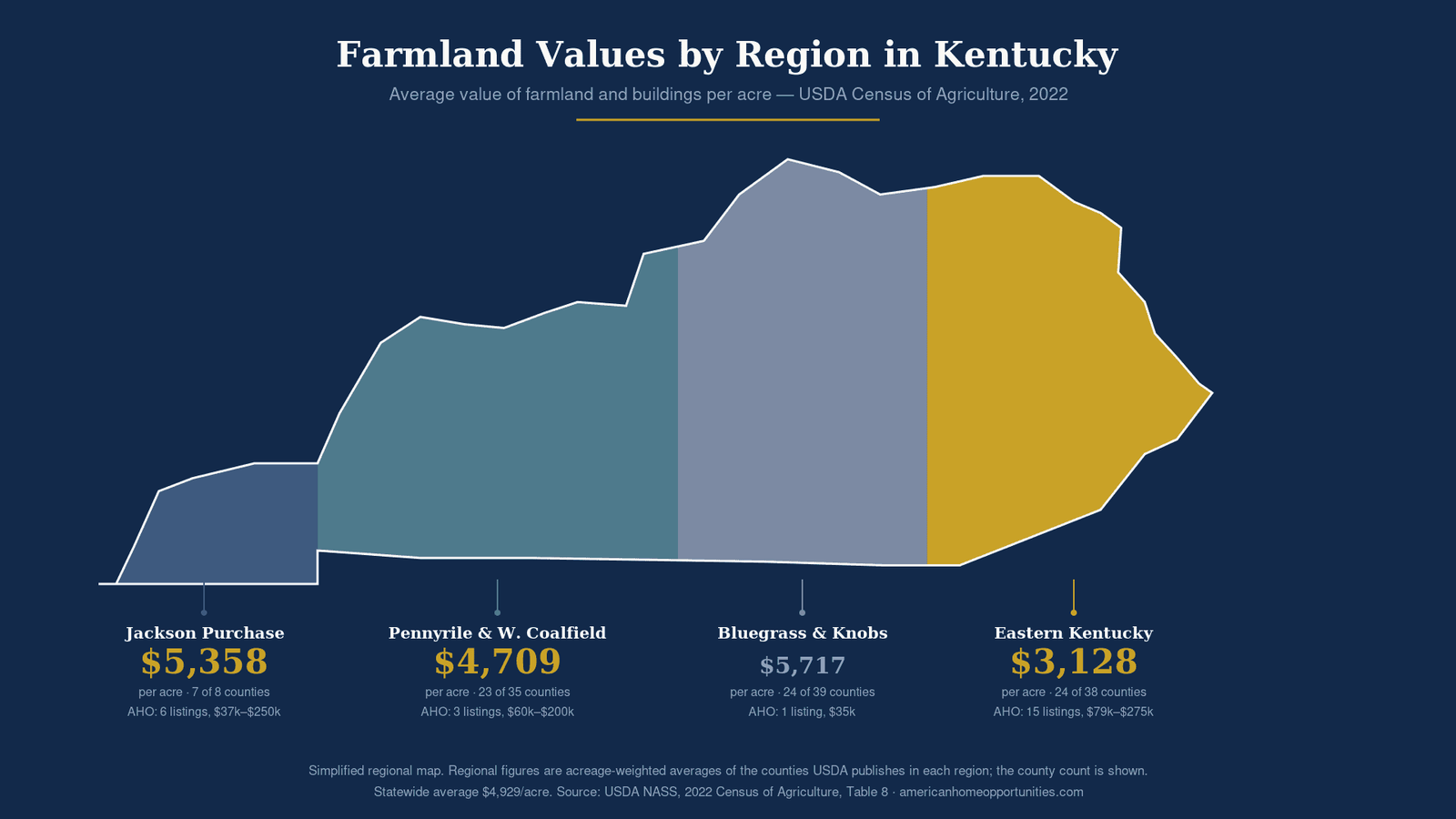
| Region | Farmland value per acre USDA, 2022 census | Range across counties | What we have featured there |
|---|---|---|---|
| East — Appalachia the coalfield and the Cumberland Plateau | $3,128 24 of 38 counties | $1,450 in Leslie to $4,682 in Laurel | 15 properties, $79,000–$274,500. Parcels of 13 acres and up are normal here. |
| Pennyrile and Western Coalfield the south and the lower Ohio valley | $4,709 23 of 35 counties | $2,793 in Cumberland to $6,404 in Logan | 3 properties, $59,900–$199,900. Flatter ground, better roads. |
| Jackson Purchase the far west, past the Tennessee River | $5,358 7 of 8 counties | $4,478 in Ballard to $5,673 in McCracken | 6 properties, $36,900–$250,000. Mostly houses on one-acre lots, not acreage. |
| Bluegrass and Knobs Lexington, Louisville, horse country | $5,717 24 of 39 counties | $3,229 in Bracken to $16,231 in Fayette | 1 property, $35,000. This is the expensive end of the state. |
| Kentucky statewide | $4,929 all 120 counties | USDA 2022 census. The 2025 USDA survey puts farm real estate at $5,480, cropland at $6,450 and pasture at $3,900. | |
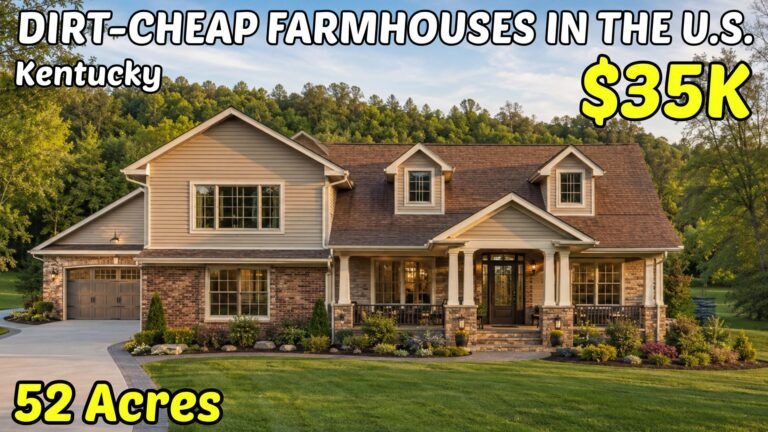
Two things are worth pulling out of that table. The first is that eastern Kentucky is not slightly cheaper, it is roughly half the state average and a fifth of Fayette County. The second is subtler: our own listings line up with it. The fifty-two-acre place we featured in Knott County worked out to $2,865 an acre with a livable house and a barn included, against a USDA farmland value of $2,596 an acre for bare ground in that county. In other words the buildings added about ten percent. In the eastern coalfield the house really does come close to free, and that is not our opinion, it is what the census says the dirt is worth.
One warning about figures you will see elsewhere. Listing sites advertise Kentucky averages above $11,000 an acre. That is an average of what is currently for sale, not of what sells. Overpriced parcels sit on the market for months while fair ones move in weeks, so the expensive listings pile up and drag the average with them. Any site quoting active-listing averages as market value is showing you the wrong number. The USDA survey is the defensible one.
Where the cheap land is, and why it is cheap
The cheapest ground in Kentucky is in the eastern coalfield — Letcher, Knott, Harlan, Leslie, Perry, Breathitt and their neighbours. Wooded hillside parcels, reclaimed mine land, narrow valleys with a creek running through them. It is genuinely beautiful country, and it is some of the least expensive rural land east of the Mississippi.
It is cheap for a reason, and you should hear the reason from us rather than discover it after closing.
Eastern Kentucky is one of the most economically distressed regions in the United States. The federal Appalachian Regional Commission classifies counties each year by unemployment, income and poverty. For fiscal year 2026, 38 of Kentucky’s 54 Appalachian counties are classified as distressed — the bottom 10% of all counties nationally — and another 12 are at-risk. Not one is rated competitive or attainment. Kentucky has more distressed counties than any other state in Appalachia.
That is what the price is telling you. The coal economy that built these towns has largely gone, and the jobs, the tax base and the young people went with it. Land is cheap because demand is thin, not because nobody has noticed it yet.
None of which makes it a bad buy. If you are retired, working remotely, homesteading, or looking for hunting ground and a cabin, thin local demand is the reason you can afford fifty acres. What it does mean is that you should not plan on finding a job there, that resale may take a long time, and that the services you take for granted are further away than the map suggests. Buy it for what it is.
There is a middle tier worth knowing about too. Warren County, around Bowling Green, gives you a real city with a hospital and an employment base, with genuinely rural and affordable country a short drive out. The counties along Kentucky Lake and Lake Barkley put water access within reach at prices that would be impossible on a comparable lake further east. And the Purchase region in the far west — flatter, better soil, better roads — trades acreage for convenience.
What to check before buying rural property in Kentucky
Every state has its own traps. These are Kentucky’s, and a listing page will not mention a single one of them.
You may not own what is under your land
This is the one that is specific to Kentucky, and it is why we put it first. Here, one person can own the surface of a property and a completely different party can own the coal, oil or gas beneath it. Lawyers call it a severed estate, and in the eastern coalfield it is common rather than exceptional.
The historical mechanism is the broad form deed. In the late 1800s and early 1900s, coal companies bought mineral rights across the mountains using deeds written so broadly that the mineral owner could extract coal over the objection of the person who owned the surface — including the house standing on it. Many were signed in the 1890s, long before anyone imagined strip mining.
In 1988 Kentucky voters passed the Broad Form Deed Amendment, now Section 19(2) of the state constitution. Those old deeds no longer authorise surface mining unless someone can show that method was known and in use in the area when the deed was signed. It is real protection, but it is not the same as owning your minerals.
What to do: have a local title attorney trace the chain of title back to the point where the minerals were severed. In parts of eastern Kentucky that means reading handwritten deeds from the 1890s, which is exactly why you hire someone who does it for a living. Ask the seller directly, in writing, whether the mineral rights convey. “I think so” is not an answer.
Flood risk, and why the FEMA map is not enough
Between 26 July and 1 August 2022, catastrophic flooding hit eastern Kentucky and killed 45 people — the region’s worst natural disaster in more than eighty years. Some of the households that later entered floodplain buyout programmes flooded again in 2025.
The numbers that matter to a buyer: across the four hardest-hit counties — Breathitt, Knott, Letcher and Perry — roughly 45% of parcels carry a flood risk rated 9 or 10 out of 10. Across the thirteen counties in the federal disaster declaration, about 40% do. In a designated A or AE zone, a property has roughly a 26% chance of flooding at least once over a 30-year mortgage.
Here is the part that catches people. According to FEMA, close to a third of all flood damage happens outside the zones FEMA maps as flood-prone. A narrow valley with a creek in it can flood badly without ever appearing on the map, because the map was drawn for river systems, not for water coming off a mountainside in an hour.
What to do: check the address on Kentucky’s official flood zone lookup at eec.ky.gov, then ask neighbours and the county road department what the creek has actually done. Get a flood insurance quote before you budget, not after. And know this: if you rebuild in a flood zone and choose to go without insurance, you can lose eligibility for future FEMA assistance.
“There is a hospital in town” is not the question
Rural healthcare in Kentucky is under real strain. The Chartis 2026 rural health report counts 417 rural hospitals nationally that are vulnerable to closure, with more than 40% of rural hospitals running at a loss, and Kentucky is among the states where inpatient care disappeared from facilities during 2025.
The eastern coalfield is where this bites hardest. Among the Kentucky hospitals reported at risk are five of the seven original Miners’ Memorial Hospitals — built by the mineworkers’ union in 1956 at Whitesburg, Middlesboro, Harlan, South Williamson and McDowell — along with facilities in Prestonsburg, Manchester, Louisa, Corbin, Pineville, Martin and Barbourville.
Services get cut long before a building closes. In February 2026 Ephraim McDowell Health announced it was closing the birthing unit at Fort Logan Hospital in Stanford, leaving expectant mothers in that area to find somewhere else. The hospital is still open. The maternity ward is not.
What to do: do not check for “nearest hospital”. Check three things separately and write down the drive time for each: the nearest emergency room, the nearest hospital that actually admits inpatients, and — if it applies to you — the nearest labour and delivery unit. Then call and confirm the service is still running.
Legal access, and who maintains the road
Rural parcels with no direct access to a public road are not unusual in Kentucky. In hill country the driveway often crosses somebody else’s ground, and the arrangement may be a handshake that has held for forty years and has never been recorded anywhere.
Land without documented legal access is difficult to finance, difficult to insure and difficult to sell, which is frequently why it is priced the way it is.
What to do: confirm deeded frontage or a recorded easement, and have an attorney read it — what it permits, whether it survives a sale, whether it allows you to build. Ask who maintains the gravel and what happens when it washes out, because on a shared road that is your problem too. A licensed surveyor will mark the real boundaries and flag any easement giving a third party the right to cross your land.
Water, wells and septic
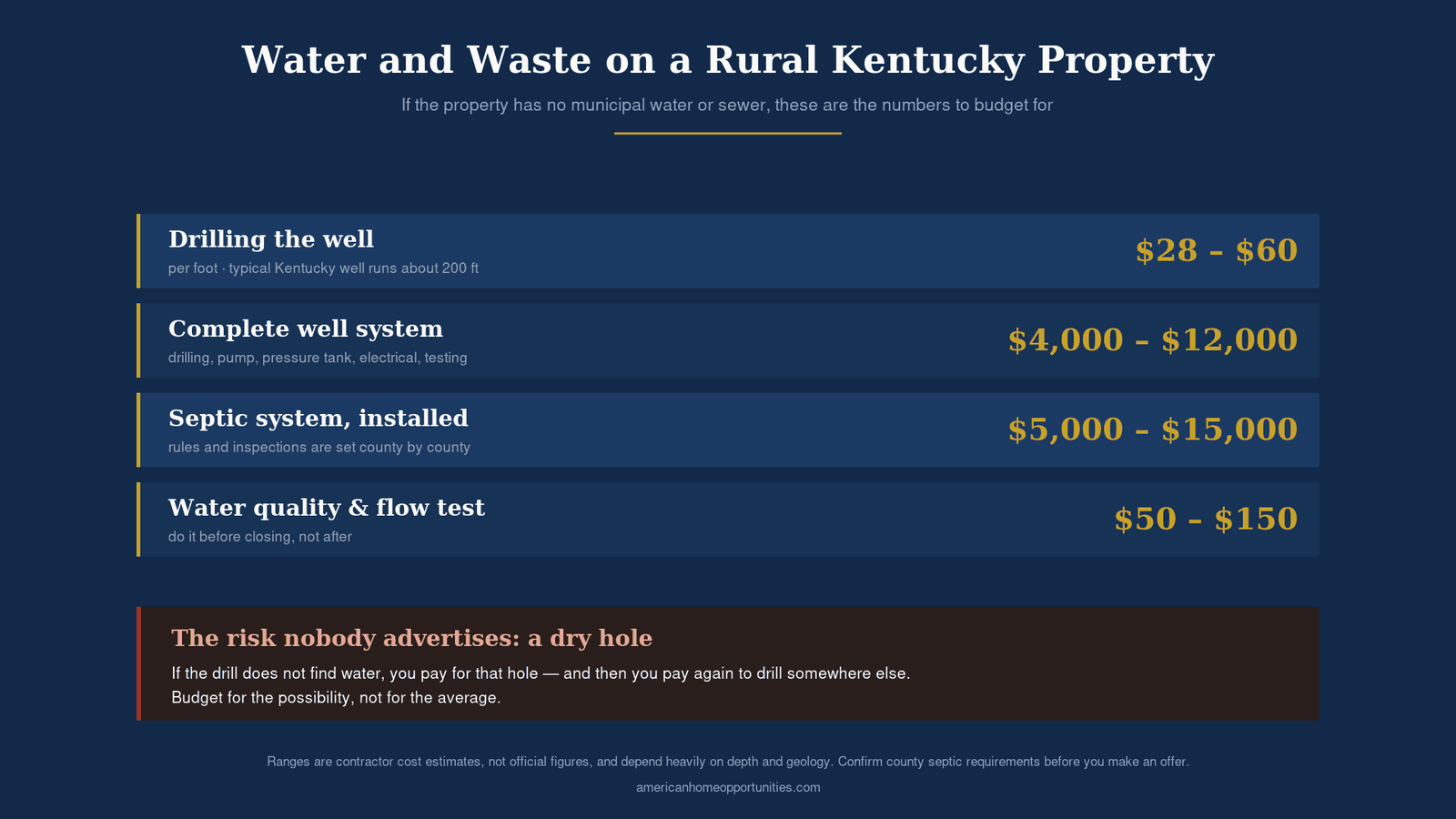
Plenty of rural Kentucky homes run on a private well, a septic system, or both. Septic approval, inspection and installation requirements are set county by county, so the rules in Knox County are not the rules in Calloway County.
If there is no well and you will need one, contractor estimates put a complete well system in Kentucky — drilling, pump, pressure tank, electrical and testing — at somewhere between $4,000 and $12,000, with depth the main variable. Installing a septic system runs $5,000 to $15,000. Treat that as a planning range rather than a quote; it comes from contractor cost aggregators, not an official source.
The risk nobody advertises is a dry hole. If the drill does not find water, you pay for that hole and then you pay again to drill somewhere else. Budget for the possibility rather than the average.
What to do: on an existing system, have the septic inspected and the well tested for both flow rate and water quality before closing, and make both a contingency in the offer.
Broadband changes from one hollow to the next
About one in ten Kentuckians cannot buy internet service of at least 25 Mbps down and 3 up. Close to two in ten cannot buy it for $60 a month or less. In the mountains, coverage can change between one ridge and the next.
It is improving. The state announced 47 grants worth more than $89.6 million covering 36 counties, and providers continue to extend service. But deployment economics still leave gaps, and a coverage map showing green over a county does not mean service reaches the end of a gravel road in it.
What to do: if you work remotely this is a deal-breaker item, not a detail. Call the provider with the exact street address and ask whether they will connect that specific service point and what it costs to run the line. Do it before you make an offer.
We run these checks before we feature a property
Every week we go through Kentucky listings and publish the ones that hold up — mineral rights, flood risk, legal access, the lot. Join the list and you will see them as they go out.
What it costs to own it once you have it
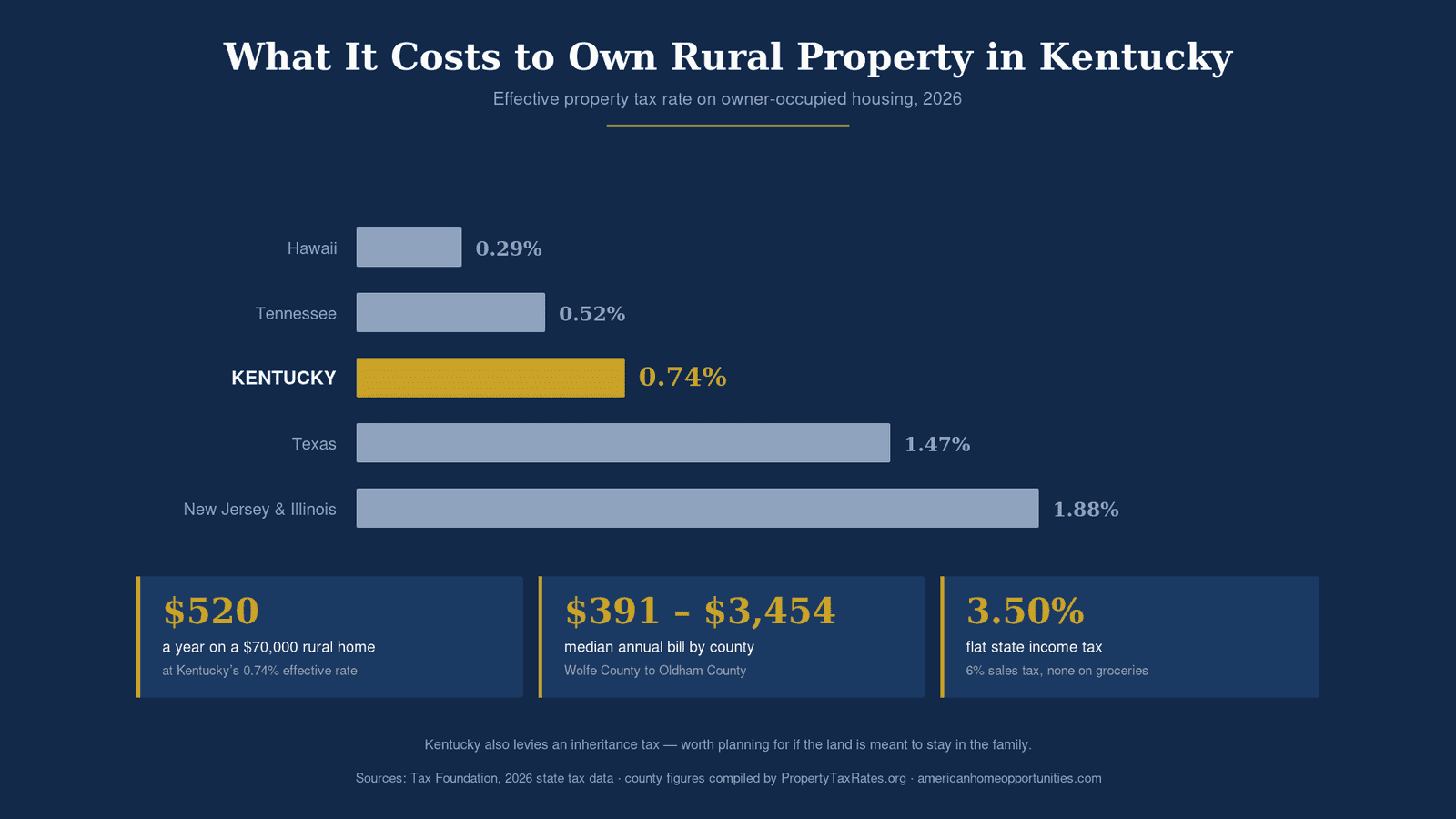
Kentucky’s effective property tax rate averages about 0.74%, against a national range of 0.29% in Hawaii to 1.88% in New Jersey and Illinois. On a $70,000 rural home that is roughly $520 a year. For a buyer coming from New Jersey, Illinois or Texas, that figure is not a saving — it is the difference between owning land and not owning land.
The average is not what you will pay, though. Property tax is levied at county level and funds schools, police, fire and roads, so it swings hard. County effective rates run from about 0.481% in Rockcastle to about 1.064% in Campbell County near Cincinnati, and 86 of the 120 counties sit below the state median. Look up the county, not the state.
Two Kentucky-specific programmes are worth knowing about before you budget.
The homestead exemption reduces the assessed value of a primary residence by $49,100 for the 2025–2026 assessment period. It is widely misunderstood: it is not available to every homeowner. You have to be 65 or older, or totally disabled. Confirm eligibility with the county Property Valuation Administrator before you count on it.
Agricultural value assessment taxes qualifying farmland on its agricultural use value rather than market value. It generally requires roughly ten acres or more in genuine agricultural use. On a twenty-five or fifty-acre parcel it can change the tax bill substantially, so ask the PVA whether the land currently qualifies and whether that status survives the sale.
Beyond property tax, Kentucky charges a flat 3.50% state income tax and does not tax groceries. On the purchase side rather than the holding side: the statewide median home sale price was $281,500 in May 2026 — but that figure includes Louisville and Lexington, which is precisely the Kentucky this site does not cover. The rural properties we feature run from $35,000 to about $275,000.
Kentucky properties we have featured
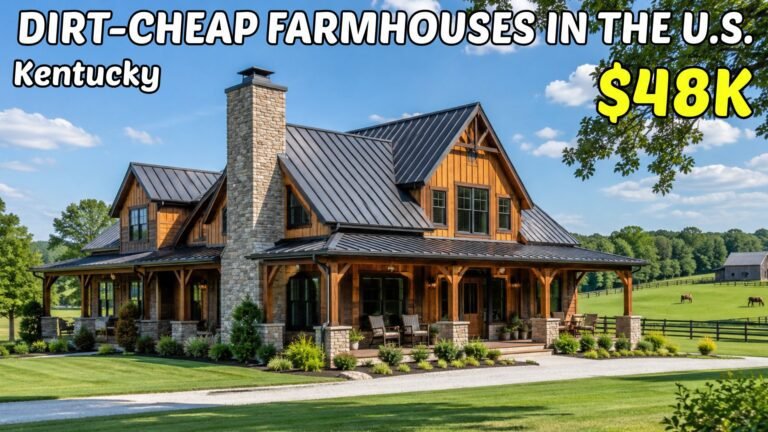
Everything above is the background. These are the actual listings, with the walkthroughs, our scoring and direct links to each one.


Keep exploring
Everything above is Kentucky. The pieces below sit underneath it and hold true in any state.
Start with why cheap rural homes do not sell, which unpacks the eight reasons a sound house sits unsold and the four financing routes that still close. The full guides library has the other states and the rule-by-rule explainers. Our scoring method shows what we weigh, and the Field Guide condenses the checks into nine pages.
Get the next batch of Kentucky listings first
You have just seen what we have covered so far. We publish a new set of rural — and usually cheap — Kentucky properties most weeks, and the ones that hold up tend to be under contract within a month or two. Join the list and you will see the next batch the day it goes out, rather than finding it after somebody else did.
One email when a new batch goes out. No sales calls, and you can leave any time.
Common questions about buying rural property in Kentucky
Where is the cheapest land in Kentucky?
The eastern coalfield — Letcher, Knott, Harlan, Leslie, Perry and Breathitt counties and their neighbours. USDA puts farmland there at $3,128 an acre against a state average of $4,929, with Leslie County the lowest in the state at $1,450. The reason is economic: 38 of Kentucky’s 54 Appalachian counties are federally classified as distressed. Cheap land there reflects thin demand, not an oversight by the market.
Do I automatically own the mineral rights when buying rural property in Kentucky?
No. Kentucky allows the surface and the minerals beneath it to be owned separately, and in the eastern coalfield they frequently are, often severed by deeds signed in the 1890s. The 1988 Broad Form Deed Amendment limits what a mineral owner can do to the surface, but it does not give the minerals back. Have a local title attorney trace the chain of title and get the seller’s answer in writing.
How much is property tax on a rural Kentucky home?
At the statewide average effective rate of about 0.74%, roughly $520 a year on a $70,000 home. County rates range from about 0.481% to about 1.064%, and median annual bills range from about $391 in Wolfe County to about $3,454 in Oldham. Check the specific county’s Property Valuation Administrator before budgeting.
Is Kentucky or Tennessee better for rural property?
Kentucky generally gives you more acreage for the money, particularly in the east, where large parcels with a livable house still trade near the cost of bare pasture. Tennessee is cheaper to hold: a 0.52% effective property tax rate against Kentucky’s 0.74%, and no state income tax against Kentucky’s flat 3.50%. Buying acreage points to Kentucky; minimising the annual cost points to Tennessee.
Get Kentucky listings before they are gone
Tell us your price range and how soon you are planning to buy, and we will email you when we feature Kentucky properties that fit. You will also get our free Rural Property Buyer’s Guide, the checklist we run through before featuring any listing.
One question before you go
What is the biggest thing standing between you and a rural property in Kentucky? One click, and it tells us what to write next.
Figures on this page are drawn from the USDA National Agricultural Statistics Service 2022 Census of Agriculture (county farmland values, Table 8) and its 2025 land value survey, the University of Kentucky Department of Agricultural Economics, the Kentucky Department of Revenue, the Appalachian Regional Commission (FY 2026), Redfin (May 2026), county tax data compiled by PropertyTaxRates.org, BroadbandNow and the Kentucky Office of Broadband Development, FEMA and the Kentucky Energy and Environment Cabinet, the Chartis Center for Rural Health (2026) and Kentucky Lantern, and were current as of July 2026. Property counts and price ranges attributed to American Home Opportunities are our own, from the 25 Kentucky properties we have featured since February 2026, and reflect asking prices rather than sale prices. Land prices move, county rules differ and services change. Nothing here is legal, tax or financial advice, and every buyer should verify these details with the relevant county office and their own professionals before making an offer.