
Buying Rural Land in Virginia
What an acre really costs county by county, why the cheapest land is not where you think, and the six checks that decide whether a listing is worth a drive.
$5,303
Average value per acre, statewide
$3,397
Southside Virginia, the cheapest region
4.7x
Spread from cheapest to priciest county
0.78%
Effective property tax rate
Virginia’s cheapest farmland is not where almost everybody says it is
Ask around and you will be told the cheap land in Virginia is in the coalfields — Buchanan, Dickenson, Wise, the far southwestern tip where the state narrows to a point. The federal census says something different. The cheapest farmland in Virginia sits along the North Carolina border, in the tier of counties that runs from Patrick and Henry east through Halifax, Mecklenburg and Brunswick. Southside Virginia. Land there averages $3,397 an acre, against $4,230 in the southwest and $5,303 for the state as a whole.
The individual counties are just as blunt. Dickenson County is the cheapest single county we could measure at $2,612 an acre. Loudoun County, sixty miles from the Capitol, runs $12,276 across 110,133 acres of real working farmland. That is a spread of 4.7 times inside one state, and it is the whole reason a page like this exists: in Virginia, the county line matters more than the state line.
Every number on this page comes from the 2022 Census of Agriculture, which is a census and not a survey — the USDA counts every farm in every county. We use it because the alternative is worse. As we write this, one of the listing sites ranking on the first page of Google for this exact search tells you the average cost of rural land in Virginia is $21,214 per acre. The census says $5,303. We will show you exactly where that four-fold gap comes from, and we will use our own listings to do it.
What buying rural land in Virginia actually costs, region by region
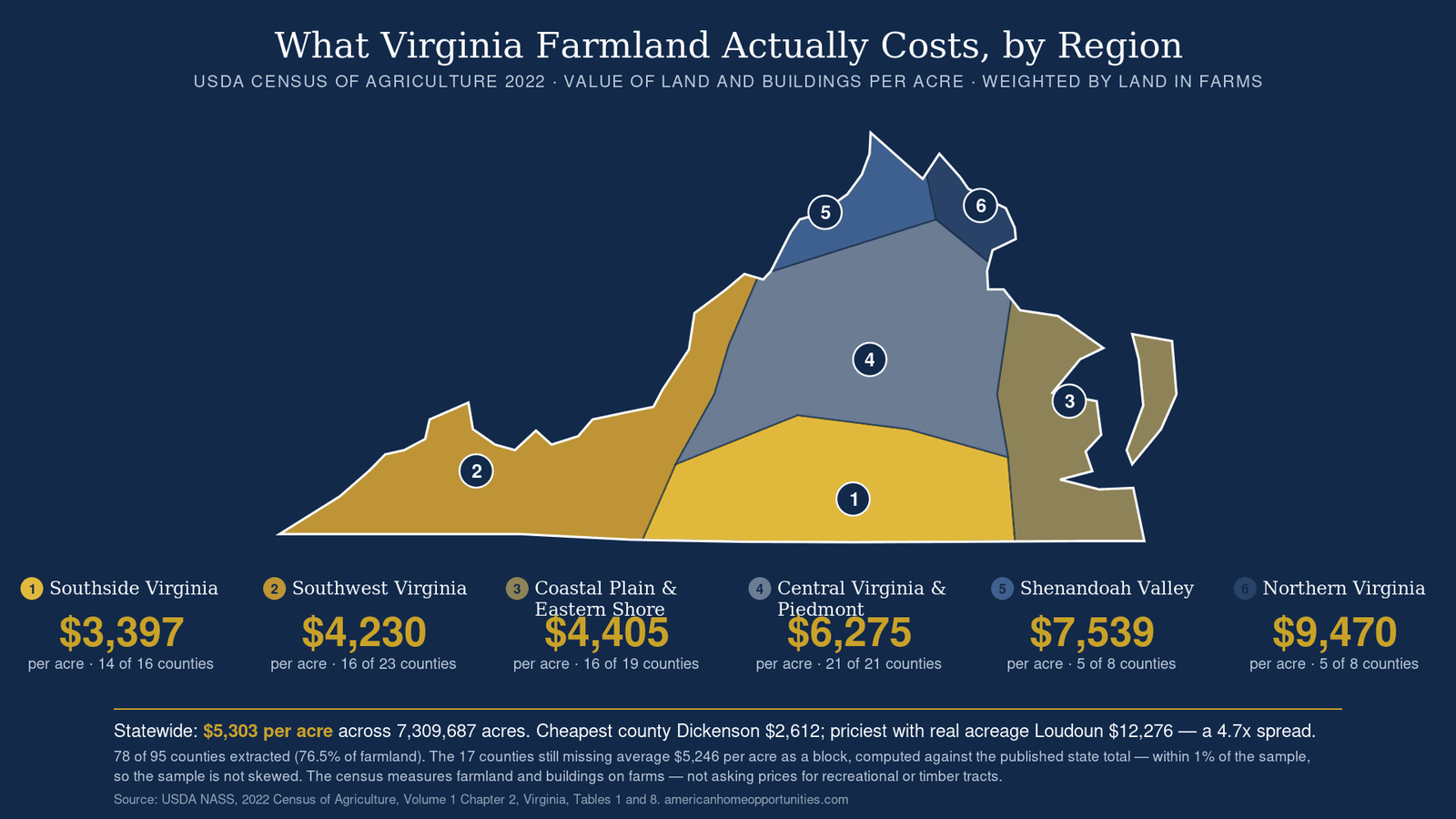
| Region | Farmland value per acre USDA, 2022 census | Cheapest county measured | Priciest county measured |
|---|---|---|---|
| Southside Virginia | $3,397 14 of 16 counties | Brunswick $2,749 | Nottoway $4,440 |
| Southwest Virginia | $4,230 16 of 23 counties | Dickenson $2,612 | Roanoke $6,876 |
| Coastal Plain & Eastern Shore | $4,405 16 of 19 counties | King and Queen $3,460 | James City $10,715 |
| Central Virginia & Piedmont | $6,275 21 of 21 counties | Amelia $4,304 | Albemarle $9,048 |
| Shenandoah Valley | $7,539 5 of 8 counties | Rockbridge $5,763 | Clarke $9,610 |
| Northern Virginia | $9,470 5 of 8 counties | King George $6,250 | Loudoun $12,276 |
| Virginia, statewide | $5,303 7,309,687 acres in farms | Dickenson $2,612 | Loudoun $12,276 |
How complete this is, and why we are telling you
We extracted 78 of Virginia’s 95 counties, covering 76.5% of the farmland in the state. Seventeen counties are missing, including Rockingham, Washington, Wise and Scott. Most pages would quietly leave that out. Here is what we did instead.
Because the USDA publishes the statewide total, the seventeen missing counties can be solved for by subtraction. As a block they hold 1,718,375 acres worth an average of $5,246 an acre — within one percent of both our 78-county sample ($5,321) and the published state figure ($5,303). The sample is not skewed.
The ranking survives too. For Southwest Virginia to fall below Southside once its seven missing counties are added, those seven would have to average somewhere between $1,151 and $2,274 an acre depending on how much land they hold. The cheapest county measured anywhere in Virginia is Dickenson at $2,612. The order holds. And Southside’s own two missing counties, Southampton and Sussex, are coastal-plain row-crop ground that would only push its number up — to about $3,800 on generous assumptions, still the cheapest region in the state.
We would rather show you the seams than hand you a clean number you cannot check.
Where the cheap land is, and the honest reason it is cheap
Land is cheap where fewer people want to be, and in Virginia you can usually name the reason. That matters, because a reason you can name is a reason you can plan around.
Southside: cheap land, cheap taxes, and a shrinking hospital map
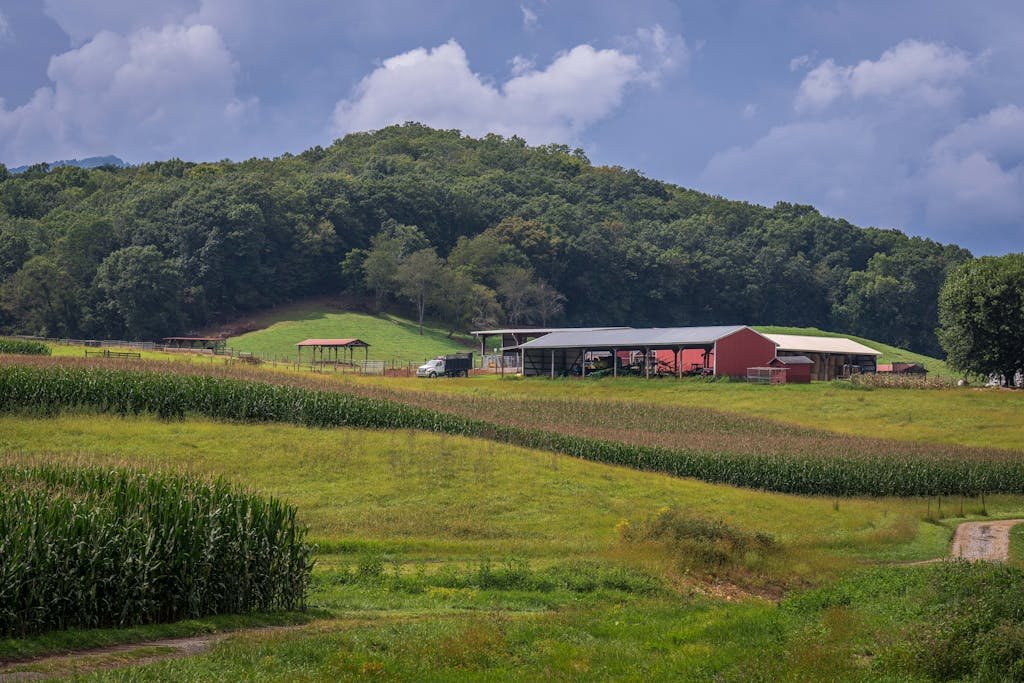
The ten cheapest counties we measured are dominated by Southside: Brunswick $2,749, Greensville $2,861, Henry $3,027, Pittsylvania $3,197, Halifax $3,199, Charlotte $3,223, Mecklenburg $3,268. This was tobacco and textile country, and both industries left. What is still there is farmland, a low cost of living, and — unusually — low property tax rates to go with the low land prices. Lunenburg County levies $0.330 per $100 of assessed value, the lowest county rate in Virginia. Mecklenburg is $0.360.
The cost shows up in services. Virginia has lost a quarter of its birthing hospitals in fourteen years, and two of those closures land squarely in the counties on this list. Sovah Health–Martinsville, in Henry County, closed its labor and delivery unit in May 2022. Sentara Halifax Regional, in Halifax County, closed its own in August 2023. Both counties are in the cheapest seven in the state. That is not a coincidence and we are not going to pretend otherwise.
The right question in rural Virginia is not “is there a hospital.” Services get cut long before a building closes. Ask three separate questions: where is the nearest emergency room, where is the nearest hospital that admits inpatients, and where is the nearest hospital that delivers babies. In parts of Southside the three answers are three different towns.
Southwest Virginia: cheap land, steep ground, and water that moves fast
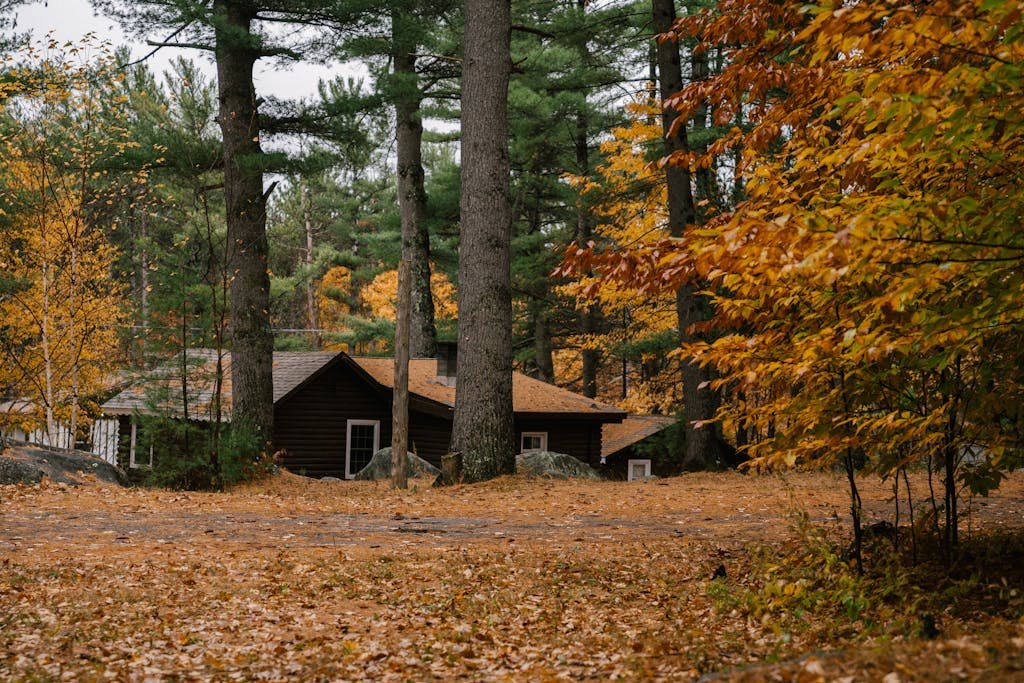
The far southwest is the second cheapest region and the one people picture first. Dickenson is the cheapest county in the state. Bland is $2,949, Lee $3,526, Buchanan $4,490. The scenery is the best in Virginia and the houses are the cheapest we cover anywhere on the East Coast.
The reason is partly geology. Narrow hollows, steep slopes and heavy summer rain make for flash flooding that arrives in minutes rather than hours. In August 2021 more than seven inches fell in a short window over Hurley, in northern Buchanan County. Eleven months later, on 12 and 13 July 2022, four to six inches fell in a few hours across Buchanan and Tazewell: 37 homes destroyed, 54 more badly damaged, and more than 40 people unaccounted for at the peak. FEMA subsequently denied individual assistance to Buchanan County property owners, and state aid did not arrive until fifteen months later.
None of that makes southwest Virginia a bad place to buy. It makes elevation, drainage and the flood map part of the purchase decision rather than an afterthought. A parcel forty feet up a hillside and a parcel on the creek flat are two completely different propositions at the same price per acre.
And where it is expensive, the reason is Washington
Northern Virginia at $9,470 an acre and the Shenandoah Valley at $7,539 are not expensive because the soil is better. They are expensive because of commuting distance to Washington, the Valley’s poultry and livestock economy, and — in Albemarle, Clarke and Fauquier — a horse-and-vineyard market that bids farmland well above what it earns. If your budget is under $200,000 and you want acreage, these are not your regions, and no amount of searching will make them so.
What to check before buying rural land in Virginia
These are the six things that most often turn a good Virginia listing into a bad purchase. None of them show up in the photographs.
1. Who owns the coal, oil and gas under the property
Across the Southwest Virginia Coalfield — roughly 1,550 square miles taking in all of Buchanan and Dickenson, most of Wise, and parts of Lee, Russell, Scott and Tazewell — mineral rights are frequently severed from the surface. The person who owns the ground may not own what is under it, and the mineral owner can hold a legal right to come onto the surface to get at it. Ask the seller explicitly whether the sale includes the minerals, and if it does not, ask who holds them and whether any lease is active. Wise, Buchanan and Tazewell have good online land records; some neighbouring counties will charge you for the same information.
2. Whether the land is in land-use assessment, and what the roll-back would be
Most Virginia localities let farm, forest and open-space land be taxed on its use value instead of its market value. When the use changes, the deferred tax comes back. Under Virginia Code § 58.1-3237 the roll-back is the deferred tax for the five most recent complete tax years plus simple interest, at a rate each locality sets. The honest nuance, which a lot of pages get wrong: a sale by itself does not trigger it if you keep the qualifying use and revalidate with the assessor. What triggers it is changing the use, or asking to rezone to something more intensive. Ask the Commissioner of the Revenue for the current deferred balance before you sign, because you inherit the clock.
3. Whether the soil will take a conventional septic system
On suitable ground a conventional system runs $8,000 to $15,000 installed. If the soil will not percolate, you are into an Alternative Onsite Sewage System, and those run $20,000 to $55,000 — typically two to four times a conventional system, and three to five times for the complex ones. Add $300 to $500 for the construction permit and $500 to $800 for a soil evaluation in Southside or the southwest. The part almost nobody mentions: under Virginia regulation an AOSS must be operated, maintained and inspected by a licensed professional. That is a recurring bill for as long as you own the house, not a one-off. Never buy an unimproved lot without a soil evaluation in hand.
4. Where the water comes from, and what it costs to get it
A complete private well system in Virginia runs $5,000 to $15,000. Drilling is $28 to $62 a foot, with the state average landing around $8,820 at 210 feet, plus $1,000 to $2,500 for the pump, $700 to $1,500 for the pressure tank, roughly $300 for the health department permit and $25 to $50 for water testing. Geology decides the bill: hard rock in the Piedmont and Blue Ridge costs more per foot than coastal-plain sediment. If the listing already has a well, ask its depth, its yield in gallons per minute, and the date of the last bacterial test.
5. On the coastal plain, the hundred-foot buffer
Every Tidewater locality is required to have a Chesapeake Bay Preservation Act ordinance. The Resource Protection Area covers tidal wetlands and shores, connected non-tidal wetlands, and a hundred-foot vegetated buffer landward of every water body with perennial flow — creeks included, not just the Bay. New development has to sit outside it and the buffer stays in its natural state. Exceptions exist for water-dependent structures and by grant of the local Chesapeake Bay Board, but on a small parcel with a stream running through it the buffer can consume the only buildable spot. This is the most common reason a cheap waterfront lot in eastern Virginia is cheap.
6. Broadband, at the address rather than in the county
Virginia has moved faster on this than most states. More than 221,500 locations have been connected since July 2021 through the Virginia Telecommunications Initiative, and over 400,000 have gained access since 2022. The federal BEAD programme covers the remainder — 133,000 approved passings, with construction starting in autumn 2026. What that means practically is that coverage now changes street by street. Do not accept a county-level map or a seller’s assurance. Give the provider the exact address and ask whether that specific location is a serviceable passing today, and if not, which programme covers it and when.
We run these checks before we feature a property
Mineral rights, flood exposure, septic feasibility, the roll-back balance, the drive to the nearest emergency room. If a listing does not survive them, it does not go in the video. Leave your email and you will get the ones that do.
What it costs to own it once you have it
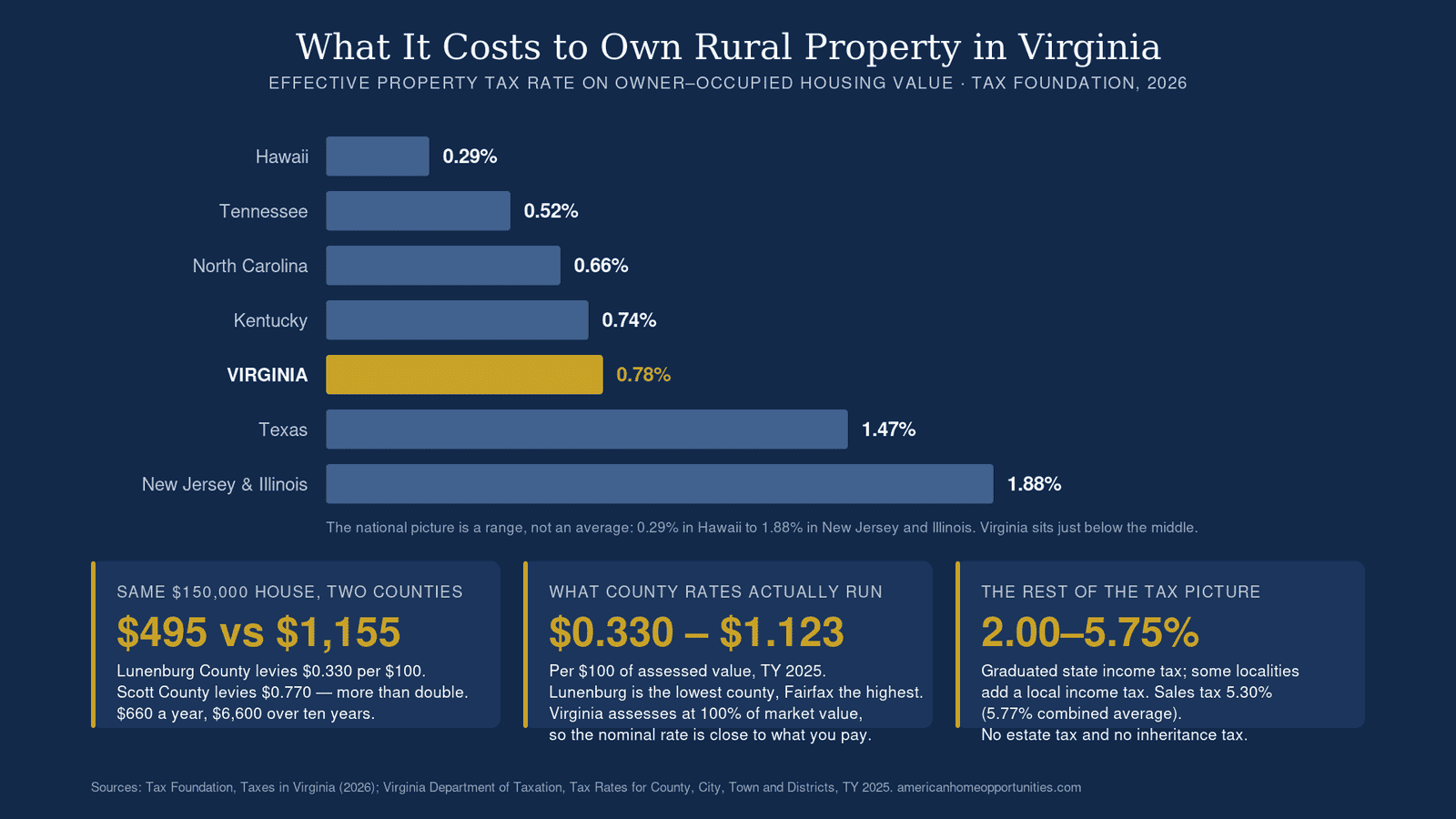
Virginia’s effective property tax rate on owner-occupied housing is 0.78%. There is no national average worth quoting — the real picture is a range, from 0.29% in Hawaii to 1.88% in New Jersey and Illinois — and Virginia sits a little below the middle of it. The state income tax is graduated from 2.00% to 5.75%, with a handful of jurisdictions adding a local income tax on top. Sales tax is 5.30% including a mandatory one percent local add-on, averaging 5.77% combined. There is no estate tax and no inheritance tax, which is worth more to most buyers than the difference in any of the rates above.
The number that actually decides your bill is the county rate, and Virginia assesses at 100% of fair market value, so the nominal rate is close to what you really pay. Rates run from $0.330 per $100 in Lunenburg County to $1.123 in Fairfax. On a $150,000 house that is $495 a year against $1,685.
Here is the part worth planning around. Cheap land and cheap taxes do not automatically travel together. Lunenburg and Mecklenburg give you both — $3,724 and $3,268 an acre with rates of $0.330 and $0.360. Move to the far southwest and the land stays cheap while the rate roughly doubles: Lee County is $3,526 an acre at $0.740, Scott County is $0.770. The same $150,000 house costs $495 a year in Lunenburg and $1,155 in Scott. That is $660 a year, $6,600 over ten years, between two equally rural, equally affordable counties. Run the rate before you fall in love with the listing.
The Virginia tax nobody quotes you: your vehicles
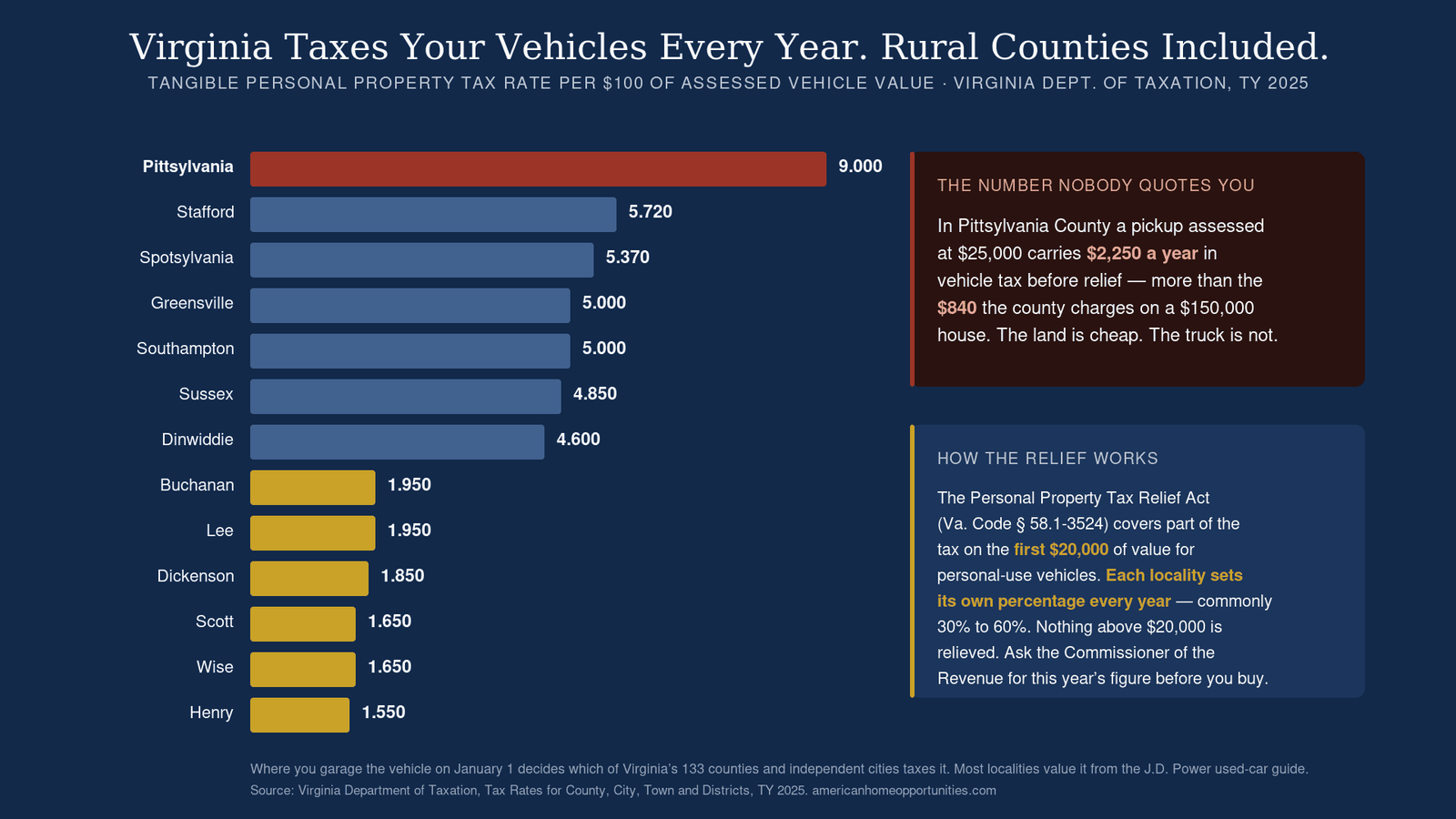
Virginia taxes cars, pickups and trailers every single year, and every county sets its own rate. If you are moving from a state that does not do this, it is the cost most likely to catch you out, because it never appears on a listing.
The spread is enormous. Pittsylvania County levies $9.000 per $100 of assessed vehicle value. Henry County, forty miles west, levies $1.550. Scott and Wise are $1.650. On the high side, Stafford is $5.720 and Spotsylvania $5.370. In Pittsylvania a pickup assessed at $25,000 carries roughly $2,250 a year before relief — more than the $840 the same county charges on a $150,000 house. The land is cheap. The truck is not.
Relief exists but it is partial and local. The Personal Property Tax Relief Act (Virginia Code § 58.1-3524) covers part of the tax on the first $20,000 of assessed value for personal-use vehicles. Each locality sets its own percentage every year — commonly somewhere between 30% and 60% — and nothing above $20,000 is relieved at all. Whichever county you are looking at, call the Commissioner of the Revenue and ask for this year’s relief percentage and this year’s rate before you commit. Where you garage the vehicle on 1 January decides which of Virginia’s 133 counties and independent cities gets to tax it.
In Virginia you are buying the house, not the land — including from us
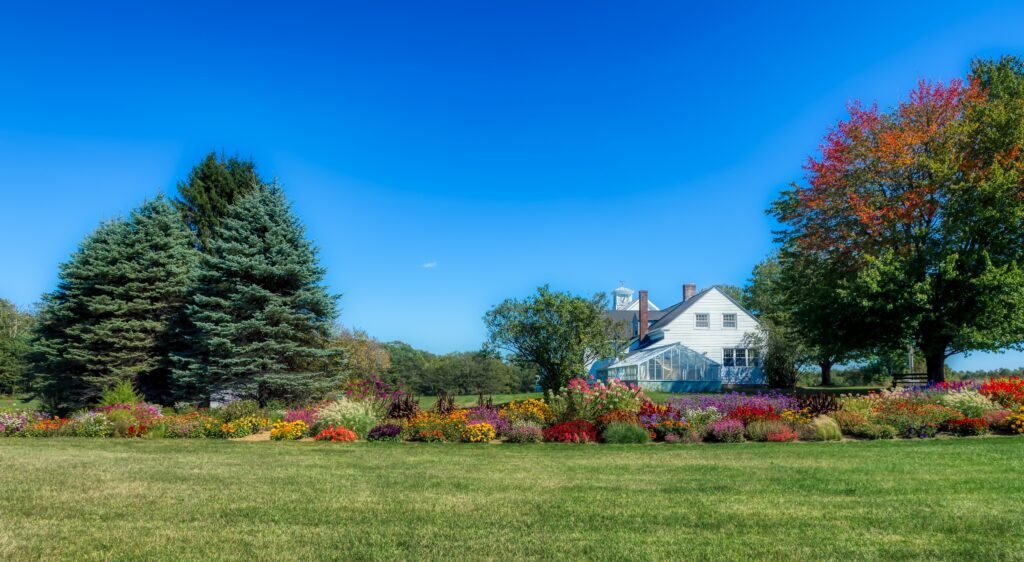
We have covered fifteen Virginia properties. Ten of them sit in counties the census measures, and together those ten carry $1,348,950 in asking prices. The census value of all the land underneath them is $229,653. The dirt is 17% of the price. The house and the outbuildings are the other 83%.
The extreme case is a half-acre lot in Clintwood, Dickenson County, that we featured at $34,700. At the county’s census value the land is worth $1,306 — 3.8% of the price. You are buying a house and the ground comes along with it.
This is the exact opposite of eastern Kentucky, where we found the house arriving almost free on top of the land. And it is why we opened this page by picking a fight with that $21,214-per-acre figure. Divide our own fifteen Virginia asking prices by our own acreage and you get $18,934 an acre — practically the same number, produced by the same mistake. Both are the price of a house buried inside a number that says “per acre.” The counties those houses sit in have land worth $2,612 to $4,490 an acre.
So when you compare listings, compare them on what you are actually buying. On five acres in Virginia, price per acre tells you almost nothing about the land and almost everything about the roof.
Virginia properties we have covered
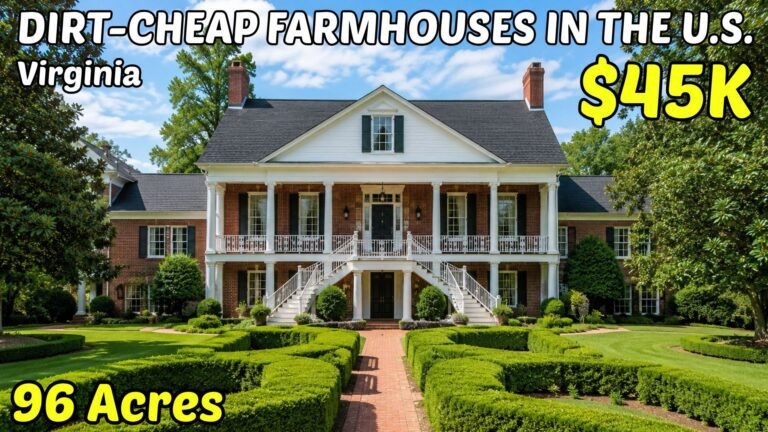
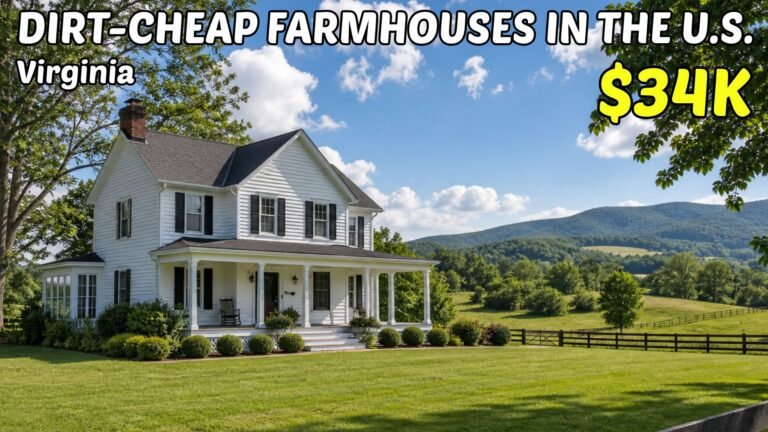
Every roundup below is a real listing we checked, filmed and priced at the time of publication. Properties sell; the reasoning does not go stale.
More Virginia guides
Deeper reading on the parts of a Virginia purchase that deserve more than a paragraph.
Keep exploring
Everything above is Virginia. These are the pieces underneath it, and they hold wherever you buy.
The guides library is where the rest lives: the other states, the financing rules and what ownership really costs. Why cheap rural homes do not sell covers the eight mechanisms behind a price that looks too low, how we score a property sets out what we weigh, and the Rural Property Field Guide is the free checklist for a viewing.
Get the next batch of Virginia listings first
New Virginia properties go out to the list before the video is published. No spam, one email, unsubscribe whenever you like.
Buying rural land in Virginia: the questions we get most
What is the cheapest county in Virginia to buy land?
Of the 78 counties we could measure in the 2022 USDA census, Dickenson is the cheapest at $2,612 an acre, followed by Brunswick $2,749, Greensville $2,861, Bland $2,949 and Henry $3,027. By region rather than by county, Southside Virginia is the cheapest at $3,397 an acre. Be careful with any page that answers this question without citing the census — one of the sites currently ranking for it names Buchanan as the cheapest county at $5,063 an acre, when the census puts Buchanan at $4,490 and does not rank it cheapest at all.
How much does an acre of land cost in Virginia?
Statewide, $5,303 an acre for farmland and the buildings on it, across 7,309,687 acres. You will see much larger figures on listing sites — around $21,000 an acre is commonly quoted. Those are averages of what is currently for sale, with the value of any house folded into a number labelled “per acre.” They are not land values and they are not sale prices.
Are property taxes high in Virginia?
Moderate. The effective rate on owner-occupied housing is 0.78%, against a national range of 0.29% to 1.88%. County rates run from $0.330 per $100 in Lunenburg to $1.123 in Fairfax, and Virginia assesses at 100% of market value. The bigger surprise for most people arriving from out of state is the annual tangible personal property tax on vehicles, which is set by each county and reaches $9.000 per $100 in Pittsylvania.
Do I need a lawyer to buy rural land in Virginia?
Virginia permits closings to be handled by a licensed settlement agent rather than requiring an attorney. That said, for anything involving severed mineral rights, an easement or right-of-way, land-use assessment, or a parcel inside a Chesapeake Bay Resource Protection Area, a Virginia real estate attorney is money well spent. These are the four situations where a title search alone will not tell you what you can actually do with the land. We are not lawyers, and this page is not legal advice.
Ask us one question about Virginia
Pick whichever is closest. It opens an email with the subject already written — you only have to add the county or the listing.
Tell us what you are looking for in Virginia
If you would rather we came to you when something fits, give us the shape of it — budget, acreage, the part of the state, and when you are hoping to move. We will keep an eye out.
Sources and disclaimer
Farmland values: USDA National Agricultural Statistics Service, 2022 Census of Agriculture, Volume 1 Chapter 2, Virginia, Tables 1 and 8. State tax figures: Tax Foundation, Taxes in Virginia (2026). County real estate and personal property tax rates: Virginia Department of Taxation, Tax Rates for County, City, Town and Districts, TY 2025. Roll-back taxes: Code of Virginia § 58.1-3237. Vehicle tax relief: Code of Virginia § 58.1-3524. Septic regulation: Virginia Department of Health, Regulations for Alternative Onsite Sewage Systems. Broadband: Annual Report for the Virginia Telecommunication Initiative, 2026. Flooding: Cardinal News and USGS reporting on the August 2021 and July 2022 Buchanan and Tazewell County floods. Hospital services: reporting by WDBJ7 and VPM, 2026. Well and septic cost ranges are contractor aggregates and are labelled as such.
Prices quoted for properties American Home Opportunities has covered are asking prices at the time of publication, not sale prices, and listings change or sell without notice. Tax rates, relief percentages and regulations change; verify everything with the county Commissioner of the Revenue and the local health department before you rely on it. This page is general information and is not legal, tax or financial advice. Page compiled 4 August 2026.