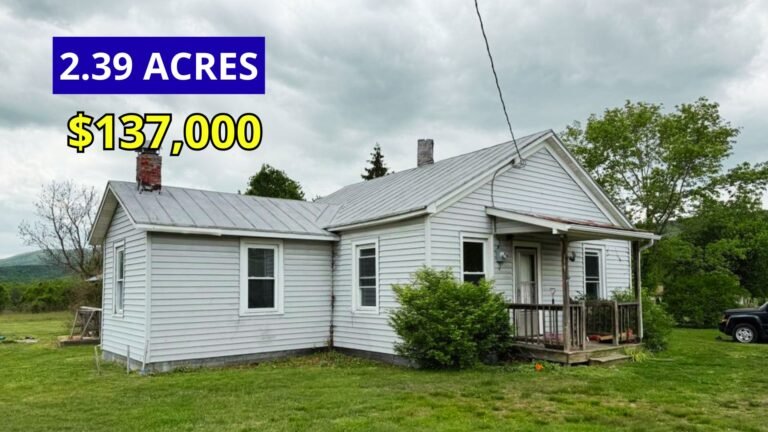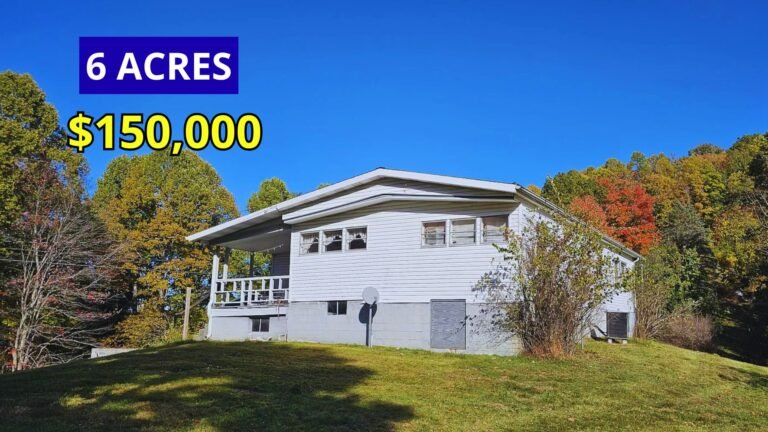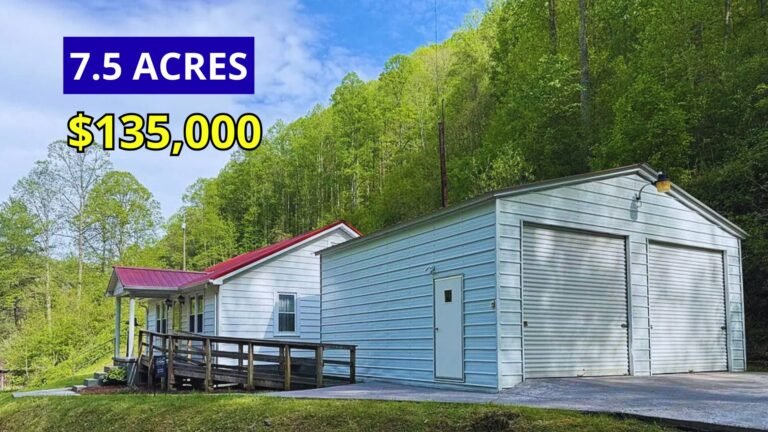
Best Counties in Virginia for Homesteading: County Land Values and 10 Real Listings
An acre of farmland in Loudoun County is assessed at more than fifteen times what the same acre is worth in Dickenson County. Same state. Same growing season, near enough. Same Department of Motor Vehicles. The USDA puts Virginia’s statewide average at $5,303 an acre; Dickenson County comes in at $2,612 and Stafford County at $16,854. That spread is the entire reason this page exists.
This guide ranks the best counties in Virginia for homesteading by what the land underneath actually costs, using the 2022 USDA Census of Agriculture for all 95 Virginia counties. Then it puts ten real listings against those numbers, priced from $45,000 to $250,000, so you can see what the ranking looks like when there is a house standing on it.
One warning before the tables, because it is the single most expensive thing new buyers get wrong here. Virginia’s land use assessment program — the one that cuts rural tax bills by half or more — sets a default floor of 5 acres for agricultural and horticultural land and 20 acres for forest land, and it is a local option, meaning your county has to have adopted the ordinance at all. Of the ten properties below, only five clear 5 acres and only two clear 20. Acreage is not a nice-to-have when you are comparing the best counties in Virginia for homesteading. It is the line between two different tax bills.
The page has two halves and they age differently. The county rankings are stable and worth bookmarking. The ten listings are a moment in time — treat them as evidence, not as inventory. And one of the ten is not a homestead property at all: #1 in Lebanon sits on 0.14 acres inside the town limits under commercial zoning. It is here because it is the cheapest building on the list and because leaving it out would be dishonest, and its own section says so plainly.
Jump to a property
This page runs long on purpose — the county data first, then all ten listings in full. Use these links to go straight to any property.
- #10 — Amherst, Amherst County — $250,000, 16.23 acres
- #9 — Oakwood, Buchanan County — $225,000, 96 acres
- #8 — Swords Creek, Russell County — $179,000, 37.5 acres
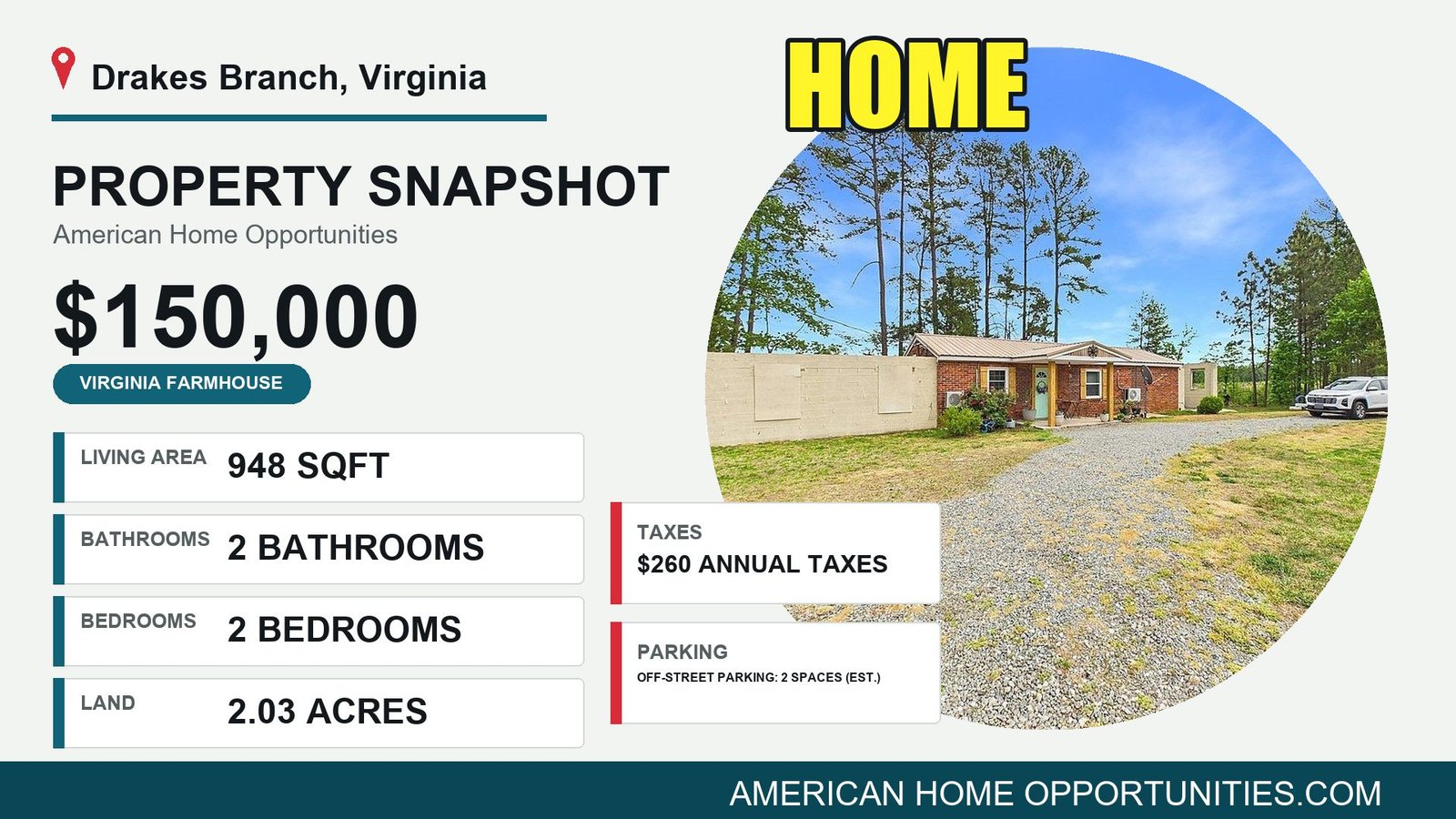
- #7 — Drakes Branch, Charlotte County — $150,000, 2.03 acres
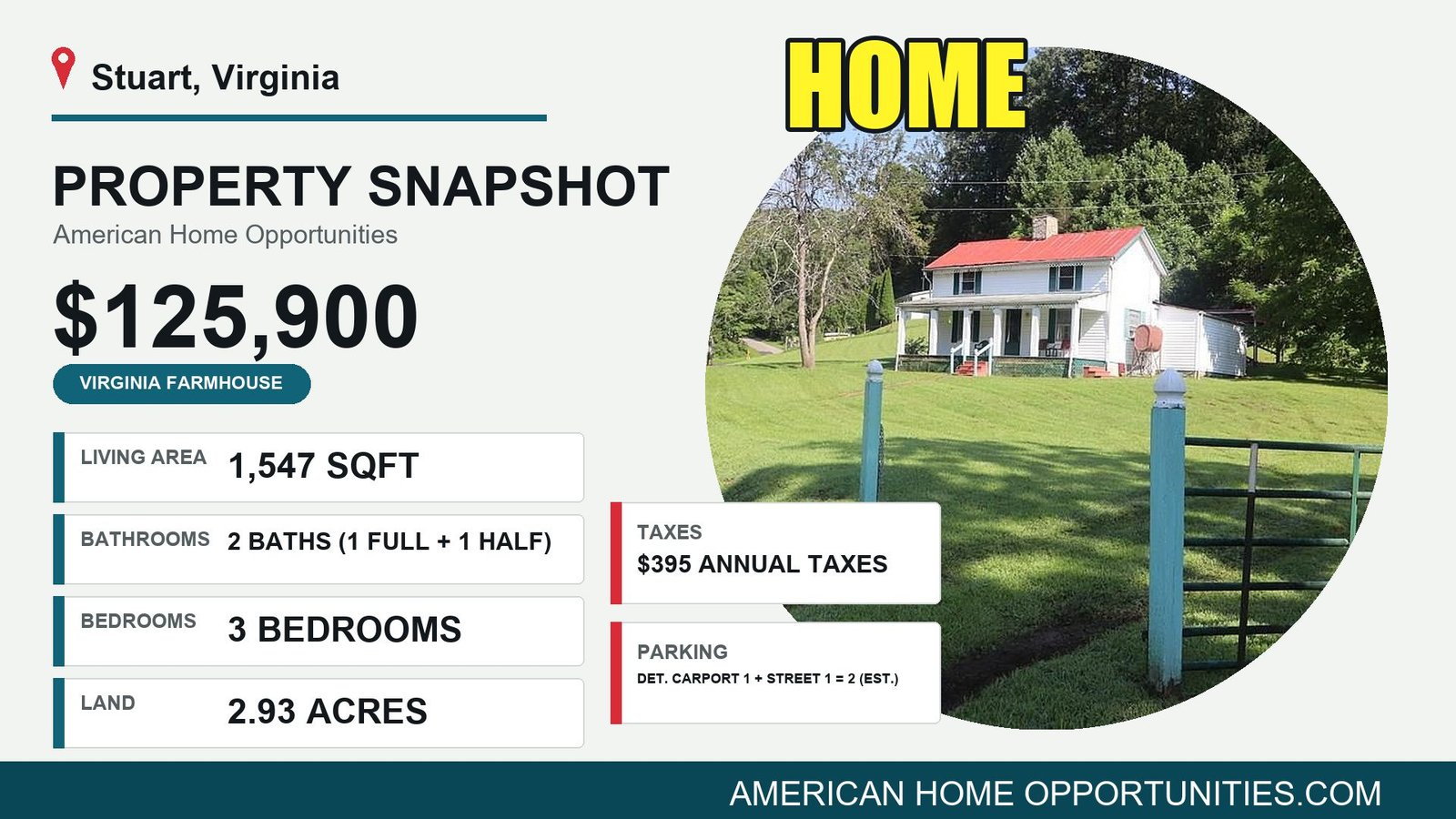
- #6 — Stuart, Patrick County — $125,900, 2.93 acres
- #5 — Duffield, Scott County — $110,000, 1.34 acres
- #4 — Chase City, Mecklenburg County — $85,500, 2.05 acres
- #3 — Grundy, Buchanan County — $85,000, 6.23 acres
- #2 — Willis, Floyd County — $50,000, 7.95 acres
- #1 — Lebanon, Russell County — $45,000, 0.14 acres
Watch the Full Tour
Every property below was filmed and walked through in the video version of this list. If you would rather see the rooms than read about them, start there and come back for the county data — the video does not have room for the USDA figures or the land-use rules that decide which are the best counties in Virginia for homesteading.
What You’ll Find: Best Counties in Virginia for Homesteading
This page does two jobs. The first half is a permanent reference: what bare agricultural land costs in every Virginia county, why the cheap counties are cheap, and the state rules that decide whether your acreage saves you money or costs you money. The second half is a dated snapshot of ten listings from August 2026, scored and compared against those same county figures.
Below are the twelve cheapest counties in Virginia by average per-acre value of farm land and buildings. Two of the ten properties in the snapshot sit inside this table — Charlotte County at #10 and Mecklenburg County at #11 — and two more sit in Russell County at #14.
| Rank | County | Region | Avg $/Acre | Acres in Farms |
|---|---|---|---|---|
| 1 | Dickenson | Appalachian Plateau (coalfields) | $2,612 | 10,617 |
| 2 | Brunswick | Southside | $2,749 | 64,864 |
| 3 | Greensville | Southside | $2,861 | 38,694 |
| 4 | Sussex | Southside | $2,861 | 69,562 |
| 5 | Bland | Southwest Virginia | $2,949 | 79,310 |
| 6 | Surry | Tidewater | $2,949 | 46,226 |
| 7 | Henry | Southside / Blue Ridge foothills | $3,027 | 44,869 |
| 8 | Pittsylvania | Southside | $3,197 | 244,183 |
| 9 | Halifax | Southside | $3,199 | 159,004 |
| 10 | Charlotte | Southside | $3,223 | 116,680 |
| 11 | Mecklenburg | Southside | $3,268 | 123,797 |
| 12 | Alleghany | Alleghany Highlands | $3,293 | 31,836 |
Source: USDA 2022 Census of Agriculture, Volume 1, Chapter 2 (County Level), Virginia — Table 1, County Summary Highlights, and Table 8, Farms, Land in Farms, Value of Land and Buildings, and Land Use. Figures are the estimated market value of land and buildings on operating farms, averaged per acre. All 95 Virginia counties are included and none were suppressed for confidentiality. County totals reconcile to 38,455 farms across 7,178,268 acres; the published state totals of 38,995 farms and 7,309,687 acres are higher because the census also counts Virginia’s independent cities, which are not counties and are excluded from this ranking.
Why These Counties Are Cheap
Four structural reasons explain almost the entire ranking, and each one is also a description of what daily life looks like in those counties. Reading them honestly is how you separate the best counties in Virginia for homesteading from the counties that are merely cheap.
- No commuter shed. Northern Virginia’s price gradient radiates outward from Washington. Dickenson, Bland, Buchanan and Lee are four to six hours from it, so no amount of remote-work demand has ever reached them. What you gain is a price. What you accept is that the nearest interstate is a genuine drive, and every trip out is a mountain road.
- Terrain that will not take a tractor. The coalfield counties are cheap partly because the ground is vertical. Slope limits cropland, complicates septic drainfields, and makes driveway maintenance a recurring line item rather than a one-off. Pasture and woodland are what this land does well; row crops are what it does badly.
- An extractive economy that already peaked. Coal and natural gas built Buchanan, Dickenson, Wise and Russell, and the payroll has been shrinking for forty years. Population decline pushes housing prices down faster than land prices, which is why you can buy a house on acreage here for less than the acreage is worth. It also means mineral rights are frequently severed from the surface — somebody else may own what is under your ground.
- Southside’s row-crop legacy. Brunswick, Greensville, Sussex, Halifax, Charlotte, Pittsylvania and Mecklenburg are cheap for the opposite reason: flat, workable, and historically tobacco. When the tobacco buyout came, the land stayed and the reason to farm it did not. The result is inexpensive, genuinely usable ground within reach of Richmond and the Research Triangle — which is why Southside dominates the cheapest twelve.
Get the Next State’s Properties Before They Go Live
We publish a new state every week — the county data first, then ten real listings against it. If you are working through the best counties in Virginia for homesteading and want the next state before it goes live, tell us what you are looking for and we will send the batch before the video goes up.
What the Cheap Land Actually Costs With a House On It
The USDA number is the right tool for comparing counties and the wrong number to quote at a closing. It measures agricultural land and buildings on operating farms — working acreage, valued in bulk. A residential parcel with a house, a well, a septic system and road frontage does not trade at that figure, and nobody should expect it to.
What the benchmark is good for is showing you how much of your purchase price is land and how much is building. Run every listing on this page through it — acres times the county’s per-acre figure, divided by the asking price — and the results split the ten cleanly in half. The median comes to 21%. The average is 43.2%, dragged upward by a single outlier. And the range runs from 1.1% to 191.6%.
That outlier is worth stopping on. The 96 acres in Buchanan County under listing #9 are worth roughly $431,000 at the county’s USDA average — nearly double the $225,000 asking price for the land, the 1930 cottage, the barn, the shed and the carport combined. Land value above 100% of the asking price is not a pricing error. It is what happens when a county’s houses have been depreciating for forty years while its acreage has not.
Here is the pattern that matters, and it is the reason this page is organised around homesteading rather than around price. The five properties with real acreage — #9, #8, #2, #10 and #3 — carry land shares of 191.6%, 70.8%, 71.9%, 37.6% and 32.9%. The five small-lot properties carry 9.1%, 7.8%, 4.4%, 4.4% and 1.1%. On the first group you are buying land and getting a house. On the second you are buying a house and getting a yard. Both can be good purchases. They are not the same purchase, and the best counties in Virginia for homesteading are the ones where the first kind is still available.
The 5-Acre Rule That Decides Your Tax Bill
Virginia’s land use assessment program taxes qualifying land at its use value instead of its market value, and the gap routinely cuts a bill by 50% to 90%. It is the largest single lever on the cost of holding rural ground, and it has three conditions that catch buyers out.
First, it is a local option. The county or city has to have adopted an ordinance; not all of them have. Before you make an offer anywhere in Virginia, call the Commissioner of the Revenue for that county and ask whether the program exists there at all.
Second, the state sets default minimums of 5 acres for agricultural and horticultural use and 20 acres for forest land. Localities are allowed to go lower — some accept two or three acres — but they cannot go higher. Five acres is the number to plan around.
Third, the rollback. Convert qualifying land to a non-qualifying use and you owe rollback taxes for the current year plus the five preceding years, with 10% interest. That is up to six years of the difference between use value and market value, payable at once. Virginia’s rollback window is twice Tennessee’s.
Now hold the ten listings against that rule, because this is where the angle argues with itself. Only #9 (96 acres), #8 (37.5 acres), #10 (16.23 acres), #2 (7.95 acres) and #3 (6.23 acres) clear the 5-acre agricultural floor. Only #9 and #8 clear the 20-acre forest floor. The remaining five — 2.93, 2.05, 2.03, 1.34 and 0.14 acres — fall below the state’s default minimum entirely, and would need a locality that has chosen to set its threshold lower. That is not a reason to skip them. It is a reason to price them honestly.
August 2026 Snapshot: Ten Real Listings
These ten properties were listed in August 2026 and are held here against the same county data used to rank the best counties in Virginia for homesteading above. Four sit in counties from the cheapest fifteen in the state — Charlotte at #10, Mecklenburg at #11 and Russell at #14, twice. The rest sit higher in the ranking, which is exactly why price per acre and price per square foot tell opposite stories across this list.
| # | Town | County | Price | Acres | Price / Acre | AHO Score |
|---|---|---|---|---|---|---|
| 10 | Amherst | Amherst | $250,000 | 16.23 | $15,404 | 84 |
| 9 | Oakwood | Buchanan | $225,000 | 96 | $2,344 | 88 |
| 8 | Swords Creek | Russell | $179,000 | 37.5 | $4,773 | 79 |
| 7 | Drakes Branch | Charlotte | $150,000 | 2.03 | $73,892 | 70 |
| 6 | Stuart | Patrick | $125,900 | 2.93 | $42,969 | 73 |
| 5 | Duffield | Scott | $110,000 | 1.34 | $82,090 | 70 |
| 4 | Chase City | Mecklenburg | $85,500 | 2.05 | $41,707 | 66 |
| 3 | Grundy | Buchanan | $85,000 | 6.23 | $13,644 | 76 |
| 2 | Willis | Floyd | $50,000 | 7.95 | $6,289 | 83 |
| 1 | Lebanon | Russell | $45,000 | 0.14 | $321,429 | 57 |
How the AHO Score Works
Every property gets a score out of 100, built from six weighted components: price and value (25), land and usability (20), condition (20), practical location (15), charm (10) and future potential (10). Scores come only from verifiable listing data and photographs. Where a listing does not specify something, it is scored mid-band and the gap is stated rather than guessed upward.
On this page the spread runs from 88 down to 57, and it lines up with the angle without being pushed there: the properties with real homestead acreage cluster at the top, and the one town lot that cannot be a homestead scores lowest by a clear margin. Full methodology is published separately.
It is an editorial tool for comparison — not an appraisal, an inspection, or investment advice.
Full methodology: The AHO Score Methodology.
Published August 2026. Rural listings move, and some of the ten below will already be gone by the time you read this. That is expected and it is why the page is built the way it is.
The county rankings, the land use rules and the checklist stay accurate regardless of what happens to any individual listing. Use the ten as calibration — this is what $45,000 to $250,000 actually buys in these counties — and use the first half of the page to shortlist the best counties in Virginia for homesteading before you start looking at houses at all.
More on the state as a whole: Buying Rural Land in Virginia: What an Acre Really Costs.
The ten properties
All ten, most expensive first, exactly as they appear in the video.
Coming From the Video?
Coming from the video? Get the next state’s properties before the video goes live — one email a week with the new batch and nothing else.
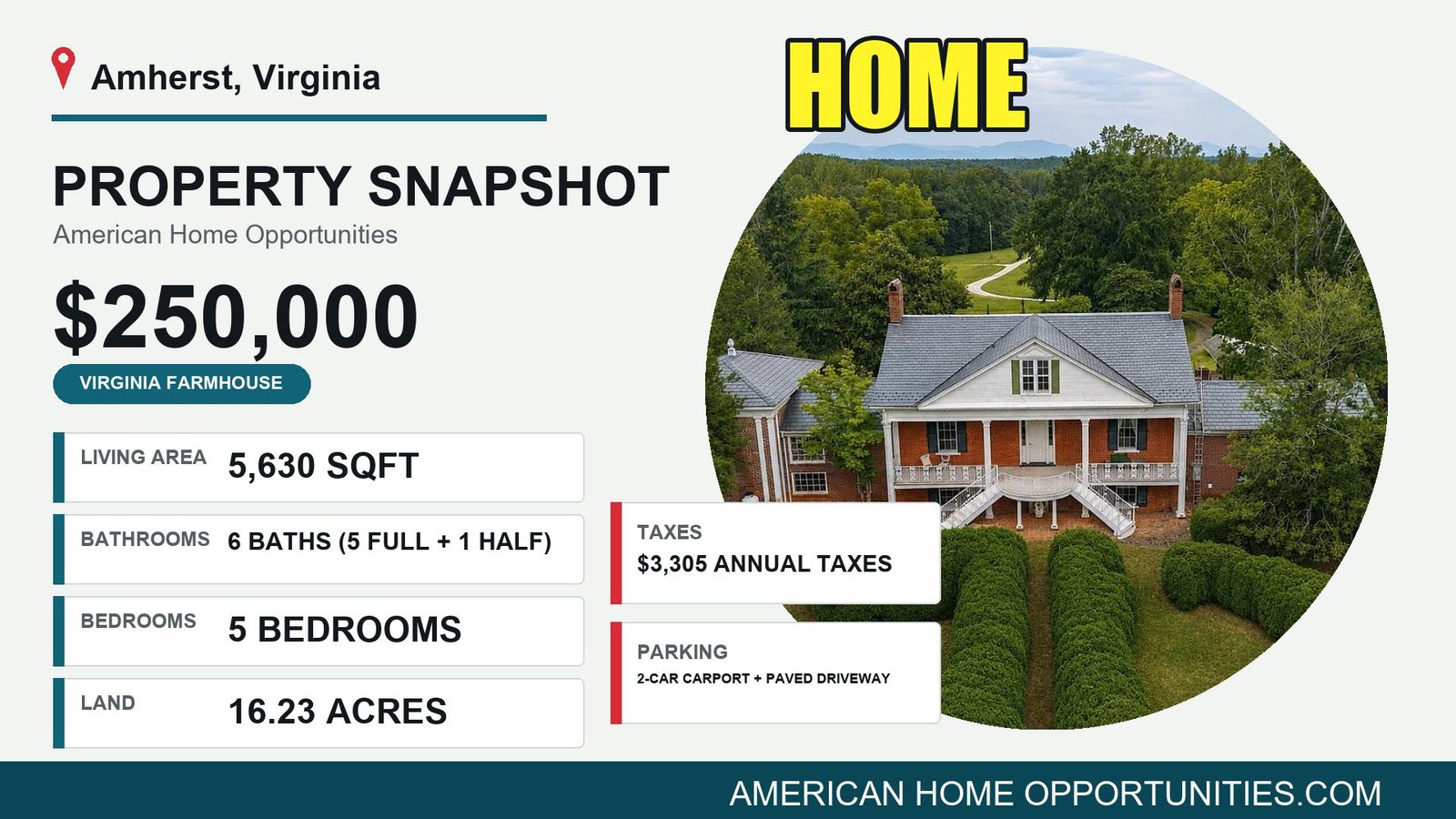
#10 — Amherst, VA — $250,000 — 16.23 acres
A Federal-style manor from 1826 on 16 acres of Blue Ridge pasture, with barns, a stable and an airplane hangar.
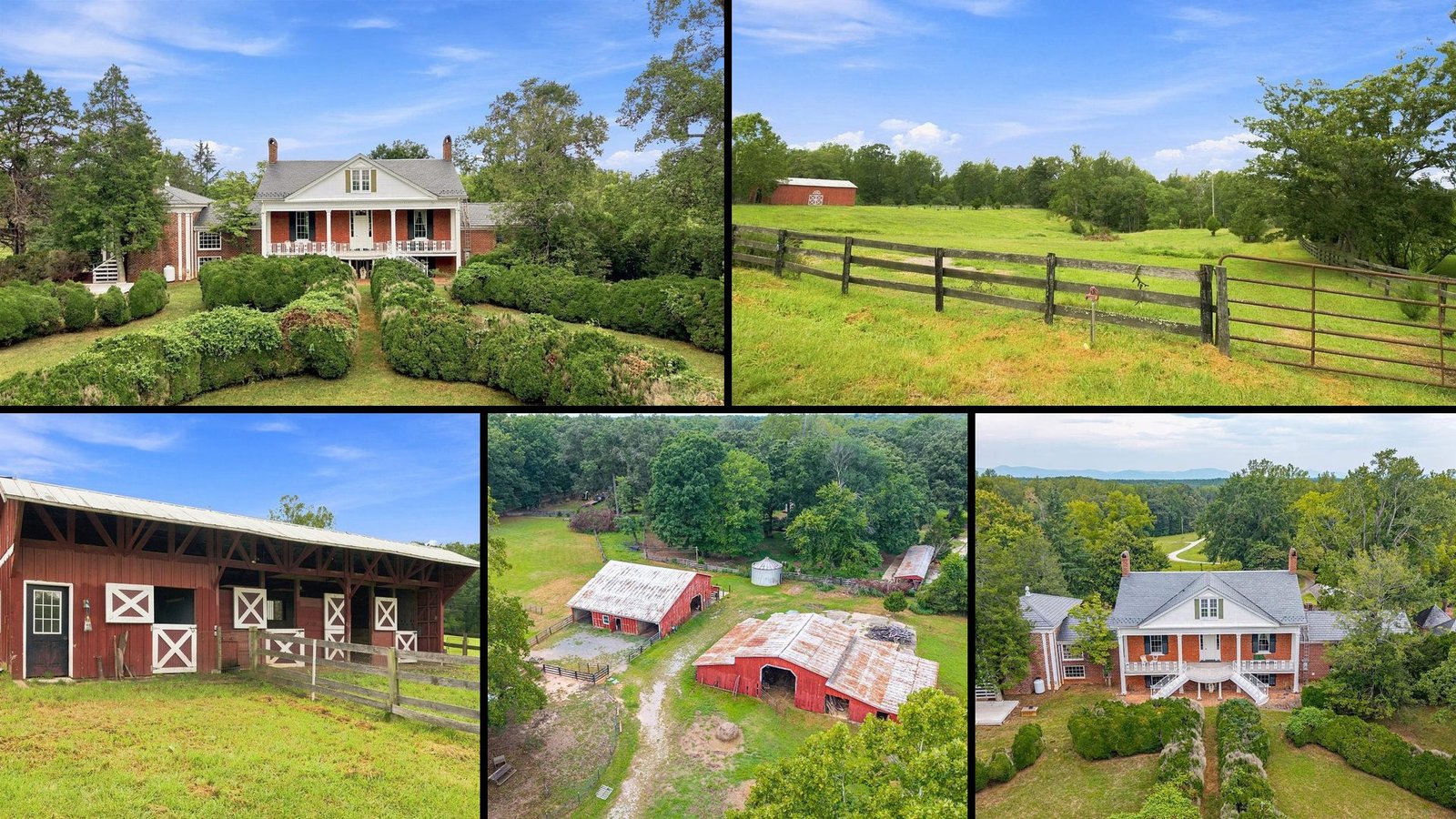
Edloe Glades has stood in the foothills of the Blue Ridge for two hundred years, and it looks it in the way that matters: brick and wood siding under a slate roof, porches on three sides, and sixteen acres of open pasture running out from the house. The land is fenced and cleared rather than wooded, which is the difference between a view and a working farm.
This is the most house on this page by a factor of three, and the most complicated purchase on it. It sells at live auction.
Inside the Home
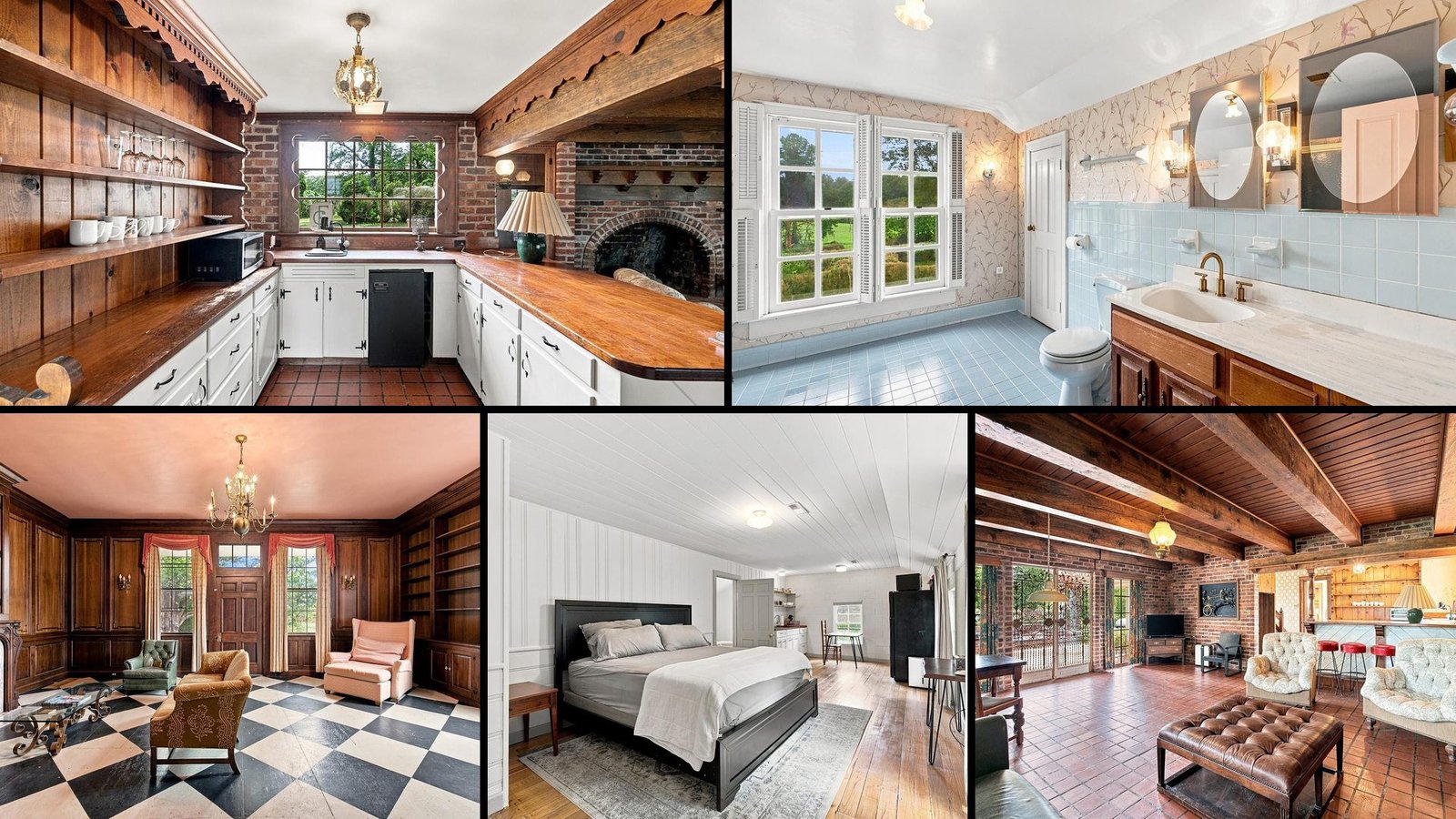
Five thousand six hundred and thirty square feet across three floors, with 11-foot ceilings and extensive crown molding through every principal room. There are eight fireplaces, six of them framed by ornamental mantels of marble imported from New Orleans — a detail that tells you exactly what the original owner was spending.
The proportions are the point. The living room measures 28 x 18 feet, the family room 19 x 27, and the dining room, kitchen and great room are each a full 18 x 18. Five bedrooms and five and a half bathrooms are spread across three levels: the primary suite at 19 x 24 on the second floor, two more 18 x 18 bedrooms on the third. Flooring runs hardwood, wood, ceramic tile and concrete depending on the room. There is a wet bar, a walk-in closet, a main-level bedroom and den, and a full apartment contained inside the house. High-speed internet is already connected, which is not a given at this address.
Land and Outdoor Potential
Sixteen point two three acres of pasture, fenced and ready for livestock or horses, with multiple barns, a stable and a run of outbuildings behind the house. County records also list an airplane hangar and a pole building among the structures. A paved drive brings you in past a landscaped lawn.
On homesteading capacity this clears the state’s 5-acre agricultural threshold comfortably but falls short of the 20-acre forest minimum. It is pasture rather than timber, which suits livestock, hay or a hobby farm and does not suit a forestry classification. The listing names a wedding venue as one intended use, and sixteen acres with a manor house and a stable is genuinely that inventory.
About Amherst, Virginia
Amherst is the county seat and it is minutes away. Lynchburg is roughly 25 minutes south on Route 29, and that is where the real medicine is — Centra Lynchburg General Hospital, a full acute-care centre rather than a critical access outpost. Sweet Briar College sits inside Amherst County and is among its five largest employers, alongside Glad Manufacturing, Greif Packaging and Johnson Health Center, which runs the local clinics. The Blue Ridge Parkway and the Appalachian Trail both cross the county’s western edge.
The honest trade-off: Amherst County ranks 64th of 95 on land value, well above the state’s cheap end. Land in a county this pretty is wanted by everyone, and it does not price like coalfield ground.
AHO Score: 84/100 — Strong AHO Pick
| Component | Score |
|---|---|
| Price / Value (25) | 20 |
| Land / Usability (20) | 19 |
| Condition (20) | 11 |
| Practical Location (15) | 14 |
| Charm (10) | 10 |
| Future Potential (10) | 10 |
| Total | 84 |
Amherst County averages $5,795 an acre in the USDA census, 64th cheapest of Virginia’s 95 counties. At 16.23 acres the land alone accounts for roughly $94,000 — about 37.6% of the $250,000 figure attached to the listing. Price per square foot works out at $44, which is the number that makes people stop. But that $250,000 is an auction placeholder, not an asking price, and the section below explains what it actually is. For a frame of reference, the county bills $3,305 a year in tax against the property. The score is carried by charm, land and future potential, all at or near maximum; it is held down by condition, because a 200-year-old house sold as-is with no inspection contingency cannot honestly be scored any higher without evidence.
Mark’s Verdict
This is the rare property where the building genuinely is the asset. Eight fireplaces, 11-foot ceilings, a slate roof and 5,630 square feet of Federal-period architecture do not come back on the market often, and the sixteen acres of pasture around it are usable rather than decorative.
The caveat is the process. This is a live auction: cash or financing arranged in advance, as-is with no inspection contingency, a buyer’s premium on top of the winning bid, and a deposit due when the hammer falls. The auction is scheduled for Friday, September 18, 2026 at 11:00 AM, and pre-auction offers are encouraged. The $250,000 on the listing is a number the auction company entered so the listing could publish — it is not the asking price, not the starting bid, and not what this will close at.
Who it is for: a buyer with liquid funds and a restoration appetite who understands that an auction sells for what the room decides on the day. Fewer people attend an auction than walk an open house, and that gap is the entire opportunity.
#9 — Oakwood, VA — $225,000 — 96 acres
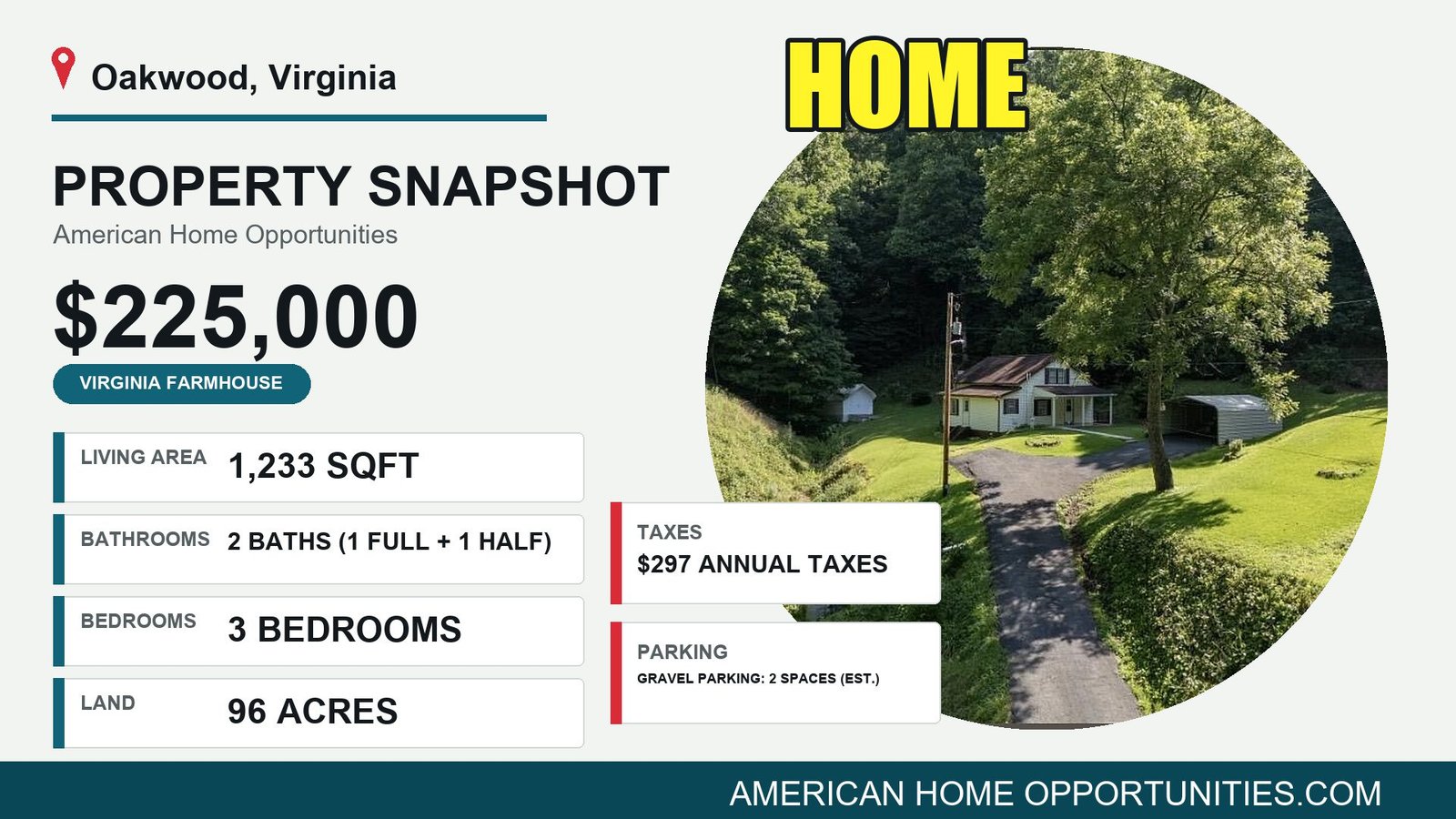
Ninety-six private acres in Buchanan County where the land alone is worth nearly double the asking price.
Ninety-six acres with no neighbour visible in any direction — not a rooftop, not a light at night. At that scale the listing’s talk of deer and birdsong stops being marketing copy and becomes a description of what owning the whole ridge is like.
The house on it is a 1930 cottage in vinyl siding, kept rather than restored. It is the smallest building on this page relative to its land, and that ratio is the entire story.
Inside the Home
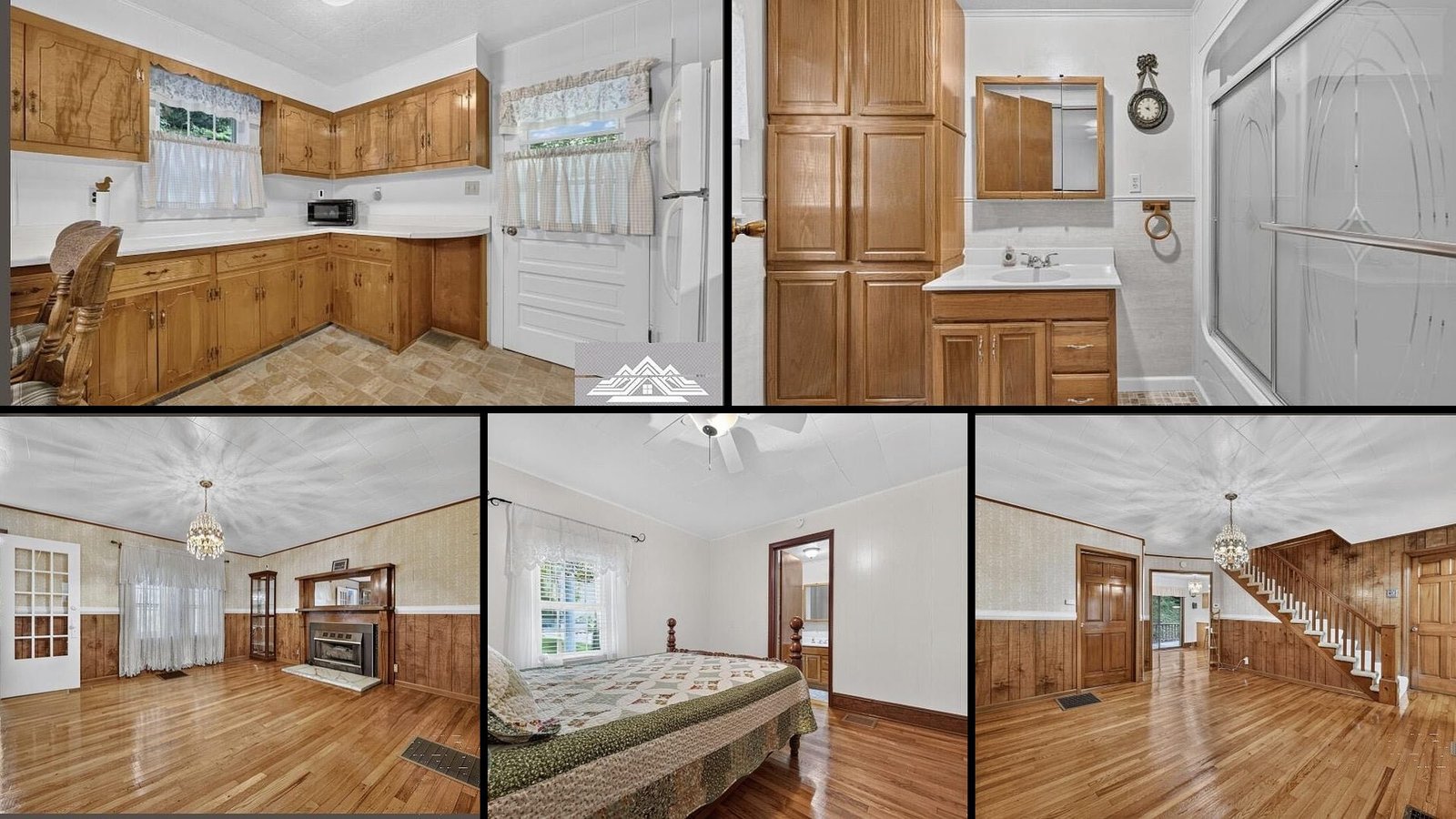
One thousand two hundred and thirty-three square feet, three bedrooms and one and a half bathrooms. The honest word for it is cottage, not farmhouse, and the listing’s description of a very loved house holds up in the details: the windows are double-pane replacements rather than originals, storm doors are fitted, and ceiling fans turn in the rooms.
A heat pump handles the heating and electric cooling handles the summer. Underneath the whole house is a full unfinished basement with its own exterior entry, pushing the total structure to 1,763 square feet — a workshop, a root cellar, or the place canning and a chest freezer live without touching the living space above. Washer and dryer connections are in, and there is a security system on the house. Water is a private well; waste is a septic tank.
Land and Outdoor Potential
Ninety-six acres, private, wooded and rolling, with a carport, a shed and a barn behind the house for equipment, animals and the gear that accumulates when you own this much ground. Parking is gravel. There is a covered porch on the front and a private yard cut out of the treeline.
This is the strongest homesteading parcel on the page by a wide margin, and the only one that clears both the 5-acre agricultural and the 20-acre forest thresholds with room to spare. Timber, a hunting lease, a small cattle operation and a land use assessment application are all genuinely open here. Ninety-six acres is also a job — boundary lines, access roads, timber management and trespassers — and a survey and a tractor belong in the budget before curtains do.
About Oakwood, Virginia
Oakwood sits in Buchanan County, and the Appalachian College of Pharmacy is minutes from this driveway — a full doctor-of-pharmacy programme in a place this size. Grundy, the county seat, is roughly 15 minutes north and carries the Appalachian School of Law and Buchanan General Hospital, a 111-bed facility with a genuine emergency department, an intensive care unit and operating rooms. Coal and natural gas still carry most of the private payroll.
The honest trade-off: the nearest interstate is a long way off, and every trip out of this county is a mountain road. That isolation is what you are buying and what you are accepting.
AHO Score: 88/100 — Strong AHO Pick
| Component | Score |
|---|---|
| Price / Value (25) | 23 |
| Land / Usability (20) | 20 |
| Condition (20) | 15 |
| Practical Location (15) | 11 |
| Charm (10) | 9 |
| Future Potential (10) | 10 |
| Total | 88 |
Buchanan County averages $4,490 an acre, 46th of 95 — squarely mid-table, not a cheap county on paper. But at 96 acres the land alone comes to roughly $431,000, which is 191.6% of the $225,000 asking price. The USDA’s farmland value for this acreage is nearly double what is being asked for the land, the cottage, the barn, the shed and the carport combined. Price per acre paid works out at $2,344 — the lowest on this page by a distance — while price per square foot runs $182, the highest. That inversion is precisely what it looks like when a county’s housing stock has been depreciating for forty years and its acreage has not. The score is carried by land at a full 20 and price at 23; it is held down by location and by one and a half bathrooms serving three bedrooms.
Mark’s Verdict
If you came to this page for homesteading rather than for a house, this is the property. Ninety-six contiguous private acres with a habitable dwelling, a barn and outbuildings, a well, a septic system and a $297 annual tax bill is a combination that does not appear often at any price, let alone this one.
The caveats are real and they are about the building, not the land. The cottage is 1,233 square feet with one full bathroom and a half — small for three bedrooms, and cramped for a family. The unfinished basement is the obvious expansion, but it is unfinished for a reason and finishing it below grade in this climate means moisture management. Confirm the mineral estate before closing; severed mineral rights are common across Buchanan County.
Who it is for: a buyer whose priority is land, privacy and low carrying cost, who is content to live small while the acreage does the work.
#8 — Swords Creek, VA — $179,000 — 37.5 acres
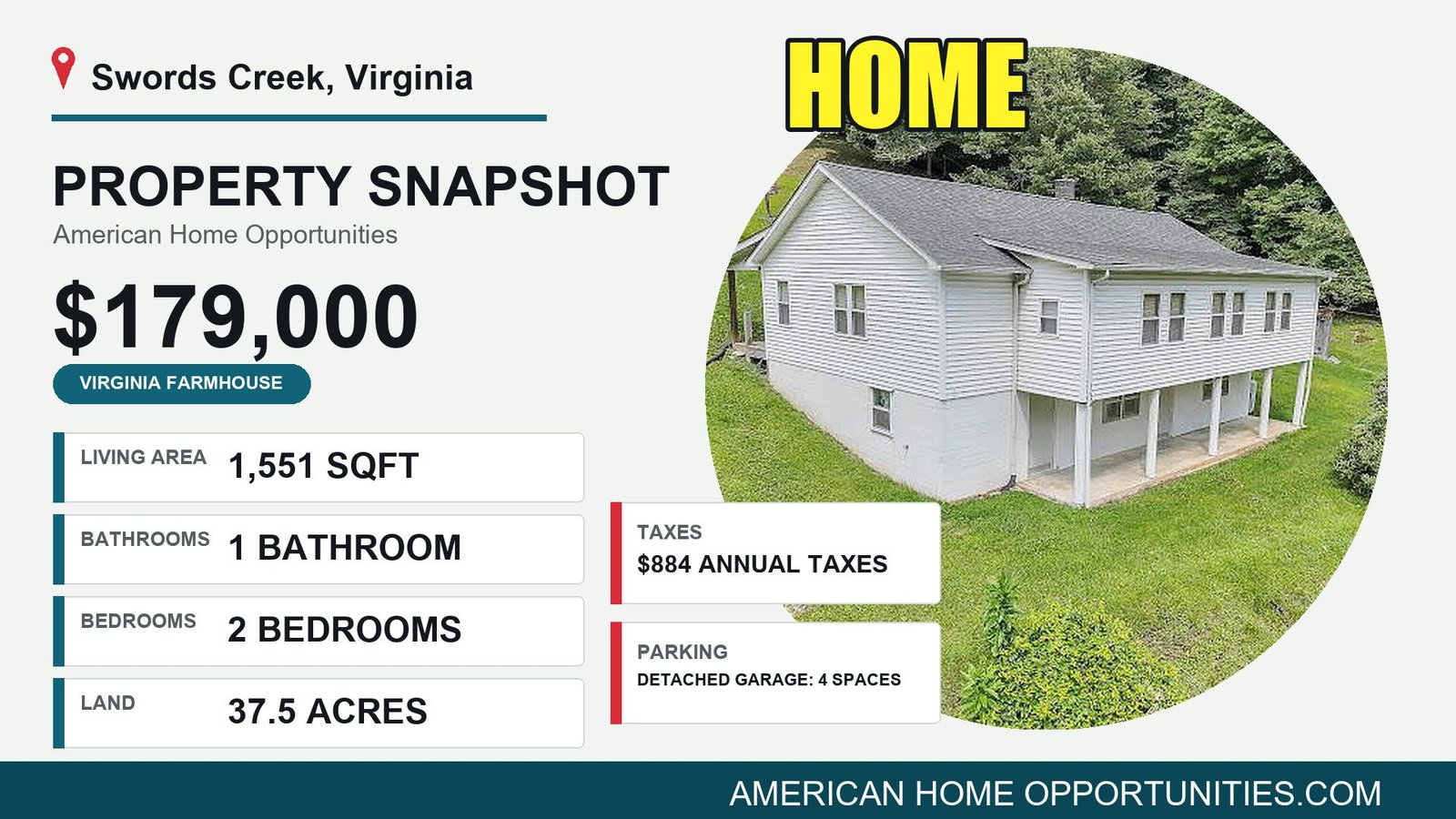
Thirty-seven and a half acres with a creek, a four-bay garage, and a county assessment $51,600 above the asking price.
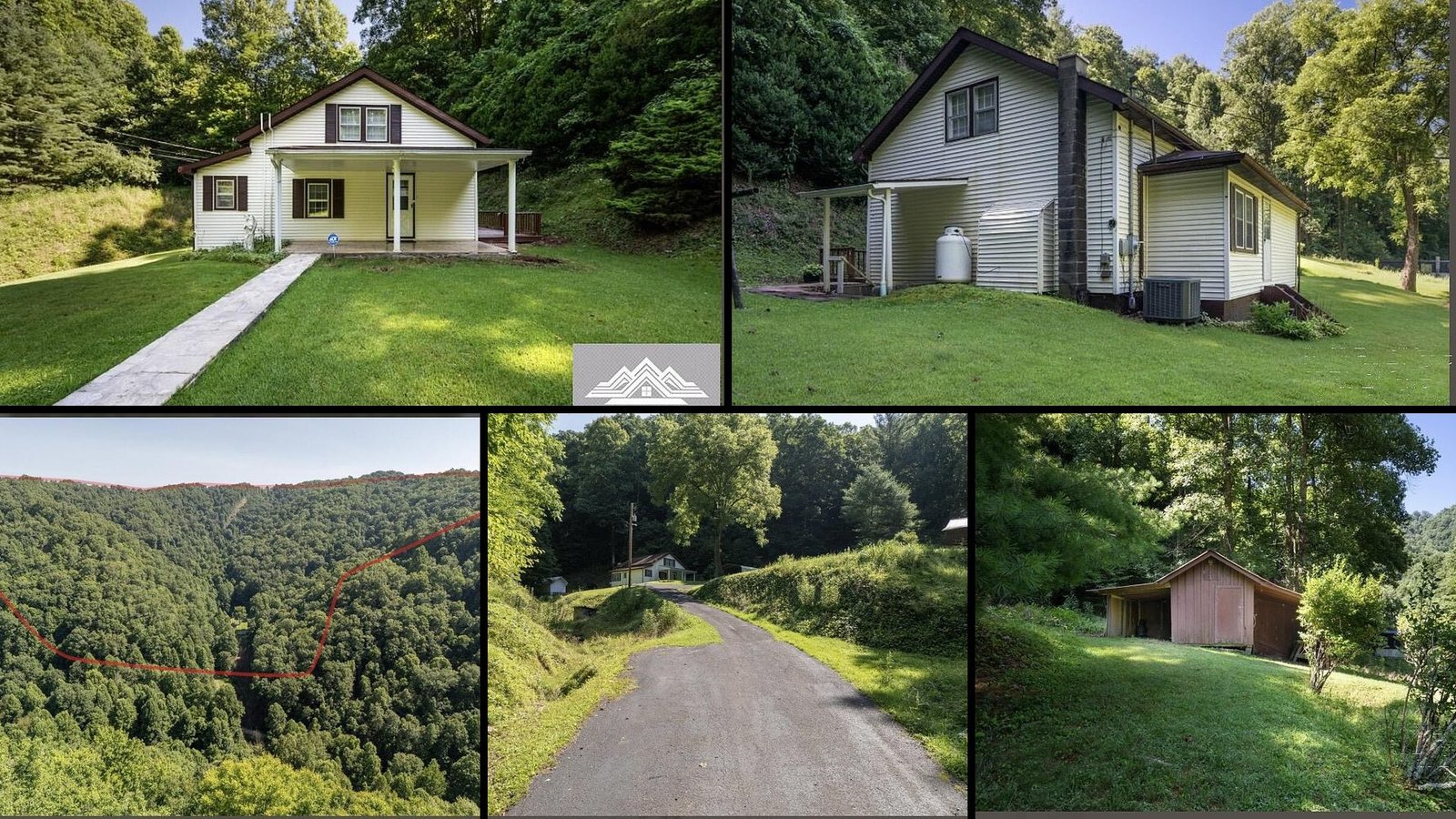
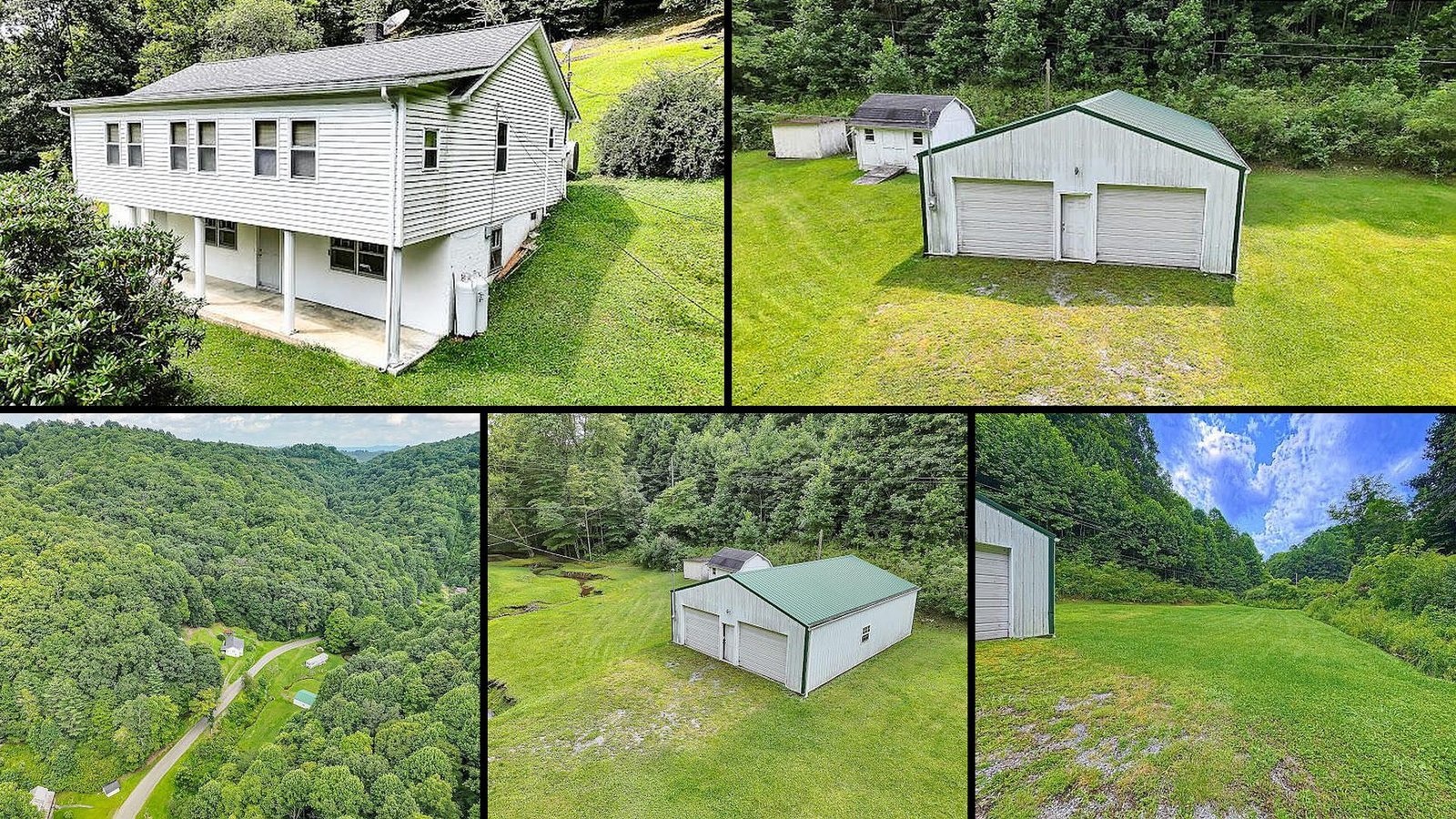
Thirty-seven and a half acres of wooded, steeply pitched ground with a creek running through it. The listing calls it an outdoorsman’s property and does not pretend otherwise — this is timber and slope, not pasture.
The building that decides it for most buyers is not the house. It is the detached garage: 30 x 39 feet, four bays, 1,170 square feet of covered floor.
Inside the Home
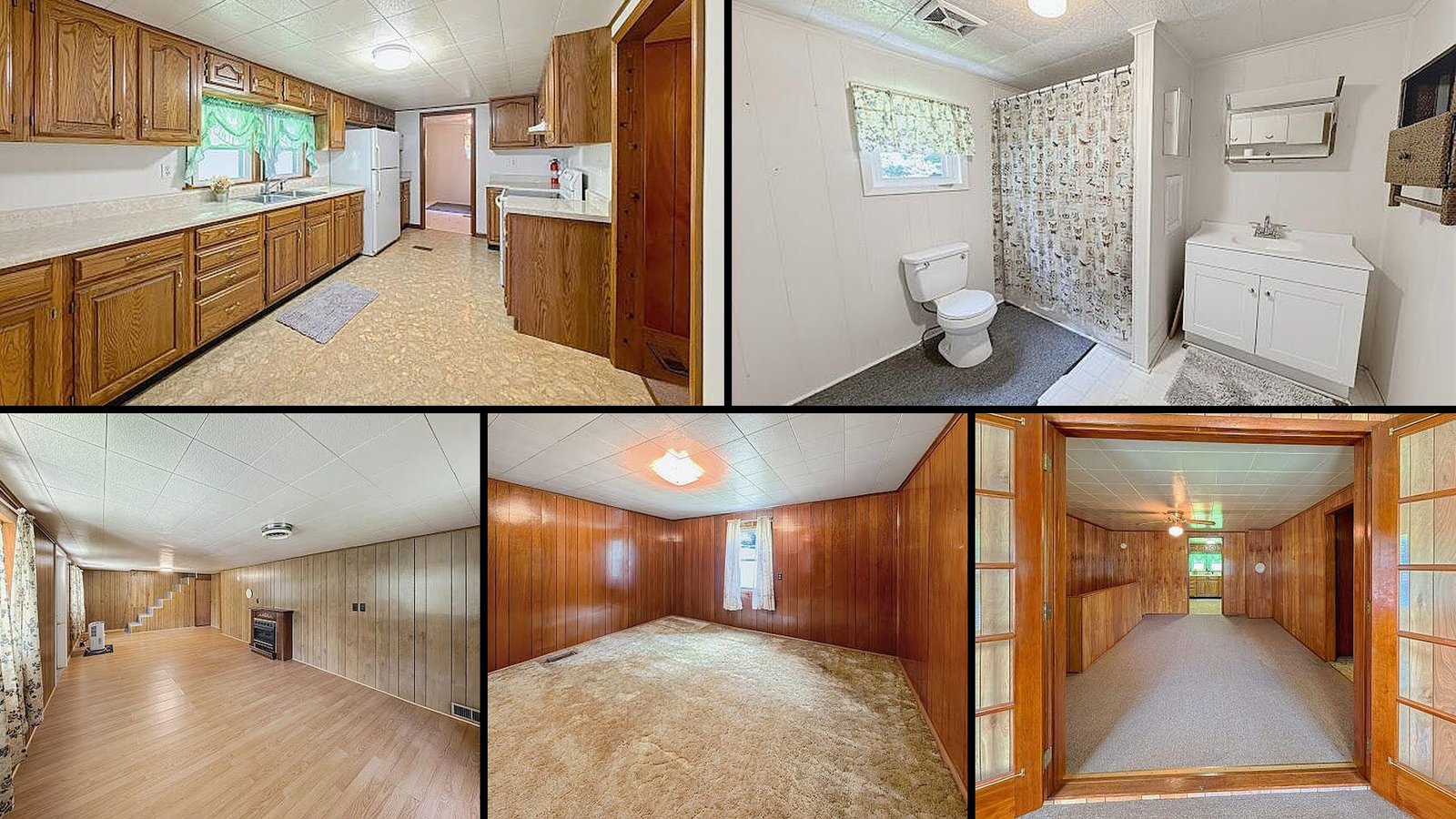
One thousand five hundred and fifty-one square feet across two levels, reading exactly as what it is — a 1950 country house somebody kept simple. Two bedrooms and one full bathroom, with the primary bedroom, the bath, the kitchen, the dining room and the living room all on the main level, so single-floor living is possible.
The second bedroom sits downstairs in the finished portion of the basement, adding 371 square feet below grade to the 1,180 above it. Walls carry wood paneling. Flooring is carpet, laminate and vinyl. Windows are insulated. There is a fireplace running a ventless gas log, and heat comes from oil and propane. The detail that surprises people at this address: the house is on public water, not a well. Thirty-seven acres in the mountains and you still turn a tap and get a utility.
Land and Outdoor Potential
Thirty-seven point five acres, wooded, with steep slope noted in the county’s own feature list and a creek and creek view on the property. The listing flags potential for additional homesites, which on this much acreage with paved road frontage is a real possibility rather than a phrase. The four-bay detached garage doubles as workshop, tractor barn and project space.
On homesteading capacity this is the second-strongest parcel here and the only other one that clears the 20-acre forest threshold, which makes a forestry land use classification worth investigating with Russell County. The slope is the constraint: it limits cropland, complicates a drainfield and makes driveway maintenance recurring. Pasture and timber are what this ground does well.
About Swords Creek, Virginia
Honaker is the closest town at about 10 minutes, with the grocery, the pharmacy and the schools. Lebanon is the county seat roughly 20 minutes out, and that is where Russell County Hospital sits — 78 beds, part of Ballad Health, with a 24-hour emergency department, inpatient and outpatient surgery and behavioural health. Richlands and Claypool Hill are about 25 minutes the other direction for larger retail.
The honest trade-off is winter. The lot is on a steep slope and the roads through here climb; four-wheel drive is a working requirement in January rather than a preference.
AHO Score: 79/100 — Solid Rural Deal
| Component | Score |
|---|---|
| Price / Value (25) | 21 |
| Land / Usability (20) | 18 |
| Condition (20) | 12 |
| Practical Location (15) | 12 |
| Charm (10) | 8 |
| Future Potential (10) | 8 |
| Total | 79 |
Russell County averages $3,381 an acre, 14th cheapest of Virginia’s 95 counties and the cheapest county represented on this page alongside listing #1. At 37.5 acres the land alone comes to roughly $126,800 — 70.8% of the $179,000 asking price. Price per acre paid is $4,773 and price per square foot is $115. The number that stands out, though, is the county’s own assessment: $230,600 against a $179,000 asking price, a gap of $51,600. Assessments are not appraisals and should not be treated as one, but a spread that direction is worth asking questions about. The score is carried by price and land; it is held down by condition, because the property sells as-is, and by future potential, because the mineral rights do not convey.
Mark’s Verdict
The acreage-to-price ratio here is the second best on the page, and unlike most cheap mountain acreage it comes with public water and a genuinely useful outbuilding. Thirty-seven and a half acres, a creek, and 1,170 square feet of four-bay garage for $179,000 is a serious homesteading start.
Two caveats, and read the second one twice. The house is 1950 and sells as-is, with all inspections for the buyer’s information only — budget for older systems. And the listing states plainly that mineral rights do not convey. In Southwest Virginia that sentence carries weight: somebody else owns what is under this ground, and in coal country that can eventually mean equipment and access on land you paid for. Ask for a title search that reports the mineral estate specifically.
Who it is for: a buyer who wants timber, hunting ground and workshop space, and who will do the title work properly before closing.
#7 — Drakes Branch, VA — $150,000 — 2.03 acres
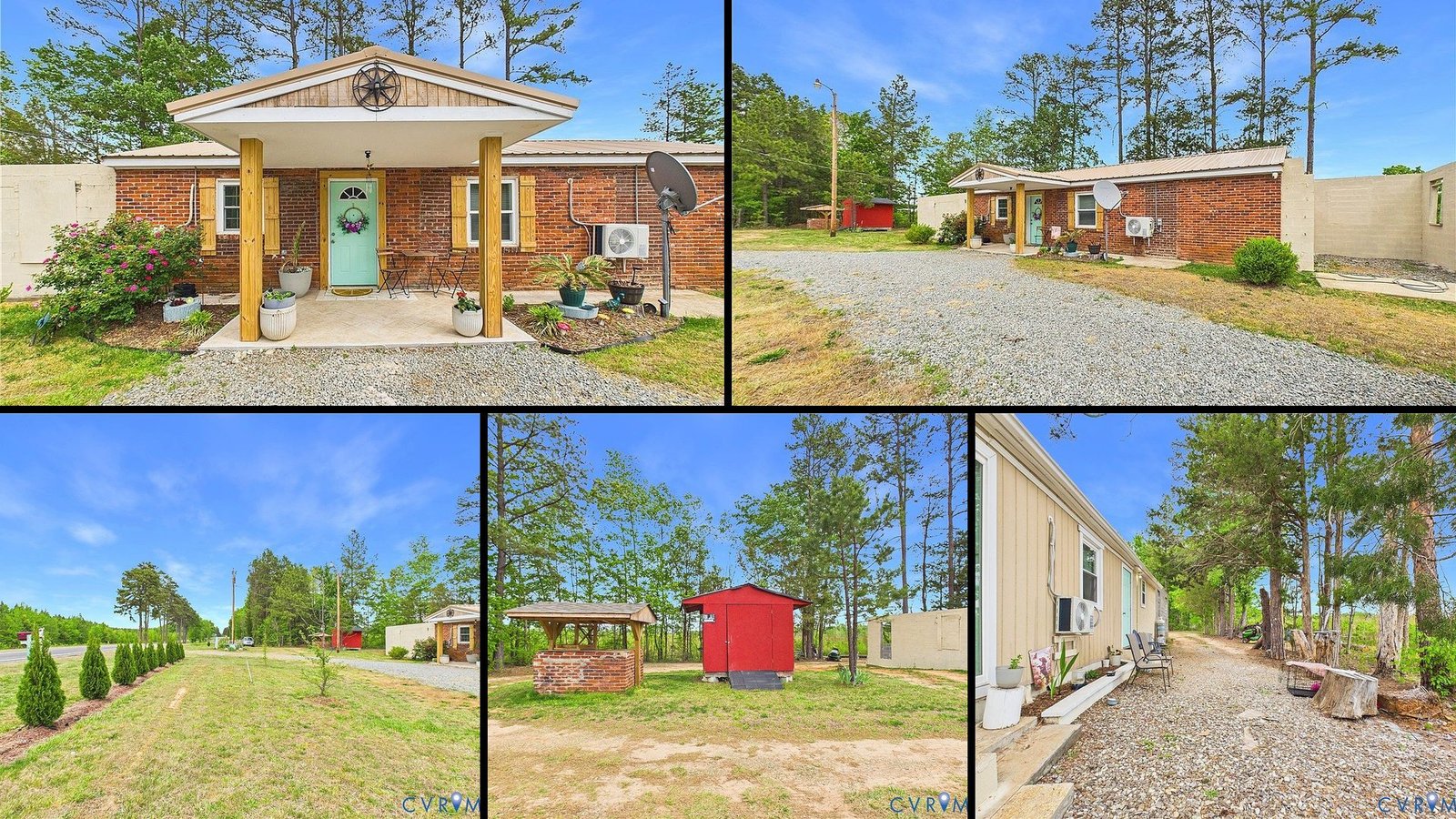
A brick-and-block ranch where the expensive work is already finished, on a long, narrow two acres with no close neighbours.
Two point zero three acres in Charlotte County, shaped long and narrow — which sounds like a drawback until you understand what it buys. There is no close neighbour on either side of this house.
The house is brick and block on a slab, masonry rather than frame, under a brand-new metal roof. It sits along a main road, so it gets plowed and access does not disappear in weather.
Inside the Home
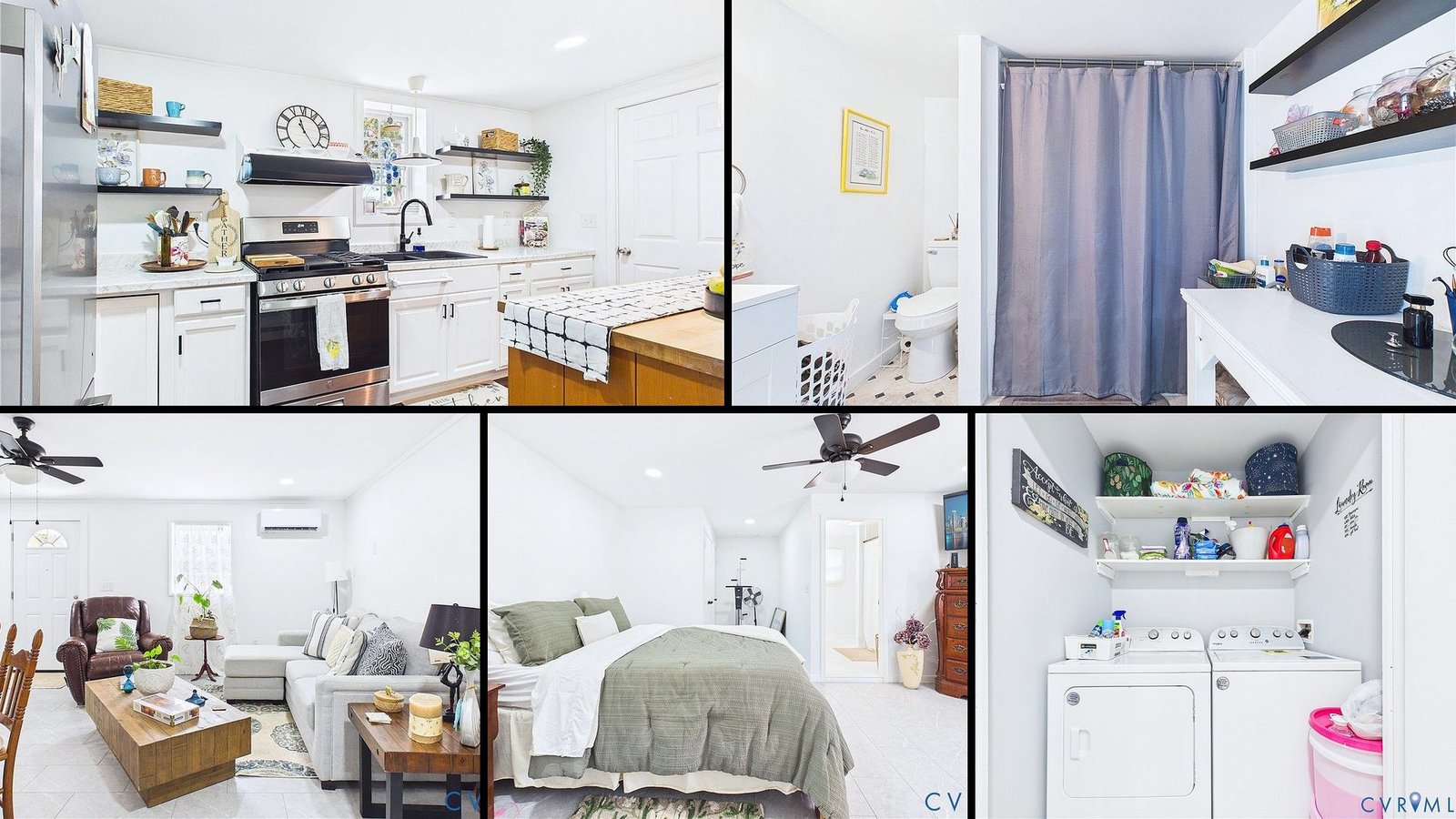
Nine hundred and forty-eight square feet on a single floor, and every dollar of recent money went where it should. Fresh paint, new laminate and tile flooring, a kitchen rebuilt from the ground up, and two bathrooms fully renovated — all inside the last five years. Three ductless mini-split units carry heating and cooling on separate zones.
The room dimensions say something about how the house was drawn. The primary bedroom runs 21.4 x 16.6 feet, which is enormous for a house this size and larger than the living room at 10.11 x 15.10. The second bedroom is 21.2 x 8.7 — long and narrow, a natural office, studio or bunk room. The kitchen is compact at 13.11 x 7.11. Two full bathrooms in a two-bedroom house is a ratio you rarely see at this price. Masonry walls on a slab keep utility bills low.
Land and Outdoor Potential
Two acres, long and narrow, with two existing attached cinder block structures already standing. Right now they are shells, but the foundations, walls and roofs of a garage, workshop or small guest apartment are already poured and paid for. Water is a private well and waste is septic.
On homesteading capacity, this is one of the five properties on the page that does not clear Virginia’s default 5-acre agricultural minimum for land use assessment. Two acres is a serious kitchen garden, poultry and possibly a couple of goats — a smallholding rather than a farm. Charlotte County’s threshold would need checking directly with the Commissioner of the Revenue, since localities may set theirs lower than the state floor.
About Drakes Branch, Virginia
The hard part first: there is no hospital in Charlotte County. Centra Southside Community Hospital in Farmville is the emergency room, about 40 minutes north — 116 beds, full service, with a birthing centre. Farmville is also the employment anchor, carrying Longwood University and Hampden-Sydney College. Charlotte Court House, the county seat, and Keysville are both 15 minutes or less for the courthouse, the post office and groceries. South Hill is around 45 minutes southeast.
The honest trade-off is that 40-minute drive to an emergency room. Decide how you feel about it before you fall for the house.
AHO Score: 70/100 — Solid Rural Deal
| Component | Score |
|---|---|
| Price / Value (25) | 15 |
| Land / Usability (20) | 12 |
| Condition (20) | 19 |
| Practical Location (15) | 10 |
| Charm (10) | 6 |
| Future Potential (10) | 8 |
| Total | 70 |
Charlotte County averages $3,223 an acre and ranks 10th cheapest of Virginia’s 95 counties, putting it inside the table at the top of this page. But at 2.03 acres the land accounts for only about $6,500 — 4.4% of the $150,000 asking price. Price per acre paid is $73,892; price per square foot is $158, the second highest here. You are buying a renovation, not land, and the numbers say so without ambiguity. The county assesses the property at $63,196 and bills $260 a year. The score is carried almost entirely by condition at 19 of 20; it is held down by land, by charm and by the distance to a hospital.
Mark’s Verdict
Move-in-ready rural inventory is genuinely thin across Southside Virginia, and this house needs nothing. A new metal roof, two renovated bathrooms, a rebuilt kitchen and three zoned mini-splits inside five years is the expensive half of a renovation already paid for by somebody else. It also widens the pool of buyers who can finance it, including those using loan programmes that require a property to be habitable on day one.
The caveat is size. Nine hundred and forty-eight square feet is small and no amount of good work changes that: two bedrooms, one floor, no basement. If you are bringing a family, those cinder block shells outside stop being a bonus and start being a requirement — and finishing them means permits, since Virginia has no unpermitted jurisdictions.
Who it is for: one or two people who want to move in rather than renovate, and who can live with a 40-minute hospital run.
#6 — Stuart, VA — $125,900 — 2.93 acres
A 1920 farmhouse with a creek across the lawn, where the four expensive jobs are done and the water comes from a spring.
Two point nine three acres in Patrick County with a creek running across it and a lawn the listing calls gorgeous — for once defensibly. About an acre is house and open lawn; the rest is woods.
That split is the useful part. You get a yard you can maintain and two acres of standing timber behind it that nobody can build on.
Inside the Home
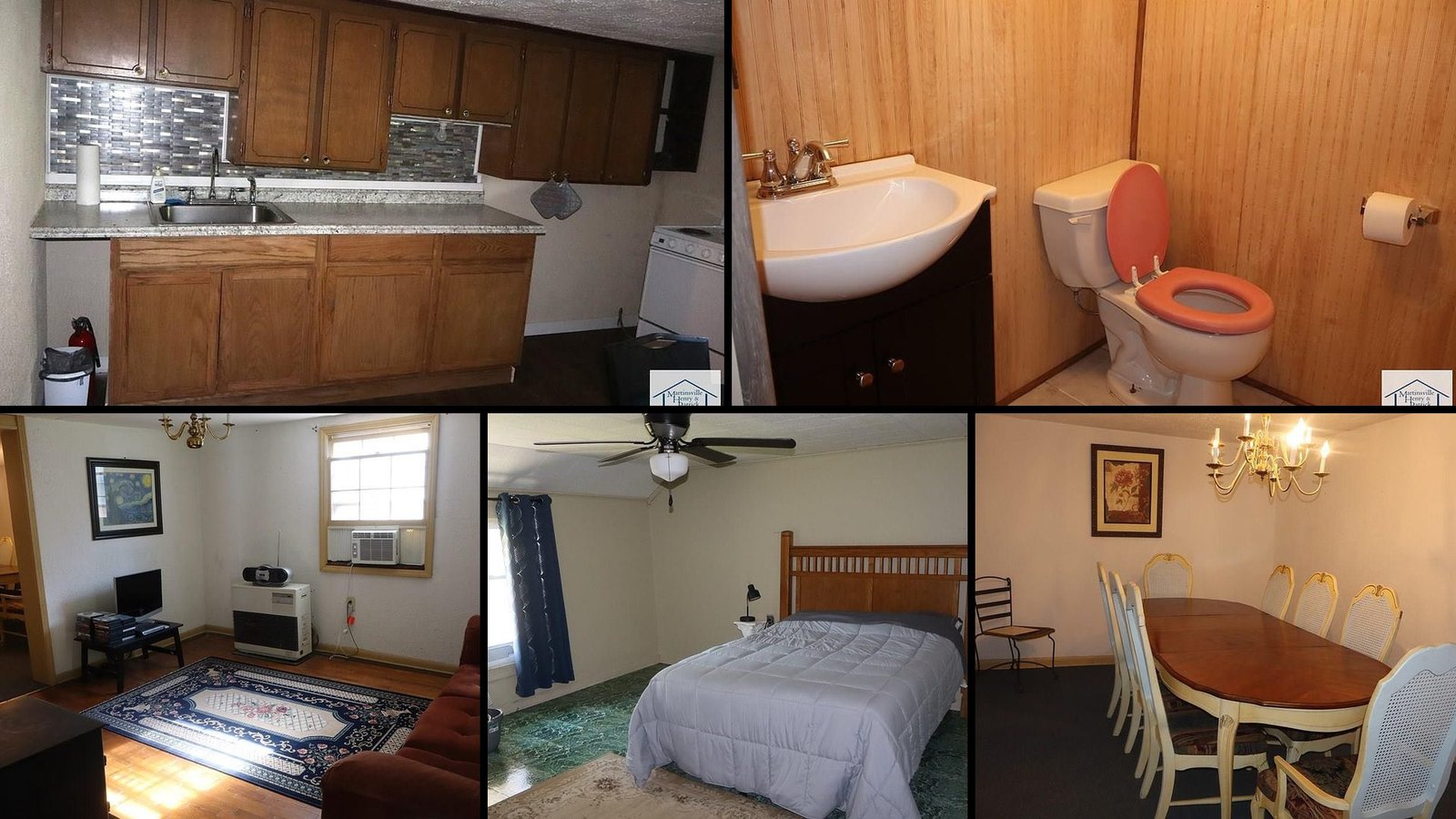
One thousand five hundred and forty-seven square feet, three bedrooms, one full bathroom and a half. The listing describes it as partially renovated, and the word partially is doing honest work — but look at which parts are done. The plumbing is new. Both bathrooms are remodeled. The windows are double-pane replacements. The roof is metal.
Those are the four expensive, unglamorous jobs on a hundred-year-old farmhouse, and all four are finished. What remains is cosmetic, which is the kind of work you can do one room at a time. Heat comes from a Monitor oil heater with a woodstove as backup, and the wood-burning stove is what actually keeps the house warm when the power goes down. Cooling is a portable unit and a window unit, so central air is a project you would be adding. Flooring is carpet, vinyl and wood. It comes partially furnished.
Land and Outdoor Potential
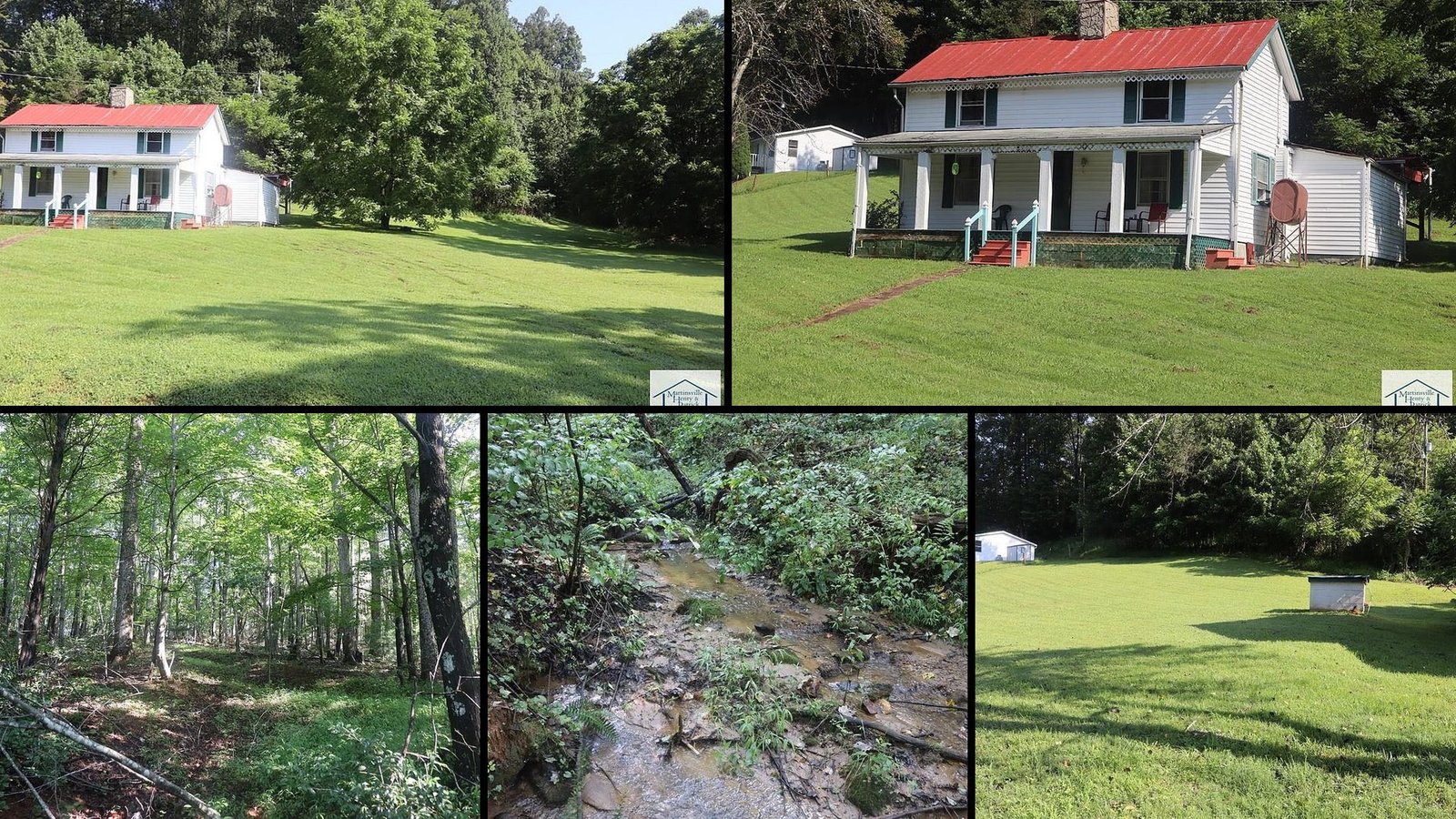
Two point nine three acres split roughly one acre of lawn to two acres of woodland, with a creek crossing the property and a detached single carport. The road out front is paved secondary rather than gravel, which in Patrick County terrain matters more than it sounds.
On homesteading capacity this sits below Virginia’s default 5-acre agricultural threshold, so a land use classification would depend on Patrick County having set a lower minimum. What the acreage does support is a substantial garden, poultry, bees and a woodlot for fuel — the wood stove is already installed. The water supply is the constraint here, not the ground.
About Stuart, Virginia
Stuart is minutes away and it is the county seat, and there is a fact here worth having. Patrick County went without a hospital from 2017 until January of this year. Stuart Community Hospital reopened in January 2026 with 25 beds, a working emergency department, an in-house pharmacy, X-ray and a CT scanner, after Braden Health bought the building at auction and spent $15 million returning it to service. Martinsville is about 45 minutes east for the larger hospital and the bigger job market. The Blue Ridge Parkway crosses the northern end of the county.
The honest trade-off: that hospital is one year old in its second life, and one hospital is one hospital.
AHO Score: 73/100 — Solid Rural Deal
| Component | Score |
|---|---|
| Price / Value (25) | 16 |
| Land / Usability (20) | 13 |
| Condition (20) | 14 |
| Practical Location (15) | 13 |
| Charm (10) | 9 |
| Future Potential (10) | 8 |
| Total | 73 |
Patrick County averages $3,929 an acre, 30th of 95. At 2.93 acres the land accounts for roughly $11,500 — 9.1% of the $125,900 asking price. Price per acre paid is $42,969; price per square foot is $81, which is low for a house with new plumbing, new windows, two remodeled bathrooms and a metal roof. The county assesses it at $54,100 and bills $395 a year. The score is carried by charm and location, the latter helped considerably by a hospital reopening inside the county; it is held down by land area and by a condition rating that reflects the cosmetic work still outstanding.
Mark’s Verdict
This is the best-value renovation position on the page. The four jobs that break budgets on a 1920 farmhouse — plumbing, roof, windows, bathrooms — are already paid for, and what remains is the kind of work that is genuinely enjoyable if you like this sort of thing. A creek, a woodlot, a wood stove and a partially furnished house at $81 a square foot is a strong start.
The caveat is the water. This house is on a spring, not a drilled well, and spring-fed supply makes conventional lenders nervous. Get a flow test and a bacterial test early, and speak to a local bank before assuming a standard mortgage is available. Add central air to the budget as well; a portable and a window unit is not a system.
Who it is for: a hands-on buyer with financing already arranged, or cash, who wants a working smallholding with a creek and does not need the last 20% of the renovation done for them.
#5 — Duffield, VA — $110,000 — 1.34 acres
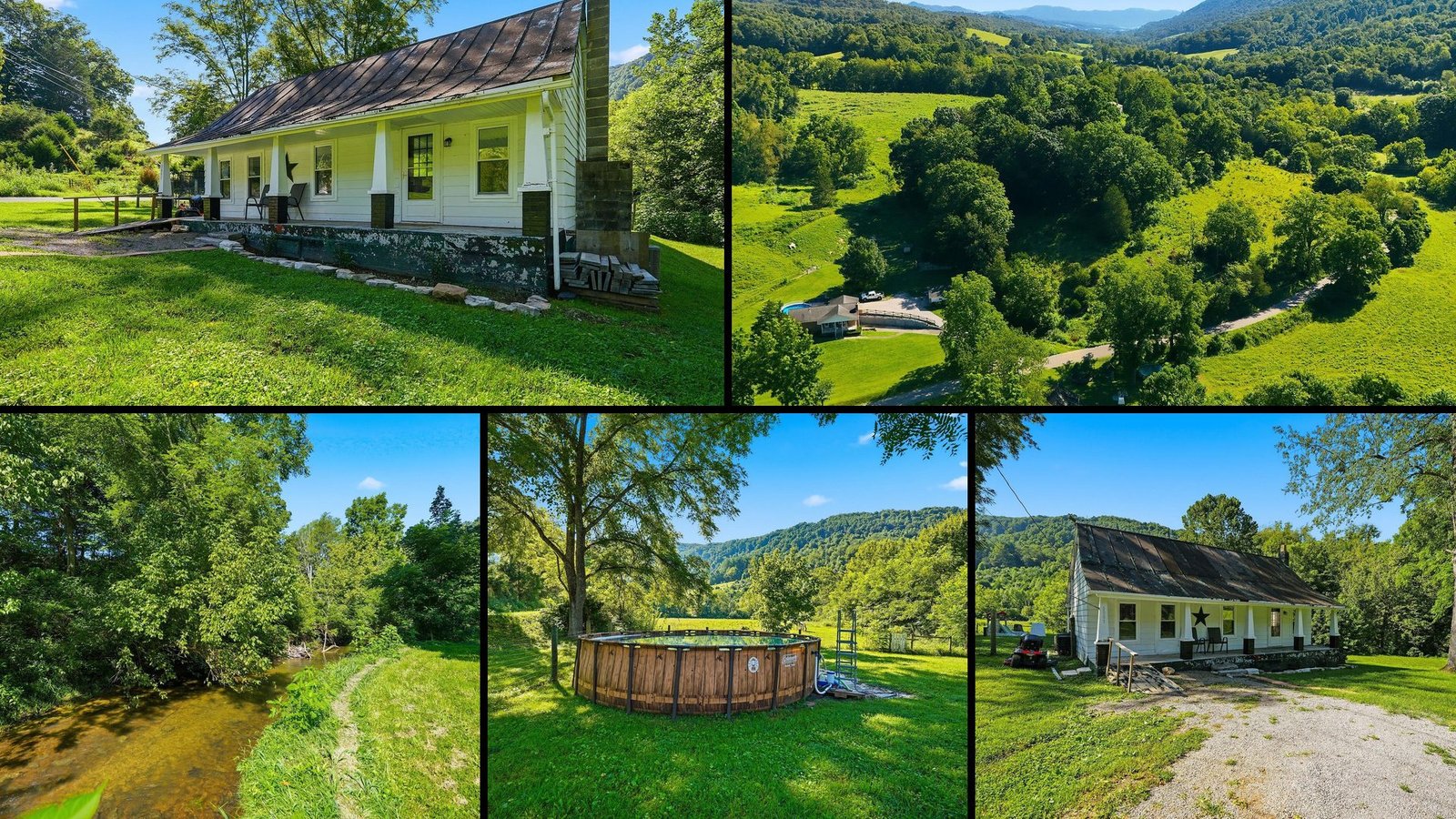
A remodeled farmhouse on Middle Wallens Creek with fiber at the road, two full baths in a thousand square feet — and a flood zone on the county record.
One point three four acres along Middle Wallens Creek, and the ground here is level — worth saying out loud after the slopes further up this page. Mature shade trees stand over the lot, there are mountain views off the back, and the creek is a genuine water view.
The house is a 1950 farmhouse in wood siding under a metal roof, and the county lists it as updated and remodeled. It is the most recently listed property here.
Inside the Home
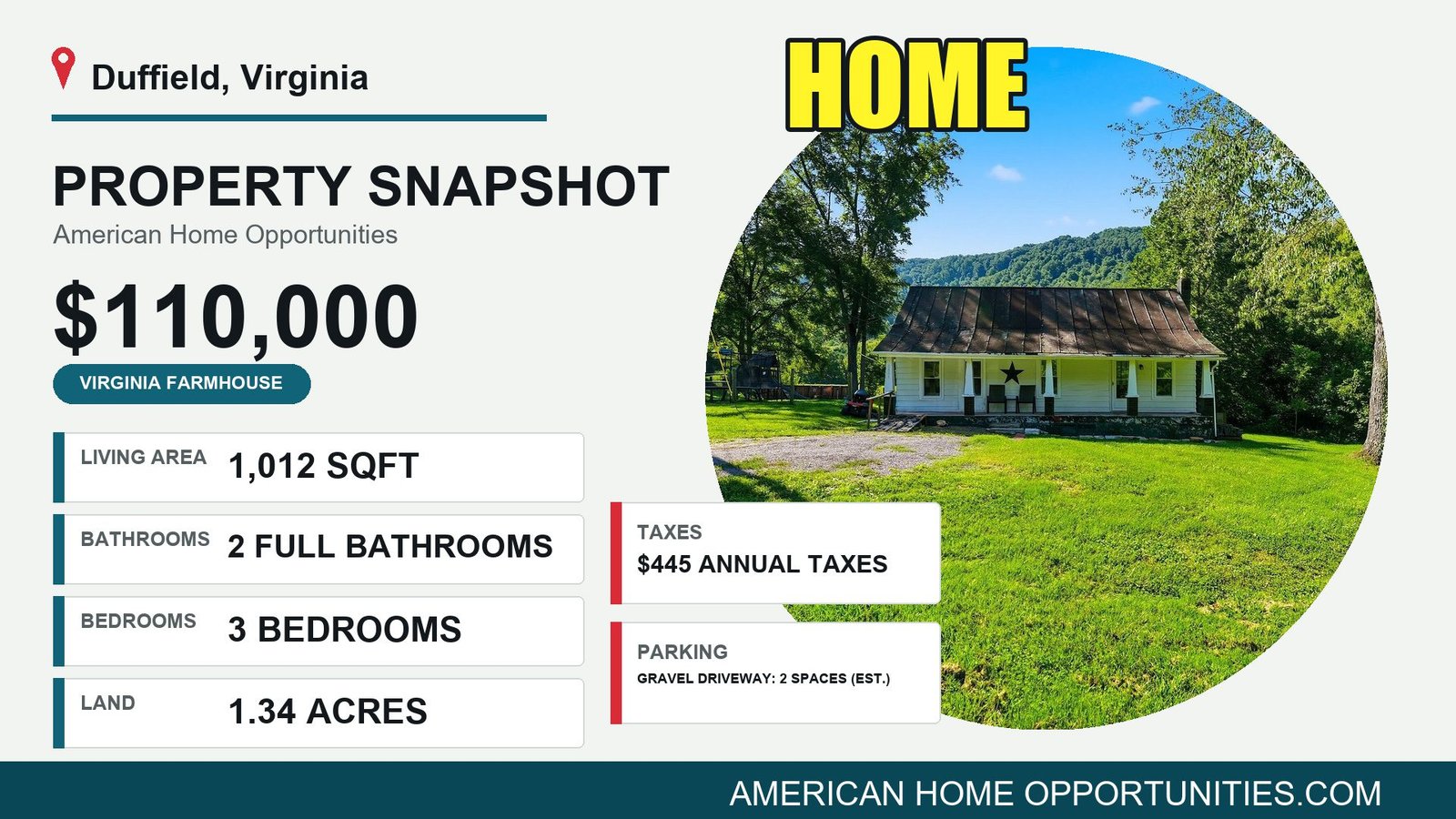
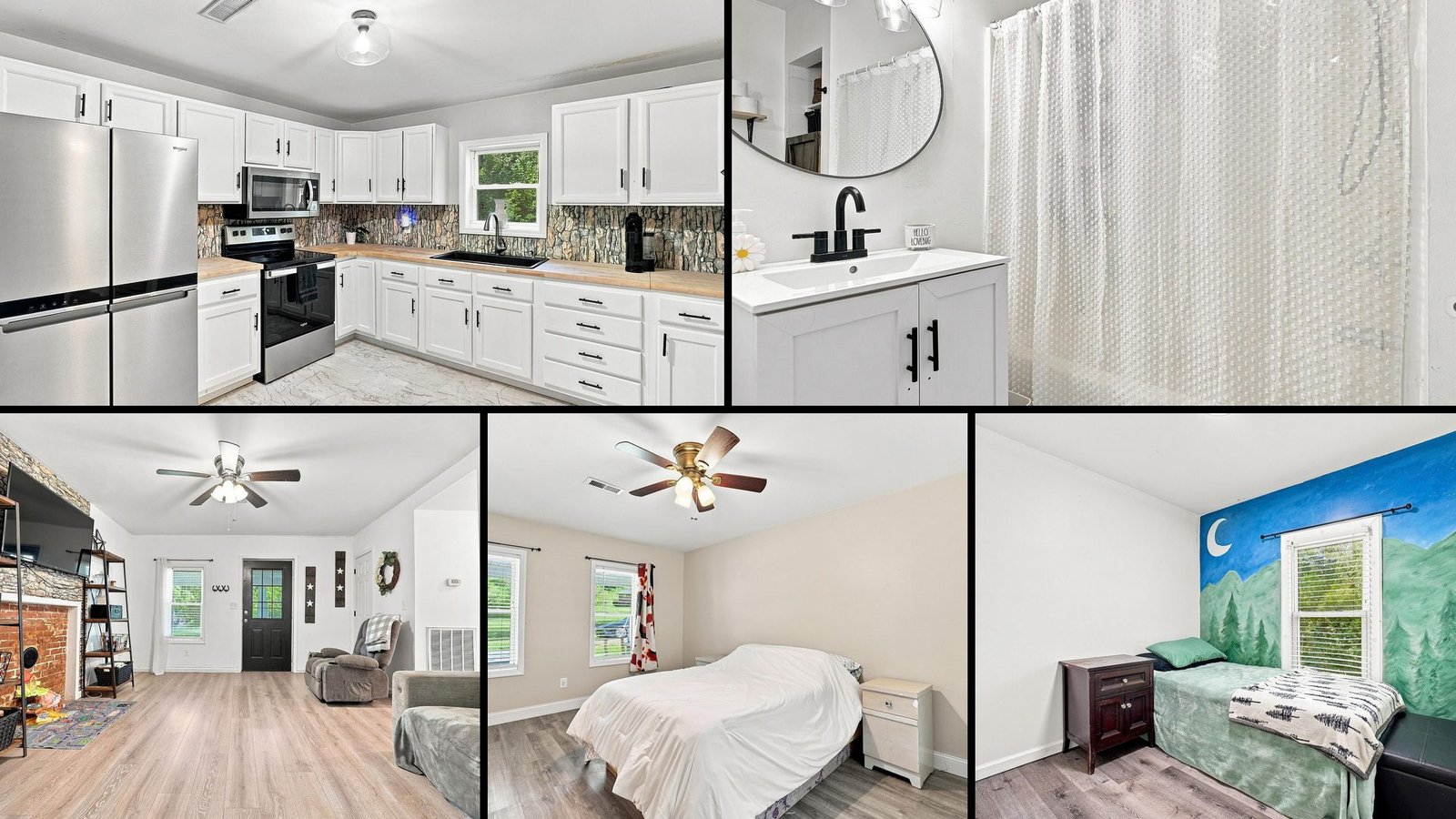
One thousand and twelve square feet with every room on one floor: all three bedrooms, both full bathrooms, the living area and the kitchen. No stairs anywhere. Two full bathrooms inside a thousand square feet is a ratio you almost never get at this price — a house this size normally hands you one.
The remodel specifics hold up. New laminate flooring throughout, double-pane windows, and a kitchen carrying newer appliances that convey with the sale: an electric range, a microwave and a refrigerator, with the washer and dryer staying. A single heat pump runs both heating and cooling, so there is one system to service rather than two. Underneath is a crawl space. There is no fireplace, which at this square footage is no loss. What you have is a small house where somebody already spent the money on floors, windows, appliances and a working heat pump.
Land and Outdoor Potential
One point three four acres, level, fenced at the rear, with mature shade trees, an above-ground pool and a gravel driveway. Water is a private well; waste is a private septic system. There is also a spring-fed watering station on the property, separate from the house supply and set up for a garden or animals.
On homesteading capacity the listing itself uses the words mini homestead and hobby farming, and at 1.34 fenced and level acres with a dedicated watering station that is fair — this is a serious garden, poultry and a couple of animals. It does not clear Virginia’s default 5-acre agricultural minimum, so a land use classification would depend on Scott County’s own threshold. The flood zone designation is the more important constraint and it is covered below.
About Duffield, Virginia
Duffield sits in Scott County on Route 23, and the geography works in your favour. Gate City, the county seat, is about 15 minutes southeast; Big Stone Gap is roughly 25 minutes north. The real anchor is Kingsport, Tennessee, about 25 minutes south — Duffield is inside the Kingsport-Bristol metropolitan area, and Eastman Chemical, headquartered in Kingsport, employs around 7,000 people in northeast Tennessee, making it the largest employer in the region. Holston Valley Medical Center and Indian Path Community Hospital are both there. Natural Tunnel State Park is minutes from the driveway.
The honest trade-off: Scott County has no hospital of its own, so every emergency is a drive across the state line.
AHO Score: 70/100 — Solid Rural Deal
| Component | Score |
|---|---|
| Price / Value (25) | 15 |
| Land / Usability (20) | 11 |
| Condition (20) | 17 |
| Practical Location (15) | 12 |
| Charm (10) | 8 |
| Future Potential (10) | 7 |
| Total | 70 |
Scott County averages $3,600 an acre, 21st of 95. At 1.34 acres the land accounts for roughly $4,800 — 4.4% of the $110,000 asking price, tied with listing #7 for the second-lowest land share here. Price per acre paid is $82,090; price per square foot is $109. The county assesses it at $64,500 and bills $445 a year, and Zillow’s own estimate sits at $107,500 against the $110,000 ask, which means this one is priced close to market rather than under it. The score is carried by condition; it is held down by land area and by future potential, where the flood zone caps what can sensibly be built.
Mark’s Verdict
Fiber internet at a rural Southwest Virginia address is not a given, and it changes who can live here — remote work stops being a compromise. Combine that with a completed remodel, two full bathrooms, single-floor living, level ground and a 25-minute commute to the largest employer in the region, and this is the most immediately liveable property on the page.
And now the caveat that outranks everything else. The county records the topography on this parcel as level, and flood zone. It sits on a creek. That is where the value and the risk are both coming from. Pull the FEMA flood map, get a written insurance quote before you decide what this house costs per month, and ask the seller directly what the property has done in a heavy spring. Do that before anything else.
Who it is for: a remote worker or a Kingsport commuter who wants a finished house and a garden, and who prices flood insurance into the monthly number rather than discovering it at closing.
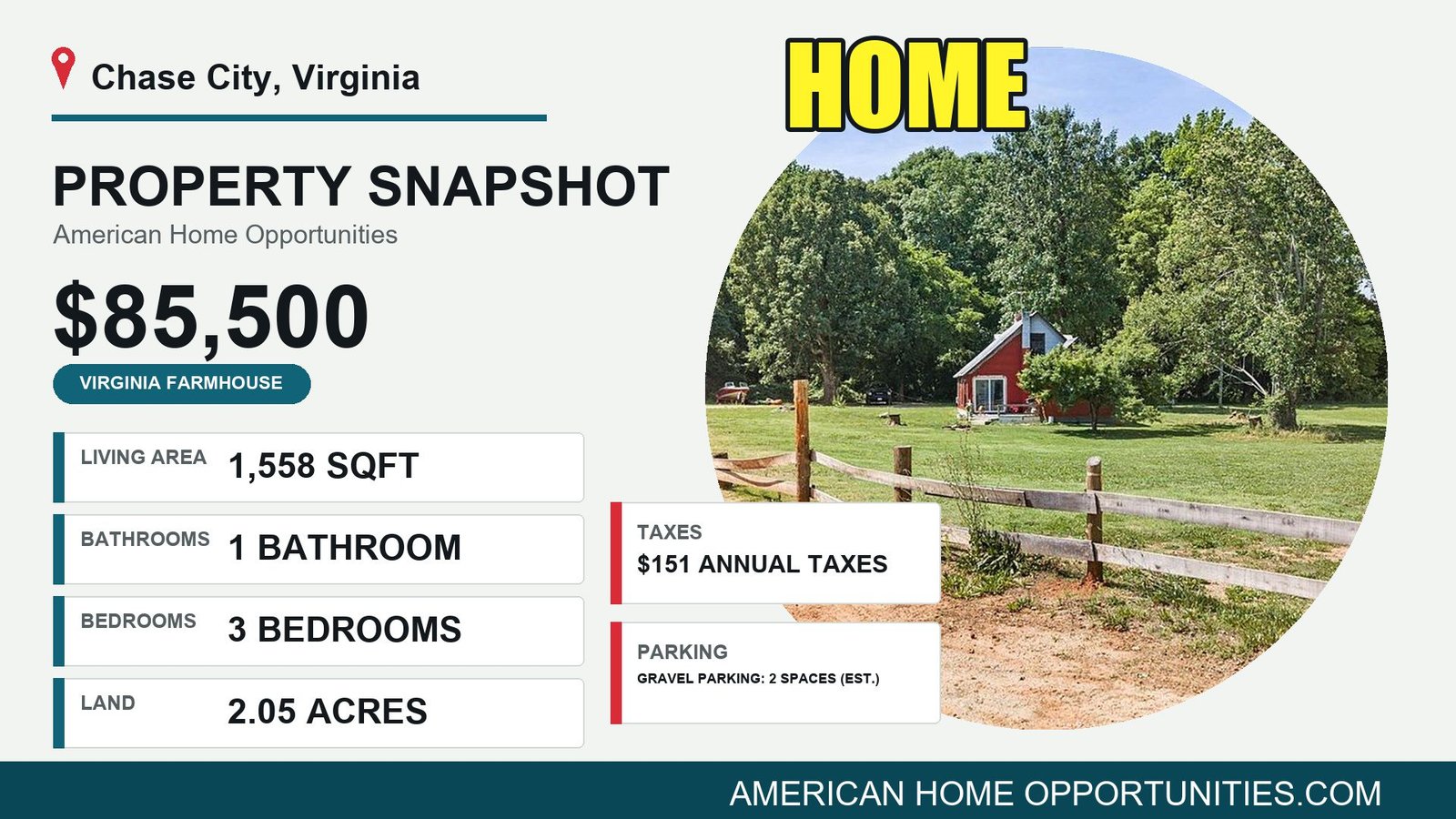
#4 — Chase City, VA — $85,500 — 2.05 acres
A diamond in the rough on two agriculturally zoned acres, 25 minutes from one of the largest data centre campuses in the country.
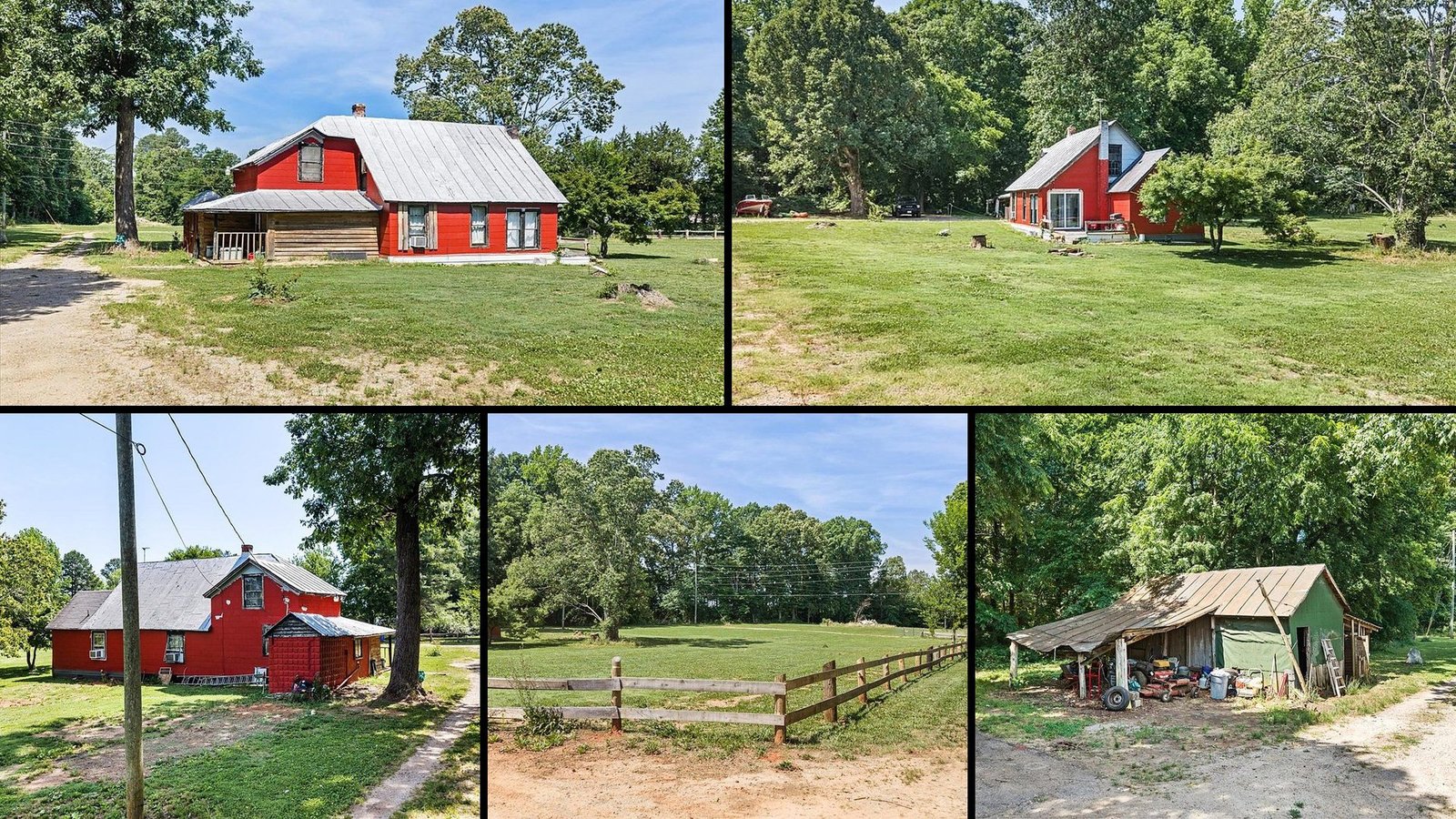
Two point zero five acres in Mecklenburg County — two separate deeded lots sold together, zoned agricultural — with a circular drive bringing you in past the front. That drive tells you the house was built to be arrived at rather than parked beside.
The seller’s own words are diamond in the rough, and quoting that is more useful than dressing it up. Some updates are done. The finishing touches are yours.
Inside the Home
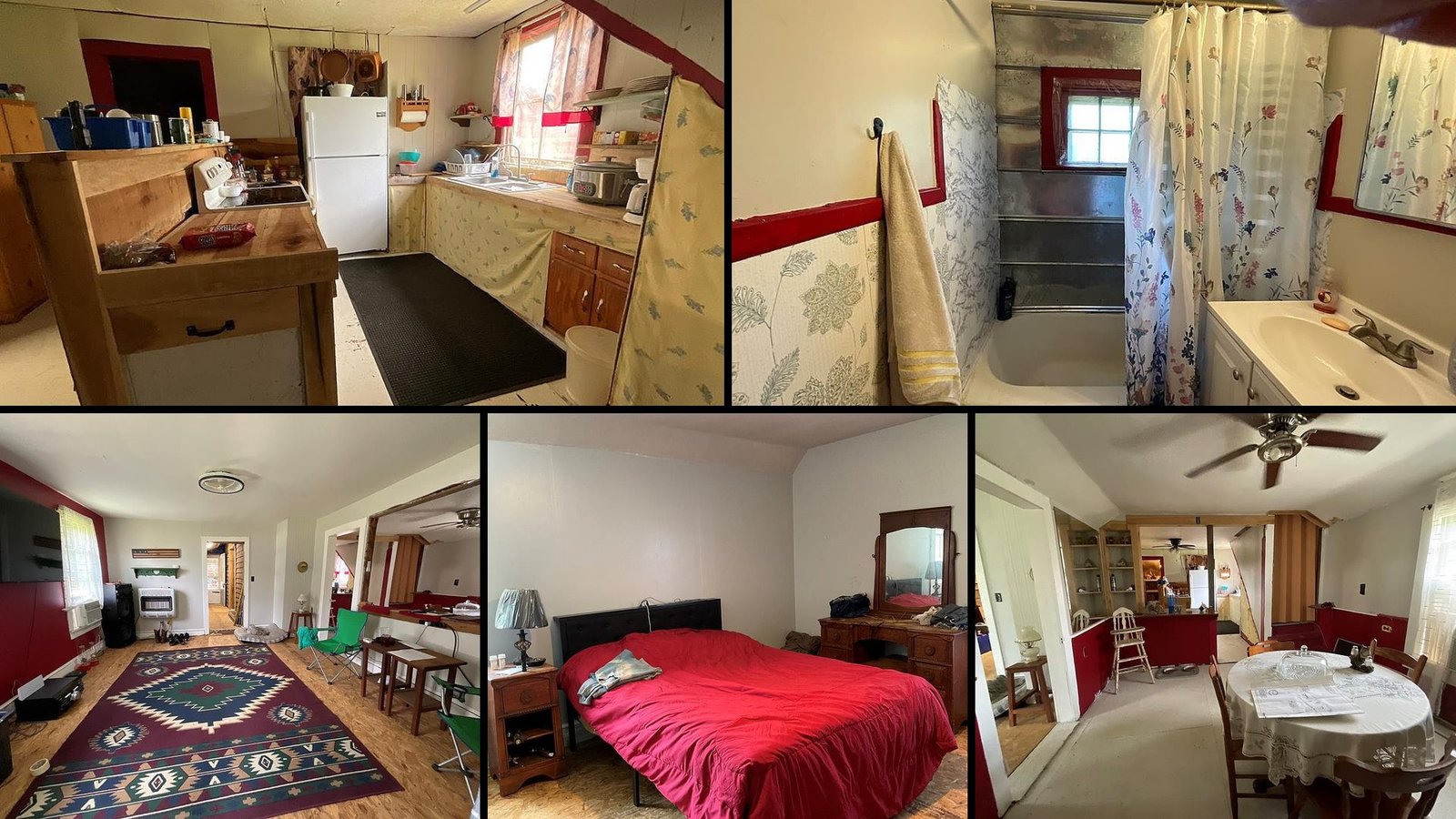
One thousand five hundred and fifty-eight square feet, three bedrooms, one full bathroom. The layout is unusually generous for the money: a separate living room, a separate family room, a dining room and a kitchen all on the first floor, plus two of the three bedrooms. The third bedroom is upstairs under the roofline.
Laundry is a real first-floor laundry room with an electric dryer hookup, not a closet at the end of a hallway. Heating is a wall furnace and cooling is window units — the honest reality of a 1956 house nobody has converted yet. Flooring is vinyl. There is no basement and the attic is access only. But this much square footage carved into this many separate rooms means doors, and doors are what open-plan houses at this price cannot offer.
Land and Outdoor Potential
Two point zero five acres across two lots, zoned agricultural, under mature trees with a deck, a front porch and a garden. No garage and no carport, so parking is open gravel. Water is a private well and waste is septic.
On homesteading capacity the agricultural zoning is the genuine asset — it removes the land-use question that residential zoning creates elsewhere on this page. But 2.05 acres still falls below Virginia’s default 5-acre minimum for land use assessment, so Mecklenburg County’s own threshold needs confirming. What two zoned agricultural acres do support is a market garden, poultry, bees and a couple of head of livestock.
About Chase City, Virginia
Chase City carries the restaurants, the groceries and the medical clinics. The hospital is VCU Health Community Memorial in South Hill, about 25 minutes east — a full facility in a brand-new building, the first medical building erected in South Hill since 1954, tied into the VCU system in Richmond. The employment story is not what agricultural zoning would suggest: Boydton, roughly 25 minutes south, holds one of Microsoft’s largest data centre campuses in the country, running since 2010 and still expanding, with a Datacenter Academy training programme delivered through Southside Virginia Community College. Kerr Lake is minutes away.
The honest trade-off: that work is technical, and getting into it means training first. The data centre payroll is real but it is not a walk-in job.
AHO Score: 66/100 — Niche Opportunity
| Component | Score |
|---|---|
| Price / Value (25) | 16 |
| Land / Usability (20) | 12 |
| Condition (20) | 11 |
| Practical Location (15) | 13 |
| Charm (10) | 6 |
| Future Potential (10) | 8 |
| Total | 66 |
Mecklenburg County averages $3,268 an acre and ranks 11th cheapest of Virginia’s 95 counties, placing it inside the table at the top of this page. At 2.05 acres the land accounts for roughly $6,700 — 7.8% of the $85,500 asking price. Price per acre paid is $41,707 and price per square foot is $55, the second cheapest here. Note that the county assesses the property at $42,000, well below the asking price; assessments lag and are not appraisals, but the gap is worth raising. The annual tax bill is $151. The score is carried by location and price; it is held down by condition and charm, and the asbestos siding covered below is the reason condition does not score higher.
Mark’s Verdict
Fifty-five dollars a square foot for 1,558 square feet of separate rooms on two agriculturally zoned acres, 25 minutes from a hospital and 25 minutes from a growing technical payroll, is a genuinely good starting position. Two deeded lots rather than one adds optionality most buyers at this price never get.
Two caveats. The first is the systems: a wall furnace and window units means heating and cooling are both projects, not features. The second is the siding. This house is clad in asbestos shingle, which was standard in 1956 and is not a crisis — intact asbestos siding is stable and legal to leave alone. But you cannot sand it, break it or dry-cut it, and removing it is licensed abatement at real cost. Price that in before planning any exterior work.
Who it is for: a buyer who wants agricultural zoning and room to grow, who is comfortable renovating in stages, and who leaves the siding alone.
#3 — Grundy, VA — $85,000 — 6.23 acres
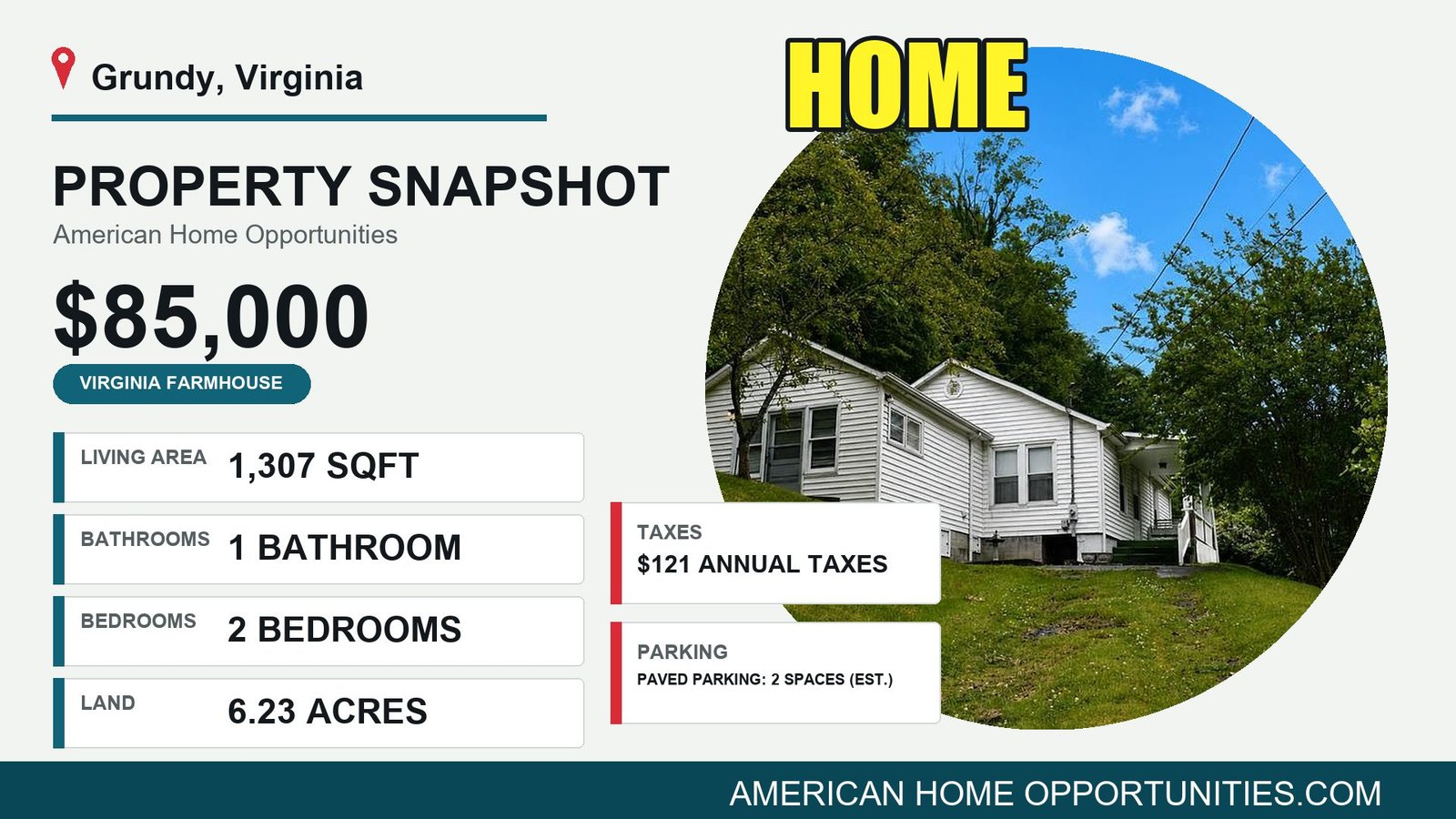
Six acres of Buchanan County hillside with public water and public sewer, four rooms you can sleep in, and a $121 tax bill.
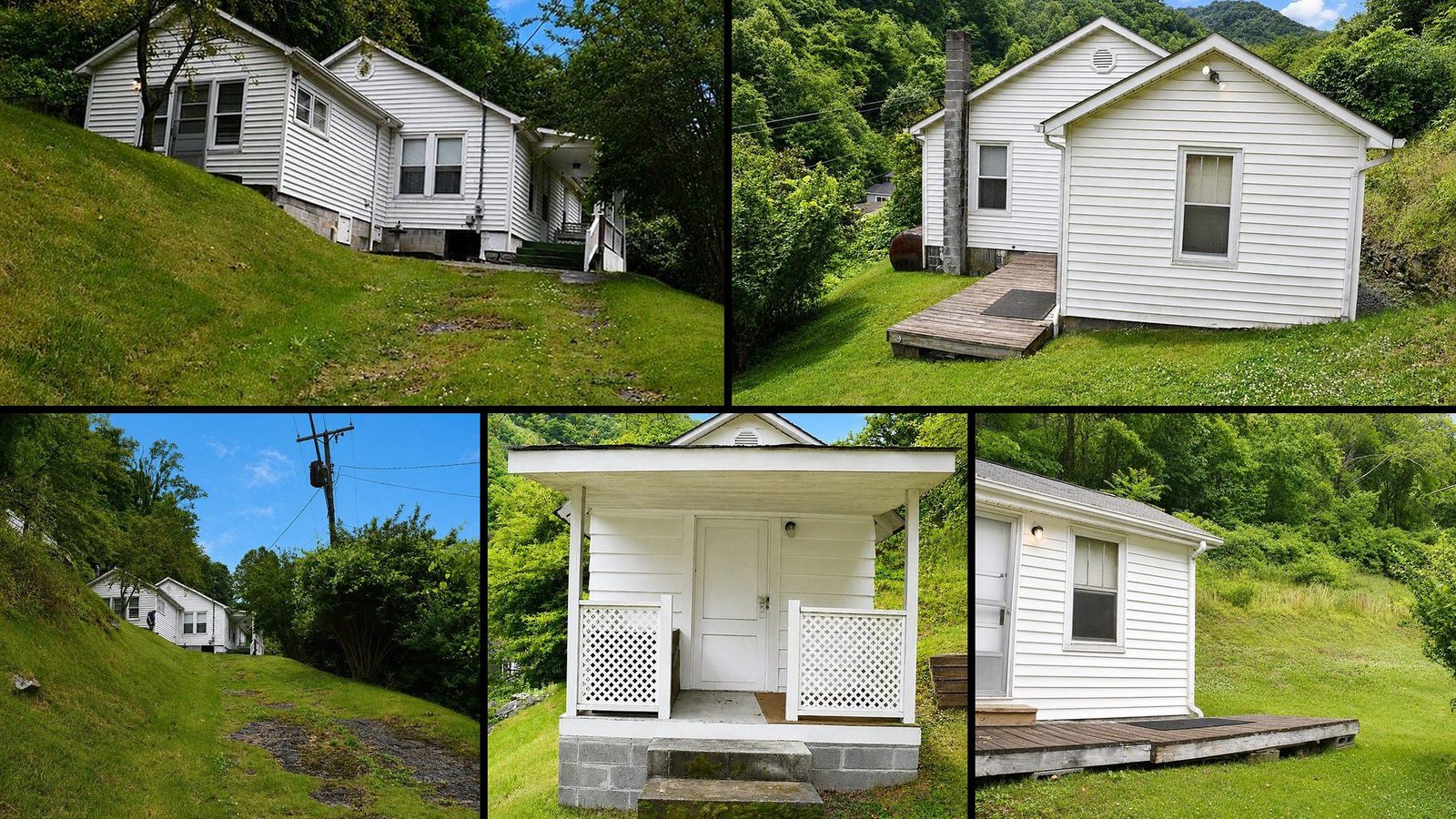
Six point two three acres just outside the town of Grundy, doing what Buchanan County land does — it rolls, it pitches, and it hands you a view. The lot is irregular and wooded with a steep pitch in places, which is why the county’s own feature list leads with views rather than acreage.
The house is a 1948 cottage in vinyl siding on a block foundation, and set apart from it is a detached outbuilding with its own roof.
Inside the Home
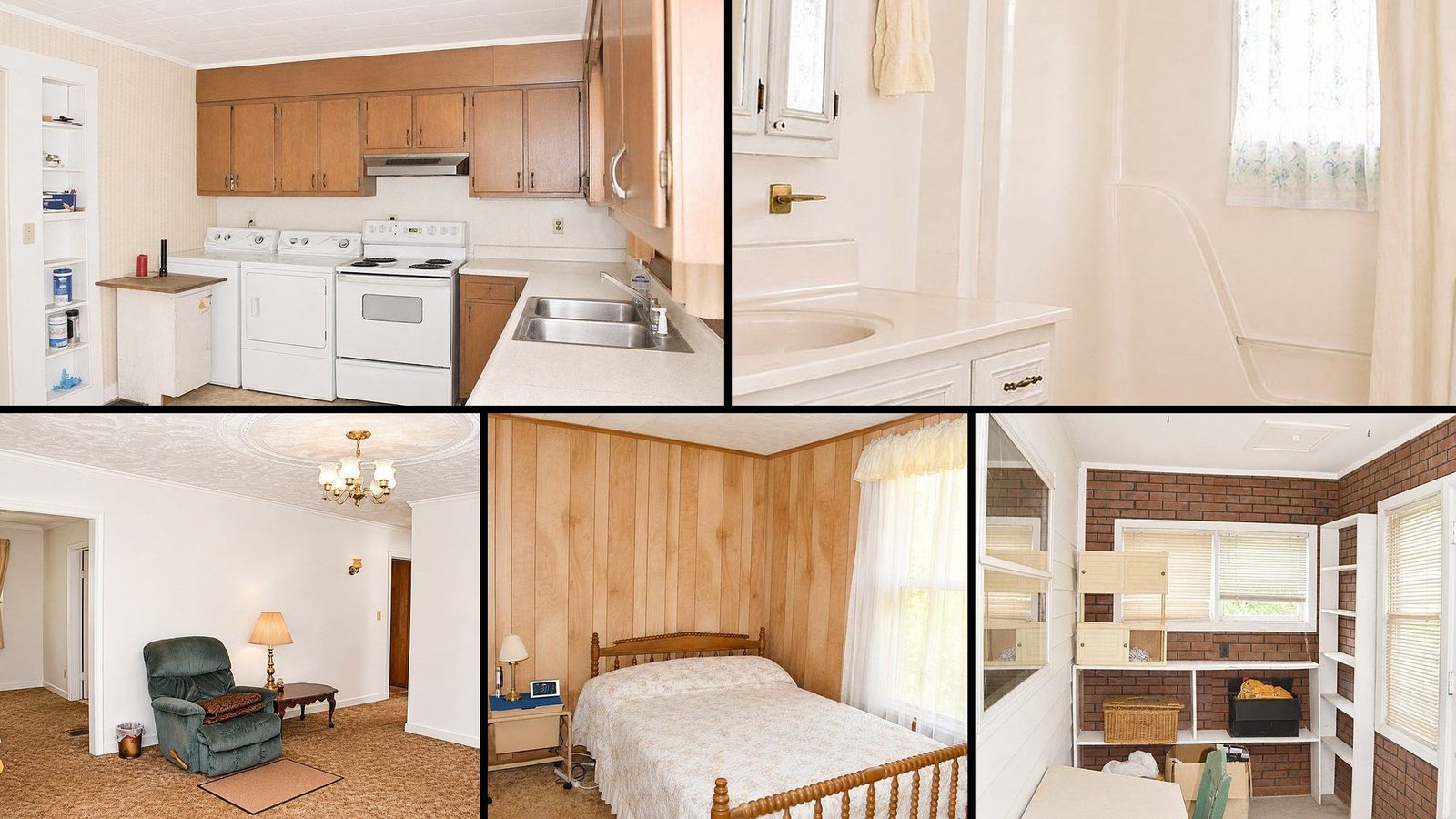
One thousand three hundred and seven square feet, and the bedroom count undersells the house. Two bedrooms and one full bathroom, but also two bonus rooms — and a bonus room with four walls and a door is a bedroom, an office or a hobby room depending on the week.
Everything lives on the main level: both bedrooms, the bath, the kitchen, the living room and a separate dining area, which is a room most houses this size gave up decades ago. Heating and cooling both run off a single heat pump. There is a free-standing fireplace, flooring is carpet and laminate, and the windows carry storm sash. The kitchen came with everything in it — electric cooktop, range, range hood, microwave, refrigerator — and the washer and dryer stay. Total structure measures 1,707 square feet, so there is roughly 400 feet of enclosed space beyond the finished living area.
Land and Outdoor Potential
Six point two three acres, wooded and rolling with steep sections, irregular in shape, with paved parking and a covered porch. The detached outbuilding is the piece worth planning around: a separate structure with a roof becomes a studio, a workshop, storage or income. Utilities are the surprise — public sewer and public water, on six acres, outside town.
On homesteading capacity this clears Virginia’s 5-acre agricultural minimum, which makes a land use application worth pursuing with Buchanan County directly. The slope is the working constraint: it limits flat ground for anything you would add later and it makes drainage a real question. Walk this property in the rain, not on a dry October afternoon.
About Grundy, Virginia
Grundy is minutes down the hill and it is the county seat, with Buchanan General Hospital right there — 111 beds, an emergency department, an intensive care unit and operating rooms. Here is what to know before buying anywhere near this town: Grundy’s entire downtown was physically rebuilt by the US Army Corps of Engineers, raised and relocated, because the Levisa Fork flooded it repeatedly. That project tells you exactly what the river does, and it is why a house sitting up on six sloping acres is in a very different position from a lot on the valley floor. County government and the school system are the steadiest employers; coal and gas carry the rest.
The honest trade-off: everything here is a mountain road, and the slope that keeps you out of the floodplain is the same slope that makes your driveway a maintenance item.
AHO Score: 76/100 — Solid Rural Deal
| Component | Score |
|---|---|
| Price / Value (25) | 18 |
| Land / Usability (20) | 14 |
| Condition (20) | 14 |
| Practical Location (15) | 13 |
| Charm (10) | 8 |
| Future Potential (10) | 9 |
| Total | 76 |
Buchanan County averages $4,490 an acre, 46th of 95 — the same county as listing #9, and mid-table rather than cheap. At 6.23 acres the land accounts for roughly $28,000, which is 32.9% of the $85,000 asking price and the fourth-highest land share on this page. Price per acre paid is $13,644; price per square foot is $65. The county assesses it at $31,200 and bills $121 a year, the lowest annual tax on this page. The score is carried by price and by future potential, the latter helped by the separate outbuilding and the two bonus rooms; it is held down by the terrain, which is what keeps the land component at 14 rather than higher.
Mark’s Verdict
This is the best balance on the page between acreage and price. Six acres clears the state land-use threshold, the tax bill is $121 a year, the appliances convey, and there is a separate outbuilding to convert. Public water and public sewer on six acres outside a town is genuinely unusual and removes two of the biggest unknowns in rural buying.
The caveat is the ground itself. Steep slope, rolling slope and irregular lot all appear in the county’s own feature list, and that means driveway maintenance, drainage questions and limited flat space for anything you want to add. Grundy also pulls in law students, pharmacy students, gas and coal contractors and hunters in season, and short-stay lodging here is thin — the listing’s mention of a small Airbnb is fair rather than fanciful, but check Buchanan County’s short-term rental rules first.
Who it is for: a buyer who wants real acreage and a low tax bill without a big house to heat, and who is willing to manage a hillside.
#2 — Willis, VA — $50,000 — 7.95 acres
Two separate cabins built in 2020 on nearly eight acres, minutes from the Blue Ridge Parkway — sold at online auction.
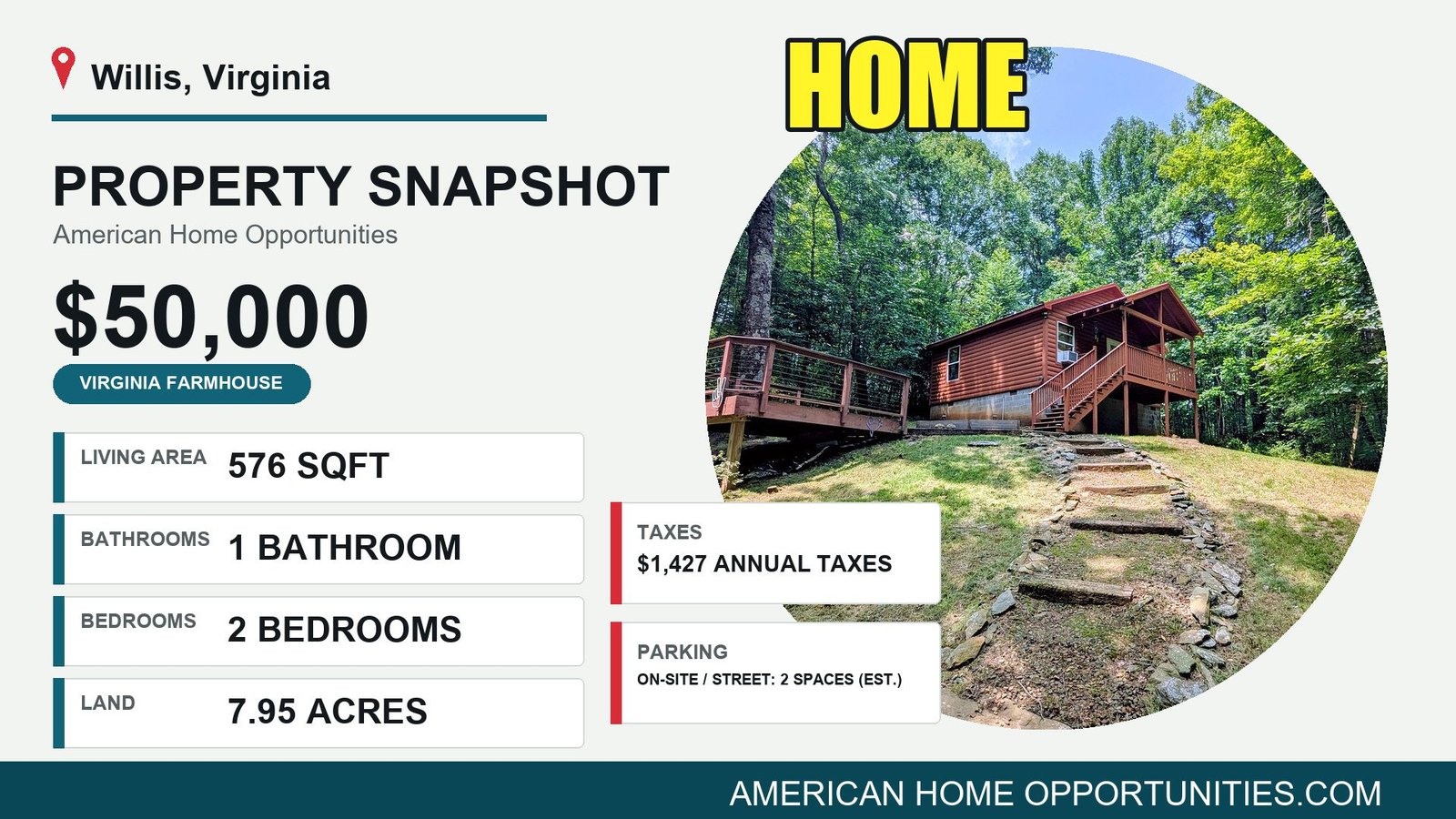
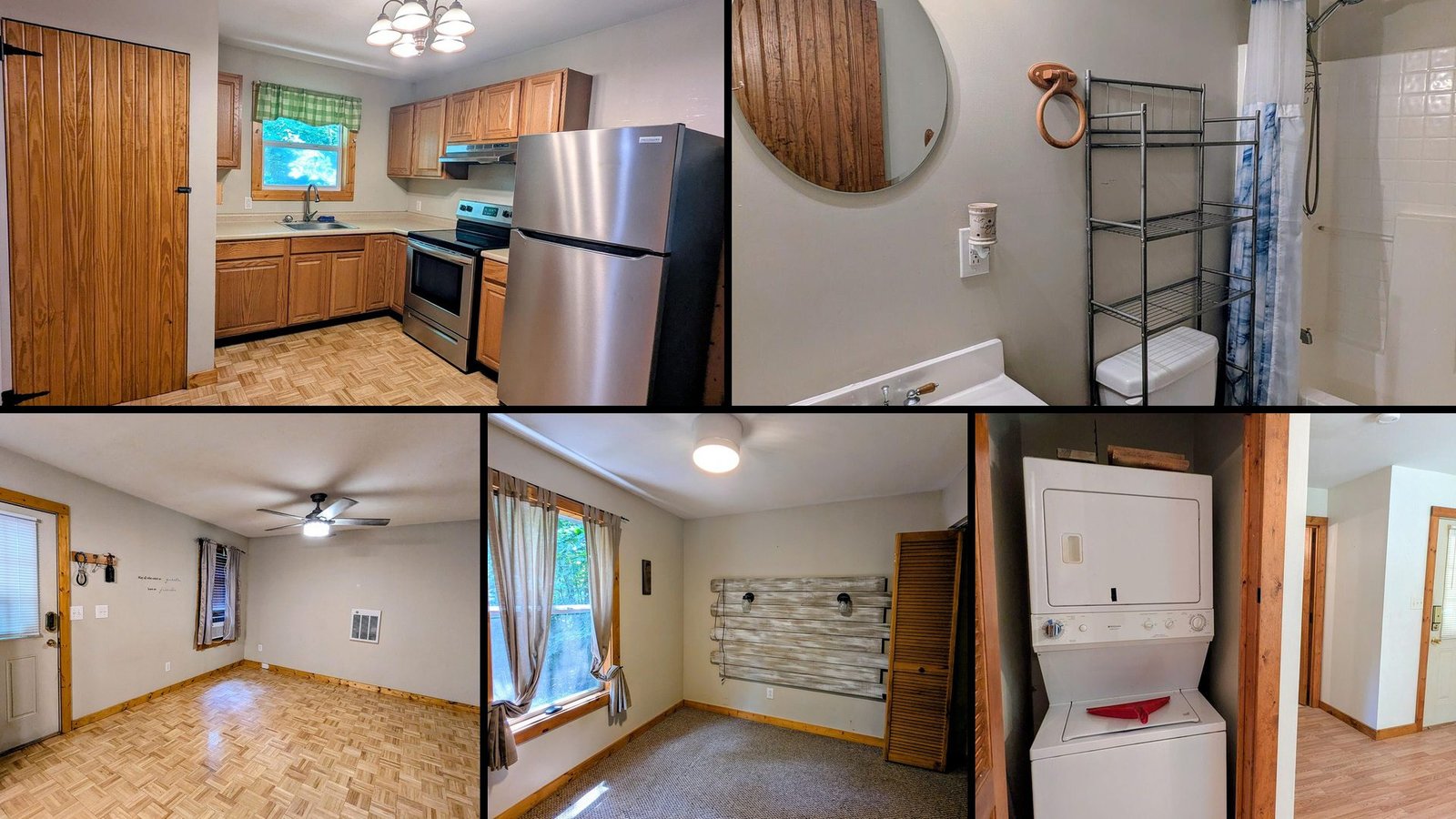
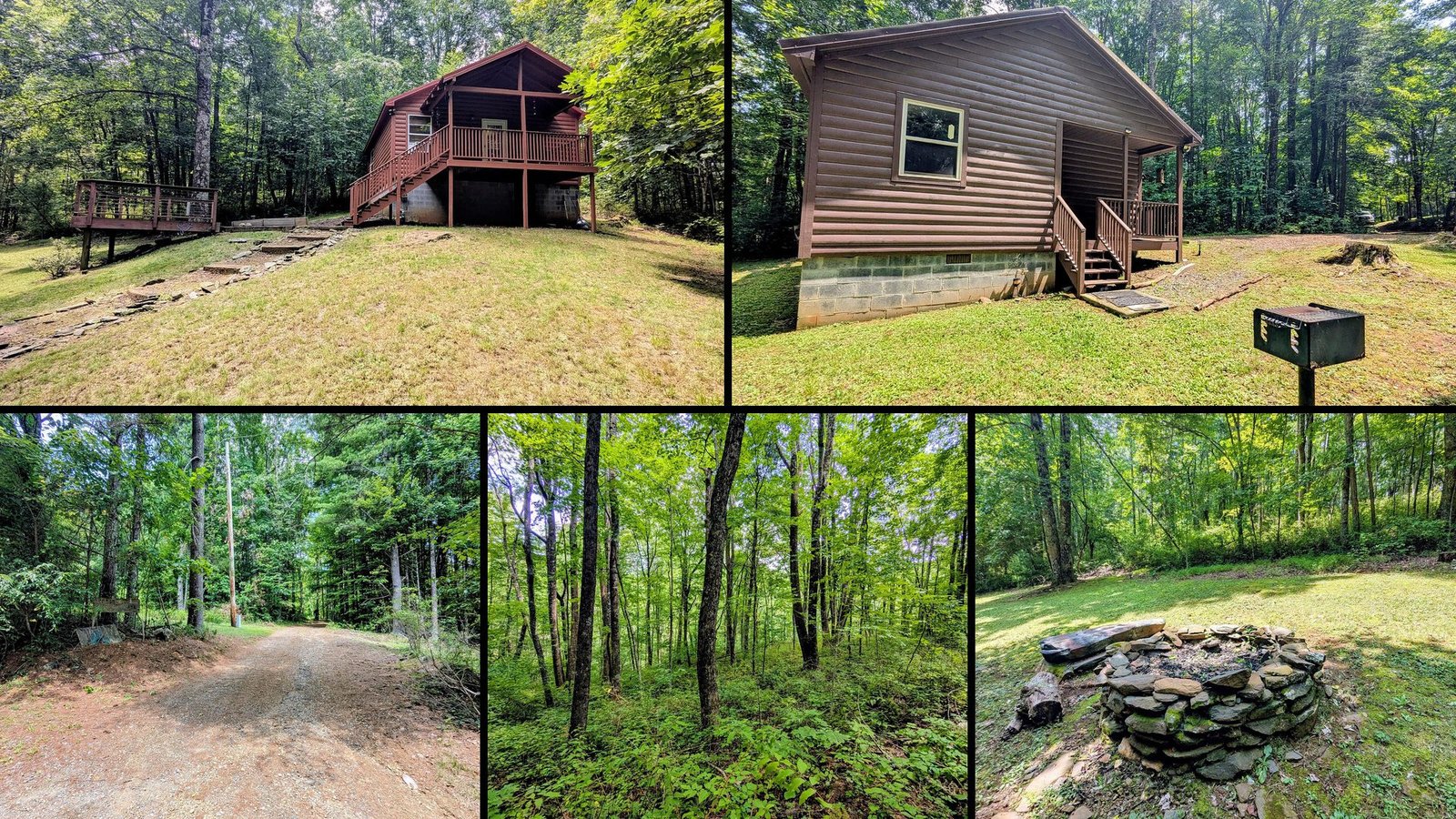
Seven point nine five acres in Floyd County, gently sloping rather than steep, with two separate cabins standing on it. Not a house and a shed: two finished dwellings, each with its own kitchen, bathroom and heat.
Both were built in 2020, which makes them the newest construction on this page by roughly seventy years. The address is the asset — minutes from the Blue Ridge Parkway at milepost 174, in the Rocky Knob stretch.
Inside the Home
Cabin one is 576 square feet with two bedrooms and a full bathroom. Cabin two is 468 square feet with one bedroom and a full bathroom. Neither is large and neither pretends to be; these are efficient, purpose-built buildings where everything was chosen for low maintenance rather than for show.
Cabin one carries a refrigerator, a range, washer and dryer hookups, a window air conditioning unit and an electric thermostat wall heater. Cabin two has a range, a stackable washer and dryer already installed, a window unit and the same wall heat. No furnace, no ductwork and no boiler anywhere on the property, which means very little to break and very little to service on a schedule. Between the two buildings you have 1,044 square feet of finished heated space and three bedrooms. Water comes from a well.
Land and Outdoor Potential
Seven point nine five acres, gently sloping and wooded, carrying two separate dwellings with real distance between them. The Blue Ridge Parkway is minutes away at milepost 174 and the Virginia-North Carolina line is within an hour.
On homesteading capacity this clears Virginia’s 5-acre agricultural minimum, so a land use application is worth raising with Floyd County. Gentle slope rather than steep makes this the most workable acreage on the page after listing #10’s pasture — garden ground, small livestock and a woodlot are all realistic here. The second cabin is what makes this unusual: a homestead with a built-in income unit, or space for family, already finished and permitted.
About Willis, Virginia
Floyd is the county seat, about 15 minutes north, and it is an unusual small town — the Floyd Country Store and the Crooked Road music trail pull visitors through year-round, and that traffic is the reason a rental cabin works here at all. Now the hard fact: Floyd County has no hospital. Carilion New River Valley Medical Center in Christiansburg is the emergency room, roughly 40 minutes north, a 146-bed facility and a Level III trauma centre. Christiansburg and Blacksburg are also the job market, with Virginia Tech anchoring the region.
The honest trade-off is that 40-minute drive, and mountain weather can lengthen it in winter.
AHO Score: 83/100 — Strong AHO Pick
| Component | Score |
|---|---|
| Price / Value (25) | 20 |
| Land / Usability (20) | 16 |
| Condition (20) | 18 |
| Practical Location (15) | 10 |
| Charm (10) | 9 |
| Future Potential (10) | 10 |
| Total | 83 |
Floyd County averages $4,519 an acre, 47th of 95. At 7.95 acres the land alone comes to roughly $35,900 — 71.9% of the $50,000 figure attached to the listing, the second-highest land share on this page. Price per acre works out at $6,289 and price per square foot at $87 across both cabins. But that $50,000 is a starting bid, not a price: this sells at online auction and the figure is what the auction company entered so the listing could publish. The replacement cost of two 2020-built cabins alone is a multiple of it. The county bills $1,427 a year in tax on the whole property. The score is carried by condition and future potential, both near maximum; it is held down by location, because the nearest emergency room is 40 minutes away.
Mark’s Verdict
Two finished, five-year-old dwellings on nearly eight acres minutes from the Blue Ridge Parkway is the clearest income position on this page, and the listing does not hide it — Parkway traffic runs heavy from May through October and again through fall colour. It is equally a homestead with a guest cabin, or a homestead that pays part of its own carrying cost.
The caveat is the process, and it is the same shape as listing #10. This sells at online auction ending September 2, 2026 at 4:00 PM: money arranged in advance, as-is with no inspection contingency, a buyer’s premium added on top of your bid, and a deposit due immediately. The $50,000 is a starting bid and nothing more. Confirm Floyd County’s short-term rental rules before you build a business plan on the second cabin.
Who it is for: a buyer with funds ready who wants acreage plus a rentable unit, and who understands that an auction closes on a fixed day for whatever the room decides.
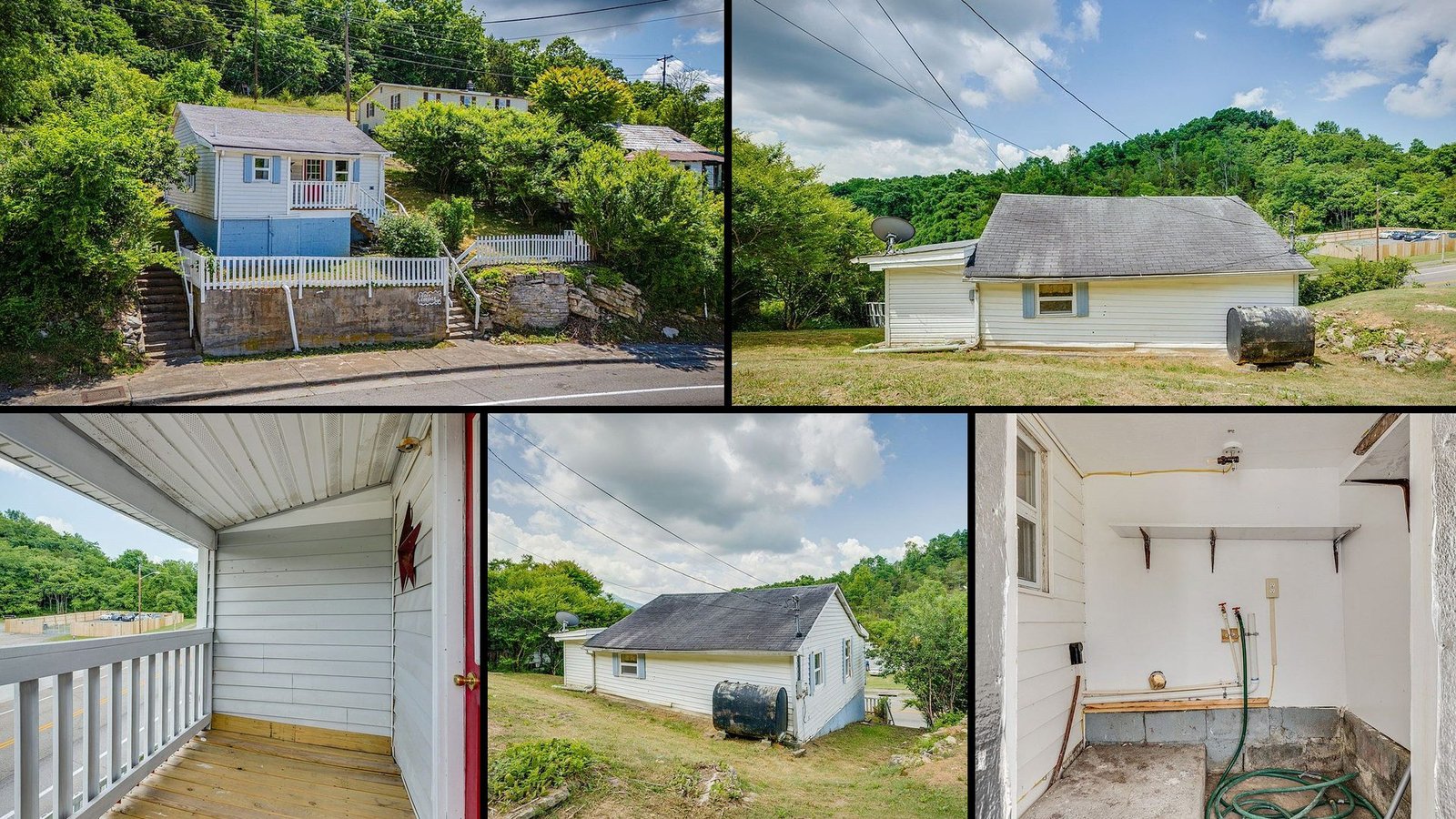
#1 — Lebanon, VA — $45,000 — 0.14 acres
The cheapest building on this page, on a seventh of an acre inside town limits under commercial zoning.
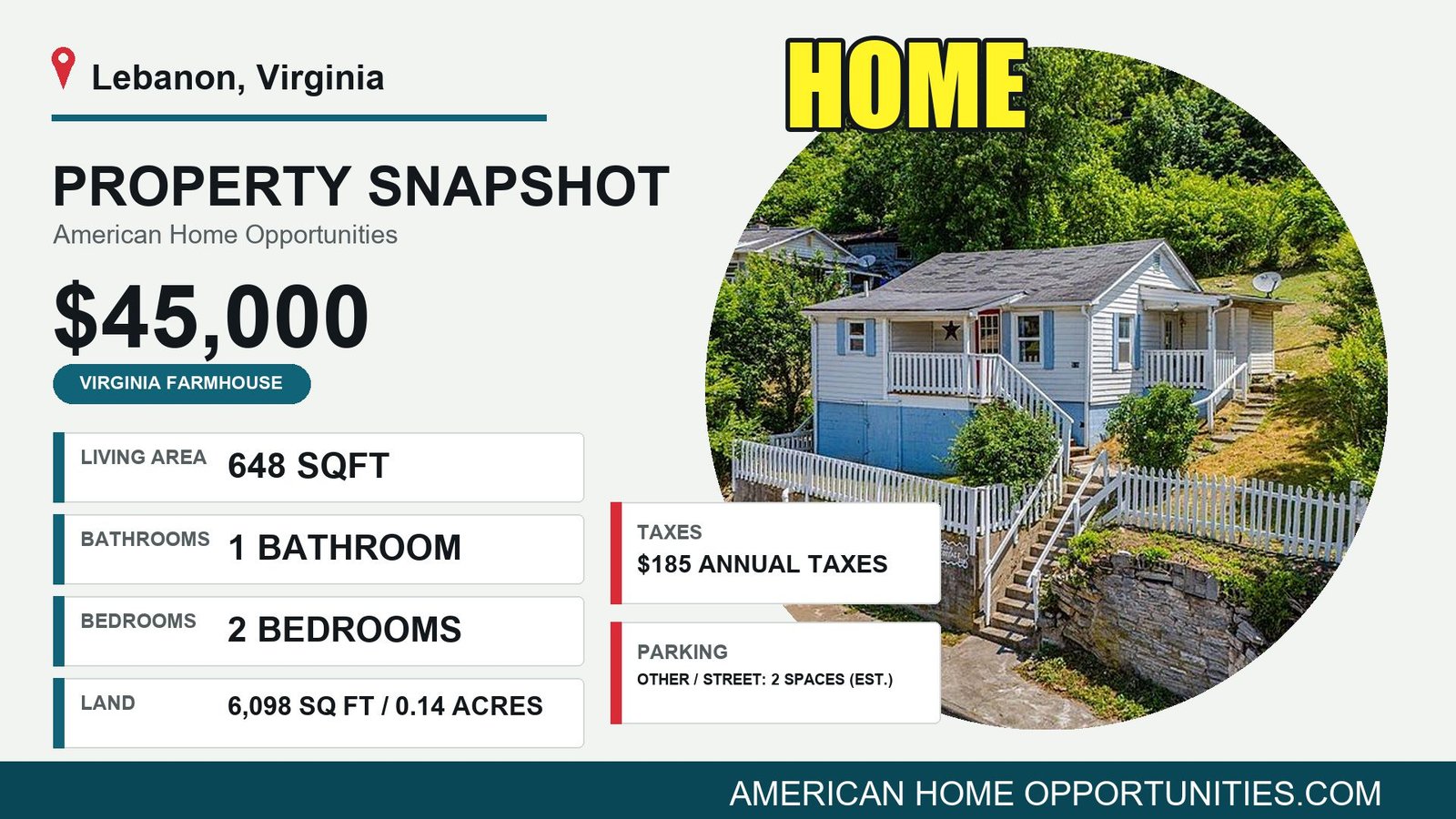
This is the property that does not fit the page, and it is here on purpose. Six thousand and ninety-eight square feet of lot — about a seventh of an acre — inside the town limits of Lebanon.
After ninety-six acres, thirty-seven acres and eight acres of cabins, this is a town lot with a yard you could cross in a dozen steps. It is also the cheapest thing on the list, and the only address here where you can walk to a grocery store.
Inside the Home
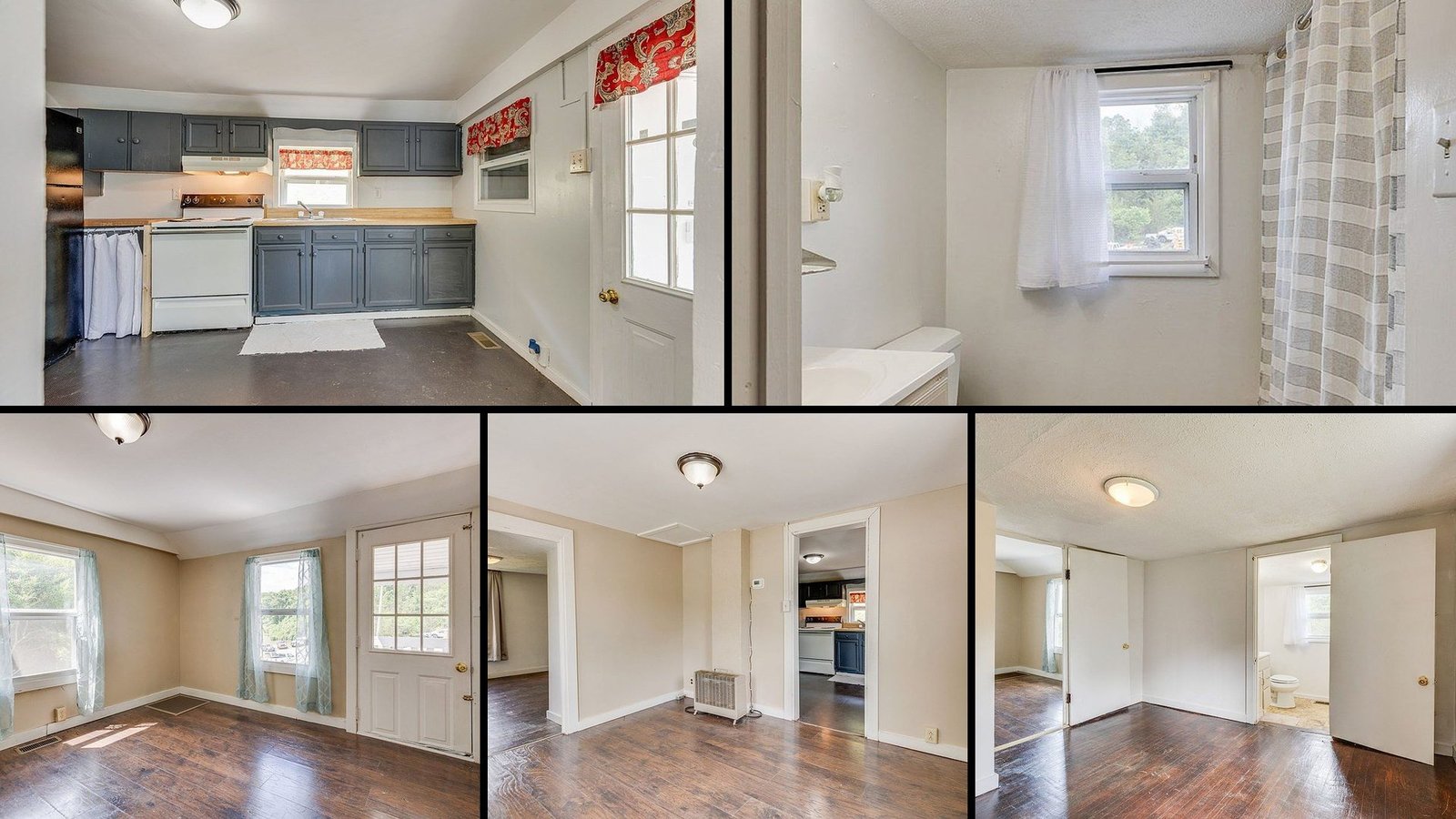
Six hundred and forty-eight square feet. Two bedrooms, one full bathroom, a living room and a kitchen, all on one level with nothing above and nothing below but a crawl space. The listing rates both interior and exterior condition as average, which is a rare piece of honesty and worth taking at face value: average means it works and it is tired, not that it is broken.
Flooring is laminate, vinyl and wood. The windows are vinyl, so they have been replaced. The walls carry plaster in places, which dates the build and holds heat better than drywall. The kitchen has an electric oven, an electric range, a range hood and a refrigerator, and laundry is on the main level with the hookups in. Heat is electric. And here is what is not in this house: there is no cooling of any kind — no central air, no heat pump, not even a window unit on the specification. In Southwest Virginia that is survivable, but it is the first thing you would buy.
Land and Outdoor Potential
Six thousand and ninety-eight square feet of lot, irregular in shape with a rolling slope, with a covered porch across the front. Utilities are public water and public sewer. Zoning is C-1, commercial.
This is the one property on this page that is not a homesteading parcel and cannot be made into one. At 0.14 acres it is nowhere near Virginia’s 5-acre agricultural minimum, nowhere near any locality’s reduced threshold, and the commercial zoning points it at a different use entirely. It is included because it appears in the video, because it is the price floor for the whole list, and because leaving it out would misrepresent what the cheapest end of the Virginia market actually looks like. If you came here for land, skip to #9.
About Lebanon, Virginia
This location you describe by walking it. Lebanon is the seat of Russell County, and the schools, the shopping, the town park and the community events are inside the town rather than a drive away. Russell County Hospital is right here — 78 beds, part of Ballad Health, with a 24-hour emergency department. And Lebanon has something almost no town this size has: CGI, the global information technology firm, runs a delivery centre in this town, putting salaried technical jobs on the local payroll alongside the hospital and the county government.
The honest trade-off is simple. In town means neighbours close, and after everything else on this list that is a real adjustment. This is the strongest practical location on the page and the weakest piece of land on it, and those two facts are the same fact.
AHO Score: 57/100 — High-Caution
| Component | Score |
|---|---|
| Price / Value (25) | 15 |
| Land / Usability (20) | 5 |
| Condition (20) | 12 |
| Practical Location (15) | 15 |
| Charm (10) | 4 |
| Future Potential (10) | 6 |
| Total | 57 |
Russell County averages $3,381 an acre, 14th cheapest of Virginia’s 95 counties. At 0.14 acres the land accounts for roughly $470 — 1.1% of the $45,000 asking price, and the lowest land share on this page by a wide margin. Price per acre paid is $321,429, which makes this the most expensive land on the page by a factor of more than a hundred against listing #9’s $2,344. Price per square foot, meanwhile, is $69 — among the cheapest here. Those two numbers are measuring completely different purchases, and this listing is the clearest illustration on the page of why land share matters. The county assesses it at $32,000 and bills $185 a year. The score of 57 is held down by land at 5 of 20 and charm at 4 of 10; it is carried entirely by location, which scores a full 15.
Mark’s Verdict
Forty-five thousand dollars for a functional two-bedroom on public water and public sewer, walking distance from a hospital, a town park, schools and shops, is a real proposition for the right buyer. The C-1 commercial zoning is the interesting part: a commercially zoned building this size in a county seat can be an office, a shop or a small service business, which widens the buyer pool well past people looking for somewhere to live.
The caveats are stacked. There is no cooling of any kind. The lot is a seventh of an acre. And the listing states outright that the square footage and acreage came from multiple sources with some estimated — take that seriously and get a survey, because on a lot this small a few feet either way is a meaningful percentage of what you are buying.
Who it is for: someone who wants a cheap, walkable base in a county seat, or a small business that needs a commercially zoned building. It is not for anyone who came to this page to homestead, and it scores accordingly.
Final Thoughts on the Best Counties in Virginia for Homesteading
The best values clustered in one place, and it was not the cheapest place. Buchanan County ranks 46th of 95 on price per acre — squarely mid-table — and it produced both the highest-scoring property on this page and the only listing where the land alone is worth more than the asking price. Southside’s counties dominate the cheap end of the ranking, but Southside inventory on this list came with two and three acres, not ninety-six. Cheap land and available acreage are two different questions, and the best counties in Virginia for homesteading are where the answers overlap.
Price per acre and price per square foot tell flatly opposite stories here, and the two extremes prove it. Listing #1 in Lebanon costs $321,429 an acre and $69 a square foot. Listing #9 in Oakwood costs $2,344 an acre and $182 a square foot. By land, Lebanon is the most expensive thing on the page by a factor of a hundred and thirty. By building, it is among the cheapest. Neither number is wrong; they are measuring different purchases, and which one you should care about depends entirely on whether you intend to farm.
And the best value was not the cheapest property. #1 in Lebanon is the lowest price on the list and scored 57, the only High-Caution band here. #9 in Oakwood costs five times as much and scored 88. The cheapest number on a page is almost never the best purchase on it — it is just the smallest one.
None of this replaces standing on the ground. Walk the boundary, walk it in the rain, and call the county before you call the agent.
A Checklist for Choosing the Best Counties in Virginia for Homesteading
Work through these before you make an offer anywhere. They are specific to Virginia, and several of them have no equivalent in neighbouring states, which is what makes shortlisting the best counties in Virginia for homesteading a different exercise from shortlisting in Tennessee or the Carolinas.
- Call the Commissioner of the Revenue first, not the agent. Ask two questions: does this county have a land use assessment ordinance, and what is its minimum acreage. The state floor is 5 acres agricultural and 20 forest, but localities may set theirs lower, and some have no program at all. This single call can be worth thousands of dollars a year.
- Budget the rollback before you plan any change of use. Converting qualifying land back out of the program triggers rollback taxes for the current year plus five preceding years, plus 10% interest. Six years, payable at once. If you plan to subdivide, build a second dwelling, or stop farming, price that liability into the offer.
- You cannot find a county with no building code. Virginia enforces a single Uniform Statewide Building Code. Unlike Tennessee, where a handful of counties require no permit at all, there is no jurisdiction here where you can build a dwelling unpermitted. Plan for permits and inspections everywhere.
- But use the farm building exemption, because it is generous. Under § 36-99, a farm building or structure is exempt from the building code entirely — no permit, no inspection — provided it is not used for residential purposes, sits on property where farming operations take place, and is used for storing, handling, producing or selling agricultural products, or for sheltering and handling animals. Barns, equipment sheds and animal shelters fall squarely inside it.
- If you will invite the public in, the exemption changes shape. A farm building used for agritourism — where the public enters for recreation, entertainment or education, and products are displayed, sampled or sold — still qualifies, but it must carry portable fire extinguishers, a simple written emergency plan, and a posted sign stating that the building is exempt from the Building Code.
- Get the well and septic permits before you get anything else. On a property without public water and sewer, the Virginia Department of Health permits both, and the county will not issue a building permit until they exist. Since August 2019 the application must be accompanied by supporting work from a private-sector consultant licensed through DPOR — typically a soil scientist or engineer. The construction permit expires 18 months after issue, so do not pull it early.
- Test a spring before you assume it is a water supply. Spring-fed and shared systems are common in Southwest Virginia and they complicate conventional financing. Get a flow test and a bacterial test, and talk to a local bank before you assume a standard mortgage is available. Listing #6 on this page is on a spring, not a drilled well.
- In coal country, confirm who owns what is underneath. Mineral rights are frequently severed from the surface across Buchanan, Dickenson, Russell, Wise and Tazewell counties. Listing #8 states outright that mineral rights do not convey. Ask for a title search that specifically reports the mineral estate, not just the surface.
- Check the topography line on the county record, not just the photos. Flood zone designations appear in the assessor’s topography field and rarely in the listing copy. Listing #5 is recorded as level and flood zone, on a creek. Pull the FEMA map and get an insurance quote in writing before you decide what the property costs per month.
- Know that the homemade food rules just changed in your favour. Virginia requires no state permit, licence, inspection or training to sell non-perishable homemade food direct to consumers, and there is no revenue cap on baked goods, jams, candy, honey or dried foods. As of HB 402, effective 1 July 2026, you may also sell and deliver online within Virginia for the first time, and the cap on acidified vegetables and pickles was removed. Label with your name, address and phone number.
- Price the vehicles, not just the land. Virginia levies an annual personal property tax on vehicles, assessed locally, and rates vary widely by county. A truck and a trailer are part of a homestead’s running cost here in a way they are not in every state. Ask the Commissioner of the Revenue about rates and about farm use plates before you budget.
You Might Also Like
Buying Rural Land in Virginia: What an Acre Really Costs · 10 Cheap Farmhouses in Virginia With Land · The AHO Score Methodology
Disclaimer
American Home Opportunities is not a real estate broker or agent, and is not affiliated with Zillow, with any listing agent, or with any auction company named on this page. Property information is taken from public listings and is subject to change or withdrawal without notice. Verify every detail independently before acting on it.
County land values quoted here are USDA 2022 Census of Agriculture data describing the estimated market value of land and buildings on operating farms. They are a comparison tool between counties, not an appraisal of any individual parcel.
The AHO Score is an editorial rating produced by American Home Opportunities. It is not an appraisal, an inspection, or investment advice.
Land use assessment minimums, rollback periods, permit requirements and personal property tax rates vary by locality and change over time. Confirm all of them with the county before making an offer.
Property photographs are from each property’s public listing and remain the copyright of the listing agent, brokerage or photographer. American Home Opportunities is not a real estate brokerage and claims no ownership of these images. Every property above links to its original listing. The article’s cover image is a digital illustration and does not depict a specific property. See our Copyright & Takedown Policy.