
How to Buy Land in West Virginia: What an Acre Costs and What Lies Under It
How to buy land in West Virginia, all 55 counties: what an acre really costs, who owns the minerals and the mountains, and the checks the state asks of you on mines, floods, access and a tax bill that doubles if you do not live there.
How to buy land in West Virginia: start by setting the Eastern Panhandle aside
If you are working out how to buy land in West Virginia, start with one number and then distrust it. The 2022 Census of Agriculture counts every farm in the state and puts the average value of West Virginia farmland and its buildings at $3,303 an acre. The USDA’s 2026 survey puts farm real estate at $3,640, against $4,500 for the country as a whole. Both are honest averages. Both are pulled up by three counties that behave like suburbs of somewhere else.
Berkeley, Jefferson and Morgan counties, the Eastern Panhandle, sit within commuting range of the Washington, D.C. area. The census averages them at $6,873 an acre, more than twice the rest of the state. Take those three counties out and the other 52 fall into a narrow band: from $2,593 an acre in central West Virginia and the Mid-Ohio Valley to $3,460 in the north. That is a gap of only a third between the cheapest region and the most expensive one. So the real decision when buying land in West Virginia is not which region is cheap. Almost all of it is. The decisions that change your money are underground and on paper: who owns the minerals, whether a mine runs beneath the parcel, whether the creek floods, and whether you live on the land or only visit it, because that last one can double the tax bill.
On the ten West Virginia homes we covered, the land was 12.1% of the price
We checked the census against the ten properties in our September 2026 West Virginia list, priced from $34,700 to $350,000. For each one we multiplied the acreage by its county’s census value and compared the result with the asking price. On average the ground underneath came to 12.1 percent of what the seller was asking. The highest share was 20.4 percent, on 8.4 acres outside Charleston. The lowest was 3.9 percent, on a third of an acre in Farmington, where nearly the whole price is a brick house.
That is the shape of this market. A $350,000 log home on seven acres in Lewis County sits on about $18,600 of census-value ground. In West Virginia you are not paying for land. You are paying for the house, the well, the septic and the road in, and the acreage comes along almost free. Judge a West Virginia property by the house and the paperwork, not by the price per acre.
Buying land in West Virginia: the numbers in short
West Virginia land prices by region: what an acre actually costs
We pulled all 55 West Virginia counties from the census and grouped them into the five regions people actually shop in. Each average is weighted by the acres in farms, so a county with a lot of farmland counts for more than one with a little. The last column names the cheapest county inside each region.
| Region | Farmland value per acre USDA, 2022 census | Land in farms | Cheapest county in the region |
|---|---|---|---|
| Eastern Panhandle | $6,873 | 144,964 acres 3 of 55 counties | Morgan, $5,715 |
| Northern West Virginia | $3,460 | 717,894 acres 12 counties | Wetzel, $2,290 |
| Potomac Highlands | $3,380 | 879,388 acres 8 counties | Randolph, $2,785 |
| Southern West Virginia | $3,298 | 828,029 acres 17 counties | Mingo, $1,361 |
| Central West Virginia and Mid-Ohio Valley | $2,593 | 978,829 acres 15 counties | Calhoun, $1,800 |
| West Virginia, all counties | $3,303 | 3,549,104 acres 55 counties | Mingo, $1,361 |
Why the regional table matters less here than in most states
In Kentucky or Tennessee the region you pick moves the price by half. In West Virginia, once the Eastern Panhandle is set aside, the most expensive region is only 33 percent dearer than the cheapest. The spread between single counties is wider, 5.2 to 1, but most of that is a few outliers: the D.C. commuter belt, Monongalia around Morgantown, and Cabell around Huntington at $5,367. Most of the state’s farmland sits between $2,000 and $4,300 an acre. We show the regions because buyers search by them, but we would not choose a West Virginia county by its census average. Choose it by the drive to work, the drive to a hospital and the flood map.
Where the cheapest land in West Virginia is, and the honest reason it is cheap
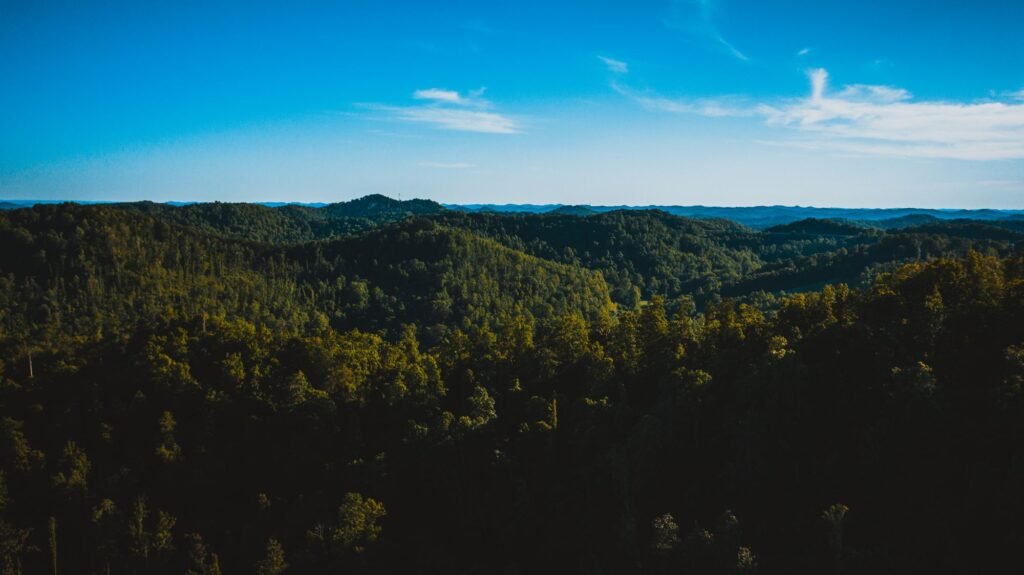
The cheapest real farmland in West Virginia is in the middle of the state. Calhoun County averages $1,800 an acre across almost 61,000 acres of farms. Braxton is $1,813, Webster $1,960, Roane $2,057 and Gilmer $2,104. These are the hill counties between Interstate 79 and the Ohio River, and together with the Mid-Ohio Valley they hold more than a quarter of the state’s farmland.
The reasons are not hidden. Most of the ground is steep and wooded, so an acre feeds fewer cattle than an acre of valley pasture. The jobs that built these towns, oil and gas, timber and some coal, have thinned, and the population has fallen with them. Interstate 79 crosses Braxton and Lewis, but much of the region is an hour or more from a larger hospital or a big-box store on two-lane roads. None of that makes the land bad. It makes it priced for people who can work remotely, retire, or live on less, and who have checked the drive before they fall for the view.
The coalfields look cheapest on paper, and that is misleading
Mingo County has the lowest census value in the state, $1,361 an acre. But the census counts only 4,083 acres of farmland in all of Mingo, and just 752 in Logan. The six southern coalfield counties, Boone, Lincoln, Logan, McDowell, Mingo and Wyoming, hold 1.1 percent of West Virginia’s farmland between them. The average there describes a handful of small farms, not a market where acreage is for sale.
The reason is who owns the mountains. A 2013 study by the West Virginia Center on Budget and Policy found that the 25 largest private owners hold 17.6 percent of the state’s private land, and that not one of the ten largest is headquartered in West Virginia. In six counties, five of them in the south, the top ten owners hold at least half of the private land. In Wyoming County two companies own more than 51 percent. That is why cheap listings in the coalfields are mostly houses on small lots in the hollows, not acreage. If you want 20 acres in southern West Virginia, expect to look harder and to read the mineral and mining history of every deed.
The counties at the top, and why
Jefferson ($7,118) and Berkeley ($7,055) are the most expensive counties because they are the most connected: Interstate 81, the MARC commuter train from Martinsburg and Harpers Ferry, and an hour or so to the outer suburbs of Washington. Monongalia ($5,944) has Morgantown and West Virginia University. Morgan ($5,715) is the Berkeley Springs weekend market. Cabell ($5,367) is Huntington. If you need a commute, you will pay for it. If you do not, every other county in the state is on sale by comparison.
What to check before buying land in West Virginia
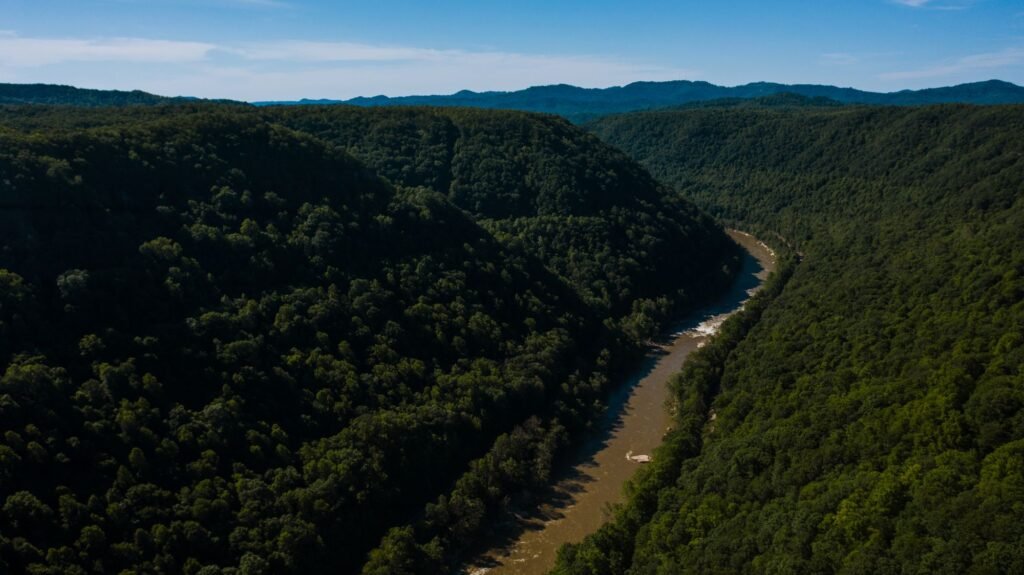
If you are learning how to buy land in West Virginia from another state, these are the six checks specific to it, in the order we would run them. The first three are about what is under the ground and what comes down the valley.
They are the ones a buyer from another state does not think to ask about, and they are the ones that decide whether a cheap parcel stays cheap.
In short, the six are: who owns the minerals, whether a mine runs underneath, whether the creek floods, whether the road in is legally yours, whether the ground will pass a perc test and take a well, and what the county actually regulates. None of them shows up in the asking price. All of them cost far less to check before you make an offer than after you close, and on a cheap parcel any one of them can be worth more than the land itself.
1. Find out who owns the minerals, and whether they are leased
2. Ask whether there is a mine under the parcel
3. Look up the flood zone, then the creek
4. Confirm the road in is yours to use
5. Get the septic and well permits lined up first
6. Ask the county what it actually regulates
We check the minerals, the flood map and the road before a West Virginia home makes our list
Every property we feature has been run against its county census value, its flood zone and its access before it reaches the channel. Leave your email and you get the next list, with the checks already done.
What it costs to own rural land in West Virginia
If you buy land in West Virginia, the property taxes look low, and for a home you live in they are. The Tax Foundation puts the effective rate on owner-occupied homes at 0.51 percent, against a national range of 0.29 percent in Hawaii to 1.88 percent in New Jersey and Illinois. The state income tax runs from 2.11 to 4.58 percent, sales tax averages 6.59 percent with local add-ons, and there is no estate or inheritance tax.
The catch is in how land is classified. Every county assessor values property at its market value and taxes 60 percent of it. Then the property falls into a class. A home you live in, and a farm worked by its owner or a tenant, is Class II. Anything else outside a town, vacant land, a hunting tract, a weekend cabin, a rental, is Class III. Inside a town it is Class IV. By law the Class III rate is twice the Class II rate. In 2025 the statewide average levies were $1.21 per $100 of assessed value for Class II, $2.19 for Class III and $2.95 for Class IV.
The arithmetic, with the state’s own 2025 averages
Take a $60,000 parcel outside town: ten acres with a small house. The county assesses it at 60 percent, or $36,000. If it is your home, Class II at the statewide average comes to about $436 a year. Buy the same place as a weekend retreat and it is Class III: about $788. If you are 65 or older, or permanently disabled, and it is your home, the homestead exemption takes $20,000 off the assessed value and the bill drops to about $194. Your county’s actual levy will differ from the state average, so ask the sheriff’s tax office for the current rate by class.
Farm use, managed timberland and the homestead exemption
Two programs can lower the tax on the land itself. Farm use valuation taxes farmland on what it earns as a farm rather than on its market value. County assessors apply it to units of at least 5 acres producing $1,000 or more a year in farm products, or smaller units with at least $500 in sales, and the form is due by September 1. Managed Timberland, run by the West Virginia Division of Forestry, needs at least 10 contiguous wooded acres and a forest management plan from a registered forester, with the contract filed before July 1. Neither is automatic, and neither follows the land to a new owner without a new filing. The homestead exemption of $20,000 of assessed value is for owners who are 65 or older, or permanently and totally disabled, on their primary residence.
Closing, broadband and the drive to a hospital
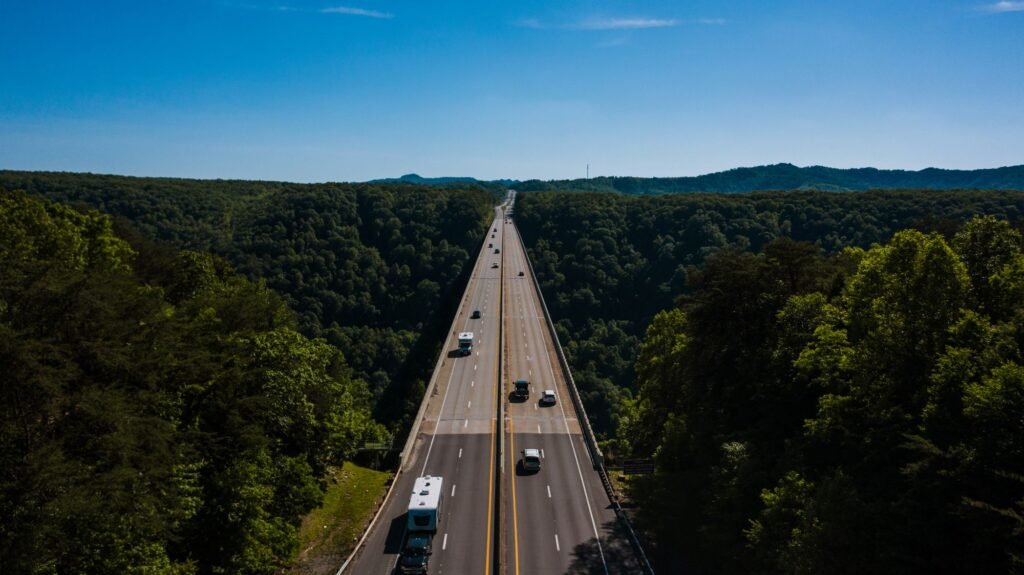
When you buy land in West Virginia, it closes with a deed and, if there is a loan, a deed of trust. The state charges a transfer tax of $1.10 for each $500 of value, and counties add 55 cents for each $500, which is $3.30 per $1,000 in most counties. By custom the seller usually pays it, but it is negotiable. Budget for a survey: old West Virginia deeds often describe boundaries by trees, stones and creeks, and a fence line is not a property line.
Internet is still the weak point in the hills. Under the federal BEAD program the state is extending broadband to its remaining unserved homes, but in 2025 about 40,000 households that rely on fixed wireless were reclassified as already served, so check what actually reaches the address rather than the county map. Do the same with health care. Look up the nearest emergency room, the nearest hospital that admits patients, and the nearest maternity ward if it matters to you, and drive the route in winter before you commit.
Why the price per acre on a listing site is not the price of land
Search online for land to buy in West Virginia and you will see averages far above the census. In October 2026 LandSearch showed 2,966 West Virginia listings asking an average of $14,605 an acre, about 4.4 times the census value of farmland. That is not because land is four times more expensive than the USDA says. A listing-site average divides asking prices, including houses, by acres, and its average listing is only 21.5 acres. Small parcels with a house, a well and a road carry most of their price in those improvements. Compare price per acre only between parcels of similar size, and price per square foot only between similar houses.
Cheap land and homes we have covered in West Virginia
Every list we have published for people looking to buy land in West Virginia, with the county data behind each property. Asking prices are from the date of each list and many of these homes have since sold.
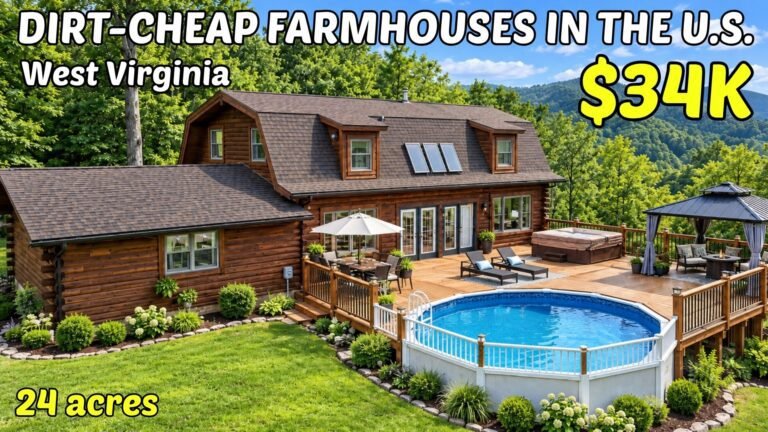
West Virginia guides
The two questions that decide most West Virginia purchases: who owns what lies under the land, and what it really costs to move here and live on it.
Keep exploring before you settle on West Virginia
West Virginia is the cheapest state we cover for a house with land, and the one where the deed deserves the closest reading. These are worth a look while you are still deciding how to buy land in West Virginia and where.
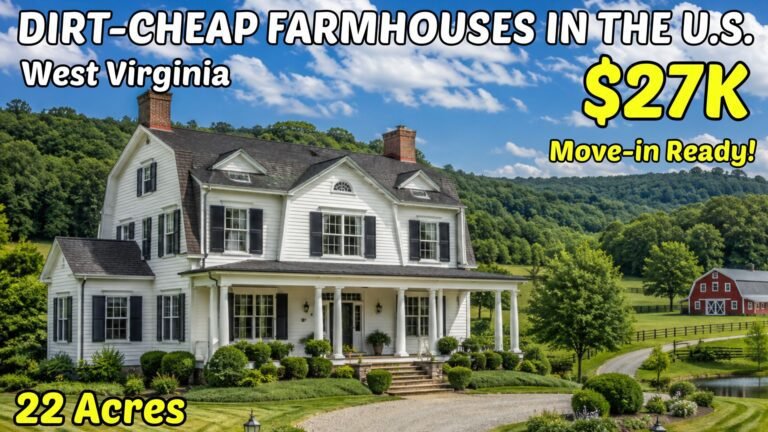
- Cheap houses in West Virginia – ten real homes with land, county by county, with the census check on each one.
- Why cheap rural homes don’t sell, and how to buy one anyway – the financing and inspection traps behind the lowest prices.
- VA loans for manufactured homes – what the VA requires of a manufactured home and its land before it will back the loan. In West Virginia, 13.2% of homes are mobile or manufactured, one of the highest shares in the country.
- The cheapest states to buy land in America – where West Virginia sits against the rest, measured with the same federal survey.
- The best states to homestead – land, tax and rain scored together.
- Rural property guides, the Rural Property Field Guide and how the AHO Score works – every guide we publish, the checks we run, and how a property earns a place on our lists.
Get the next batch of West Virginia listings first
We keep coming back to West Virginia, because it is where a house with land still costs less than a new truck. Leave your details and the next West Virginia list reaches you before it goes public.
Common questions about buying land in West Virginia
How much is an acre of land in West Virginia?
West Virginia farmland and farm buildings averaged $3,303 an acre in the 2022 USDA Census of Agriculture, and farm real estate averaged $3,640 in the USDA’s 2026 survey, against $4,500 nationally. Counties range from $1,361 an acre in Mingo to $7,118 in Jefferson. Listing sites ask far more, about $14,605 an acre in October 2026, mostly for small parcels with houses.
Where is the cheapest land in West Virginia?
The cheapest farmland is in central West Virginia, between Interstate 79 and the Ohio River. In the 2022 USDA census Calhoun County averaged $1,800 an acre, Braxton $1,813, Webster $1,960, Roane $2,057 and Gilmer $2,104. Mingo is lower at $1,361, but the southern coalfields have very little farmland for sale, so cheap listings there are mostly small lots with houses.
Why is West Virginia land so cheap?
West Virginia land is cheap because most of it is steep and wooded, the population is shrinking and many rural areas are far from jobs and hospitals. Outside the Eastern Panhandle near Washington, D.C., county farmland averages from about $1,800 to $4,300 an acre. Mineral severance, mine subsidence and flood risk also keep some parcels cheap.
Who owns most of the land in West Virginia?
Mostly private owners, and a large share are out-of-state companies. A 2013 West Virginia Center on Budget and Policy study found the 25 largest private owners held 17.6 percent of the state’s private land, none of the top ten headquartered in the state. In six counties, five in the southern coalfields, the top ten owners held at least half the private land.
Do you get the mineral rights when you buy land in West Virginia?
Often not. In much of West Virginia the coal, oil and gas were severed from the surface long ago, so your deed may convey the surface only. A mineral owner with a lease can then build a well pad or road on your land, with notice and compensation set by state law. Ask the title examiner to search the mineral estate before closing.
Do you need a building permit in West Virginia?
It depends on the county. The State Building Code applies only where a county or town has adopted it, and many rural counties have not. You still need county health department permits for a septic system and a well, and a floodplain permit if the site is in a mapped flood zone.
How much are property taxes on land in West Virginia?
Property is assessed at 60 percent of market value and then taxed by class. In 2025 the statewide average levy was $1.21 per $100 of assessed value on a home you live in and $2.19 on vacant land or a second home outside town. On a $60,000 parcel that is about $436 a year as your home and $788 as a weekend place.
Before you buy, the important part
American Home Opportunities is a publisher. We are not a real estate broker, agent, lender, appraiser, attorney or financial advisor, and nothing on this page is legal, tax or financial advice.
County farmland values come from the USDA Census of Agriculture 2022, West Virginia, Table 8, and measure farmland and the buildings on working farms rather than asking prices for small parcels; the regions are our own grouping of all 55 counties, weighted by land in farms. State farm real estate values come from the USDA NASS Land Values 2026 Summary. The effective property tax rate and income and sales tax rates come from the Tax Foundation, and the average rates of levy by class from the West Virginia State Tax Department for tax year 2025. Median home value and homeownership come from the Census Bureau’s American Community Survey 2020–2024.
Legal references are to W. Va. Code § 11-3-1 (assessment at 60 percent), § 11-8-5 (property classes), § 11-1A-10 (farm use valuation), § 11-22-2 (transfer tax) and § 33-30-6 (mine subsidence insurance), to the Division of Forestry’s Managed Timberland program, and to Cobb v. Daugherty (W. Va. 2010) on easements by necessity. Land ownership figures come from the West Virginia Center on Budget and Policy, 2013; flood risk from the First Street Foundation; broadband from the Benton Institute, September 2025. Listing-site prices come from LandSearch, October 2026.
Any price we quote for a property is an asking price at the time of writing, not a sale price. Rural land carries risks this page can introduce but not resolve for your parcel, including severed minerals, mine subsidence, flooding, water and wells, septic suitability, legal access, surveys, easements, title, repairs, insurance and financing. Verify everything with the county assessor, the health department, the title examiner and licensed professionals before you commit money. Page published October 2026.