
How to Buy Land in Ohio: What an Acre Costs, Hills to Flatlands
How to buy land in Ohio, all 88 counties: why the line the glaciers left still sets the price of an acre, what the southeast hills save you, and the checks Ohio leaves to its counties on mines, mineral rights, lot splits, wells and septic.
How to buy land in Ohio: start with the line the glaciers left
How to buy land in Ohio comes down to one line on the map. North and west of it, the last glaciers flattened the ground and left deep soil, and an acre is priced on what corn and soybeans pay. South and east of it, in the hills the ice never reached, the same acre costs about half as much.
This guide walks through how to buy land in Ohio with the federal census for all 88 counties: what an acre costs in each region, why the cheapest counties are cheap, and the checks that matter here and almost nowhere else, from mine subsidence to severed oil and gas rights. Every figure has its source next to it, so you can check it before you buy land in Ohio yourself.
On the ten Ohio homes we covered, the land was 14 percent of the price
We priced each property’s acreage at its county’s census value and divided by the asking price. The exceptions prove the rule: a 20-acre place near Andover in Ashtabula County, where the land alone was worth 39.5 percent of the price, and a farm near Empire in Jefferson County at 31.2 percent. Where the acreage is big and the county is cheap, the land starts to matter. Everywhere else, inspect the house first.
Buying land in Ohio: the numbers in short
Ohio land prices by region: what an acre actually costs
| Region | Farmland value per acre USDA, 2022 census | Land in farms | Cheapest county in the region |
|---|---|---|---|
| Southeast hill country | $4,905 | 2,009,545 acres 19 of 88 counties | Lawrence, $3,357 |
| Outer Appalachian Ohio | $6,682 | 1,847,839 acres 13 of 88 counties | Adams, $5,254 |
| Central | $8,580 | 2,063,726 acres 11 of 88 counties | Fairfield, $7,551 |
| Northwest | $8,653 | 3,861,738 acres 18 of 88 counties | Williams, $7,565 |
| Northeast and north-central | $9,387 | 1,387,093 acres 13 of 88 counties | Huron, $7,432 |
| West-central and southwest | $9,450 | 2,482,405 acres 14 of 88 counties | Montgomery, $7,918 |
| Ohio, statewide | $8,043 | 13,652,346 acres 88 of 88 counties | Lawrence, $3,357 |
Two gaps tell you how to read this table. Between regions, the most expensive costs 1.9 times the cheapest. Between counties, among the ones that still have real farmland, the spread is 3.7 times, from Lawrence at $3,357 to Mercer at $12,513. So the region narrows your search, but the county decides the price, and that is the first rule of how to buy land in Ohio. Cuyahoga ($32,555) and Summit ($21,036) are left out of that comparison: they have under 16,000 acres of farms each, and those acres are priced as suburbs.
Why the flat northwest costs nearly twice the southeast hills
Ohio farmland is priced on yield. The glaciated two thirds of the state has the deep, level soil that grows corn and soybeans at scale, and a farmer bidding on a field in Darke or Mercer County is paying for what that field produces. That is why the west-central counties, with the biggest grain and livestock operations in the state, top the table.
The southeast is a different landscape. The ridges and hollows of the unglaciated Allegheny Plateau are steep, wooded and thin-soiled, and much of the ground was mined for coal in the last century. It makes poor cropland and good hunting, timber and homestead land, and the census prices it accordingly. For a buyer working out how to buy land in Ohio for acreage, woods and a view rather than a grain operation, that is the opportunity.
One region breaks the pattern. Holmes County sits inside Appalachian Ohio on paper, but at $9,808 an acre it is priced like the northwest. It is the heart of Ohio’s Amish country, where small family farms compete for every acre that comes up. If you are shopping the hills on a budget, look south of Interstate 70.
Where the cheapest land in Ohio is, and the catch
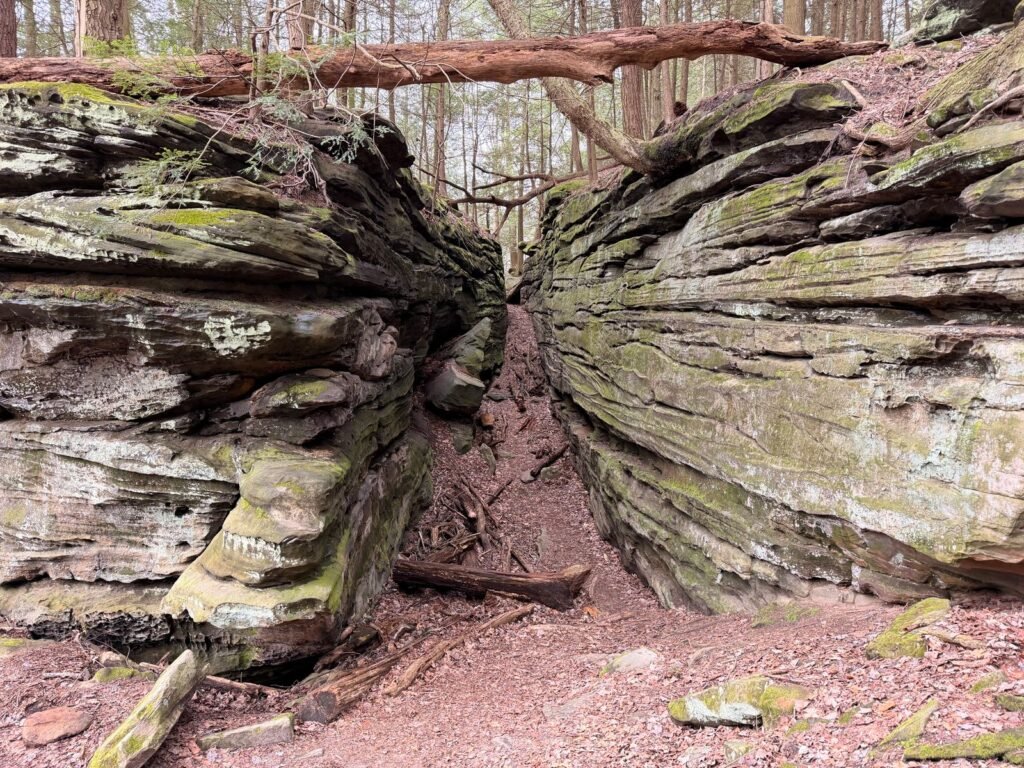
The ten cheapest counties in Ohio are all in the southeast, and they form one continuous block along the Ohio River and the hills behind it. Lawrence, Gallia and Meigs face West Virginia across the river. Athens, Vinton, Jackson and Pike run inland toward Chillicothe. Monroe, Noble and Morgan fill the hills around Marietta and up toward Zanesville.
The catch is not hidden, and it is not the land. It is distance and services. Some of these counties have one grocery store, a critical access hospital rather than a full one, and long drives to a specialist. The coal mines and power plants that once anchored the region have mostly closed. That is exactly what keeps the price down, and it is worth weighing honestly before you fall for the view.
The upside is real too. Hocking County, home to the Hocking Hills, averages $6,488 an acre and has a steady visitor economy. Washington County around Marietta averages $4,671 and has a college town and a regional hospital within reach. Cheap does not have to mean isolated if you choose the county with care.
The ten cheapest counties for farmland in Ohio
- Lawrence County: $3,357 an acre, on 51,104 acres of farms
- Gallia County: $3,625 an acre, on 101,469 acres of farms
- Meigs County: $3,816 an acre, on 63,118 acres of farms
- Pike County: $3,899 an acre, on 87,549 acres of farms
- Athens County: $4,123 an acre, on 106,866 acres of farms
- Monroe County: $4,184 an acre, on 99,313 acres of farms
- Vinton County: $4,236 an acre, on 34,112 acres of farms
- Jackson County: $4,273 an acre, on 66,565 acres of farms
- Noble County: $4,332 an acre, on 98,064 acres of farms
- Morgan County: $4,363 an acre, on 93,381 acres of farms
All ten are in the southeast hill country, and nine of them are counties where Ohio builds mine subsidence coverage into every homeowners policy. That is why two of the six checks below, mine subsidence and mineral rights, matter most in exactly the counties where the land is cheapest.
What to check before you buy land in Ohio
Ohio leaves most of the decisions about rural land to its 88 county auditors and health districts and to the townships. These six checks are the ones that come up again and again in the hill counties, and the ones a listing will not tell you about.
1. Ask about old mines under the land
2. Find out who owns the oil, gas and coal
3. Know the five-acre line before you split or build
4. Test the well yourself
5. Find out what the septic system really is
6. Ask whether the land is enrolled in CAUV
We look at the county, the mines and the minerals before an Ohio home makes our list
Every Ohio property we feature is checked against its county’s farmland value, the mine subsidence map and the road in before it reaches the channel. Leave your email and the next list arrives with that work already done.
What it costs to own rural land in Ohio
Ohio taxes real property more heavily than most of its neighbors. The Tax Foundation puts the effective rate on owner-occupied homes at 1.36 percent. The mechanics are simple: the county auditor appraises the land, it is assessed at 35 percent of that value, and the local millage, set by each township, school district and county levy, is applied to the assessment. On farm and timber land, CAUV changes the whole picture, and it belongs in any plan for how to buy land in Ohio on a budget.
The arithmetic, with one township’s real rate
Two warnings about that chart. CAUV values the soil, so steep woods and poor hill soils sit near the floor while prime cropland can reach $4,390 an acre. And the program is for working land: the 10-acre and $2,500 tests are real, and the auditor can and does remove parcels that stop qualifying.
CAUV, the homestead exemption and the other breaks
If you will live on the land, the owner-occupancy credit lowers the tax on your home, and Ohio is raising it in steps through 2029 under House Bill 186. Owners 65 and older or permanently disabled, with income under the state limit, can also take the homestead exemption on part of the home’s value, and disabled veterans get a larger one. All of them are filed with the county auditor, and none of them transfers automatically when you buy.
On the income side, Ohio moves to a flat 2.75 percent income tax on nonbusiness income above $26,050 from tax year 2026. The state sales tax is 5.75 percent, and counties add their own on top.
Closing, the conveyance fee and building permits
Most Ohio sales close through a title company, which runs the title search, holds the money and records the deed with the county recorder. Ask for an owner’s title policy and, on any rural parcel without a recent survey, pay for one: fence lines in the hills often wander well off the legal description.
The state charges a conveyance fee of $1 per $1,000 of the sale price, and nearly every county adds up to $3 more, for a maximum of $4 per $1,000. By custom the seller pays it, but the contract decides.
Ohio has a statewide residential building code, but it is enforced only where a certified local building department exists. In many rural townships nobody inspects a new house or an addition. That does not mean anything goes: the well and the septic system still need health district permits, and a lender or an insurer will still want to see the work. Treat an unpermitted addition on an older farmhouse as a question, not a bargain.
Why the price per acre on a listing site is not the price of land
Land listing sites showed an average asking price of $45,259 an acre across 5,942 Ohio listings when we checked in October 2026, 5.6 times the census value. That gap is mostly about size. Most listings are small building lots of one to five acres, priced as homesites, and a few lots near the cities pull the average far above what a working acre sells for. The census measures whole farms. For a sense of what a large tract is worth, use the county figure in the table above; for a small lot, compare recent sales of lots of the same size in the same township.
Cheap land and homes we have covered in Ohio
Every list we have published for people looking to buy land in Ohio, with the county census value behind each property. Asking prices are from the date of each list, and some of these homes may have sold since.

Ohio guides
The two questions that come right after the price of an acre: what it really costs to live here, and how to make a homestead work under Ohio’s rules.

Keep exploring before you commit to Ohio
Ohio is really two markets, the flat farm country and the hills, and the right one depends on what you want the land for. These pages help you compare before you decide how to buy land in Ohio, or whether a neighboring state fits better.
- Moving to Ohio: the real cost of rural living – prices against the US average, the local income taxes newcomers miss, and your first 30 days.
- Homesteading in Ohio – the five-acre rule, wells and cisterns, CAUV and the food you can sell, step by step.
- Homes with land for sale in Ohio – ten real listings from $29,999 to $350,000, with the county census value and the AHO Score on each one.
- Why cheap rural homes don’t sell, and how to buy one anyway – the financing and inspection traps behind the lowest prices.
- The cheapest states to buy land in America – where Ohio sits against Kentucky, West Virginia and Pennsylvania, with the same federal data.
- The best states to homestead – land, tax and rainfall scored together.
- Rural property guides, the Rural Property Field Guide and how the AHO Score works – the checklists we use on every property.
Get the next batch of Ohio listings first
We publish new Ohio homes with land as we find them, from the river counties to the northeast. Tell us what you are looking for and the next Ohio list reaches you before it goes public.
Common questions about buying land in Ohio
How much is an acre of land in Ohio?
Ohio farmland averaged $8,043 an acre in the 2022 USDA Census of Agriculture, counting land and farm buildings across all 88 counties. The USDA’s 2026 land value survey puts it at $9,650, with cropland at $10,100 and pasture at $4,250. Prices run from $3,357 in Lawrence County to over $12,000 in Mercer and Wayne.
Where’s the cheapest place to buy land in Ohio?
The cheapest land in Ohio is in the southeast hill country. In the 2022 USDA census, Lawrence County averaged $3,357 an acre, followed by Gallia at $3,625, Meigs at $3,816 and Pike at $3,899. The 19 counties of the unglaciated southeast averaged $4,905 an acre, about half the $9,450 of west-central Ohio.
What is the 5-acre rule in Ohio?
In Ohio, the five-acre rule usually means Revised Code 711.001: dividing land into parcels of more than five acres, with no new streets or access easements, is exempt from subdivision platting. Smaller splits need county planning approval. Separately, Revised Code 519.21 limits how townships can zone agriculture on subdivision lots larger than five acres.
How does CAUV work in Ohio?
Ohio’s Current Agricultural Use Value program taxes farmland on what its soil can produce instead of its market value. Land needs 10 acres in commercial agriculture for three years, or average gross income of $2,500 on less. Owners renew every year with the county auditor, and leaving the program costs the last three years of tax savings.
Who owns the mineral rights on land in Ohio?
In Ohio, mineral rights are often owned separately from the surface, especially in the eastern Utica shale and old coal counties. The Dormant Mineral Act, Revised Code 5301.56, lets a surface owner reclaim unused rights, but the Ohio Supreme Court ruled it is not automatic: notice is required, and the holder has 60 days to preserve them.
Do I need mine subsidence insurance in Ohio?
In 26 Ohio counties, including Athens, Belmont, Meigs, Stark and Washington, mine subsidence coverage comes with every homeowners policy, at no more than $5 a year, and pays up to $300,000. In 11 other counties insurers must offer it for up to $20 a year and you can decline it. Check the parcel against state mine maps.
Are property taxes high in Ohio?
Yes, by national standards. The Tax Foundation puts Ohio’s effective property tax rate on owner-occupied homes at 1.36 percent. Land is assessed at 35 percent of the auditor’s value and local levies set the millage. In Benton Township, Hocking County, 20 acres at market value pay about $1,934 a year, and far less if enrolled in CAUV.
Before you buy, the important part
American Home Opportunities is a publisher. We are not a real estate broker, agent, lender, appraiser, attorney or financial advisor, and nothing on this page is legal, tax or financial advice.
County farmland values come from the USDA Census of Agriculture 2022, Ohio, Table 8, and measure farmland and the buildings on working farms rather than asking prices for small parcels; the regions are our own grouping, weighted by land in farms. The 2026 statewide values are from the USDA land values survey. The effective property tax rate is the Tax Foundation’s. Mine subsidence coverage follows Ohio Administrative Code 3901-1-48; CAUV values are from the Ohio Department of Taxation; the conveyance fee follows Revised Code 319.54 and 322.01 to 322.07; well and septic rules are Ohio Administrative Code 3701-28 and 3701-29. Figures checked in October 2026.
The figures we quote for our own properties are asking prices on the date of each list, not sale prices. Rural property involves wells, septic systems, access, surveys, easements, mineral rights, repairs, insurance and financing that are specific to each parcel. Verify everything with the county auditor, the health district, a title company and licensed professionals before you buy.