
How to Buy Land in Massachusetts: What an Acre Costs, Berkshires to the Cape
How to buy land in Massachusetts, all 14 counties: why an acre in the western hill towns costs a third of one on the Cape, and the checks every town makes on septic, wetlands, frontage, wells and Chapter 61 land.
How to buy land in Massachusetts: look west of Worcester first
Buying land in Massachusetts is really two different purchases. In the ten eastern counties, from Worcester to the Cape, an acre of farmland averages $17,724 and is priced on what a house lot near Boston is worth. In the four western counties, Berkshire, Franklin, Hampshire and Hampden, the same acre averages $9,733, and those four counties hold almost half of all the farmland in the state.
This guide shows how to buy land in Massachusetts with the federal census for all 14 counties: what an acre costs in each region, why the hill towns are the cheapest, and the checks that decide whether a parcel here is a home site or just a view, from the Title 5 septic inspection to the wetlands buffer and the town’s right to buy Chapter 61 land out from under you. Every figure has its source next to it.
On the ten Massachusetts homes we covered, the land was 17.5 percent of the price
We priced each property’s acreage at its county’s census value and divided by the asking price. On a small lot in Deerfield the land was 4 percent of the price; on the big New Salem tract it was 138 percent. The rule that comes out of it is simple. In Massachusetts you are usually paying for the house, the septic system and the right to build, and only a large tract in a cheap county gives you the land at anything close to farm value.
Buying land in Massachusetts: the numbers in short
Massachusetts land prices by region: what an acre actually costs
| Region | Farmland value per acre USDA, 2022 census | Land in farms | Cheapest county in the region |
|---|---|---|---|
| The Berkshires | $8,606 | 71,860 acres 1 of 14 counties | Berkshire, $8,606 |
| Franklin County and the hill towns | $8,637 | 71,519 acres 1 of 14 counties | Franklin, $8,637 |
| Pioneer Valley: Hampshire and Hampden | $11,655 | 82,886 acres 2 of 14 counties | Hampshire, $10,568 |
| Central Massachusetts | $15,447 | 90,983 acres 1 of 14 counties | Worcester, $15,447 |
| South Coast and South Shore | $16,709 | 82,049 acres 2 of 14 counties | Plymouth, $14,377 |
| Greater Boston and the North Shore | $21,207 | 53,883 acres 4 of 14 counties | Essex, $20,111 |
| Cape Cod and the Islands | $26,849 | 11,271 acres 3 of 14 counties | Dukes, $8,824 |
| Massachusetts, statewide | $13,831 | 464,451 acres 14 of 14 counties | Berkshire, $8,606 |
Two gaps tell you how to read this table. Between regions, the Cape and Islands cost 3.1 times the Berkshires. Between counties, the spread runs from Berkshire at $8,606 to Barnstable at $58,917, almost 7 times. Two figures need a warning. Suffolk County, which is Boston, reports $52,340 an acre on just 206 acres of farms, so it says nothing about rural land. Dukes County, Martha’s Vineyard, reports $8,824 on 66 farms: island farmland rarely changes hands, and you will not find house lots there at that price.
Why the hill towns cost half of what the east does
Massachusetts farmland is not priced on what it grows. Outside the Connecticut River valley, most of the state’s soil is thin and stony, the fields are small and the season is short. What sets the price of an acre is what it would bring as a house lot, and that depends on the drive to a job. The closer the land is to Route 128 and Interstate 495, the more a farmer competes with a builder for every field.
West of the Quabbin Reservoir the pressure fades. The hill towns of Berkshire and Franklin counties are an hour or more from Boston, many have fewer than 1,000 people, and a lot of their land is steep woods, wetlands and state forest that will never be built on. That is why the census prices them at about $8,600 an acre. For a buyer who wants woods, a pond and quiet rather than a commute, it is the best value in New England’s most expensive state.
The Pioneer Valley sits in between. Hampshire County, around Northampton and Amherst, has the best farm soil in the state along the Connecticut River and two large universities nearby, and at $10,568 an acre it costs more than the hills on either side. If you are shopping on a budget, the hill towns on the edges of the valley usually beat the valley floor.
Where the cheapest land in Massachusetts is, and the catch
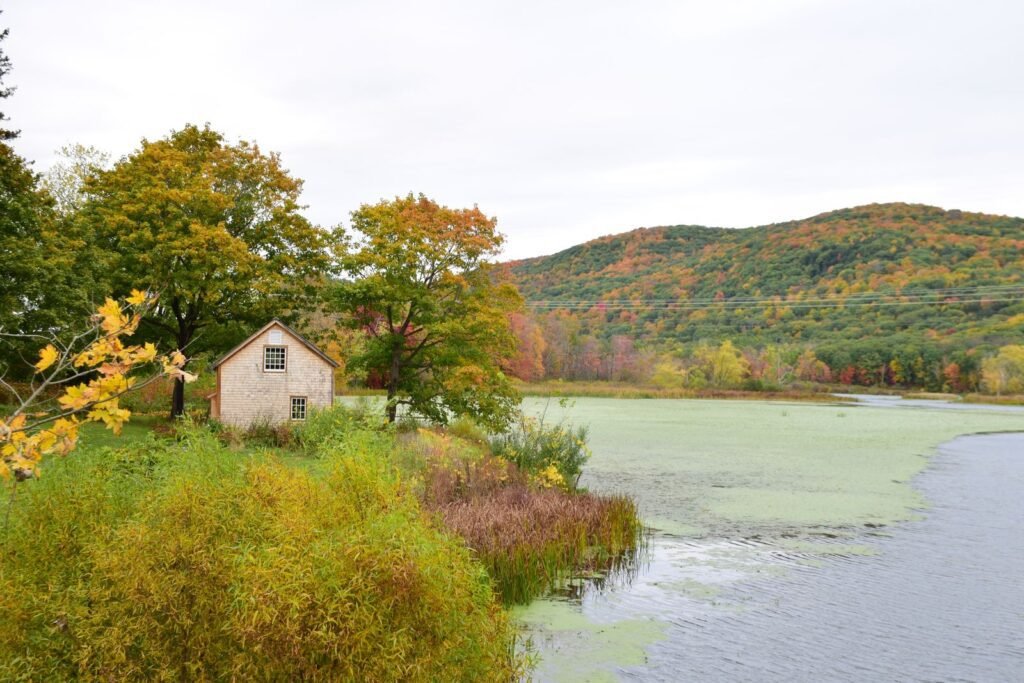
The cheapest farmland in Massachusetts is in a band along the state’s western and northern edge. Berkshire County runs from Williamstown and North Adams down to Sheffield on the Connecticut line. Franklin County covers the hill towns north of the Mohawk Trail, Route 2, from Charlemont and Heath to Warwick and New Salem. Together they hold almost a third of the state’s farmland at about $8,600 an acre.
The catch is not the land. It is distance, winters and services. Some hill towns have no grocery store, no high school of their own and no town water or sewer, and the nearest full hospital can be 30 or 40 minutes away, in Pittsfield, Greenfield or North Adams. High-speed internet reached many of these towns only in the last few years, through town-built fiber networks. That is what keeps the price down, and it is worth weighing before you fall for the foliage.
The upside is just as real. The Berkshires have a year-round arts and visitor economy, Pittsfield and Great Barrington have hospitals and shopping, and Franklin County is a short drive from the colleges and jobs of the Pioneer Valley. Cheap does not have to mean cut off if you choose the town with care.
The five cheapest counties for farmland in Massachusetts
- Berkshire County: $8,606 an acre, on 71,860 acres of farms
- Franklin County: $8,637 an acre, on 71,519 acres of farms
- Dukes County, Martha’s Vineyard: $8,824 an acre, on 6,404 acres of farms
- Hampshire County: $10,568 an acre, on 53,268 acres of farms
- Hampden County: $13,611 an acre, on 29,618 acres of farms
If you want to buy land in Massachusetts at the lowest price per acre, leave Dukes County out of your search: its figure comes from 66 island farms that rarely sell. The real choice is between the four western counties, and inside them, between towns. That is where the six checks below decide whether a cheap parcel is a bargain.
What to check before you buy land in Massachusetts
Massachusetts leaves most of the decisions about land to its 351 cities and towns: the board of health, the conservation commission, the planning board and the assessors. These six checks come up on almost every rural parcel, and a listing will rarely tell you about them. Knowing them is most of what it takes to buy land in Massachusetts without an expensive surprise.
1. Get the Title 5 inspection, and read it
2. Map the wetlands before you plan anything
3. Confirm the lot is buildable: frontage first
4. Test the well yourself
5. Ask whether the land is in Chapter 61, 61A or 61B
6. Old house, two state certificates
We check the county, the septic and the wetlands before a Massachusetts home makes our list
Every Massachusetts property we feature is checked against its county’s farmland value, its tax rate and the obvious red flags before it reaches the channel. Leave your email and the next list arrives with that work already done.
What it costs to own rural land in Massachusetts
If you are working out how to buy land in Massachusetts on a budget, the tax bill belongs in the math from day one. Massachusetts does not tax land through a county formula. Each of its 351 cities and towns sets its own rate per $1,000 of assessed value every year, inside the limits of Proposition 2½, and the assessors value property at full market value. The Tax Foundation puts the effective rate on owner-occupied homes at 1.00 percent, but the town line matters far more than the state average: in the same county, the rate on a home can differ by a factor of three.
The arithmetic, with four real Berkshire County rates
Two notes about that chart. The rates are for the 2026 tax year and towns reset them every year, so check the assessors’ page before you budget. And low rates often come with fewer services: some of the cheapest hill towns have no town water, no trash pickup and a regional school district far away.
Chapter 61, the homestead protection and the other breaks
On wooded or farmed acreage, Chapters 61, 61A and 61B can cut the tax on the land to a fraction of its market value, with the strings described above. If you will live on the property, every owner-occupied home in Massachusetts gets $125,000 of automatic protection from most creditors under the state homestead law, chapter 188, and recording a declaration of homestead raises it to $500,000. Many towns also offer their own exemptions for seniors and veterans, filed with the assessors.
On the income side, Massachusetts has a flat 5 percent income tax, plus a 4 percent surtax on income above about $1 million, adjusted each year for inflation. The sales tax is 6.25 percent statewide with no local add-on, and the state has its own estate tax.
Closing, the deed stamps and the two-step offer

A Massachusetts purchase usually happens in two steps. The buyer signs a short offer to purchase with a small deposit, and within a week or two the parties sign a fuller purchase and sale agreement, with the inspection, financing and septic contingencies. Read both before you sign the first one: Massachusetts courts have held that a signed offer can already be a binding contract.
Closings are run by attorneys, usually the lender’s, who search the title, prepare the documents and record the deed at the registry of deeds. Ask for an owner’s title policy and, on rural land without a recent survey, pay for one: stone walls in the hill towns often wander well off the legal description.
The seller pays the deed excise, the “deed stamps”, at $4.56 per $1,000 of the price, or $6.48 in Barnstable County, where a county excise is added. On a $300,000 sale that is $1,368 outside the Cape. The buyer pays the recording fees and the lender’s attorney.
Why the price per acre on a listing site is not the price of land
Land listing sites cannot agree with each other, and none of them agrees with the census. When we checked in October 2026, one major site showed a median asking price of $35,357 an acre for Massachusetts, and another showed an average of $244,527 across 810 listings, against the census value of $13,831. The gap is about size. Most listings are one-acre house lots priced on the right to build, and a handful of lots near Boston pull the average out of reach. The census measures whole farms, which is why it is the better guide when you buy land in Massachusetts by the acre. For a large tract, use the county figure in the table above; for a house lot, compare recent sales of lots of the same size in the same town.
Cheap houses and land we have covered in Massachusetts
Every list we have published for people looking to buy land or a cheap house in Massachusetts, with the county census value and the reason each property is still for sale. Asking prices are from the date of each list, and some of these homes may have sold since.
Massachusetts guides: moving, septic and the details
Two deeper guides for the questions that come right after the price of the land: what it really costs to live in rural Massachusetts, and how to read the Title 5 septic report before you buy.
Keep exploring before you commit to Massachusetts
Massachusetts is the most expensive state we cover, and the hill towns are its exception. Before you decide how to buy land in Massachusetts, or whether a neighboring state gives you more for the money, these pages put it in context.
- Cheap houses for sale in Massachusetts, and why they sit – ten real listings from the Quabbin to the Berkshires, with the census value of the land and the reason each one has not sold.
- Moving to Massachusetts: the real cost of rural living – what life costs by region, from the town tax rate to the health insurance mandate and the car excise.
- Title 5 inspections in Massachusetts – how to read the septic report, what a failed system costs and the $18,000 state credit.
- Why cheap rural homes don’t sell, and how to buy one anyway – the financing and inspection traps behind the lowest prices.
- The cheapest states to buy land in America – where Massachusetts sits against New York, Pennsylvania and the rest of the country, with the same federal data.
- The best states to homestead – land, tax and rainfall scored together for all 48 contiguous states.
- Rural property guides, the Rural Property Field Guide and how the AHO Score works – the checklists we use on every property.
Get the next batch of Massachusetts listings first
We publish new Massachusetts homes and land as we find them, from the Berkshires to the Quabbin hills. Tell us what you are looking for and the next Massachusetts list reaches you before it goes public.
Common questions about buying land in Massachusetts
How much is an acre of land in Massachusetts?
Massachusetts farmland averaged $13,831 an acre in the 2022 USDA Census of Agriculture, counting land and farm buildings across all 14 counties. Prices run from $8,606 in Berkshire County and $8,637 in Franklin County to $58,917 in Barnstable County on Cape Cod. A small house lot near Boston sells for far more than any of these figures.
Where is the cheapest place to buy land in Massachusetts?
The cheapest land in Massachusetts is in the western hill towns. In the 2022 USDA census, Berkshire County averaged $8,606 an acre and Franklin County $8,637, against $13,831 statewide. The four western counties, Berkshire, Franklin, Hampshire and Hampden, hold almost half the state’s farmland at an average of $9,733 an acre.
What is a Title 5 inspection in Massachusetts?
A Title 5 inspection is the septic system check that Massachusetts requires before most property sales. A MassDEP-approved inspector must do it within two years before the sale, or three if the system is pumped yearly, and weather can push it to six months after. A failed system must be upgraded within two years.
What is Chapter 61 land in Massachusetts?
Chapter 61, 61A and 61B are Massachusetts programs that tax forest, farm and recreation land at its use value. Forest land needs 10 acres and a certified plan; farmland needs 5 acres and $500 in sales. Leaving the program costs rollback or conveyance taxes, and the town gets 120 days to match a sale offer.
Can you build a house on any lot in Massachusetts?
No. In Massachusetts each town sets its minimum lot size and frontage, and a lot without the required frontage on a public way may not be buildable. Land within 100 feet of a wetland, or 200 feet of a year-round river, needs conservation commission review, and the lot must pass a Title 5 soil test for a septic system.
Who pays the transfer tax in Massachusetts?
In Massachusetts the seller customarily pays the deed excise, known as deed stamps, at $4.56 per $1,000 of the sale price, or $6.48 per $1,000 in Barnstable County, where a county excise is added. On a $300,000 sale that comes to $1,368. The buyer usually pays recording fees and the lender’s attorney.
Are property taxes high in Massachusetts?
Massachusetts property taxes are close to the national middle in rate, but high in dollars. The Tax Foundation puts the effective rate on homes at 1.00 percent, and the FY2026 average single-family bill was $8,113. Each town sets its own rate: in Berkshire County it runs from $5.96 per $1,000 in Otis to $17.50 in Pittsfield.
Before you buy, the important part
American Home Opportunities is a publisher. We are not a real estate broker, agent, lender, appraiser, attorney or financial advisor, and nothing on this page is legal, tax or financial advice.
County farmland values come from the USDA Census of Agriculture 2022, Massachusetts, Table 8, and measure farmland and the buildings on working farms rather than asking prices for house lots; the regions are our own grouping, weighted by land in farms. The effective property tax rate and income and sales tax figures are the Tax Foundation’s; the town tax rates were compiled by the Berkshire County Board of Realtors for 2026, and the statewide average tax bill is from the Division of Local Services. Septic rules follow Title 5, 310 CMR 15.000, as summarized by MassDEP; well testing guidance is from MassDEP’s private well guide; wetlands rules follow General Laws chapter 131, section 40; Chapter 61, 61A and 61B rules follow General Laws chapters 61, 61A and 61B; the deed excise follows chapter 64D, with the Barnstable County rate from the Cape Cod Commission. Figures checked in October 2026.
The figures we quote for our own properties are asking prices on the date of each list, not sale prices. Rural property involves wells, septic systems, wetlands, access, surveys, easements, repairs, insurance and financing that are specific to each parcel. Verify everything with the town assessors, the board of health, the conservation commission, a closing attorney and licensed professionals before you buy.