
Buying Rural Land in Pennsylvania
What an acre really costs in all 67 counties, why the bargains show up in the most expensive state we cover, and the checks that decide whether a listing is worth the drive.
$8,019
Average value per acre, statewide
$4,841
The PA Wilds, the cheapest region
8.3x
Spread from cheapest to priciest county
1.26%
Effective property tax rate
Pennsylvania is not a cheap-land state, and you should know that before you start
The first thing to say about buying rural land in Pennsylvania is the least flattering. We have built one of these pages for Kentucky, Tennessee, North Carolina, New York and Virginia. Pennsylvania is the most expensive of the six by a wide margin. Farmland here averages $8,019 an acre against $5,303 in Virginia and $4,929 in Kentucky, and the effective property tax rate is 1.26% against Virginia’s 0.78%. If your search is simply “where is land cheapest,” the honest answer is that it is not here, and you would get further looking at eastern Kentucky or Southside Virginia.
And yet cheap listings keep turning up in Pennsylvania — often more of them, and better ones, than in states where the ground costs half as much. That is not a contradiction and it is not luck. It is the single most useful thing to understand about buying rural land in Pennsylvania, and the rest of this page is built around it. The short version: you are not buying cheap land here. You are buying an old house that sits on expensive land.
The county line is worth more than the state line
The statewide average hides almost everything. Cameron County, in the northern forests, averages $2,594 an acre. Lancaster County, three hours southeast, averages $21,633 across 378,574 acres of genuine working farmland. That is a spread of 8.3 times inside one state — the widest of any state we have measured, wider than Virginia’s 4.7x and Tennessee’s 4.5x.
Lancaster is not an outlier we picked to make a point. It is the most productive farm county in the state and its acreage is real. What that means in practice is that “the average price of land in Pennsylvania” is a number you should never use for anything. The number that matters is the one for the county you are actually looking at, and below it is for every single one of them.
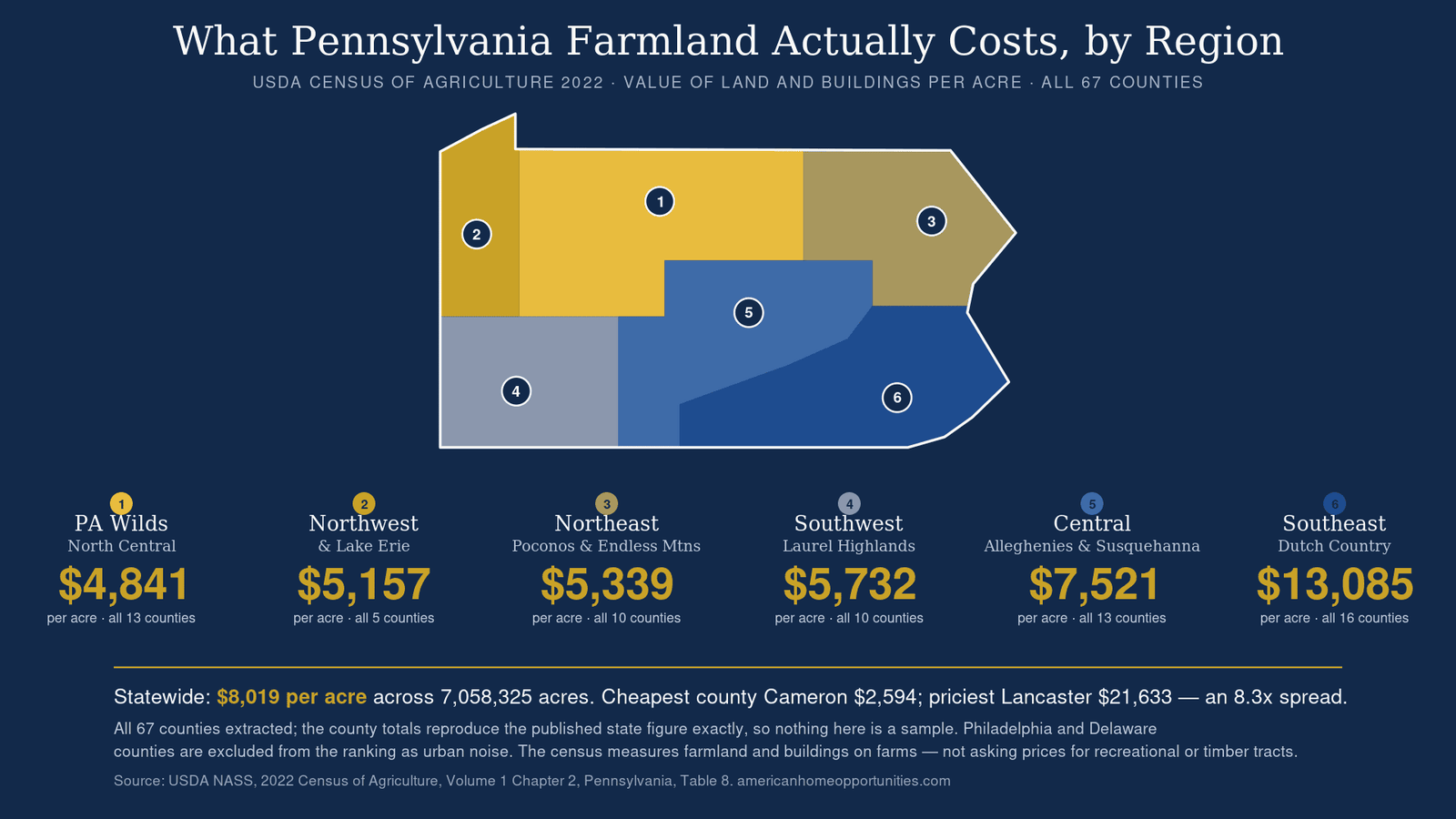
| Region | Farmland value per acre USDA, 2022 census | Cheapest county | Priciest county |
|---|---|---|---|
| PA Wilds — north central | $4,841 all 13 counties | Cameron $2,594 | Clinton $8,278 |
| Northwest & Lake Erie | $5,157 all 5 counties | Crawford $3,981 | Butler $7,134 |
| Northeast — Poconos & Endless Mountains | $5,339 all 10 counties | Pike $3,130 | Monroe $10,086 |
| Southwest & Laurel Highlands | $5,732 all 10 counties | Indiana $4,312 | Allegheny $10,009 |
| Central — Alleghenies & Susquehanna | $7,521 all 13 counties | Bedford $5,010 | Union $12,462 |
| Southeast — Dutch Country | $13,085 all 16 counties | Schuylkill $8,075 | Lancaster $21,633 |
| Pennsylvania, statewide | $8,019 7,058,325 acres in farms | Cameron $2,594 | Lancaster $21,633 |
Where the cheap land is in Pennsylvania, and the honest reason why
If you are buying rural land in Pennsylvania on a budget, everything affordable is north and west. The PA Wilds — Cameron, Clarion, Clearfield, Clinton, Elk, Forest, Jefferson, Lycoming, McKean, Potter, Tioga, Venango and Warren — average $4,841 an acre, roughly 40% below the state. The northwest around Lake Erie is $5,157 and the Laurel Highlands southwest of Pittsburgh is $5,732. The Poconos look cheap on the regional average, $5,339, but that number is doing a lot of work: Pike County is $3,130 while Monroe, one county south and inside commuting distance of New Jersey, is $10,086.
Land is cheap in the northern tier for the same reasons it is cheap anywhere: fewer people, longer drives, thinner soil, and services that have been contracting for thirty years. The clearest measure of that last one is medical. Twenty-two of Pennsylvania’s sixty-seven counties — all of them rural — have no hospital that delivers babies. In 2024 Penn Highlands Elk closed its labor and delivery unit; the county had one obstetrician and the hospital calculated it needed three more to keep the service open. Births now go to DuBois, forty-five minutes away. Elk County sits in the PA Wilds, the cheapest region on this page. Between 2010 and 2022 the rate of obstetric closures at Pennsylvania’s rural hospitals reached 46%.
That is the trade, stated plainly, and it is the one that matters most when buying rural land in Pennsylvania. It is a real trade and plenty of people make it happily. But the question to ask about any address here is not “is there a hospital” — it is where is the nearest emergency room, the nearest hospital that admits inpatients, and the nearest one that delivers babies. Services get cut years before a building closes.
The other thing that gets thinner as you go north is bandwidth. Pennsylvania still has 129,356 locations without adequate high-speed internet, and in April 2026 the NTIA approved $711 million of federal BEAD money to close the gap over roughly four years. Read the technology mix before you assume that means fibre: 57.9% of those locations are slated for fibre, but 23.1% are slated for low-orbit satellite and another 13.7% for fixed wireless. Close to one in four addresses on the “connected” list will be connected by satellite. Ask for the exact street address and check what it is actually getting.
What to check before buying rural land in Pennsylvania
Six checks, five of them specific to this state. None of them appear on a listing, and skipping any one of them is the most expensive mistake you can make buying rural land in Pennsylvania.
Is the parcel undermined?
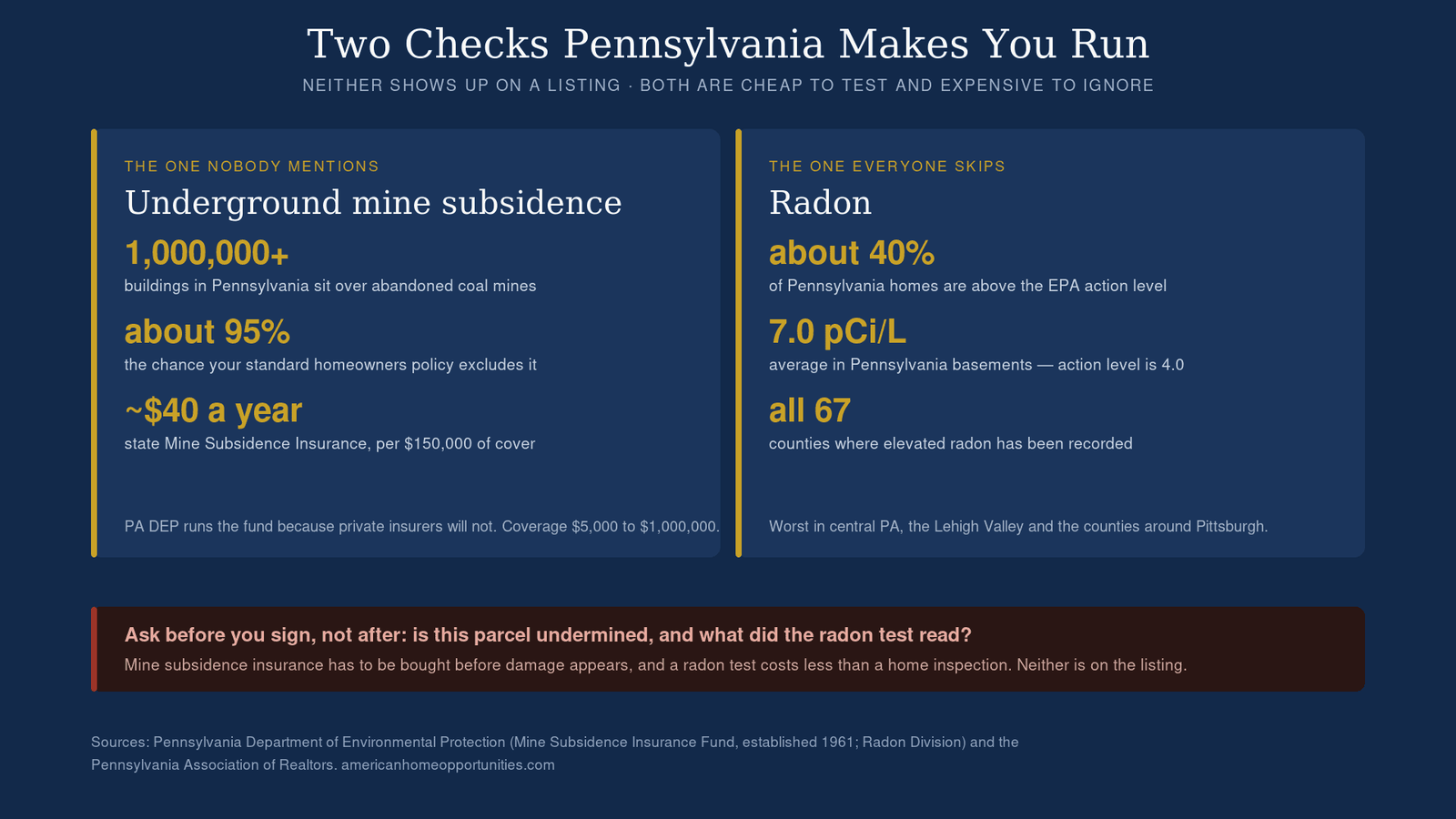
More than a million buildings in Pennsylvania sit above abandoned underground coal and clay mines. When those workings collapse the ground sinks, and the damage is structural. Standard homeowners policies almost universally exclude it — the working estimate is a 95% chance your policy does not cover it. The Commonwealth set up its own Mine Subsidence Insurance Fund in 1961 precisely because the private market would not write the risk. Cover runs from $5,000 to $1,000,000 and costs roughly $40 a year per $150,000. It has to be in place before the damage appears. This matters most in the bituminous southwest — Allegheny, Washington, Westmoreland, Fayette, Greene, Indiana, Cambria, Somerset — and in the anthracite northeast around Schuylkill, Luzerne, Lackawanna, Carbon and Northumberland.
Who owns what is underneath it?
Across the Pennsylvania Appalachians minerals were severed from the surface a century ago, when families sold to the coal companies. Read the deed for the phrase “excepting and reserving all minerals.” There is a quirk here that works in your favour: under the Dunham Rule, reaffirmed by the Pennsylvania Supreme Court in 2012, a deed that reserves “minerals” without naming oil and gas is presumed not to have reserved them — which is why Marcellus shale gas rights often did not travel with the old coal severances. Pennsylvania also has no compulsory pooling statute for unconventional wells, so pooling clauses in a gas lease are negotiable rather than imposed. Ask explicitly whether the sale includes minerals, oil and gas, and who holds them if it does not.
Is the land enrolled in Clean and Green?
Act 319 gives farm, forest and open-space land a preferential assessment, and Pennsylvania’s clawback is the harshest of any state we cover. Break the covenant and you owe seven years of deferred tax plus 6% interest a year — the year of the change plus the six before it. North Carolina claws back four years, Virginia five. What triggers it is a change of use, not the sale itself: if you keep the qualifying use and revalidate with the county assessor, the enrolment carries on. But the clock comes with the deed, so ask the assessor for the current roll-back figure in writing before you decide what you are going to do with the ground.
What did the radon test read?
Pennsylvania’s geology gives it some of the worst radon in the country. Around 40% of Pennsylvania homes are above the EPA action level of 4.0 pCi/L, basements average 7.0, and elevated readings have been recorded in all sixty-seven counties. Central Pennsylvania, the Lehigh Valley and the counties around Pittsburgh are the worst affected. A test is cheap and mitigation is a known, bounded cost — the mistake is finding out after you own it.
Will the lot take a well and a septic system?
Budget $1,000 to $3,500 for the perc test, soil probe and sewage enforcement officer’s fees, and $7,000 to $25,000 for a conventional septic system. Sand mounds and aerobic units push past $30,000. A well averages around $11,250 at 250 feet, with drilling at $28 to $65 a foot. The constraint that catches people out is not cost but geometry: DEP requires 100 feet between the septic and the well, 50 feet from a stream and 10 feet from a property line. On a small lot with a creek running through it, those setbacks can consume the only buildable spot. Cost ranges here are contractor aggregates; the setbacks are regulation.
How old is the house, really?
This is the Pennsylvania-specific one, and it is the reason the bargains exist. The median home in Pennsylvania was built 57 years ago — the fourth-oldest housing stock in the United States, against a national median of 42 years. That is what you are actually buying here, so the inspection matters more than it does in any other state on this site: roof, post-war wiring, lead paint, asbestos, insulation, and the boiler that has to get you through a northern winter.
We run these checks before we feature a property
Undermining, mineral rights, the roll-back balance, whether the lot will take a septic system, the drive to the nearest emergency room. These are the checks we run before a listing earns a place in a video, and they are the same ones worth running yourself when you are buying rural land in Pennsylvania. If a listing does not survive them, it does not go in the video. Leave your email and you will get the ones that do.
What it costs to own rural land in Pennsylvania once you have it
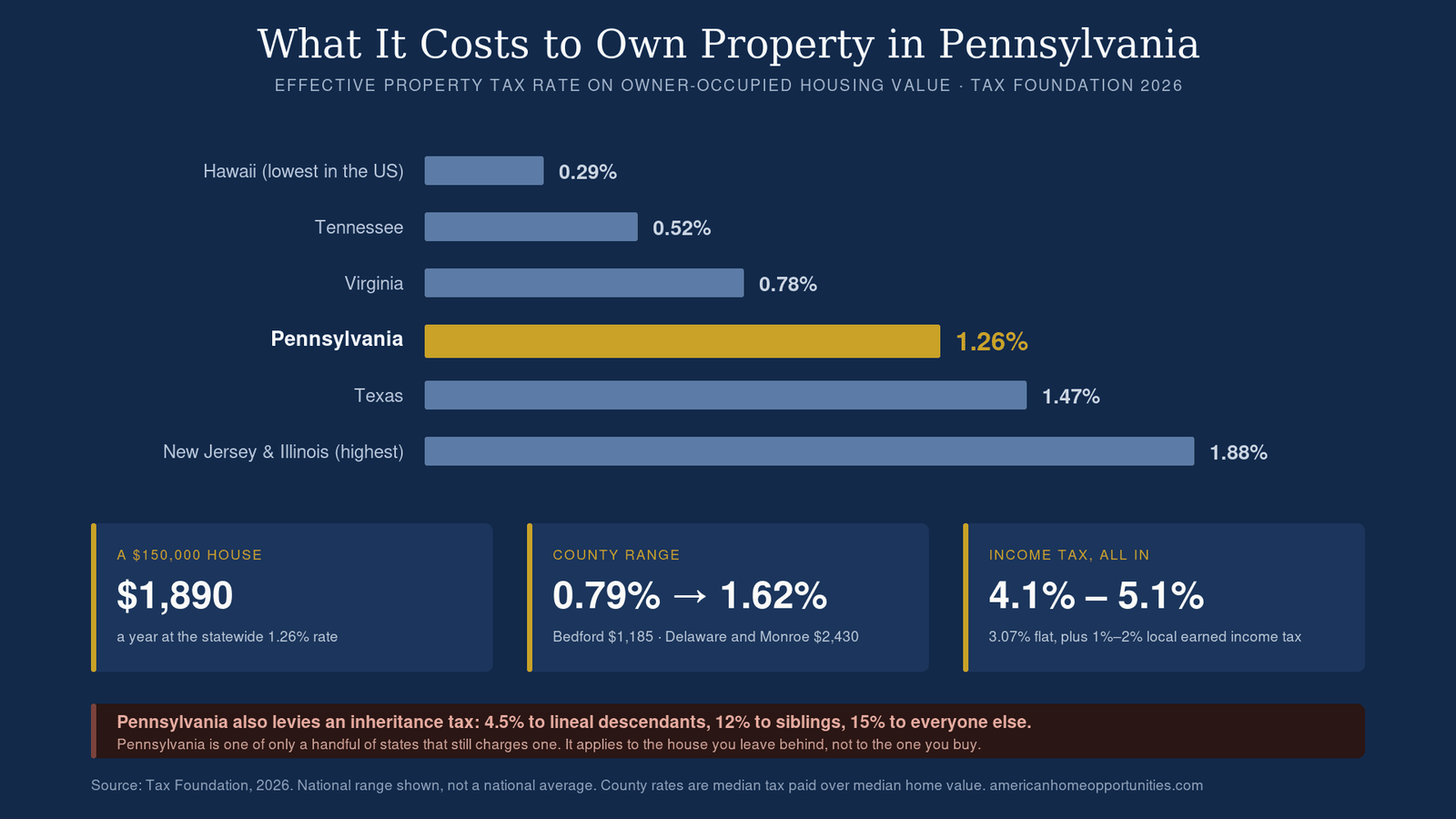
Pennsylvania’s effective property tax rate on owner-occupied housing is 1.26%, the twelfth highest in the country. There is no national average worth quoting — the real picture is a range, from 0.29% in Hawaii to 1.88% in New Jersey and Illinois — and Pennsylvania sits in the upper third of it. On a $150,000 house the statewide rate works out to about $1,890 a year. State income tax is a flat 3.07%, sales tax is 6.00% with a 6.34% combined average, and the gas tax is 58.7 cents a gallon, among the highest anywhere. Pennsylvania is also one of a handful of states that still levies an inheritance tax: 4.5% to lineal descendants, 12% to siblings, 15% to everyone else.
A warning about county comparisons. Pennsylvania taxes assessed values that in many counties have not been revalued in decades, and the ratio of assessed to market value differs wildly from one county to the next. Millage rates are therefore not comparable across counties, and any page that ranks Pennsylvania counties by millage is telling you nothing. The figures below are effective rates — median tax actually paid over median home value — which is the only version that compares.
They run from 0.79% in Bedford County to 1.62% in Delaware and Monroe. The lowest median bill in the state is Forest County at $1,145 a year; the highest is Chester at $6,308.
Cheap land and cheap taxes do not travel together
Clarion and Venango share a border, and the census values their farmland within 2% of each other — $4,159 and $4,234 an acre. Their effective tax rates are 0.91% and 1.22%. The same $150,000 house costs $1,365 a year in Clarion and $1,830 in Venango: $465 a year, $4,650 over ten years, decided by which side of a county line the driveway is on.
And the cheapest land does not come with the cheapest bill. Cameron County has the least expensive farmland in Pennsylvania and one of the higher effective rates among rural counties, at 1.31%. That is not a quirk — it is arithmetic. A county with a small tax base has to set a higher rate to fund the same schools and roads. The counties that give you both are further south and west: Jefferson County is twelfth cheapest for land at $4,424 an acre and fourth lowest for tax at 0.85%, which on a $150,000 house is $1,275 a year — $690 less than Cameron.
The Pennsylvania tax nobody quotes you: the local one
The flat 3.07% state income tax is not the whole story. Under Act 32, your municipality and your school district each levy a local Earned Income Tax on top of it, and they split the proceeds. Outside Philadelphia the combined rate is typically 1% to 2%; rural townships often land between 1.0% and 1.5%, and a few are as low as 0.5%. There is usually a Local Services Tax as well, commonly up to $52 a year. So the real rate on earned income for someone moving here is closer to 4.1% to 5.1% than to 3.07%. There is no single statewide figure to look up — the rate is tied to the PSD code for the exact address, so ask for the address, not the township.
In Pennsylvania you are buying an old house on expensive land — including from us
We have covered twenty-two Pennsylvania properties. Twenty-one of them have usable acreage, and together they carry $3,035,450 in asking prices across 67.69 acres. Value all that ground at the census figure for its own county and it comes to $401,687. The dirt is 13.2% of what is being asked. The buildings are the other 86.8% — a higher share than any other state we have measured.
That is the answer to the question this page opened with, and the single most useful fact about buying rural land in Pennsylvania. Pennsylvania has the priciest farmland of the six states we cover, and it still produces the cheap listings, because in Pennsylvania the discount is not in the ground. It is in the age of the building standing on it. The median Pennsylvania home is 57 years old against a national median of 42, and a depreciated house on costly land can be priced well below a newer house on cheap land. Eastern Kentucky was the opposite case, where the house arrived almost free on top of the land. Virginia and North Carolina were the mirror, where the land came almost free with the house. Pennsylvania is the third pattern: expensive ground, old building, and the bargain is the age.
Which is exactly why you should be careful with our own arithmetic too. Divide those twenty-one asking prices by that acreage and you get $44,843 an acre. LandSearch quotes about $27,450 an acre for rural Pennsylvania. The census says $8,019. Our number is the most absurd of the three, and it is wrong for the same reason theirs is: it buries the price of a house inside a figure labelled “per acre,” on lots whose median size is 2.41 acres. On a two-acre parcel in Pennsylvania, price per acre tells you almost nothing about the land and almost everything about the roof.
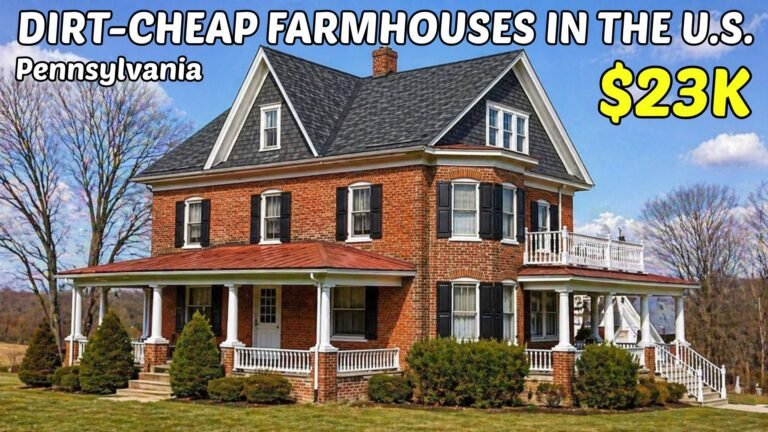
Pennsylvania properties we have covered
Every roundup below is a real listing we checked, filmed and priced at the time of publication. Properties sell; the reasoning does not go stale.
More Pennsylvania guides
Deeper reading on the parts of a Pennsylvania purchase that deserve more than a paragraph.
Keep exploring
Everything above is Pennsylvania. What follows is not state-specific, and it matters just as much.
Why cheap rural homes do not sell is the piece that explains the prices, from the mortgage minimums to the insurance underwriting. The guides library indexes every state page and every rule we have written up. How we score a property explains our judgement, and the Field Guide turns all of it into nine pages you can take with you.
Get the next batch of Pennsylvania listings first
New Pennsylvania properties go out to the list before the video is published. No spam, one email, unsubscribe whenever you like.
Buying rural land in Pennsylvania: the questions we get most
What is the cheapest county in Pennsylvania to buy land?
Cameron County, at $2,594 an acre in the 2022 USDA census, followed by Pike $3,130, Warren $3,633, Potter $3,653 and Crawford $3,981. By region, the PA Wilds are cheapest at $4,841 an acre. Worth knowing before you commit: Cameron also carries one of the higher effective property tax rates among Pennsylvania’s rural counties, at 1.31%, because a small tax base needs a higher rate. Jefferson County is the better combination — $4,424 an acre with a 0.85% rate.
How much does an acre of land cost in Pennsylvania?
Statewide, $8,019 an acre for farmland and the buildings on it, across 7,058,325 acres in farms. Listing sites quote far higher — around $27,000 an acre is commonly published for rural Pennsylvania. Those are averages of what is currently for sale, with the value of any house folded into a number labelled “per acre.” They are not land values and they are not sale prices. Our own twenty-one Pennsylvania listings produce an even sillier $44,843 an acre by the same method, which is why we do not use it.
Are property taxes high in Pennsylvania?
Yes, relatively. The effective rate on owner-occupied housing is 1.26%, the twelfth highest in the United States, against a national range of 0.29% to 1.88%. County effective rates run from 0.79% in Bedford to 1.62% in Delaware and Monroe. Two things people miss: local Earned Income Tax of roughly 1% to 2% on top of the flat 3.07% state rate, and the fact that Pennsylvania still charges an inheritance tax.
Why are houses in rural Pennsylvania so cheap if the land is expensive?
Because the houses are old. Pennsylvania has the fourth-oldest housing stock in the country, a median of 57 years against a national 42. Across the twenty-one Pennsylvania properties we have covered, the census value of the land is only 13.2% of the asking price — so 87% of what you pay is a building that is, on average, close to sixty years old. That is where the discount comes from, and it is also why an inspection here is worth more than anywhere else we cover.
Do I need a lawyer to buy rural land in Pennsylvania?
Pennsylvania does not require an attorney at closing; title companies handle most settlements. That said, for a parcel with severed minerals or an active gas lease, one enrolled in Clean and Green, or one sitting over old mine workings, a Pennsylvania real estate attorney is money well spent. Those are the situations where a title search alone will not tell you what you can do with the land or what you might owe on it. We are not lawyers, and this page is not legal advice.
Ask us one question about Pennsylvania
Pick whichever is closest. It opens an email with the subject already written — you only have to add the county or the listing.
Tell us what you are looking for in Pennsylvania
If you would rather we came to you when something fits, give us the shape of it — budget, acreage, the part of the state, and when you are hoping to move. We will keep an eye out.
Sources and disclaimer
Farmland values: USDA National Agricultural Statistics Service, 2022 Census of Agriculture, Volume 1 Chapter 2, Pennsylvania, Table 8 — all 67 counties. State tax figures: Tax Foundation, Taxes in Pennsylvania (2026). County effective property tax rates: Tax Foundation, Property Taxes by State and County, 2026. Roll-back taxes: Pennsylvania Department of Agriculture, Clean and Green (Act 319). Mineral and gas rights: Pennsylvania Supreme Court, Dunham Rule as reaffirmed in 2012. Mine subsidence and radon: Pennsylvania Department of Environmental Protection, Mine Subsidence Insurance Fund and Radon Division, with the Pennsylvania Association of Realtors. Hospital and obstetric services: Penn State Office of Rural Health and City & State Pennsylvania, 2026. Broadband: Pennsylvania Broadband Development Authority and the NTIA BEAD approval of April 2026. Housing age: NAHB analysis of the 2024 American Community Survey. Local Earned Income Tax rates vary by PSD code and are given as a range. Well and septic cost ranges are contractor aggregates and are labelled as such.
Prices quoted for properties American Home Opportunities has covered are asking prices at the time of publication, not sale prices, and listings change or sell without notice. Tax rates, relief programmes and regulations change; verify everything with the county assessor, the county tax claim bureau and the local sewage enforcement officer before you rely on it. This page is a general guide to buying rural land in Pennsylvania, not legal, tax or financial advice. Page compiled 4 August 2026.