
Buying Land in Alabama
Farmland values from all sixty-seven counties, the tax break that does not survive the sale, and the checks that decide whether cheap Alabama land is a bargain or a trap.
Alabama’s best soil sits under its cheapest land
The Black Belt runs in a crescent across south-central Alabama, and the dark prairie clay underneath it is some of the most fertile ground in the South. It is also the cheapest land in the state. Farmland and the buildings on working farms there averaged $2,493 an acre in the 2022 USDA Census of Agriculture. Two hundred miles north, in the Tennessee Valley, the same census puts the figure at $4,890.
That is a gap of almost exactly two to one between two regions of one state, and it is the widest regional spread we have measured anywhere. It is not a soil story. It is an economics story, and we go into it further down.
There is a second cheap Alabama, and almost nobody names it
Look at the table below and the Appalachian foothills read as one of the more expensive parts of the state at $4,140 an acre. That number is doing something misleading, and it is worth understanding, because the correction points at the best-value land in Alabama.
Three counties are carrying that average: Jefferson at $6,943, Calhoun at $5,855 and Shelby at $5,118. Those are Birmingham and its suburbs. Jefferson County has only 29,631 acres left in farms, and every acre of it is priced as land a developer might want.
Take the metro out and look at the hill counties along the northwest edge of the state instead. Winston, Marion, Fayette, Lamar and Walker together average $2,811 an acre across 371,527 acres in farms. That puts them second cheapest in Alabama, behind only the Black Belt, and they come without the heavy clay that makes Black Belt ground so difficult to build on and so hard to drain. Lamar County, at $1,910 an acre, is the cheapest county in the state outright.
Farmland values by region: what an acre of land in Alabama actually costs
We pulled all 67 counties out of the 2022 census and checked the extraction against the census’s own published totals. The county acres add back to 8,629,101, and the acre-weighted average of the counties lands on $3,659, which is the figure the census publishes for the state. Where the parse can be proved, it is proved.
| Region | Farmland value per acre USDA, 2022 census | Land in farms |
|---|---|---|
| The Black Belt | $2,493 15 counties | 2,367,955 acres |
| The Wiregrass, southeast | $3,458 9 counties | 1,290,953 acres |
| Piedmont and east central | $3,581 11 counties | 965,179 acres |
| Gulf coast and southwest | $3,676 7 counties | 804,609 acres |
| Appalachian foothills and Birmingham | $4,140 14 counties | 1,144,616 acres |
| Tennessee Valley, north Alabama | $4,890 11 counties | 2,055,789 acres |
| Alabama statewide | $3,659 all 67 counties | 8,629,101 acres |
County by county the range is wider than the regional table suggests: $1,910 in Lamar to $6,943 in Jefferson, a spread of about 3.6 to one. Below Lamar the next six are Wilcox at $2,163, Marengo at $2,247, Bullock at $2,258, Lowndes at $2,343, Perry at $2,354 and Sumter at $2,387. Every one of those six is Black Belt.
Where the cheapest land to buy in Alabama is, and the honest reason it is cheap
The Black Belt is cheap because of what happened around it, not because of what is under it. The cotton economy that built those counties ended, mechanization removed the work that replaced it, and people have been leaving for the better part of a century. Several of these counties hold fewer residents today than they did in 1900. Thin population means a thin tax base, and a thin tax base shows up as long drives to a hospital, roads the county maintains when it can, and schools running on less than they need.
None of that makes the land a bad buy. It makes it a buy you should enter with your eyes open. The acreage is real, the soil is genuinely good, and the price is genuinely low. What you are also buying is distance from services, and you should price that in rather than discover it.
The northwest hill counties are cheap for a different reason, and it is a more ordinary one. Winston, Marion, Fayette, Lamar and Walker are broken ground with a lot of trees on it. Timber pays slowly, the parcels are awkward for row crops, and the coal economy that once employed Walker County shrank. The land is priced as timber and pasture because that is mostly what it does. For a buyer who wants woods, water and a house site rather than a row-crop field, that is an opportunity rather than a defect.
The counties at the top, and why
Madison at $6,510 is Huntsville. Baldwin at $6,202 is the Gulf coast between Mobile Bay and the Florida line, where farmland competes with beach development. Morgan at $6,130 is Decatur, and Jefferson at $6,943 is Birmingham. These are not farmland markets with a premium attached. They are development markets that still have some farms in them, and the census figure reflects what a developer might eventually pay.
Houses for sale in Alabama with land: cheap acreage does not make a cheap house
This is the single most useful thing the census can tell an Alabama buyer, and it cuts against what most people assume when they see the acreage prices above.
In eastern Kentucky, where we have run the same comparison, the land carries most of the price and the house comes close to free. Alabama is the reverse. Take three properties we have covered here and subtract the census value of the ground they sit on. What is left is what you are paying for the building.
The practical consequence is that acreage is the wrong thing to shop on in this state. Two houses at the same price with 2 acres and 12 acres are separated by perhaps $35,000 of land in most Alabama counties. The difference in roof, foundation, wiring and septic will be larger than that, and it will be the difference that costs you money.
What to check before buying land in Alabama
Six checks that are specific to this state. They are in the order we would run them, and the first one is the one that catches the most people, because the money involved is recurring and the deadline is easy to miss.
We run these six checks before a property reaches our list
Nothing gets featured until we have looked at the county census value, the flood panel, the access, and whether the parcel is classified for current use. If that is the standard you want applied to the places you are shown, leave your email.
What it costs to own rural land in Alabama
Alabama is one of the cheapest states in the country to hold property in, and the headline number is real: the Tax Foundation puts the effective property tax rate on owner-occupied housing at 0.37 percent for 2026. Nationally the range runs from 0.29 percent in Hawaii to 1.88 percent in New Jersey and Illinois, so Alabama sits near the bottom of it. There is no estate tax and no inheritance tax. Income tax is graduated from 2.00 to 5.00 percent. Sales tax is 4.00 percent at the state level, but the combined state and local average reaches 9.46 percent, which is high, and it is where Alabama collects what it does not collect on property.
Now the part the 0.37 percent does not tell you. That is a number for a house somebody lives in. Land is taxed differently, and the difference is the whole game.
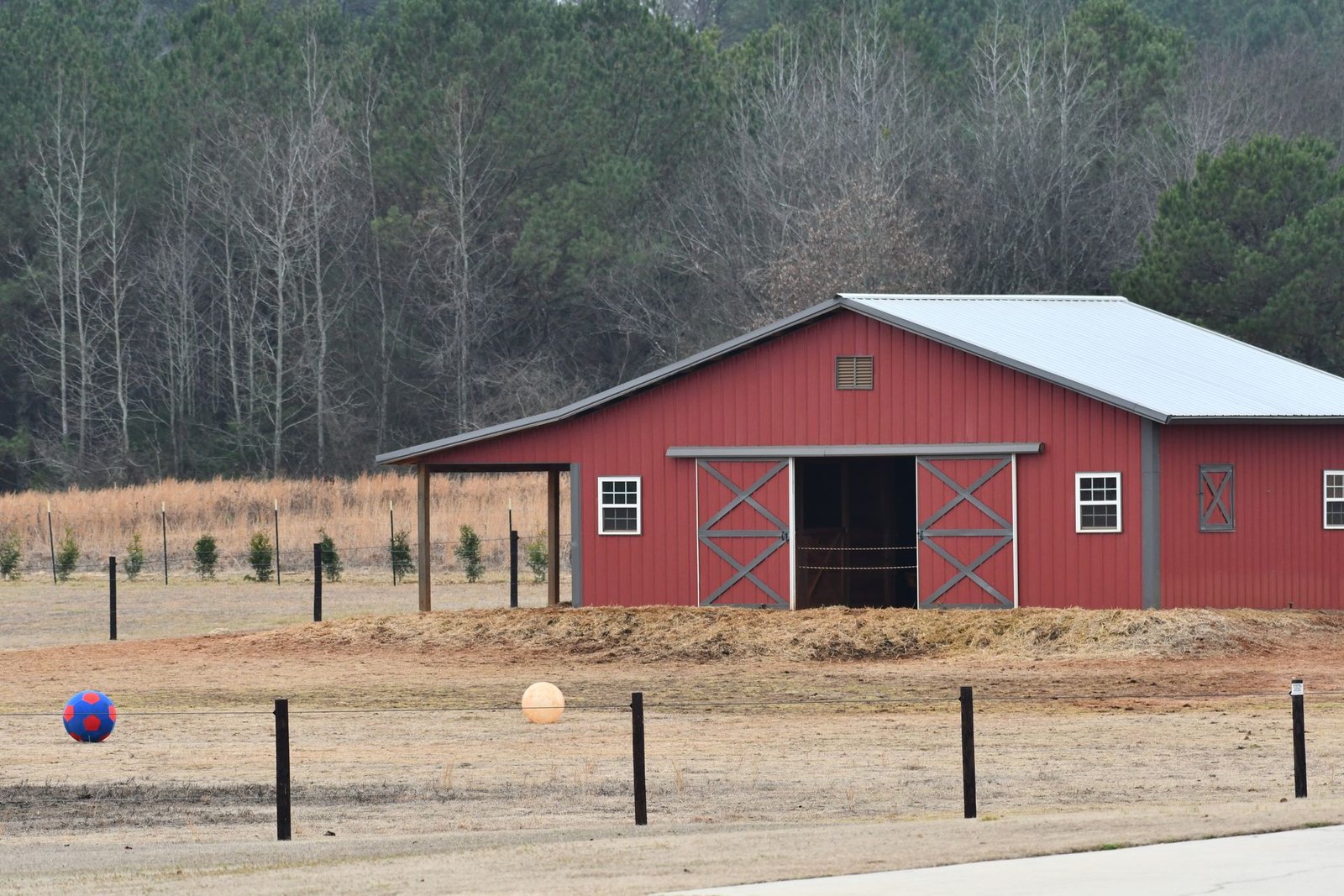
Alabama assesses property by class. Class III covers agricultural land, forest land, an owner-occupied single-family home and certified historic property, and it is assessed at 10 percent of value. Class II is everything not otherwise classified, and it is assessed at 20 percent. Bare rural land you do not live on and have not had classified for farm or forest use falls into Class II. Same parcel, double the base.
Current use, and what the state says an acre of timber is worth
Where land qualifies as Class III farm or forest, Alabama values it by productivity instead of market price, and the Department of Revenue publishes the schedule. Under directive CU-2025, covering the tax year beginning October 1, 2024 for collection from October 1, 2025, timberland is valued at $827 an acre on good soil, $630 on average soil, $449 on poor soil and $360 on non-productive soil. Cropland and pasture run $532, $443, $310 and $110 across the same productivity bands. Parcels of 5 acres or less may be asked for a management plan from the Alabama Forestry Commission before the classification is granted.
The arithmetic on 40 acres in a Black Belt county
Millage is set locally, so take a real one. Cullman County publishes 26 mills in total for property outside a municipality: 6.5 state, 9.5 county, 10 school. Apply it to 40 acres of average timber ground in a Black Belt county at the census value of roughly $2,400 an acre, which is $96,000 of market value.
Two smaller costs, for completeness. Alabama charges a deed tax of $0.50 per $500 of value under Section 40-22-1, and a mortgage tax of $0.15 per $100 of the loan under Section 40-22-2, both collected at the county probate court. On a $150,000 purchase with a $120,000 loan that is $150 and $180. Which side customarily pays each is a matter of local practice, and we could not find an official statement of it, so settle it in the contract rather than assuming.
The services that are not in the tax bill
Two figures worth knowing before you choose a county. The March of Dimes 2026 report puts one in three Alabama counties in the maternity care desert category, meaning no hospital maternity ward, no birth center and no obstetrician, gynecologist or certified nurse midwife practicing there. On 67 counties that is roughly 22. Services close long before a building does, so ask what the nearest hospital still does rather than whether there is one.
Broadband is moving, and the money is committed. Alabama received $1.4 billion under the federal BEAD program, and in March 2026 the state awarded close to $460 million across 63 projects covering about 92,000 currently unserved locations. Read the technology split before you celebrate: 71 percent of those projects use fiber, 24 percent use low-earth-orbit satellite and 5 percent hybrid fiber-coaxial. A county being covered by BEAD does not mean the address you are looking at is getting fiber. Ask which project covers it and what it is building.
Why the price per acre on a listing site is not the price of land
Alabama Ag Credit, a farm lender operating in the state, publishes an average of $3,908 an acre statewide for 2026, up 9.80 percent year over year, with sales volume up 29.06 percent in the first quarter. The census says $3,659 for 2022. Three years and a rising market explain most of that gap, and we would not call the lender’s figure wrong.
What we would say is that they publish no methodology, and a lender’s average reflects the deals a lender saw. The census is a count of every farm in every county with totals you can reconcile, which is why we lead with it. It is also fair to note where the two agree: Alabama Ag Credit puts Perry County in a range of $1,808 to $2,368 an acre, and the census has Perry at $2,354. On the ground where both sources look at the same thing, they land in the same place.
Listing-site averages are a different animal, and they are the ones to distrust. They average what is currently for sale rather than what sold, and what is for sale skews heavily toward small tracts near towns. A 3-acre lot outside Cullman and a 300-acre timber block in Choctaw County are not the same product, and averaging them produces a number that describes neither. If you are looking at small acreage near a growing town, the census figure will not price it for you, and no amount of farmland data will.
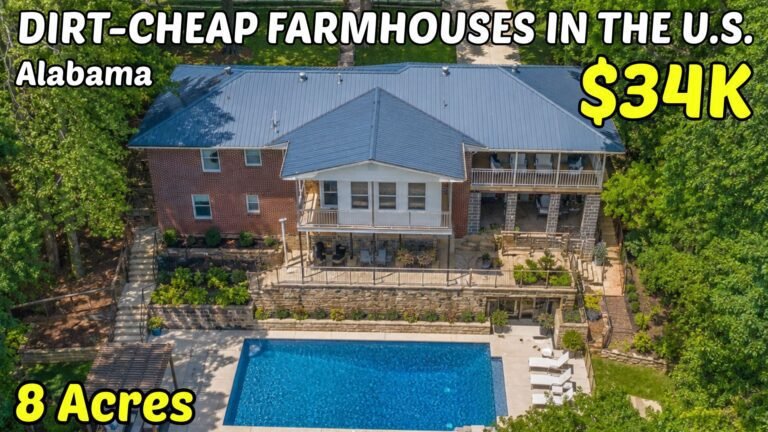
Cheap land and farmhouses we have covered in Alabama
Every property below was checked against its county census value, the flood panel and the access question before it went on the list. Prices are asking prices at the time of writing, not sale prices, and rural listings move.
Alabama guides: one question at a time
Each guide takes one question this page only touches and works it through with the state’s own numbers, starting with what hunting land sells for, what the state asks to lease its own tracts, and whether that lease pays the tax.
Keep exploring before you settle on Alabama
Cheap is one input, not a decision. These four are worth reading while Alabama is still one of several states on your list.
- The cheapest states to buy land in America – where Alabama sits against the other 49, measured with the same federal census.
- Why cheap rural homes do not sell – what is actually going on with a house that has sat unsold for 300 days at a price that looks impossible.
- The Rural Property Field Guide – our free walkthrough of the checks on this page, in the order you should run them.
- How the AHO Score works – what we look at before a property earns a place on one of our lists, and what disqualifies one.
Alabama listings, before they reach the channel
We work Alabama on a rotation, and the hill counties in the northwest are the ones readers ask about most. Leave your email and the next Alabama list goes to you first.
Common questions about buying land in Alabama
Before you buy, the important part
American Home Opportunities is a publisher. We are not a real estate broker, agent, lender, appraiser, attorney or financial advisor, and nothing on this page is legal, tax or financial advice. Farmland values come from the USDA Census of Agriculture 2022, Table 8, and measure farmland and the buildings on working farms rather than asking prices for recreational or timber tracts. Property tax figures come from the Tax Foundation for 2026 and from the Alabama Department of Revenue, including directive CU-2025 for current use values; millage is from the Cullman County Revenue Commissioner and varies by county and district. Septic and well requirements come from the Alabama Department of Public Health, the Alabama Department of Environmental Management and the Alabama Cooperative Extension System. Coalbed methane figures come from the Geological Survey of Alabama and date from 2005. Flood program consequences come from ADECA. Maternity care figures come from the March of Dimes 2026 report. Broadband figures come from the Office of the Governor of Alabama, March 2026. Comparison figures attributed to Alabama Ag Credit are that company’s own published estimates, for which no methodology is given. Any price we quote for a property is an asking price at the time of writing, not a sale price. Rural land carries risks this page can introduce but not resolve for your parcel, including wells, septic suitability, legal access, boundary surveys, easements, severed mineral rights, flood exposure, repairs, insurance and financing. Verify everything with the county and with licensed professionals before you commit money. Page published September 2026.