
Buying Rural Land in Upstate New York
What an acre actually costs county by county, why the cheapest ground in the state is where it is, and the New York tax rules that catch buyers from out of state.
$4,102
per acre, statewide
USDA 2022 census
$2,328
cheapest county
Lewis, on Tug Hill
1.30%
property tax rate
Tennessee is 0.52%
4.6x
county spread
Lewis to Dutchess
New York land is cheaper than Kentucky or Tennessee. That is not a typo.
Almost everyone assumes New York is the most expensive place in the eastern United States to buy rural land. The federal census says otherwise. In the 2022 Census of Agriculture, farmland and the buildings on it averaged $4,102 an acre across New York. The same census put Kentucky at $4,929 and Tennessee at $5,156.
Go down to the county level and the gap widens. Lewis County averages $2,328 an acre — the cheapest in the state, and cheaper than any entire region of Kentucky or Tennessee. St. Lawrence is $2,386. Chenango is $2,434. Jefferson is $2,496, and it is one of the very few counties in the country where farmland got cheaper between 2017 and 2022, down 7%.
At the other end, Dutchess County averages $10,698 and Orange $10,494. That is a 4.6x spread between the cheapest and the priciest counties that still have serious farmland acreage. Closer to the city the numbers stop meaning anything for a rural buyer — Suffolk County is $18,696 an acre — but by then you are not buying rural land, you are buying suburban lots that happen to grow potatoes.
So if the land is genuinely cheap, why does New York have the reputation it has? Because the purchase price is not where New York gets expensive. Keep reading.
What farmland is worth, region by region
Most pages about New York land quote an “average price per acre” scraped from listing sites. Those numbers average what is for sale, not what actually sells, and a handful of overpriced Catskills listings can drag the figure up by thousands. We use the USDA Census of Agriculture instead. It is a census, not a sample, and for New York we were able to extract all 62 counties covering the state’s full 6,502,286 farmland acres.
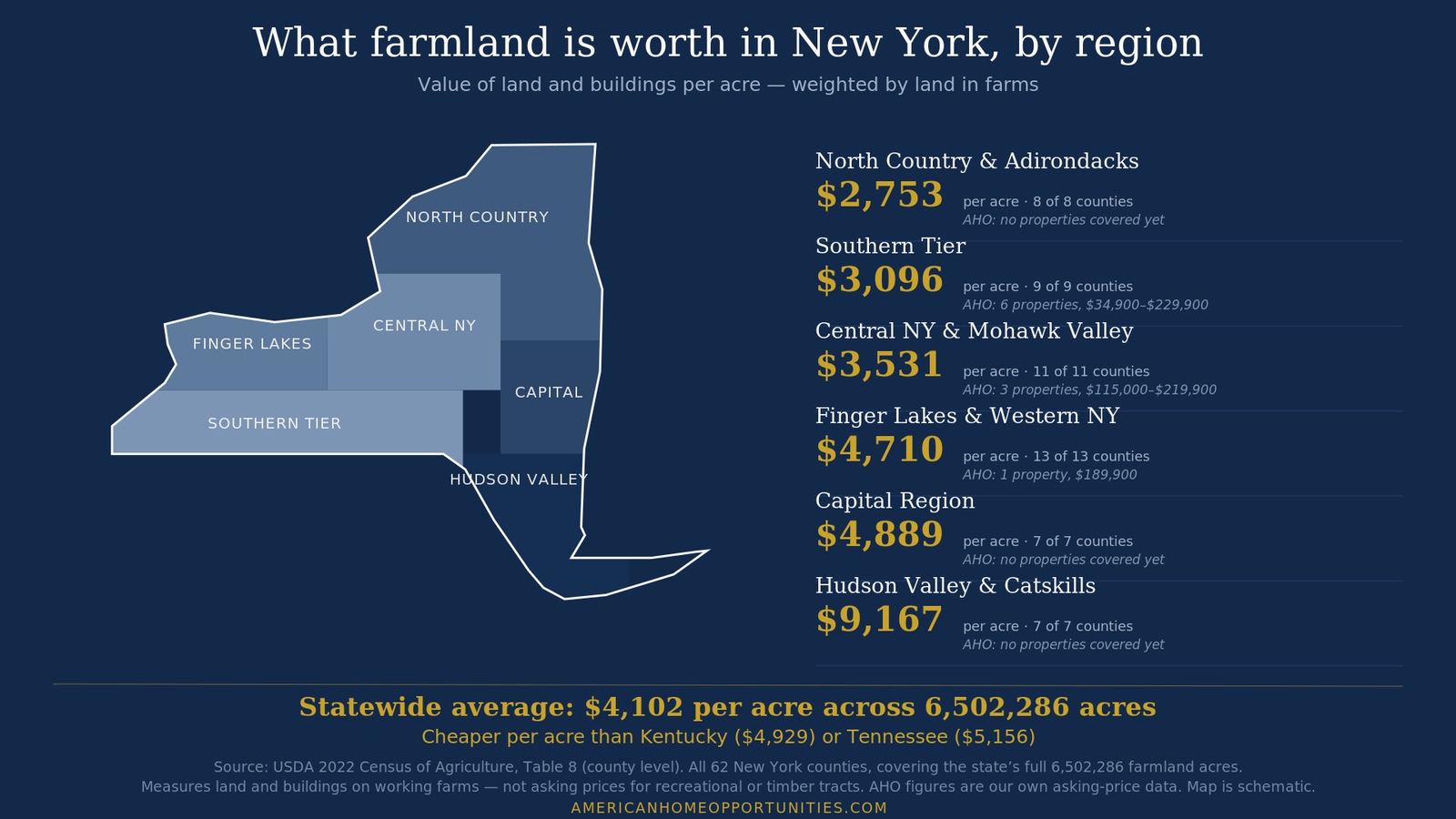
| Region | Farmland value per acre USDA, 2022 census | Properties AHO has covered our own asking prices |
|---|---|---|
| North Country & Adirondacks | $2,753 8 of 8 counties · Lewis $2,328 to Warren $6,662 | None yet — the cheapest region in the state is the one we have not filmed |
| Southern Tier | $3,096 9 of 9 counties · Chenango $2,434 to Chemung $3,542 | 6 properties $34,900 – $229,900 |
| Central New York & Mohawk Valley | $3,531 11 of 11 counties · Oswego $2,848 to Cayuga $4,355 | 3 properties $115,000 – $219,900 |
| Finger Lakes & Western New York | $4,710 13 of 13 counties · Niagara $3,796 to Yates $6,402 | 1 property $189,900 — too few to draw anything from |
| Capital Region | $4,889 7 of 7 counties · Washington $3,233 to Saratoga $6,689 | None yet |
| Hudson Valley & Catskills | $9,167 7 of 7 counties · Sullivan $5,224 to Rockland $13,052 | None yet |
| New York statewide | $4,102 All 62 counties · 6,502,286 acres | 10 properties $34,900 – $229,900 |
Two things in that table are worth sitting with. The first is that the ranking runs opposite to the way people talk about New York: the Adirondacks, which sound remote and therefore expensive, are the cheapest ground in the state, and the Hudson Valley, an hour and a half from Manhattan, is three and a half times dearer. The second is that we have never covered a property in the North Country. The cheapest region in New York is the one region where we have nothing to show you yet. We would rather say that than pretend the gap is not there.
Where the cheap land is in upstate New York, and why it is cheap
Cheap land always has a reason. In New York the reasons are unusually easy to name, which is good news: a reason you can name is a reason you can plan around or walk away from.
Lewis County is cheap because it sits under the biggest snow machine east of the Rockies
The cheapest county in the state is not cheap by accident. Lewis County covers most of the Tug Hill Plateau, where wind crosses roughly 150 miles of Lake Ontario and then climbs from 250 feet of elevation on the western edge to 2,100 feet on the eastern edge. The result is lake-effect snow on a scale that has no real rival in the eastern United States: Tug Hill almost always clears 200 inches a season, and parts of it reach 300. In the winter of 2024–25, Copenhagen and Barnes Corners — both in Lewis County — took roughly 26 feet.
That is not a hidden defect. It is a published, measurable fact you can budget for: a tractor with a blower, a metal roof designed for that load, a heating plan that does not depend on a single source, and a driveway you can actually keep open. For some buyers that is a deal breaker. For others it is the reason they can afford 40 acres in New York State.
The Southern Tier is cheap because the jobs left and the tax rate did not
Chenango, Broome, Allegany, Cattaraugus, Steuben and Tioga all sit between $2,400 and $3,300 an acre. These are counties that lost manufacturing and population and never replaced either. What they did not lose is the cost of running a county, a town and a school district — and when the tax base shrinks, the rate has to go up to raise the same money. We come back to that below, because it is the single most important number on this page.
The Hudson Valley is expensive because of a two-hour drive
Dutchess, Orange, Ulster and Putnam are priced off New York City weekenders, not off what the ground produces. If your budget is under $200,000 and you want acreage, this region will disappoint you, and no amount of searching will change that. Look north and west instead.
What to check before buying rural land in upstate New York
These are the checks that are specific to New York. They are the ones a buyer coming from another state does not know to ask about, and the ones that cost the most when they are skipped.
Ask whether the land is under an agricultural assessment — and what happens when you stop farming it
New York lets working farmland be assessed on its farming value instead of its market value. The catch is written into Agriculture and Markets Law §305. If the land is converted to another use within eight years of the last year it received the agricultural assessment, the owner owes a conversion payment of five times the tax saved in that last year, plus 6% compounded annually for up to five years of benefit. You also have to notify the assessor within 90 days of starting the conversion; miss that and the assessing unit can add a penalty of up to twice the amount owed, capped at $1,000.
The part that catches buyers: you inherit the clock. Buy a place with an active agricultural assessment, stop working the fields, and the bill lands on you. Ask the assessor, in writing, whether the parcel is enrolled and what year it was last certified.
If the parcel is in the 480-a forest programme, understand that the commitment renews every year
Real Property Tax Law §480-a gives a property tax break on tracts of 50 or more contiguous acres managed for timber under a plan approved by the state Department of Environmental Conservation. It is a ten-year commitment — but the owner re-declares it every single year, and each declaration commits the land for the next ten years. The clock never runs out while you are in the programme.
Withdrawing costs 2.5 times the taxes that would have been levied on the exemption, going back up to ten years, plus interest. Pull out only part of the tract and the penalty is 5 times the ten years of savings. The DEC finalised new regulations for the programme effective 1 March 2026, so anything you read about 480-a written before then may be out of date.
The tax figure in the listing is probably the seller’s, with STAR already taken off
New York’s School Tax Relief exemption applies only to a primary residence, and only one per married couple statewide. The state cross-checks addresses and Social Security numbers, and claiming it on two properties triggers a clawback with interest and penalties. Voter registration, vehicle registration and how much of the year you actually spend there all feed into whether a place counts as your primary residence.
So if you are buying a weekend place, a hunting camp or a second home, the annual tax number you see online is very likely lower than what you will pay. Ask the assessor for the bill without STAR before you make an offer.
Inside the Adirondack Park, file a Jurisdictional Inquiry Form before you sign anything
The Adirondack Park contains millions of acres of privately owned land, and what you may do with a private parcel there depends on how it is classified under the Adirondack Park Land Use and Development Plan. Some projects need a permit from the Adirondack Park Agency on top of the town building permit — subdivisions of ten or more lots on Rural Use land, for instance, or any subdivision of Rural Use land within 150 feet of a state highway right-of-way. Depending on the project the state Department of Environmental Conservation, Department of Health and Department of Transportation may all have a say too.
The APA publishes a free Jurisdictional Inquiry Form for exactly this situation: you describe what you want to do, staff review it and answer by letter. It costs nothing and it is the correct move before, not after, you go to contract.
Ask what the nearest hospital still does, not whether there is one
Services get cut long before a building closes. In 2023, 40% of New York’s rural counties had no hospital-based obstetric service at all, against 14% of its urban counties. Nationally, 27 rural labour and delivery units shut in 2025, up from 21 the year before.
Three separate questions, and they often have three different answers: where is the nearest emergency room, where is the nearest hospital that admits inpatients, and where is the nearest hospital that delivers babies. If you are of childbearing age, or caring for someone who is, drive that last one before you buy.
Get the perc test result before the offer, not after
Soil decides the septic bill more than anything else. Where the ground percolates you get a conventional gravity system; where you hit heavy clay or shallow bedrock — common across the Southern Tier and the Adirondack fringe — you are into an engineered or mound system at two to three times the cost. Contractor aggregates for New York put a drilled well at roughly $4,000 to $15,000, a conventional septic in Central New York at $8,000 to $15,000, and an engineered system at $15,000 to $30,000 or more. A perc test itself runs about $400 to $1,000 and is required before the system can be designed or permitted.
Those are contractor ranges, not published rates, and they vary widely by county — Western New York quotes run considerably lower. Treat them as an order of magnitude and get a local quote.
Check the address against the state broadband map, not the provider’s
New York’s ConnectALL office has identified 114,377 individual addresses in the state that are unserved or underserved, and estimated the cost of reaching all of them with fibre at $1.9 billion. The build now under way, worth $542 million and funded largely through the federal BEAD programme, covers 58,617 of those homes and businesses, mostly in rural districts.
Which means two things. Service at a given address is a coin flip until you check it, and a rural address that has no fibre today may well be in a funded build. Both are worth knowing before you decide, especially if you work from home.
We run these checks before we feature a property
Every listing that makes it into a New York video has been through the assessment history, the tax rate for that town and school district, the septic and well situation and the drive time to a hospital that admits patients. Leave your email and the next New York batch comes to you with that work already done.
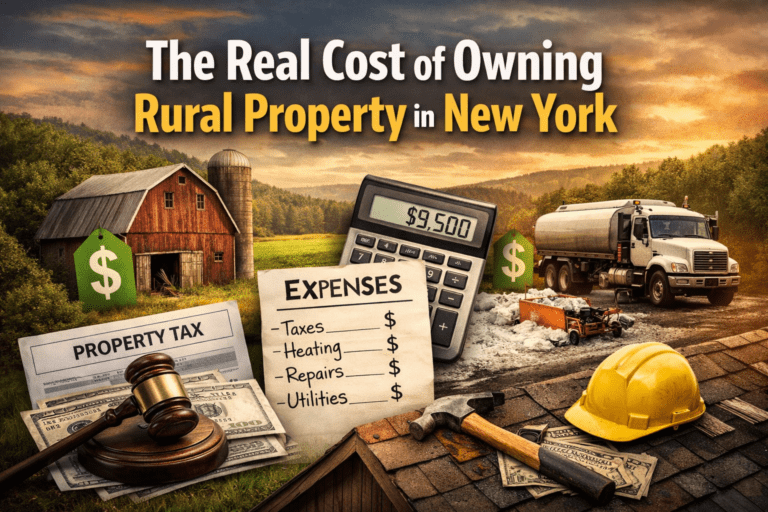
The real cost of owning rural land in upstate New York
Here is where New York earns its reputation. The Tax Foundation puts New York’s effective property tax rate on owner-occupied housing at 1.30%. Tennessee is 0.52%. North Carolina is 0.66%. Kentucky is 0.74%. The national spread runs from 0.29% in Hawaii to 1.88% in New Jersey and Illinois, so New York sits near the top end without being at it.
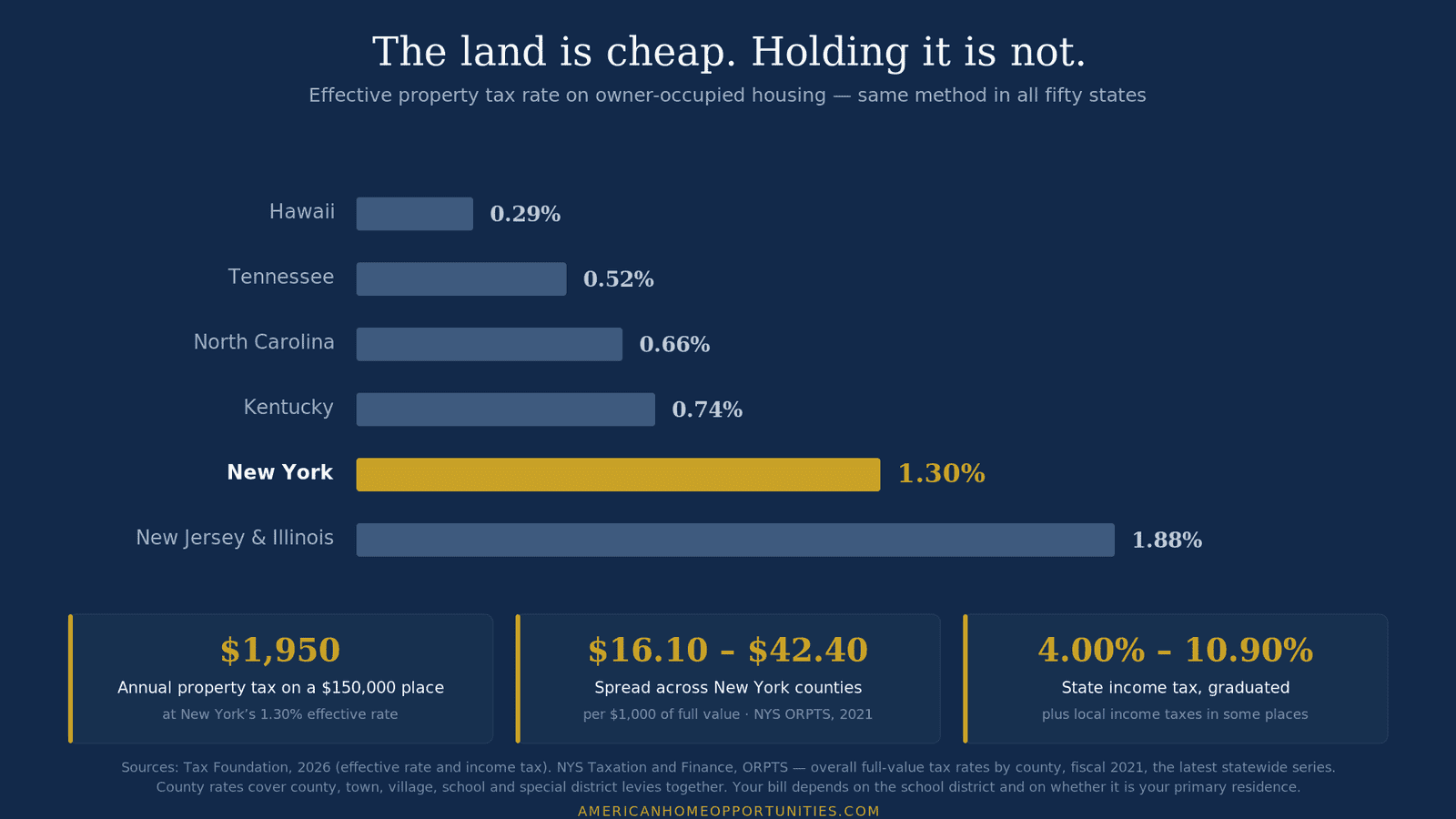
On a $150,000 place, 1.30% is roughly $1,950 a year. Against Tennessee’s 0.52% on the same price — about $780 — the gap is $1,170 a year, or $11,700 over a decade. That is a meaningful share of what you saved on the purchase.
Two numbers, two methods, and why we publish both
If you go looking, you will find New York property tax rates quoted anywhere from 1.3% to nearly 3%. Both kinds of number can be correct, because they measure different things. The Tax Foundation figure divides median tax paid by median home value on owner-occupied homes, after exemptions like STAR. New York’s own ORPTS full-value tax rates divide the total levy by taxable full value, which includes commercial and industrial property and applies no homeowner exemption. We use the Tax Foundation number to compare New York against other states, because the method is identical in all fifty, and we use ORPTS to compare counties within New York, because it is the state’s own data. Anyone quoting a single New York rate without saying which one they mean is guessing.
The cheapest land and the cheapest tax bill are in different counties
This is the finding that matters most, and it is the one no listing site will tell you. Cross the USDA census against New York’s own county tax rates and the pattern is stark: several of the counties with the cheapest ground carry the highest tax rates in the state, because a small tax base has to be taxed harder to fund the same schools and roads.
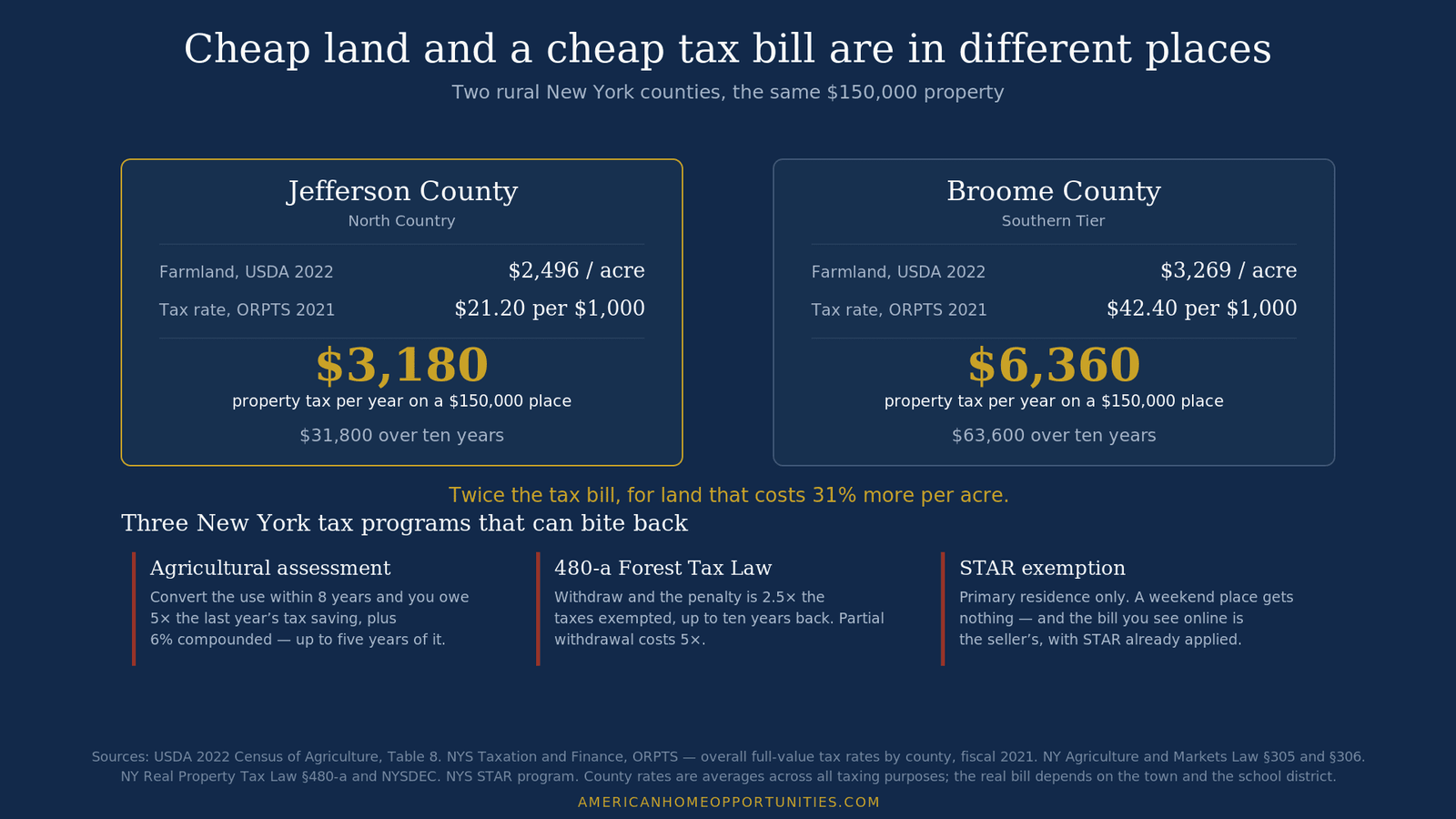
Broome County, in the Southern Tier, had the highest overall full-value rate in the state at $42.40 per $1,000. Allegany was $41.40, Oswego $39.90, Cortland $39.80, Chenango $38.00 — and every one of those counties has farmland under $3,320 an acre. At the other end, Hamilton County, deep in the Adirondacks, was the lowest in the state at $16.10, with Warren at $17.10 and Jefferson at $21.20.
Put a $150,000 property in Jefferson County and the annual bill is around $3,180. Put the identical property in Broome County and it is around $6,360. Twice the tax, for land that costs 31% more an acre. Over ten years that is $31,800 of difference — more than a fifth of the purchase price, decided entirely by which side of the state you looked at.
Those county rates come from the state’s fiscal 2021 series, the most recent one ORPTS has published statewide, and they are averages across every taxing purpose — county, town, village, school district and special districts together. Your actual bill depends on the specific town and school district, and on whether the place is your primary residence. Treat them as the shape of the map, not as a quote.
The rest of the New York tax picture
Income tax is graduated from 4.00% to 10.90%, and some jurisdictions levy a local income tax on top. Sales tax is 4.00% at the state level with an average combined state and local rate of 8.54%. New York has an estate tax — not an inheritance tax, but worth raising with an attorney if the property is meant to pass to children. And in practice you will want a lawyer at closing: New York does not legally require one for a residential purchase, but custom is that the buyer’s attorney, the seller’s attorney, the bank’s attorney and the title company all sit at the same table. Show up without one and you are the only person there who does not have counsel.
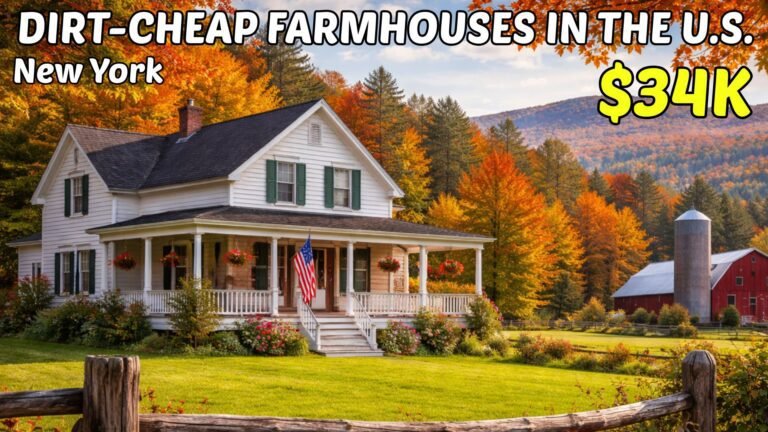
New York properties we have covered
Every property below was a live listing when we filmed it. Prices and availability change; the point of these reports is to show you what a given budget actually buys in a given county, not to sell you a specific house.
More New York guides
Deeper reading on the parts of the process that need more room than this page gives them.
Keep exploring
Everything above is Upstate New York. The rest of it applies anywhere.
If the prices on this page still look impossible, why cheap rural homes do not sell is the explanation, mechanism by mechanism. The guides library gathers the other states, the loan rules and the cost breakdowns. How we score a property shows our workings, and the Field Guide is the checklist version.
Get the next batch of New York listings first
We publish a new state roundup most weeks. Subscribers see the New York properties before the video goes up, with the price per acre and the county tax rate already worked out.
Questions people ask about buying rural land in upstate New York
Which New York county has the cheapest land?
By the 2022 Census of Agriculture, Lewis County has the lowest farmland value in the state at $2,328 an acre, followed by St. Lawrence at $2,386, Chenango at $2,434 and Jefferson at $2,496. Lewis is cheap for a specific and well documented reason: most of it sits on the Tug Hill Plateau, which takes 200 to 300 inches of lake-effect snow in a normal winter.
Is New York really cheaper per acre than southern states?
For farmland, yes. The 2022 census puts New York at $4,102 an acre against Kentucky at $4,929 and Tennessee at $5,156. What is not cheaper is holding it: New York’s effective property tax rate of 1.30% is roughly two and a half times Tennessee’s 0.52%. The land is cheap; the annual bill is not.
Can I build on land inside the Adirondack Park?
Often yes, but what you may build depends on how the parcel is classified under the Adirondack Park Land Use and Development Plan, and some projects need an Adirondack Park Agency permit in addition to the town’s. The APA’s free Jurisdictional Inquiry Form is the way to find out for a specific parcel before you commit. Do not rely on a seller’s description of what is allowed.
Will my property taxes go up after I buy?
They can, for two New York-specific reasons on top of the usual reassessment. If the seller had a STAR exemption and the place will not be your primary residence, that reduction disappears. And if the land carried an agricultural assessment and you stop farming it, converting the use within eight years triggers a payment of five times the last year’s tax saving plus 6% compounded interest. Ask the assessor for the bill without exemptions before you write the offer.
Get New York listings before they are gone
Tell us your price range and how soon you are planning to buy, and we will email you when we feature New York properties that fit. You will also get our free Rural Property Buyer’s Guide, the checklist we run through before featuring any listing.
Ask us one question about New York
Pick whichever is closest and it opens an email with the subject already written. We answer them ourselves.
Sources. Farmland values: USDA National Agricultural Statistics Service, 2022 Census of Agriculture, Volume 1, Chapter 2, County Level, New York, Table 8 — all 62 counties. State tax rates and cross-state comparisons: Tax Foundation, 2026. County tax rates: New York State Department of Taxation and Finance, Office of Real Property Tax Services, overall full-value tax rates by county, fiscal 2021. Agricultural assessment: New York Agriculture and Markets Law §305 and §306. Forest tax programme: New York Real Property Tax Law §480-a and the Department of Environmental Conservation. STAR: New York State Department of Taxation and Finance. Land use in the Park: Adirondack Park Agency. Snowfall: New York State Tug Hill Commission and the National Weather Service. Rural obstetric access: Step Two Policy Project and March of Dimes. Broadband: New York State ConnectALL Office. Closing practice: New York State Bar Association. Well and septic figures are contractor aggregates, not published rates.
Please read. Figures on this page were compiled on 2 August 2026 and are published for general information. Prices we quote for properties we have featured are asking prices at the time we filmed them, not sale prices. Nothing here is legal, tax or financial advice. Property tax rates, exemption rules and land use regulations change, and they vary by town and school district within a county — verify anything that matters to your decision with the county assessor, the town, and a New York attorney before you commit money.