
Buying Rural Property in Florida
What land actually costs county by county, why the cheapest land in the state often carries the strictest rules, and the two costs a Florida listing never shows you.
$7,319
per acre of farmland
USDA 2022 census
0.78%
effective property tax
national range 0.29–1.88%
12.1x
cheapest to priciest county
Jackson $4,146 to Miami-Dade $50,161
8%
of the price is the land
across the 20 Florida homes we feature
What land actually costs in Florida
A land listing site will tell you that the average acre in Florida costs $42,927. The USDA’s 2022 Census of Agriculture, which counts every farm in the state instead of every advertisement, puts it at $7,319. Both numbers are real. Only one of them describes what people actually own. Listing averages measure what is for sale right now, and what is for sale skews small, close to a road and close to a town. That is why we build this page on the census.
The gap between counties is the part that matters. An acre of farmland in Jackson County, hard against the Alabama line, is worth $4,146. The same acre in Miami-Dade is worth $50,161. That is a spread of just over twelve times, inside one state, measured the same way in both places.
Here is what surprised us. In Kentucky and North Carolina the region tells you most of what you need to know before you start looking. In Florida it barely tells you anything. From the cheapest region to the priciest there is a factor of 1.5. From the cheapest county to the priciest there is a factor of 12. Florida is a county game, not a region game — and some of the cheapest counties in the state are nowhere near where you would expect them to be.
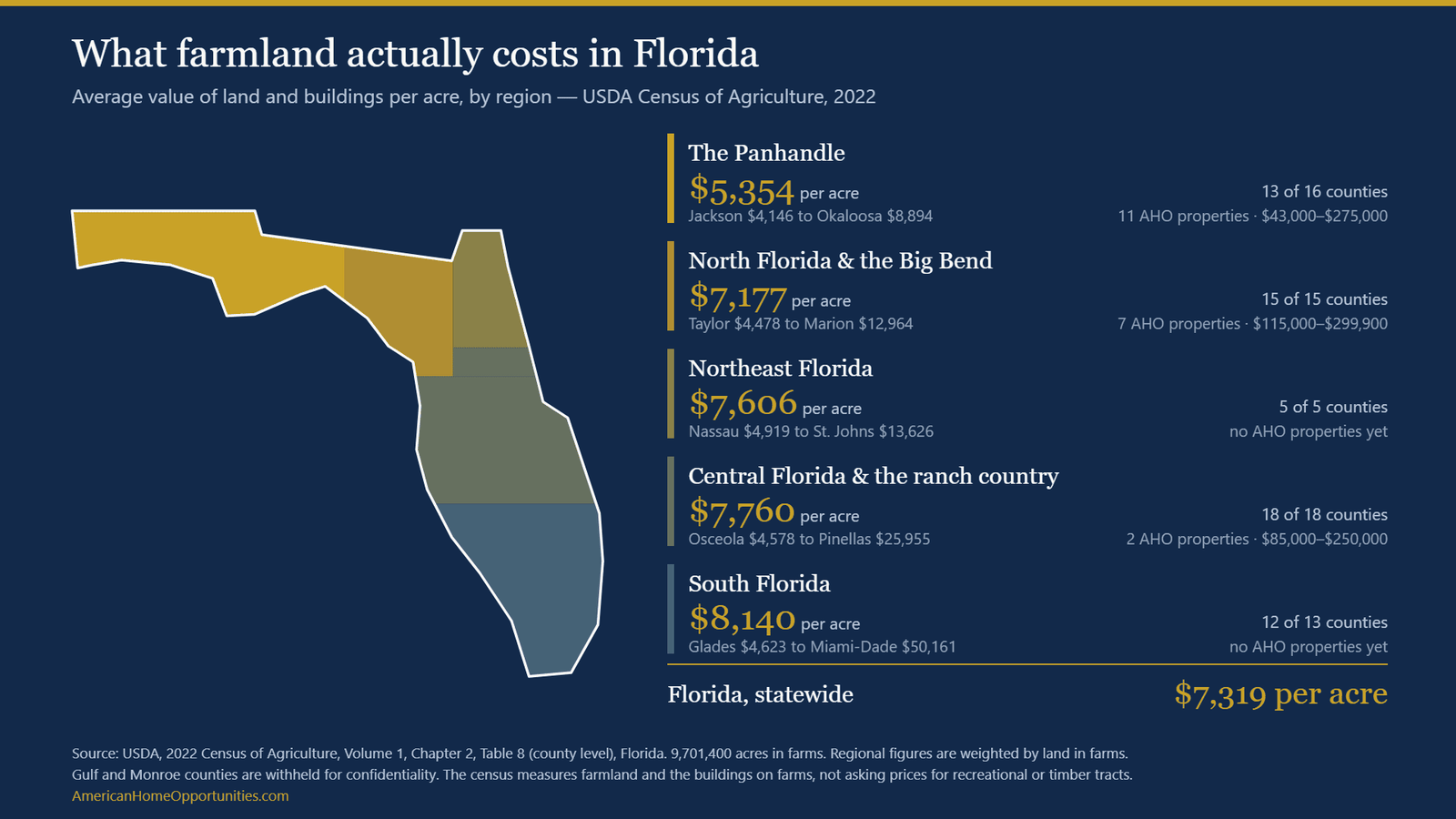
| Region | Farmland value per acre USDA, 2022 census | Cheapest and priciest county | What we have covered here |
|---|---|---|---|
| The Panhandle | $5,354 13 of 16 counties | Jackson $4,146 to Okaloosa $8,894 | 11 homes, $43,000–$275,000 |
| North Florida and the Big Bend | $7,177 15 of 15 counties | Taylor $4,478 to Marion $12,964 | 7 homes, $115,000–$299,900 |
| Northeast Florida | $7,606 5 of 5 counties | Nassau $4,919 to St. Johns $13,626 | none yet |
| Central Florida and the ranch country | $7,760 18 of 18 counties | Osceola $4,578 to Pinellas $25,955 | 2 homes, $85,000–$250,000 |
| South Florida | $8,140 12 of 13 counties | Glades $4,623 to Miami-Dade $50,161 | none yet |
| Florida | $7,319 9,701,400 acres in farms | Jackson to Miami-Dade, a 12.1x spread | 20 homes, $43,000–$299,900 |
Where the cheap land is, and why it is cheap
Six of the twelve cheapest counties in Florida are in the western Panhandle: Jackson at $4,146, Gadsden at $4,409, Calhoun at $4,502, Holmes at $4,558, Liberty at $4,646 and Washington at $4,787. None of them touches the tourist coast. There is no metro area pulling prices up, the economy is row crops, cattle and planted pine, and in 2018 Hurricane Michael came ashore as a Category 5 and flattened an enormous share of the standing timber across Jackson, Calhoun and Liberty. Land that produces less is worth less. That is the honest reason, and it is also why a farmhouse there can still be bought for double figures.
The second cluster runs east through the Big Bend: Taylor at $4,478, Dixie at $4,694, Lafayette at $4,741, Madison at $4,506 and Hamilton at $4,547. Pine plantation country, few people, no interstate, and the Gulf coast here is salt marsh rather than beach. It is quiet in a way that suits some buyers completely and would drive others out inside a year.
The counties nobody expects to be cheap
Osceola County is the eighth cheapest county in Florida for farmland at $4,578 an acre, and its northern boundary runs into the suburbs of Orlando. Glades at $4,623 and Hendry at $4,646 sit in South Florida, the most expensive region in the state on average. All three are enormous cattle and sugar operations, and extensive use across hundreds of thousands of acres keeps the farm value per acre low.
That deserves a warning rather than a celebration. The census measures farmland and the buildings on farms. It does not measure what a five-acre parcel with road frontage sells for forty minutes from a theme park. In Osceola those are two completely different numbers, and if you go shopping there expecting the census figure you will be disappointed. Where the census figure and the market do line up closely is exactly where we spend most of our time: the Panhandle and the Big Bend.
In Florida you are buying the house, not the land
We have now covered 20 properties in Florida across two lists. Put them together and something becomes obvious. The median lot is 2 acres. Across all twenty, the land underneath them is worth about 8% of the asking price at census values — roughly $274,000 of land inside $3.36 million of asking prices.
The range inside that is instructive. On 4.5 acres in Jay, Santa Rosa County, the land accounts for around a fifth of the price. On a quarter acre in Ponce de Leon it accounts for about one percent. So when a Florida listing advertises a price per acre, treat the number as decoration. On a small lot it tells you almost nothing about the land and everything about the arithmetic of dividing a house by a fraction.
The practical version: if you want a cheap house, shop the Panhandle. If you want acreage, shop the ranch counties. They are rarely the same listing, and pretending otherwise is how buyers end up disappointed on both counts.
What to check before you buy in Florida
Every state has its own set of traps. These are Florida’s, and four of the six are written into statute, which means you can look them up rather than take anyone’s word for it.
You are entitled to a flood disclosure. Ask for it.
Since 2024, section 689.302 of the Florida Statutes requires the seller of residential property to hand you a flood disclosure at or before the contract is signed. It has to state whether flooding damaged the property while they owned it, whether they filed an insurance claim including with the National Flood Insurance Program, and whether they received federal disaster assistance for flood damage. The statute defines flooding broadly enough to include standing water from sustained rainfall, not just a river coming over its banks. The disclosure form itself points out that a homeowners policy does not cover flood.
If it comes back as “no knowledge”, that is still useful — get it in writing, then check the FEMA map yourself. A seller can only disclose what happened on their watch.
A conventional septic tank may not be legal on that lot
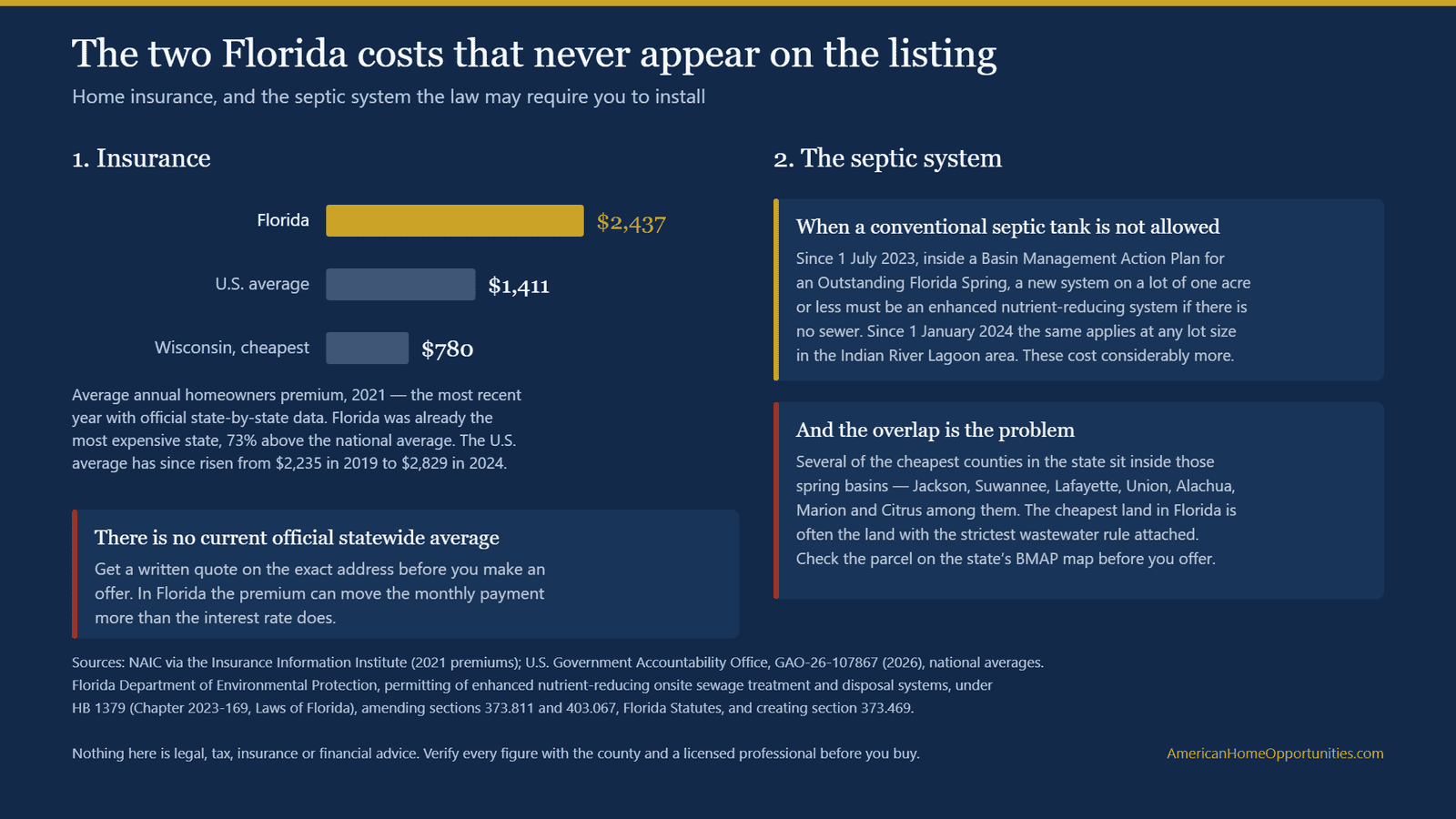
This is the one almost nobody tells rural buyers. Under HB 1379 of 2023 (Chapter 2023-169, Laws of Florida), which amended sections 373.811 and 403.067 of the Florida Statutes, a new onsite system on a lot of one acre or less inside a Basin Management Action Plan for an Outstanding Florida Spring must be an enhanced nutrient-reducing system when no sewer is available. Since January 2024 the same rule applies at any lot size inside the Indian River Lagoon area, covering parts of St. Lucie, Indian River, Brevard and Volusia counties.
An enhanced system costs considerably more than a conventional tank and drainfield. And here is the awkward part: several of the cheapest counties in the state sit inside those spring basins. Check the parcel on the state’s BMAP mapping before you make an offer, and get the number from the county health department rather than from a listing.
The tax figure on the listing is the seller’s, not yours
Florida’s Save Our Homes limitation caps the annual increase in assessed value at 3% or the change in the Consumer Price Index, whichever is lower, for as long as the same owner holds the homestead exemption. Section 193.155 of the Florida Statutes removes that cap on a change of ownership, and the property is reassessed at full market value on the following January 1.
So a house a retiree has owned for twenty years may be carrying an assessment far below what it is worth, and the tax number in the listing reflects their history, not your future. Work out your own bill from market value at the county millage rate before you decide what you can afford. If you already own a Florida homestead, portability can move the accumulated benefit to the new one — you apply by March 1 and within three years of leaving the old homestead.
Agricultural classification does not come with the land
Florida’s greenbelt law, section 193.461, taxes land in bona fide commercial agricultural use on its agricultural value rather than its market value. Two things buyers get wrong. First, you apply for it yourself, with the county property appraiser, by March 1 — missing the deadline waives it for the year. Second, the statute says a minimum acreage may not be required, so a small parcel is not disqualified on size alone, but the use has to be genuinely commercial and the appraiser will look at how long it has been farmed, how it is maintained and what you paid for it.
Useful detail if you are the one selling later: offering the property for sale is not by itself a reason to deny the classification, as long as the agricultural use continues.
Get an insurance quote before you make the offer, not after
The last official state-by-state figures, from the NAIC, put the average Florida homeowners premium at $2,437 a year against a national average of $1,411 — already the most expensive state in the country. Those are 2021 numbers, and no free, current, official statewide average exists. What is documented is the direction: the Government Accountability Office reported this year that the national average went from $2,235 in 2019 to $2,829 in 2024, and that Florida is one of three states where the premium takes the largest bite out of median household income.
Treat every current Florida premium you read online as a guess until you have a written quote on the actual address. In this state the insurance line can move your monthly payment more than the interest rate does, and on an older roof it can decide whether the purchase happens at all.
Count the buildable acres, not the advertised ones
A great deal of rural Florida is wetland. Acreage on a listing is the size of the parcel, not the part of it you can put a house, a well and a drainfield on. Where wetlands are involved you are dealing with an environmental resource permit from the state or the water management district, and potentially with the Army Corps of Engineers as well. Ask what has already been permitted and walk the parcel in the wet season if you possibly can.
One piece of good news to balance that: Florida does not require an attorney at closing the way North Carolina does. Closings run through title companies, which keeps the transaction cost lower. Hiring a Florida real estate attorney anyway on a rural parcel with easement or access questions is still money well spent.
We run these checks before we feature a property
Every Florida listing we publish gets read against the census value for its county, the flood and septic rules for its parcel, and what the town around it actually offers. Leave your email and the ones that survive that come to you.
What it actually costs to own it
Florida has no personal income tax. That is the headline everybody knows, and it is true. The part that gets left out is that Florida is not a cheap property tax state by the standards of the places we usually cover. The Tax Foundation puts the effective rate on owner-occupied housing at 0.78%, which is higher than Tennessee at 0.52%, North Carolina at 0.66% and Kentucky at 0.74%. Nationally the range runs from 0.29% in Hawaii to 1.88% in New Jersey and Illinois, so Florida sits a little above the middle.
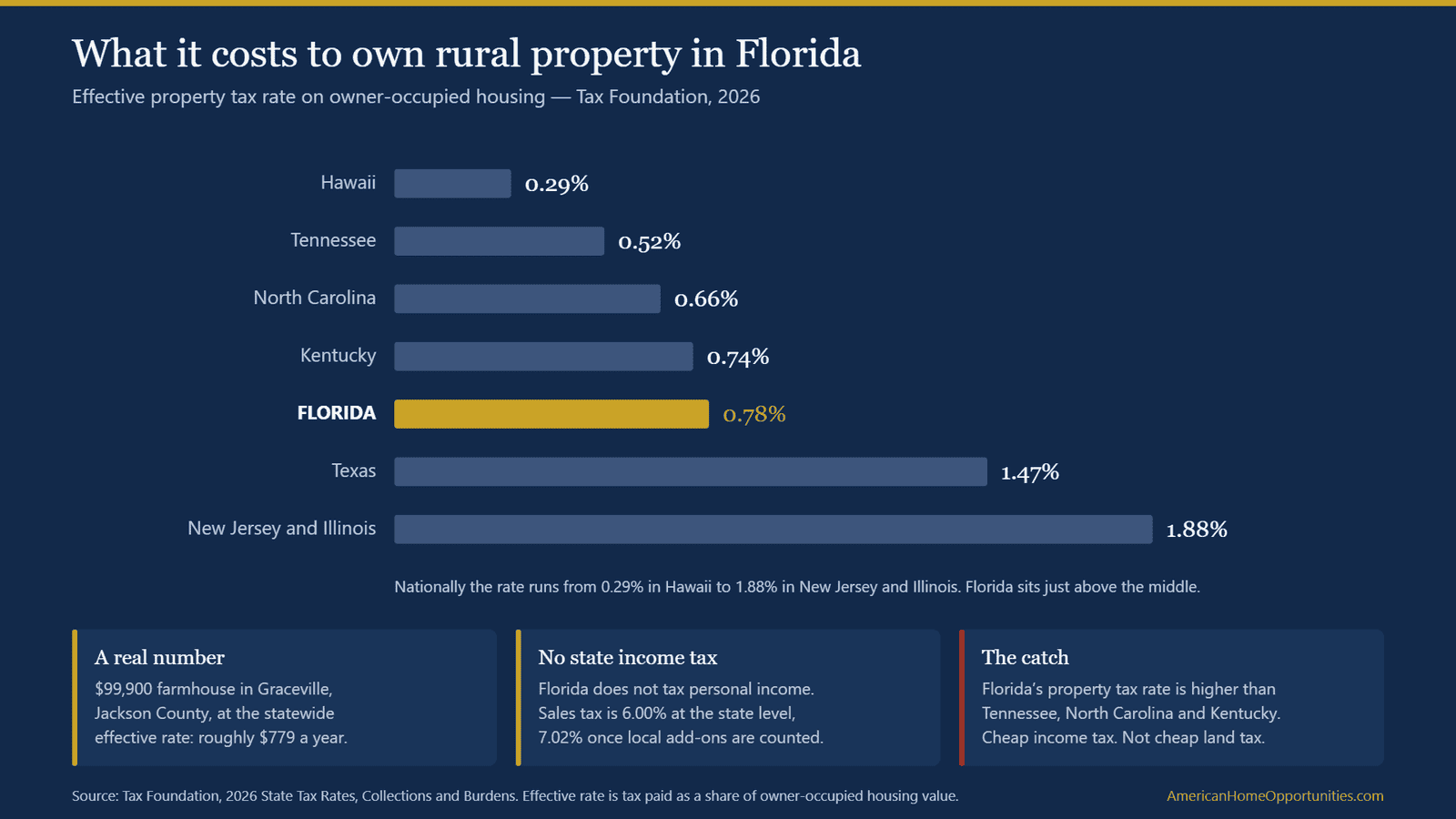
Put a real number on it. The $99,900 farmhouse we covered in Graceville, Jackson County, would owe roughly $779 a year at the statewide effective rate. Sales tax is 6.00% at state level and 7.02% once local add-ons are counted. There is no estate tax and no inheritance tax, which is one place Florida is genuinely cheaper than Kentucky.
If the house will be your primary residence, apply for the homestead exemption with the county property appraiser. It takes a slice of assessed value out of the tax base, and more importantly it is what switches on the Save Our Homes cap described above, which is worth far more over ten years than the exemption itself. The deadline is March 1, the same as the agricultural classification.
And then there are the two costs the listing never shows
Property tax is the predictable part. In Florida the two numbers that decide whether a cheap house stays cheap are the insurance premium and, on some parcels, the septic system the law requires. Neither appears anywhere on a listing, and both can be pinned down before you commit.
One well worth knowing: private well construction permits in Florida come from the five water management districts rather than from the county, so that is where the questions about depth, casing and water quality go. We do not publish a cost range for wells or for enhanced septic systems here, because we could not find an official Florida source for either, and a made-up range is worse than no range at all. Ask the county health department and two local contractors, and treat the higher number as the real one.
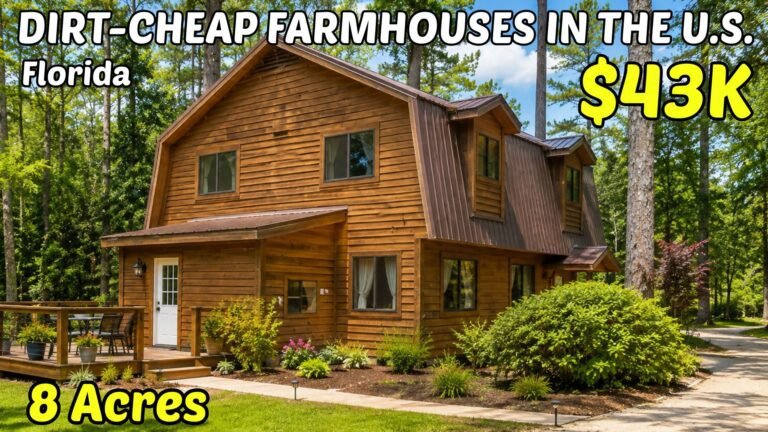
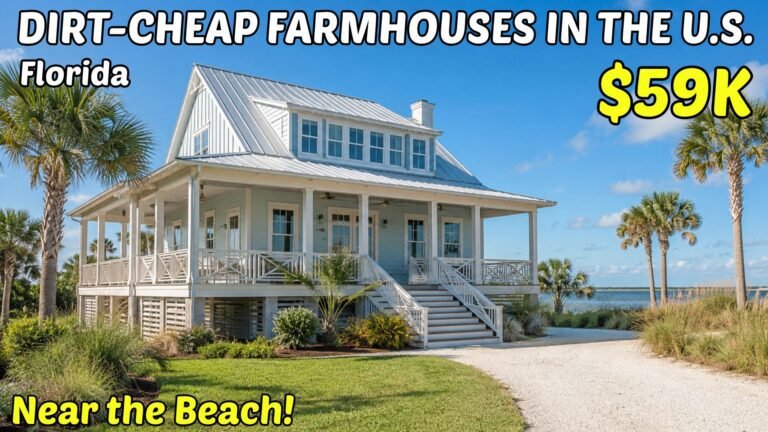
Cheap Florida farmhouses we have covered
Every property below was publicly listed when we published it, and every one of them has been read against the census value for its county before it made the list. Prices and availability change; verify anything you like directly with the listing agent before you act on it.
Keep exploring Florida
Everything above is Florida. These are the pieces that sit underneath it and apply wherever you buy.
The guides library indexes every state page and every rule we have written up, from loan minimums to septic permits. If you want the reasoning rather than the listings, why cheap rural homes do not sell explains the eight mechanics that put a house on the market at a price that looks impossible, and how we score a property sets out what we weigh before anything gets published. The Rural Property Field Guide is the free checklist version to take with you.
Florida guides
The practical companions to this page. One walks the whole buying process in order; the other answers the question that stops most rural parcels before anything else does.
Get the next batch of Florida listings first
New Florida properties go out by email before the video goes live. One message, no noise, unsubscribe in a click.
Questions people ask before buying rural property in Florida
What is the cheapest county in Florida to buy land?
Jackson County, in the western Panhandle, at $4,146 an acre. That is the average value of farmland and buildings per acre in the USDA’s 2022 Census of Agriculture, the only source that measures every county the same way. Gadsden follows at $4,409 and Taylor at $4,478. All three are a long way from a coast and a long way from a metro area, which is exactly why they are cheap.
How much is an acre of land in Florida?
$7,319 statewide, by the 2022 census. You will see figures around $42,000 an acre on land listing sites, and the difference is not an error on either side: those sites average what is currently advertised, which skews small, close to a road and close to a town. County by county the census range runs from $4,146 in Jackson to $50,161 in Miami-Dade.
Do you need a lawyer to buy property in Florida?
Florida does not require one. Residential closings normally run through a title company, unlike North Carolina where an attorney is required. On a rural parcel with questions about access, easements or wetlands, many buyers hire a Florida real estate attorney anyway. We are not lawyers and this is not legal advice — it is a description of how closings usually work in the state.
Can a small parcel get the agricultural tax classification?
Possibly. Section 193.461 of the Florida Statutes says a minimum acreage may not be required for agricultural assessment, so size alone does not disqualify a parcel. What matters is bona fide commercial agricultural use, and the property appraiser weighs how long the land has been farmed, how it is maintained and what you paid for it. You apply with the county property appraiser by March 1, and the classification does not transfer automatically when the property changes hands.
Looking for something specific in Florida?
Tell us the county, the budget and the acreage and we will keep an eye out. This form is the only place we ask for a phone number, and it is the one that gets you on the Florida list rather than the general one.
One question, one click
Pick the one that matches what you are stuck on. It opens an email with the subject already written, and a real person reads it. We are not a brokerage and we do not give legal, tax or financial advice, so what comes back is the research and the sources, not a recommendation.
Sources, and what this page is not
Land values: USDA, 2022 Census of Agriculture, Volume 1, Chapter 2, Table 8 (county level), Florida. Regional figures are weighted by land in farms and cover 63 of the 67 counties; Gulf and Monroe are withheld for confidentiality, and Franklin and Wakulla publish a value per acre but not their acreage. Taxes: Tax Foundation, 2026 state tax rates, collections and burdens. Flood disclosure: section 689.302, Florida Statutes (Chapter 2024-215, amended by Chapter 2025-166). Assessment cap and portability: section 193.155, Florida Statutes, and Florida Department of Revenue bulletin PT-112. Agricultural classification: section 193.461, Florida Statutes. Septic: Florida Department of Environmental Protection, permitting of enhanced nutrient-reducing onsite sewage treatment and disposal systems, under HB 1379 (Chapter 2023-169, Laws of Florida). Insurance: NAIC via the Insurance Information Institute for 2021 state premiums, and U.S. Government Accountability Office report GAO-26-107867 for national averages. Page last reviewed 3 September 2026.
American Home Opportunities is a publisher. We are not a brokerage, a lender, a lawyer, an insurance agent or a financial adviser, we do not represent buyers or sellers, and nothing on this page is legal, tax, insurance or financial advice. Every price we quote for a property we have covered is an asking price, not a sale price, and asking prices and availability change without notice. Statutes are cited so you can read them yourself; they are summarised here in plain language and the statute governs, not our summary. Verify everything that matters with the county, the water management district, a licensed inspector and a licensed professional in the relevant field before you buy.