
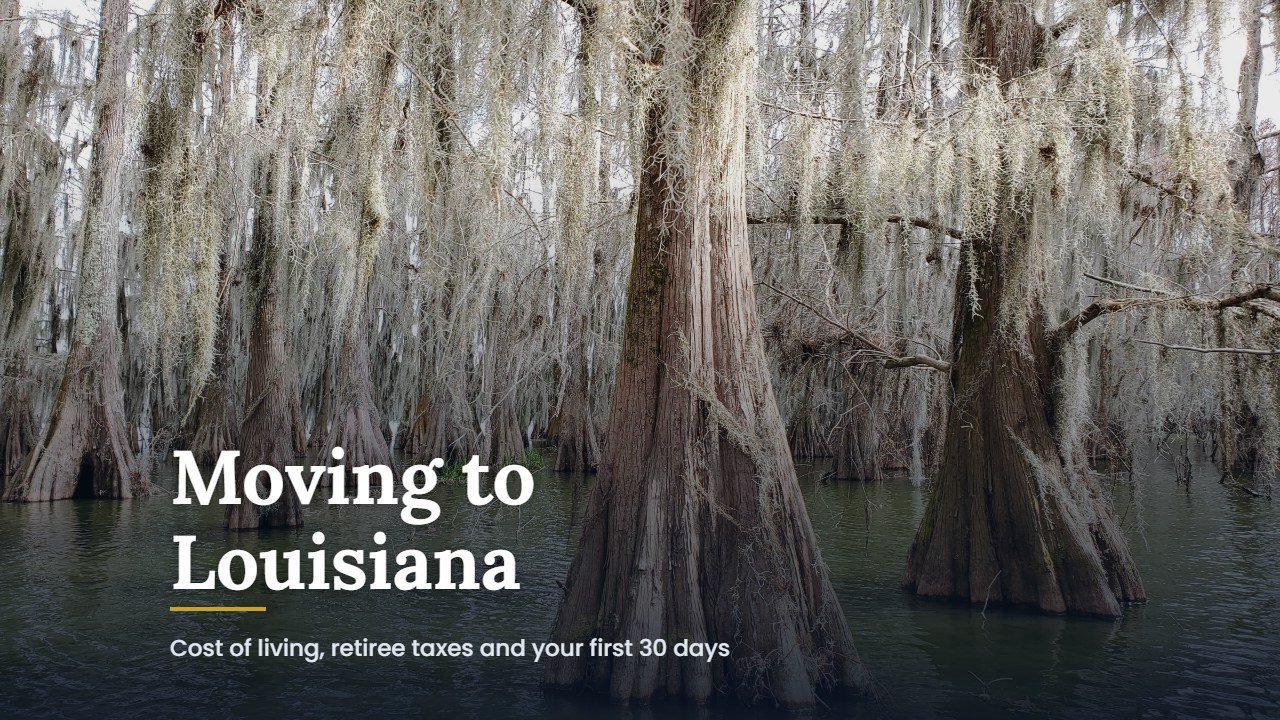
Moving to Louisiana: Costs, Taxes and Insurance (2026)
Moving to Louisiana gets you cheaper housing, a flat 3 percent income tax and a culture that no other state can copy, and it asks you to take the Gulf seriously. The state’s cost of living ranked 16th lowest in the nation in 2026, the median home is worth about $216,000, and since 2025 retirees keep more of their income than before. On the other side of the ledger sit hurricanes, flood zones, homeowners insurance that eats a bigger share of income than almost anywhere, and the highest sales tax in the country. This guide puts real numbers on both sides, from what an acre costs to the paperwork due in your first 30 days.
Moving to Louisiana: the numbers in short
What it really costs to live in Louisiana
The best comparable numbers come from the Council for Community and Economic Research, which prices the same basket of goods in hundreds of cities every quarter, and from Missouri’s economic research office, MERIC, which turns them into state rankings. In the second quarter of 2026 Louisiana scored 91.3, where the national average is 100. That is 16th lowest among the states: cheaper than most of the country, but not as cheap as its neighbors to the north and east.
The composite hides an uneven picture. Housing is where Louisiana is genuinely cheap, and utilities run well below the national level too. Groceries, transportation and health care cost close to what they do anywhere else, and the state’s sales tax, which averages 10.11 percent with local add-ons according to the Tax Foundation, the highest combined rate in the country, lands on almost everything you buy at the register.
Housing and land: what moving to rural Louisiana buys you
The statewide median value of an owner-occupied home is $216,500, according to the Census Bureau, and the median household earns $60,756. About two thirds of homes, 67.4 percent, are owner-occupied. Land costs close to the national level: the 2022 USDA Census of Agriculture puts Louisiana farmland at $3,600 an acre, and the USDA’s 2026 survey at $3,950, about 12 percent below the US average. Pasture is the surprise, at $3,600 an acre, 1.8 times the national pasture price. Our guide to how to buy land in Louisiana has the figures for all 64 parishes and the six checks to run before you buy.
Where you settle decides what kind of Louisiana you get. The north Louisiana hills, from Shreveport to Ruston and Monroe, are pine and pasture country at about $3,638 an acre, farther from the Gulf and its storms. The Delta parishes along the Mississippi are flat, quiet and among the cheapest places in the state to buy a house, with long drives to specialist care. Acadiana, around Lafayette, is rice, cane and Cajun country, at about $3,397 an acre across the region, less once you leave Lafayette Parish. The Florida Parishes north of Lake Pontchartrain cost the most, because they are where New Orleans and Baton Rouge commute from. Decide which of those you are moving for before you start looking.
One more number shapes the market. The Census Bureau estimates Louisiana had 4,618,189 residents in July 2025, 0.9 percent fewer than in 2020, and 18.8 percent of them are 65 or older. A state that is not growing tends not to bid up rural houses, and that is part of why the listings on our Louisiana list ran from $240,000 down to $49,900.
Taxes when you move to Louisiana, especially if you are retiring
Louisiana rewrote its income tax in 2024. Under Act 11 of that year’s Third Extraordinary Session, the graduated brackets were repealed, and from tax year 2025 all taxable income is taxed at a flat 3 percent. The standard deduction jumped from $4,500 to $12,500 for single filers and from $9,000 to $25,000 for married couples filing jointly, indexed to inflation from 2026. There is no estate or inheritance tax. The price of that reform is sales tax: the state rate rose to 5 percent, and the combined state and local rate averages 10.11 percent, the highest in the US.
For retirees the rules are friendly. Social Security benefits that are taxed on your federal return may be excluded from Louisiana taxable income, and so may federal retirement pay, civilian and military. Taxpayers 65 or older can exclude up to $12,000 a year each of other retirement income, such as a private pension or IRA withdrawals, double the $6,000 allowed before the reform; the old extra personal exemption for people over 65 was repealed at the same time. On a typical retirement built on Social Security and a modest pension, the Louisiana income tax bill can be small or zero.
Property tax is light on a modest home. Land and houses are assessed at 10 percent of market value, and once the house is your primary home the homestead exemption takes $7,500 of assessed value, or $75,000 of market value, off state and parish taxes, on a home with up to 160 acres. The Tax Foundation puts the effective property tax rate on owner-occupied homes at 0.55 percent. Owners 65 or older, permanently disabled owners and veterans with a VA disability rating of 50 percent or more can also freeze the assessed value of their homestead, if adjusted gross income is no more than $100,000, a limit that rises to $150,000 from January 1, 2027.
Storms, insurance and the drive to care

Louisiana took 20 direct hits from major hurricanes between 1851 and 2018, according to NOAA’s hurricane research division, second only to Florida’s 37 and one more than Texas. That count stops in 2018, and major storms have come ashore since. The risk is highest along the coast and in the south of the state, but wind, rain and power outages reach far inland, so plan for them wherever you buy.
Insurance is where the risk shows up in your budget. Between July 2021 and September 2022, 11 residential insurers in Louisiana became insolvent, with about 184,430 policies, and the state-created insurer of last resort, Louisiana Citizens, grew from 35,670 policies to 112,035, the Legislative Auditor found. The GAO counts Louisiana among the three states where homeowners insurance takes the largest share of median household income; the national average premium was $2,829 in 2024. Get a quote for the exact address before you make an offer, and ask about the wind deductible.
Flood is a separate policy, and in much of the state a required one. If the house sits in a FEMA high-risk flood zone and you borrow through a federally backed mortgage, flood insurance is mandatory, and NFIP coverage usually starts 30 days after you buy it, unless it is bought at closing. Our guide to Louisiana flood insurance explains the rules and how to check a parcel. Two things work in your favor: the state’s Fortify Homes program grants up to $10,000 toward a FORTIFIED roof, and from January 1, 2027 insurers must give those homes a discount.
Health care is better than in many rural states. The University of North Carolina’s Sheps Center counts only three rural Louisiana hospitals that closed or converted since 2005, against 197 nationwide. Distances in the Delta and the coastal parishes are still long, so find the nearest emergency room and drive the route. Internet is catching up: 86.6 percent of Louisiana households have a broadband subscription, and the state’s GUMBO 2.0 program has $1.355 billion to reach about 130,000 more locations, with a stated goal of 2028.
The pros and cons of moving to Louisiana
What works
Housing about a fifth below the national average, a flat 3 percent income tax, generous breaks for retirees, a $75,000 homestead exemption, few rural hospital closures, mild winters, and food, music and a way of life found nowhere else.
What to weigh
Hurricanes and flooding, homeowners insurance among the most expensive relative to income, the highest combined sales tax in the US, a shrinking population, and hot, humid summers.
What to check first
The flood zone and a flood quote, a homeowners quote with the wind deductible, the drive to an ER, broadband at the exact address, and whether the roof could qualify for a FORTIFIED grant.
The honest summary: Louisiana is one of the more affordable places in the country to own a home, and it treats retirees and homeowners well at tax time. Its weak points are weather and insurance, and they are worth testing in person, with real quotes for a real address, before you sign anything.
Your first 30 days after moving to Louisiana
- Transfer your driver’s license within 30 days of establishing domicile in Louisiana, at an Office of Motor Vehicles location.
- Register your vehicle within 30 days of establishing residency. If it was registered or leased in your name in another state and is used mainly for personal purposes, the use tax is capped at $90 as long as you register it within 90 days of bringing it in, so meeting the 30-day rule keeps you inside the cap.
- Put Louisiana auto and homeowners insurance in place before you register the car and before you close on a house, and get the homeowners quote, wind deductible included, before you sign a purchase agreement.
- Check the flood zone and buy flood insurance at closing if you need it; a policy bought at closing for a loan has no 30-day wait.
- Claim the homestead exemption with the parish assessor once the house is your primary home, and ask about the special assessment level if you are 65 or older, disabled or a veteran with a 50 percent or higher rating.
- Test your well water if the house has one: the Louisiana Department of Health recommends a bacteria test every year, and no-cost kits are available through the Louisiana Private Well Owner Network at 888-293-7020.
- Register to vote and update your address with Social Security, Medicare and your bank, and keep your income tax records for the retirement exclusions when you file your first Louisiana return.
Get the next batch of Louisiana listings first
If you are planning a move, the fastest way to learn the market is to watch real listings. Leave your details and the next Louisiana list reaches you before it goes public.
Keep reading
- How to buy land in Louisiana – what an acre costs in all 64 parishes and the six checks to run before you buy.
- Louisiana flood insurance – the NFIP rules, Risk Rating 2.0 and how to check a parcel before you offer.
- 10 dirt cheap farmhouses in Louisiana with land – real homes from DeRidder to Haynesville.
- The cheapest states to buy land in America – Louisiana against its neighbors, on the same federal survey.
- All our rural property guides, state by state.
Common questions about moving to Louisiana
Is Louisiana a good place to live?
For many movers, yes, if housing cost and culture matter more than weather. Louisiana’s cost of living index was 91.3 in the second quarter of 2026, 16th lowest among the states, with a housing index of 81.3, and the median owner-occupied home is worth $216,500. The trade-offs are hurricanes, flood and wind insurance, and the highest combined sales tax in the country.
What is the cost of living in Louisiana?
Below the national average, mostly because of housing. MERIC put Louisiana’s composite index at 91.3 in the second quarter of 2026, where 100 is the US average, against Oklahoma at 83.0, Alabama 86.0, Mississippi 87.4, Arkansas 89.0 and Texas 90.8. Housing scored 81.3 and utilities 85.8, while groceries, transportation and health care sat near 95.
Does Louisiana tax Social Security and retirement income?
Social Security benefits taxed on your federal return may be excluded from Louisiana income, and so may federal civilian and military retirement pay. Taxpayers 65 or older can also exclude up to $12,000 a year each of other retirement income, double the old $6,000. What remains is taxed at a flat 3 percent since tax year 2025.
What do I need to do when I move to Louisiana?
Transfer your driver’s license and register your vehicle, each within 30 days of establishing residency. If the car was already registered in your name in another state, the vehicle use tax is capped at $90 when you register it within 90 days of bringing it in. Once you own and live in your home, claim the homestead exemption with the parish assessor.
How much does it cost to bring a car to Louisiana?
For most movers, no more than $90 in use tax. Since January 1, 2025, a personal vehicle that was previously registered or leased in the new resident’s name in another state, and is registered in Louisiana within 90 days of being brought in, pays use tax capped at $90. Registration and title fees are separate.
What are the downsides of living in Louisiana?
Hurricanes above all: Louisiana took 20 direct hits from major hurricanes between 1851 and 2018, second only to Florida. Homeowners insurance takes one of the three largest shares of income of any state, flood insurance is often required, and the combined sales tax averages 10.11 percent, the highest in the US. The population fell 0.9 percent from 2020 to 2025.
Is Louisiana losing population?
Slightly. The Census Bureau estimates Louisiana had 4,618,189 residents on July 1, 2025, down 0.9 percent from 4,657,894 in April 2020. The state is also older than it used to be: 18.8 percent of residents are 65 or over. For a buyer, a flat or falling population tends to keep rural home prices in check.
Sources and the important part
Cost of living figures come from the Missouri Economic Research and Information Center’s Cost of Living Data Series for the second quarter of 2026, based on the C2ER index. Population, home values, income and owner-occupancy come from the Census Bureau’s QuickFacts and American Community Survey 2020–2024; tax rates from the Tax Foundation’s Louisiana profile; the income tax reform, standard deduction and retirement exclusions from the Louisiana Department of Revenue (Act 11 of the 2024 Third Extraordinary Session, R.S. 47:44.1 and 47:44.2); the new-resident vehicle use tax from R.S. 47:302(D)(1) and the Department of Revenue’s Revenue Information Bulletin 25-011; license and registration deadlines from the Office of Motor Vehicles and the Department of Public Safety; the homestead exemption and special assessment level from La. Const. Art. VII, Secs. 18 and 20; hurricane counts from NOAA’s Atlantic Oceanographic and Meteorological Laboratory (1851–2018); insurer insolvencies from the Louisiana Legislative Auditor (October 2022); the insurance cost ranking and national premium from the GAO (GAO-26-107867); the Fortify Homes program and FORTIFIED discounts from the Louisiana Department of Insurance; hospital closures from the UNC Sheps Center; broadband figures from the Census Bureau and the Office of the Governor; well testing from the Louisiana Department of Health; farmland values from the USDA Census of Agriculture 2022 and the USDA NASS Land Values 2026 Summary.
American Home Opportunities is a publisher. We are not a real estate broker, agent, lender, appraiser, attorney, insurance, tax or financial advisor, and nothing on this page is legal, tax, insurance or financial advice. Rural property involves flood and wind risk, wells, septic, access, surveys, servitudes, repairs, insurance and financing that this page can introduce but not resolve for your parcel. Verify every figure with the agency named and with licensed professionals before you commit money. Page published October 2026.