
Moving to Montana: Costs, Taxes and Winter (2026)
Moving to Montana is not the cheap move people assume. The land is cheap, among the cheapest in the country per acre, but the houses are not: Montana’s cost of living ranked 37th of the states in 2026, pushed up by housing that costs about 15 percent more than the national average. What the state gives back is real. There is no sales tax, the income tax is falling, Social Security is taxed no more than Washington taxes it, and utilities run about a fifth below the national average. This guide puts numbers on both sides, from winter and wildfire to the seven-month property tax rule that catches newcomers, and lists the paperwork due in your first 60 days.
Moving to Montana: the numbers in short
What it really costs to live in Montana
The best comparable numbers come from the Council for Community and Economic Research, which prices the same basket of goods in hundreds of cities every quarter, and from Missouri’s economic research office, MERIC, which turns them into state rankings. In the second quarter of 2026 Montana scored 106.0, where the national average is 100, and ranked 37th of the states. That makes it the most expensive of its neighbors by a clear margin: every state that borders it scored lower.
The composite hides a split. Housing, at 114.9, is the one category well above the national level, followed by miscellaneous goods and services at 106.9. Groceries (103.8), health care (103.9) and transportation (101.4) sit close to average. Utilities, at 80.7, are the bargain, which matters in a state where the furnace runs through a long winter.
Housing and land: what moving to rural Montana buys you
The statewide median value of an owner-occupied home is $375,800, according to the Census Bureau, and the median household earns $72,509. Montana is growing: its population reached 1,144,694 in July 2025, up 5.6 percent since the 2020 census, and 22.2 percent of residents are 65 or older. It is still sparsely settled, with 7.4 people per square mile, and 69.2 percent of households own their home.
Land tells a different story from houses. The 2022 USDA Census of Agriculture puts Montana farmland at $1,297 an acre, and the USDA’s 2026 survey at $1,260, about 28 percent of the national average. The spread inside the state is enormous: the eastern plains average $938 an acre, while Flathead County, around Kalispell, averages $9,225. At census value, $50,000 buys about 5 acres of Flathead County farmland and more than 50 acres on the plains. Our guide to how to buy land in Montana has the county-by-county figures and the six checks to run before you buy.
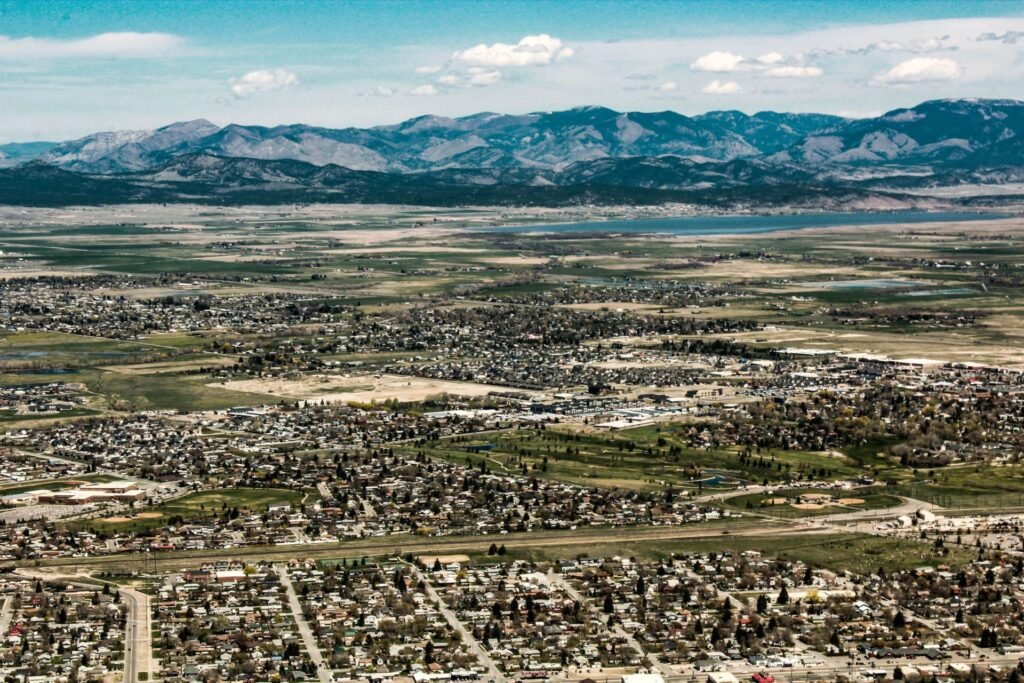
In practice that means choosing between two kinds of move. Near the western valleys and the college towns you pay for scenery, jobs and demand, and a modest house on a few acres costs real money. On the Hi-Line and the eastern plains, around towns like Havre, Glendive and Miles City, the same budget buys more house and far more land, with longer drives and harder winters. Decide which of those you are moving for before you start looking, and visit in January as well as July.
Taxes when you move to Montana, especially if you are retiring
Montana has no state sales tax and no estate or inheritance tax, according to the Tax Foundation. The one exception you will notice is a local resort tax in some resort communities, capped at 3 percent plus up to 1 percent for infrastructure, on lodging, restaurants, bars, ski areas and luxury goods. The income tax has two brackets and is falling: for 2026 it is 4.7 percent on the first $47,500 of taxable income for a single filer, $71,250 for a head of household or $95,000 for a married couple filing jointly, and 5.65 percent above that. In 2027 the brackets widen to $65,000 and $130,000 and the top rate drops to 5.4 percent.
For retirees, Montana changed the rules in 2024. The state return now starts from federal taxable income, so Social Security is taxed only to the extent it is federally taxable. The old partial deduction for pensions, annuities and IRAs was repealed and replaced with a standard subtraction for taxpayers 65 or older: $5,500 per person, or $11,000 if both spouses are 65 or older, indexed for inflation, which made it $5,660 per person for 2025. Railroad Retirement Tier I and II benefits remain subtractable, and military retirees get a partial exemption. Check the Department of Revenue for the current year’s figure.
Property tax is where newcomers get caught. The Tax Foundation puts the effective rate on owner-occupied homes at 0.61 percent, but since the 2026 reform the rate depends on whether the house is your homestead: 0.76 percent of market value on the first $378,000, with higher marginal rates above, against 1.90 percent for a second home or a vacant residential lot. To qualify you must have owned and lived in the home at least seven months of the year, and you apply between December 1 and March 1. A buyer who moves in partway through the year may not meet the seven months that first year; ask the Department of Revenue how it treats your closing date.
Two credits help older owners on modest incomes. The Elderly Homeowner/Renter Credit refunds up to $1,150 a year to filers 62 or older with household income under $45,000 who have lived in Montana at least nine months of the year and owned or rented a home there for six. The Property Tax Assistance Program cuts the tax by 30, 50 or 80 percent on the first $418,000 of market value, depending on income.
Winter, wildfire and the drive to care
Montana winters are long, but they are not what they were. NOAA’s State Climate Summary puts the average winter temperature, December through February, at 20.0 degrees, and notes that winters have run above average since 1980 and that the state has warmed almost 2.5 degrees since 1900. Days that never rise above zero have averaged 3.5 a year over the long run, and every year since 2000 has had fewer than that. The extremes are still extreme: the state record low is 70 below zero, at Rogers Pass in 1954, the lowest ever recorded in the contiguous 48 states, and some mountain areas get more than 300 inches of snow a year.
Fire is the risk that has grown. In 2012 Montana had its driest July to September on record and more than 2,000 fires burned over 1.2 million acres, and NOAA projects more frequent and severe wildfires. Headwaters Economics, using Forest Service data, estimates that more than a third of Montana homes, nearly 120,000, face moderate to high wildfire risk, almost double the number in 1990. We found no official average homeowners insurance premium for Montana, so get a quote for the exact address, and ask how the insurer rates its fire risk, before you make an offer.
Health care and internet are better than the distances suggest, and worse than a city. The University of North Carolina’s Sheps Center has recorded no rural hospital closures or conversions in Montana since 2005, but Montana State University economists, citing Sheps data, report that most of the state’s 55 rural hospitals have lost services. In the state’s federal broadband plan, 63.7 percent of the 68,498 unserved locations will be connected by low-earth-orbit satellite and only 21.0 percent by fiber. Drive to the nearest emergency room in winter, and check internet at the exact address.
What works
No sales tax, a falling income tax, Social Security taxed only as the IRS taxes it, cheap utilities, some of the cheapest farmland in the country on the plains, and 7.4 people per square mile.
What to weigh
Housing about 15 percent above the national average, long winters and long drives, wildfire and smoke in summer, thin rural services, and satellite rather than fiber internet at many remote addresses.
What to check first
An insurance quote for the address, the drive to an ER in January, broadband at the exact address, whether the house will meet the seven-month homestead rule, and the water right and well paperwork.
Your first 60 days after moving to Montana
- Title and register your vehicles within 60 days of becoming a Montana resident, through your county treasurer’s motor vehicle office.
- Budget for the registration fees. Annual registration on a light vehicle is $217 if it is up to 4 years old, $87 from 5 to 10 years and $28 at 11 years or more, plus county option taxes and small fees; Yellowstone County, for example, lists $12 for a title, $12 for new plates and a $10 Highway Patrol fee.
- Ask about permanent registration for a vehicle 11 years or older: a one-time $87.50 plus five times the county option tax and other small fees, valid until the vehicle changes owner.
- Get a Montana driver license. Once you have lived in the state more than 60 consecutive days you are a resident and must hold a Montana license to drive; for commercial drivers it is 30 days.
- Mark December 1 to March 1 on your calendar for the property tax homestead application, once you have owned and lived in the house seven months of the year.
- If the property has a well, sort out the water paperwork. Since January 2026 an exempt well needs an authorized $400 Notice of Intent before its water is used; our guide to Montana water rights explains what to ask the seller and the DNRC.
- Register to vote and update your address with Social Security, Medicare and your bank, and if you are 62 or older with household income under $45,000, claim the Elderly Homeowner/Renter Credit when you file your Montana return.
Get the next batch of Montana listings first
If you are planning a move, the fastest way to learn the market is to watch real listings. Leave your details and the next Montana list reaches you before it goes public.
Keep reading
- How to buy land in Montana – what an acre costs in all 56 counties and the six checks to run before you buy.
- Montana water rights – what passes with the land, the new well notice and how to check a parcel.
- Homes with land for sale in Montana – ten real homes, from Polaris to Glendive.
- All our rural property guides, state by state.
Common questions about moving to Montana
Is Montana an expensive place to live?
More than its neighbors. Montana’s cost of living index was 106.0 in the second quarter of 2026, where 100 is the US average, ranking 37th among the states, against 90.5 in North Dakota, 93.5 in South Dakota, 94.4 in Wyoming and 99.4 in Idaho. Housing, at 114.9, drives it; utilities, at 80.7, are about 19 percent below the national average.
Does Montana tax Social Security and retirement income?
Montana taxes Social Security only to the extent it is federally taxable, because since tax year 2024 the state return starts from federal taxable income. The old pension and IRA deduction was replaced by a standard subtraction for taxpayers 65 or older, $5,660 per person for 2025 and indexed for inflation. Railroad Retirement benefits remain subtractable.
Does Montana have a sales tax?
No. Montana has no state sales tax, and no estate or inheritance tax. The exception is a voter-approved local resort tax in some resort communities, capped at 3 percent plus up to 1 percent more for infrastructure, which applies to lodging, restaurants, bars, ski resorts, recreation and luxury goods rather than everyday purchases.
What do I need to do when I move to Montana?
Title and register your vehicles within 60 days of becoming a resident, and get a Montana driver license once you have lived in the state more than 60 consecutive days (30 days for commercial drivers). Annual registration on a light vehicle runs $217, $87 or $28 depending on its age. Apply for the property tax homestead rate between December 1 and March 1.
How much are property taxes in Montana?
The Tax Foundation puts the effective rate on owner-occupied homes at 0.61 percent. In 2026 a primary residence is taxed at 0.76 percent of market value on the first $378,000, times local mills, while a second home pays 1.90 percent. To get the homestead rate you must own and live in the home at least seven months of the year.
How cold does it get in Montana?
The state record low is 70 below zero, set at Rogers Pass in 1954, the lowest temperature ever recorded in the contiguous 48 states. The average winter temperature, December through February, is 20.0 degrees, and some mountain areas get more than 300 inches of snow a year. Winters have run warmer than average since 1980, according to NOAA.
What are the downsides of living in Montana?
Housing costs about 15 percent more than the national average, winters are long, and wildfire is a real risk: Headwaters Economics estimates more than a third of Montana homes face moderate to high wildfire risk. Distances are long, and most unserved rural addresses in the state’s broadband plan will get satellite internet, not fiber. Check the drive to a hospital and the insurance quote first.
Sources and the important part
Cost of living figures come from the Missouri Economic Research and Information Center’s Cost of Living Data Series for the second quarter of 2026, based on the C2ER index. Population, home values, income, age and homeownership come from the Census Bureau’s QuickFacts and American Community Survey 2020–2024; the sales, estate and effective property tax facts from the Tax Foundation’s Montana profile; income tax brackets, the retirement subtraction and senior credits from the Montana Department of Revenue, including its HB 337 summary; resort taxes from MCA 7-6-1503 and 7-6-1504; homestead rules from MCA 15-6-134, 15-6-402 and 15-6-405; vehicle rules from the Montana Motor Vehicle Division, MCA 61-3-321, 61-3-562 and 61-5-103 and the Yellowstone County Treasurer’s fee schedule; climate figures from NOAA’s State Climate Summary for Montana; wildfire estimates from Headwaters Economics; hospital figures from the UNC Sheps Center and Montana State University; broadband figures from the NTIA’s BEAD summary for Montana; farmland values from the USDA Census of Agriculture 2022 and the USDA NASS Land Values 2026 Summary.
American Home Opportunities is a publisher. We are not a real estate broker, agent, lender, appraiser, attorney, insurance, tax or financial advisor, and nothing on this page is legal, tax or financial advice. Rural property involves water rights, wells, septic, access, wildfire, surveys, easements, repairs, insurance and financing that this page can introduce but not resolve for your parcel. Verify every figure with the agency named and with licensed professionals before you commit money. Page published October 2026.