
How to Buy Land in Missouri: Ozark Prices, Septic and Wells
How to buy land in Missouri, all 114 counties: why the Ozarks hold the cheapest acres and the Bootheel the priciest, and the checks the state leaves to you on sinkholes, septic, wells, access and county codes.
How to buy land in Missouri: the cheap acres are in the hills, not the flatland
If you are working out how to buy land in Missouri, start with the number the federal government publishes and then turn it upside down. The 2022 Census of Agriculture counts every farm in all 114 Missouri counties and puts the average value of farmland and its buildings at $4,612 an acre. The USDA’s 2026 survey puts Missouri farm real estate at $5,200, above the national $4,500. On paper, Missouri is not a cheap land state.
In practice it is two states. The flat, rich cropland of the Bootheel in the far southeast is the most expensive farmland in Missouri, at $6,538 an acre, more than the counties around Kansas City and St. Louis. The Ozarks, the hilly, forested country that covers most of the southern half of the state, is the cheapest: $3,738 an acre across 47 counties, and every one of the ten cheapest counties in Missouri is there. So the first decision when buying land in Missouri is not the county. It is whether you are paying for ground that grows crops or for hills, springs and timber that mostly grow quiet.
On the ten Missouri homes we covered, the land ran from 4 percent to 76 percent of the price
We checked the census against the ten properties in our October 2026 Missouri list, priced from $39,500 in Kirksville to $349,900 in Des Arc. For each one we multiplied the acreage by its county’s census value and compared the result with the asking price. For the median home the ground came to about 11.5 percent of the price, the same pattern we see in most states: you are paying for the house. Two listings broke the pattern completely.
Outside West Plains in Howell County, 78.79 acres that border the Mark Twain National Forest on three sides were asking $299,000. At the county’s census value of $2,894 an acre, the land alone is worth about $228,000, or 76 percent of the price, which leaves the 2024 cabin on it almost free. Near Qulin in Butler County, 10 acres asking $75,000 sit on about $50,850 of census-value ground, 68 percent. In the Ozarks, a big tract with a small house can be priced close to the land itself, and that is where the value hides.
Buying land in Missouri: the numbers in short
Missouri land prices by region: what an acre actually costs
We pulled all 114 Missouri counties from the census and grouped them into the five regions people actually shop in. Each average is weighted by the acres in farms, so a county with a lot of farmland counts for more than one with a little. The last column names the cheapest county inside each region.
| Region | Farmland value per acre USDA, 2022 census | Land in farms | Cheapest county in the region |
|---|---|---|---|
| The Bootheel (southeast lowlands) | $6,538 | 2,085,123 acres 7 of 114 counties | Butler, $5,085 |
| Kansas City and St. Louis metro counties | $5,427 | 2,895,318 acres 15 counties | Bates, $4,006 |
| Northern and central plains | $4,894 | 9,996,115 acres 38 counties | Sullivan, $3,213 |
| West-central prairie | $4,283 | 2,493,632 acres 7 counties | Cedar, $3,763 |
| The Ozarks | $3,738 | 9,556,055 acres 47 counties | Carter, $2,342 |
| Missouri, all counties | $4,612 | 27,026,243 acres 114 counties | Carter, $2,342 |
Why the Bootheel costs more than the cities
It looks backwards until you see what the census is measuring. The Bootheel is the northern tip of the Mississippi Delta: flat, deep alluvial soil, much of it irrigated, farmed in big units for cotton, rice, corn and soybeans. Dunklin ($6,938), Stoddard ($6,814), Mississippi ($6,746), New Madrid ($6,704) and Pemiscot ($6,687) are priced on what an acre of that ground earns, and it earns a lot. The metro counties are mostly the outer rings, Bates, Cass, Lincoln and Warren, where pasture and woodland are still priced as farmland. If you want a few acres to live on rather than a field to farm, the Bootheel is the wrong place to shop: you would be paying for cropland and competing with farmers who need it.
Where the cheapest land in Missouri is, and the honest reason it is cheap
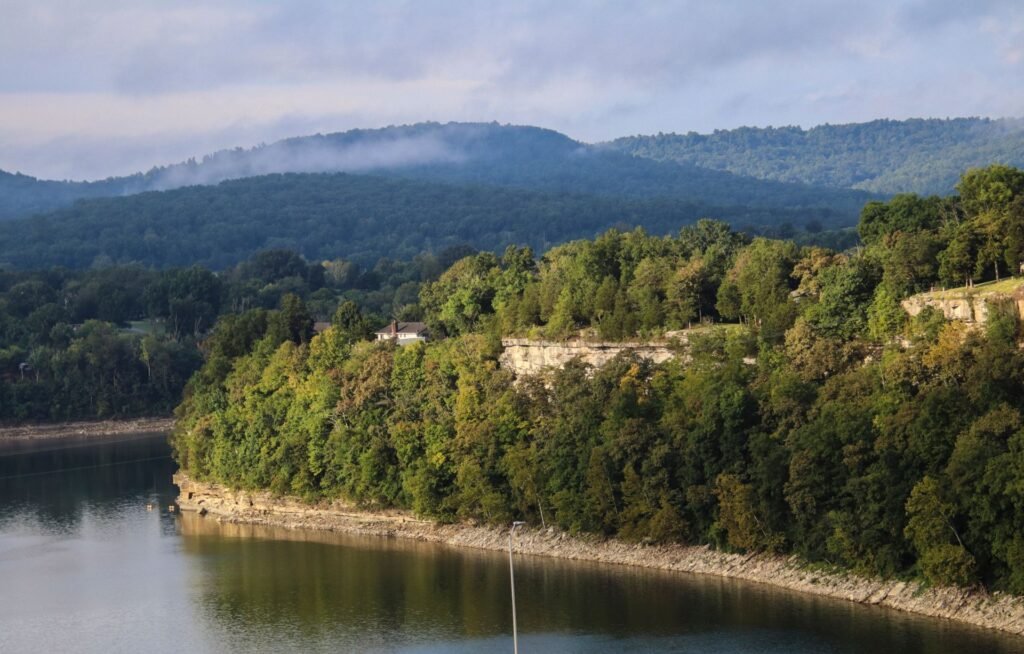
The ten cheapest counties in Missouri are all in the Ozarks, most of them in the rugged band along the Current, Eleven Point and Black rivers. Carter County averages $2,342 an acre, Shannon $2,396, Wayne $2,495, Oregon $2,560, Madison $2,627, Reynolds $2,655, Iron $2,697, Ozark $2,762, Camden $2,851 and Ripley $2,855. Together they average $2,644 an acre across 1.34 million acres of farms, so this is not a handful of odd parcels; it is a region.
The reasons are plain. The Ozark Highlands sit on dolomite and sandstone, and the federal soil surveys describe soils full of chert gravel and cobbles, often with a hard layer about two feet down. Much of the land is steep, wooded or cleared only for pasture, so an acre feeds fewer cattle than an acre of prairie and grows almost no row crops. Large parts of these counties are national forest or national riverway, the towns are small, and the drive to a full hospital often runs an hour on two-lane roads. None of that makes the land bad. It makes it priced for people who want space, water and woods more than yield.
North of the Missouri River the cheap end looks different. Sullivan ($3,213) and Putnam ($3,789) along the Iowa line are rolling cattle country with better soil and colder winters, and the census price there buys more grass per acre than in the Ozarks. Between the two, the west-central prairie around Nevada and Lamar averages $4,283, flat enough to cut hay and close enough to Joplin and Kansas City to work.
The Springfield exception inside the Ozarks
The Ozark average hides one expensive pocket. The five counties of the Springfield metro, Greene, Christian, Webster, Polk and Dallas, average $4,865 an acre; Greene alone is $7,004 and Christian $5,535, because Springfield and Branson pull buyers south along U.S. 65 and Interstate 44. Take those five out and the rest of the Ozarks averages $3,584 across 8.4 million acres. If you need a commute to Springfield, you will pay for it. If you do not, an hour east or south of it the price per acre drops by a third.
What to check before you buy land in Missouri
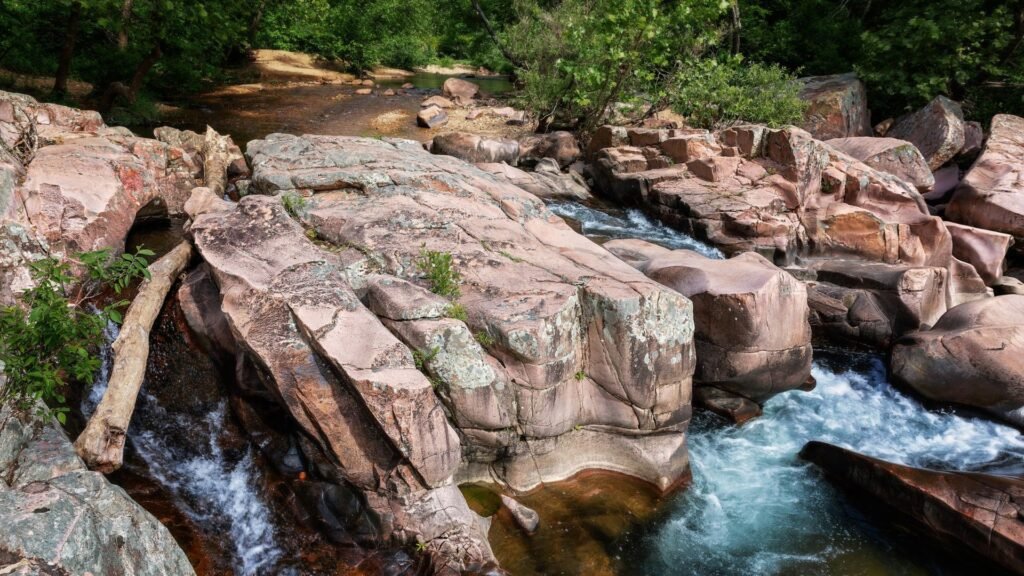
If you are learning how to buy land in Missouri from another state, these are the six checks specific to it, in the order we would run them. Missouri is unusually hands-off: no statewide building code, no permit to drill your own well, and no state septic permit on a lot of 3 acres or more. That freedom is real, and it moves the responsibility from the state to you.
The first three can cost you money after closing even when the land itself is fine: karst ground that swallows a drain field, a septic rule your county adopted on top of the state’s, and a road you have no recorded right to use. The last three decide what you can build and how you will live there: the well, the county’s own codes and zoning, and the flood map along the rivers.
None of them shows up in the asking price, and on a cheap Ozark parcel any one of them can be worth more than the land. Each one costs far less to check before you sign a contract than after you close, and most of them start with a phone call to the county with the parcel number in hand.
1. Look for sinkholes, springs and losing streams
2. Ask the county about septic, even on 3 acres or more
3. Confirm the road in is yours to use
4. Plan the well: you may drill it yourself, but not any way you like
5. Ask the county what it actually enforces
6. Check the flood map along the rivers and in the Bootheel
We check the census value, the flood map and the access before a Missouri home makes our list
Every property we feature is run against its county’s farmland value, its flood zone and its road in before it reaches the channel. Leave your email and you get the next list, with those checks already done.
What it costs to own rural land in Missouri
If you buy land in Missouri, the taxes are moderate on a house and close to nothing on farmland. The Tax Foundation puts the effective property tax rate on owner-occupied homes at 0.89 percent, against a national range of 0.29 percent in Hawaii to 1.88 percent in New Jersey and Illinois. The state income tax runs from 2.0 to 4.7 percent, sales tax averages 8.44 percent with local add-ons, and there is no estate or inheritance tax. Since 2025, capital gains, real estate included, are exempt from Missouri income tax.
The mechanics are where Missouri gets interesting. Residential property is assessed at 19 percent of market value and agricultural land at 12 percent, but agricultural land is not valued at market at all. It is valued on what it can produce, using per-acre values the State Tax Commission sets for eight land grades, from $1,035 an acre for the best cropland down to $30 for the poorest. There is no minimum acreage: land qualifies by being used for crops or livestock. Property is reassessed every odd-numbered year.
The arithmetic, with one school district’s real 2025 levy
Take the Liberal R-II school district in Barton County, on the Kansas line, where the State Auditor’s 2025 review shows an operating levy of $3.2402 and a debt levy of $0.60, a total of $3.84 for every $100 of assessed value. A $150,000 house is assessed at $28,500 and pays about $1,094 a year in school tax alone. Forty acres of Grade 6 pasture, valued at $147 an acre and assessed at 12 percent, are assessed at $706 and pay about $27. County, road and library levies add to both bills, and your district will differ, so ask the county collector for the current levies before you make an offer.
Senior credits, the home site rule and the personal property tax
Missouri gives older owners two possible breaks. The state Property Tax Credit refunds up to $1,100 a year to owners 65 or older, or 100 percent disabled, with household income up to $30,000 single or $34,000 married. And under SB 190 of 2023, counties may freeze the property tax on the home of an owner 62 or older; it is a county option, not automatic, so ask the county whether it adopted it. Two things surprise newcomers. First, the farm home site rule taxes the house and up to five acres at the residential rate. Second, Missouri taxes cars every year as personal property, assessed at one third of their value, and you must file a list with the assessor between January 1 and March 1.
Closing, broadband and the drive to a hospital
Missouri has no real estate transfer tax, and Article X, Section 25 of its constitution has barred any new one since 2010. Loans are usually secured with a deed of trust with a power of sale, and most closings are run by a title company rather than an attorney. Budget for a survey: older rural deeds describe boundaries by roads, creeks and trees, and in the Ozarks a fence line is rarely a property line.
Internet and health care are the weak points. Missouri received about $1.7 billion in federal broadband money, and the first awards in January 2026 cover more than 200,000 locations, but check the exact address on the state’s broadband map rather than trusting the county average. Ten rural Missouri hospitals have closed or converted since 2014, according to the University of North Carolina’s Sheps Center. Find the nearest emergency room, the nearest hospital that admits patients and the nearest maternity ward if it matters to you, and drive the route before you commit.
Cheap land and homes we have covered in Missouri
Every list we have published for people looking to buy land in Missouri, with the county data behind each property. Asking prices are from the date of each list and many of these homes have since sold.
Missouri guides
Step-by-step guides for buying land and living in Missouri, with the state’s own rules and the numbers behind them.
Keep exploring before you settle on Missouri
Missouri gives you cropland prices in the flat country and Ozark prices in the hills. These are worth a look while you are still deciding how to buy land in Missouri, and whether Missouri is the right state at all.
- Missouri homestead for sale: 10 real listings – homes from Kirksville to Des Arc, with the census value of the land under each one.
- 11 cheap farmhouses in Missouri with land – our first Missouri list, from $249,000 down to $28,000.
- Why cheap rural homes don’t sell, and how to buy one anyway – the financing and inspection traps behind the lowest prices.
- The best states to homestead – land, tax and rain scored together, and where Missouri lands.
- Rural property guides, the Rural Property Field Guide and how the AHO Score works – every guide we publish, the checks we run, and how a property earns a place on our lists.
Get the next batch of Missouri listings first
We keep coming back to Missouri, because in the Ozarks a house with real acreage can still cost little more than the land under it. Leave your details and the next Missouri list reaches you before it goes public.
Common questions about buying land in Missouri
How much is an acre of land in Missouri?
Missouri farmland and farm buildings averaged $4,612 an acre in the 2022 USDA Census of Agriculture, and farm real estate averaged $5,200 in the USDA’s 2026 survey, above the national $4,500. Pasture averaged $2,850. By county, the census runs from $2,342 an acre in Carter County in the Ozarks to $7,328 in Lafayette County east of Kansas City.
Where is the cheapest land in Missouri?
In the Ozarks of south-central and southeast Missouri. The ten cheapest counties in the 2022 USDA census are all there, led by Carter at $2,342 an acre, Shannon at $2,396, Wayne at $2,495 and Oregon at $2,560, and together they average $2,644 an acre across 1.34 million acres of farms.
Is buying land in Missouri a good investment?
It depends on what you buy. Missouri farm real estate rose 4.0 percent to $5,200 an acre in the USDA’s 2026 survey, and since 2025 Missouri does not tax capital gains, real estate included. But the cheapest Ozark land is cheap because it is hilly, stony and remote, so judge each parcel by its access, water and septic before its price.
Do you need a building permit in Missouri?
Missouri has no statewide residential building code; the U.S. Department of Energy lists it as a home-rule state. Codes and permits are set by cities and by counties that adopt them, and a county with no code before 2001 needs voter approval to add one. Septic rules, zoning and any city limits still apply, so call the county with the parcel number first.
Do you need a septic permit on 3 acres in Missouri?
Under RSMo 701.031, a single-family home on a lot of 3 acres or more is excluded from Missouri’s state onsite sewage rules, provided the system sits more than 10 feet from every property line and causes no runoff, contamination or nuisance. Counties may adopt stricter rules under RSMo 701.047, so many still require a permit. Ask the county health department.
Can you drill your own well in Missouri?
Yes. Missouri law lets a landowner build a water well on land they own or lease for their own home or farm without a driller’s permit (RSMo 256.603 and 256.607). The well must still meet the state construction code: in most of the Ozarks that means at least 80 feet of casing set at least 30 feet into solid bedrock.
How much are property taxes on farmland in Missouri?
Very low, because Missouri taxes farmland on what it can produce, not what it sells for. Grade 6 pasture has a state use value of $147 an acre and is assessed at 12 percent, or $17.64 an acre. In Barton County’s Liberal R-II district, the 2025 school levy of $3.84 per $100 makes that about $27 a year on 40 acres.
Before you buy, the important part
American Home Opportunities is a publisher. We are not a real estate broker, agent, lender, appraiser, attorney or financial advisor, and nothing on this page is legal, tax or financial advice.
County farmland values come from the USDA Census of Agriculture 2022, Missouri, Table 8, and measure farmland and the buildings on working farms rather than asking prices for small parcels; the regions are our own grouping of all 114 counties, weighted by land in farms. State farm real estate and pasture values come from the USDA NASS Land Values 2026 Summary. The effective property tax rate and the income and sales tax rates come from the Tax Foundation. The worked tax example uses the Liberal R-II school district levy published in the Missouri State Auditor’s review of 2025 property tax rates.
Legal references are to RSMo 137.115 (assessment ratios), 137.016 and 137.017 (agricultural classification and the farm home site), 12 CSR 30-4.010 (agricultural use values), 137.1050 (senior credit), 137.280 (personal property lists), 701.031 and 701.047 (septic exclusion and local rules), 19 CSR 20-3.060 (onsite sewage rules), 256.603 and 256.607 (water wells), 10 CSR 23-3.090 (well casing), 228.342 to 228.368 (private roads), 64.170 (county building codes), 443.290 (deeds of trust) and Article X, Section 25 of the Missouri Constitution (transfer taxes). Karst figures come from the Missouri Department of Natural Resources; hospital closures from the UNC Sheps Center.
Any price we quote for a property is an asking price at the time of writing, not a sale price. Rural land carries risks this page can introduce but not resolve for your parcel, including karst and sinkholes, flooding, water and wells, septic suitability, legal access, surveys, easements, title, repairs, insurance and financing. Verify everything with the county assessor and collector, the county health department, a Missouri title company or attorney and licensed professionals before you commit money. Page published October 2026.