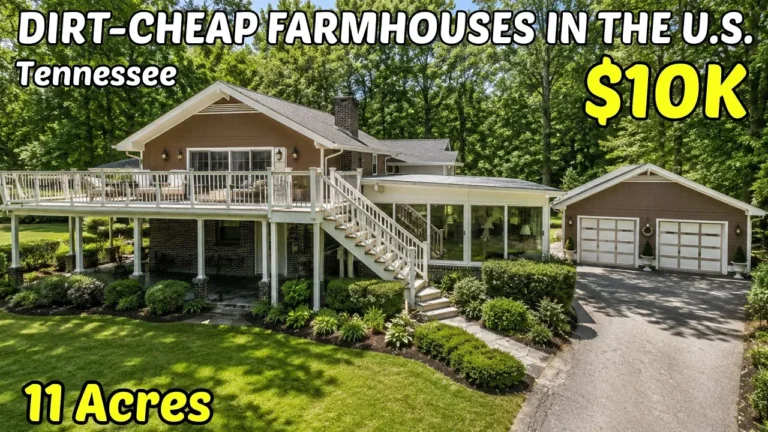

Off Grid Living in Tennessee: 37 No-Code Counties, Water, Power and Permits
Off grid living in Tennessee is legal, and in a large part of the state nobody inspects how you build the house. On the State Fire Marshal’s list, 37 of the 95 counties have opted out of the statewide residential building code. Most of them sit where land is cheapest. However, two rules follow you into every county, code or no code: the septic permit and the state electrical inspection. This guide names the counties, prices an acre in each one, and explains what you still have to get right.
Off grid living in Tennessee: the numbers in short
Is off grid living in Tennessee legal? Yes, under three separate rulebooks
To begin with, nothing in Tennessee law requires a house to connect to a power line, a water main or a sewer. Even so, people get into trouble, because three different agencies regulate three different parts of the same house, and the rules do not move together. As a result, a county that opted out of the building code has dropped only one of the three. That is the first thing to understand about off grid living in Tennessee.
The building code: local choice
Tennessee adopts a statewide residential code, but under T.C.A. § 68-120-101 a county or city can opt out for one- and two-family homes. In those places no one issues a building permit or inspects framing, insulation or stairs.
Sewage: the state, everywhere
The Department of Environment and Conservation (TDEC) permits every septic system in the state, opt-out county or not. A soil evaluation comes first, and an outhouse or composting toilet has its own rule.
Wiring: the state, everywhere
State rules require an electrical permit before wiring is installed, and T.C.A. § 68-102-143 bars any utility from connecting permanent service without an inspection approval. Opting out of the building code does not touch this.
In addition, there is a fourth layer that varies by county: zoning. Many rural Tennessee counties have little or none. Still, some regulate campers, lot sizes or setbacks even where there is no building code. Before you buy, read the county’s own zoning page, or call its planning office.
Tennessee counties with no building codes, and what an acre costs in each
The State Fire Marshal’s Office keeps a list of every county and city with its residential code status, last updated August 21, 2026. It uses three labels, and the no-code counties are the ones marked opt out. For anyone weighing off grid living in Tennessee, those 37 counties are the short list.
Exempt does not mean no code
The label that confuses people is exempt. An exempt county is not a no-code county. In fact, it is exempt from state enforcement because it runs its own permit and inspection office, the way Knox, Davidson, Williamson and 47 other counties do. Meanwhile, a third group of eight counties takes part in the State Residential Building Program, so the state itself issues the permits and sends the inspectors: Campbell, Chester, Giles, Hardeman, Hawkins, Lauderdale, Meigs and Smith.
For example, several lists online count Hancock or Clay among the no-code counties. On the Fire Marshal’s August 2026 list both are marked exempt. Treat any list that does not cite that page and its date as out of date.
What an acre costs in the no-code counties
To see whether the no-code counties are also the cheap ones, we matched the Fire Marshal’s list against the federal farmland census for all 95 counties. The short answer is yes, and by a wide margin.
The full list: 37 counties, cheapest first
| County | Farmland value per acre USDA, 2022 census | Rank of 95 1 = cheapest |
|---|---|---|
| Decatur | $2,946 | 3 |
| McNairy | $2,954 | 4 |
| Henderson | $2,956 | 5 |
| Hardin | $3,021 | 6 |
| Perry | $3,130 | 8 |
| Wayne | $3,142 | 9 |
| Benton | $3,196 | 11 |
| Humphreys | $3,358 | 12 |
| Carroll | $3,459 | 13 |
| Lewis | $3,635 | 15 |
| Scott | $3,689 | 16 |
| Houston | $3,906 | 19 |
| Stewart | $4,031 | 20 |
| Overton | $4,036 | 21 |
| Jackson | $4,084 | 22 |
| Bledsoe | $4,089 | 23 |
| Obion | $4,192 | 25 |
| Moore | $4,198 | 26 |
| Fentress | $4,211 | 27 |
| Morgan | $4,274 | 29 |
| Henry | $4,384 | 32 |
| Pickett | $4,393 | 33 |
| Claiborne | $4,395 | 34 |
| Sequatchie | $4,508 | 35 |
| Van Buren | $4,510 | 36 |
| Lake | $4,535 | 37 |
| Lawrence | $4,579 | 38 |
| Weakley | $4,680 | 41 |
| Grundy | $4,988 | 44 |
| McMinn | $5,610 | 57 |
| Monroe | $5,749 | 59 |
| Grainger | $5,809 | 61 |
| Franklin | $5,951 | 66 |
| Johnson | $6,031 | 67 |
| Cocke | $6,181 | 70 |
| Polk | $6,300 | 73 |
| Unicoi | $10,994 | 93 |
The census measures working farmland and the buildings on it, not the asking price of a small wooded lot, which usually runs higher. Use it to compare counties, not to price a parcel. Status: State Fire Marshal’s Office, August 21, 2026. Towns inside a county can have a different status from the county itself.
Check the town line
That last line matters. For instance, inside Benton County, Big Sandy has opted out like the county, and so have towns such as Linden and Lobelville in Perry County and Tracy City in Grundy. On the other hand, other towns inside an opt-out county may enforce a code of their own. If the parcel is near a town line, confirm which side it is on. For the parcels themselves, our cheap land for sale in Tennessee roundup walks through real listings, several of them in these counties.
No code is not the same as no paperwork
Still, opting out has a cost that shows up later. With no inspections there is no certificate of occupancy, and some lenders and insurers ask for one. Fortunately, since 2017 an owner in an opt-out county can buy a state residential building permit anyway and ask the State Fire Marshal’s Office to inspect the house during construction. If it passes, the state then issues the certificate, and that can open loan programs that would otherwise be closed. So if you ever plan to sell or refinance, it is cheap insurance.
The 5-acre rule in Tennessee
People asking about the “5 acre rule” usually mean the state’s definition of a subdivision. Under T.C.A. § 13-3-401, in most counties a division of land counts as a subdivision when it creates lots under 5 acres, or when it needs new streets or utilities. By contrast, splits into tracts of 5 acres or more, with frontage on an existing road and no new utility construction, generally fall outside it, so they do not need a subdivision plat approved by the planning commission.
For an off-grid buyer, that has two practical effects. First, tracts of 5 acres or more are easier to split off and sell, which is why so many rural listings come in 5-acre pieces. Also, a buyer who wants to carve a smaller homesite out of a larger tract later should expect plat review. However, some counties apply their own rules on top of the statute, so ask the county planning office before you count on a split.
Water for off grid living in Tennessee: a well, rain or the utility line
For off grid living in Tennessee, water is rarely the hard part. The statewide average is 52.3 inches of rain a year, and most of the state sits over aquifers that a domestic well can reach. So the choice for off grid living in Tennessee is between drilling, catching rain or, often, simply connecting to a rural utility district line that already runs past the land.
Drilling a well: notice first, then a licensed driller
Tennessee does not require a homeowner to get a permit in the usual sense, but the Water Well Act does require a Notice of Intent for every new well. Under T.C.A. § 69-10-111 the homeowner or the driller files it with TDEC’s Division of Water Resources, and it must arrive at least one hour before drilling starts (five days ahead if mailed). After that, the drilling itself must be done by a licensed driller, who files a well report within 60 days. A state fee applies, and it is due even if the well comes up dry.
Next comes cost, and what the well costs depends on geology. Contractor estimates for Tennessee run about $28 to $58 a foot for drilling alone, before the pump, pressure tank and wiring, and typical depths range from well under 100 feet over the West Tennessee sands to several hundred feet in the eastern mountains. Also, over the limestone of Middle and East Tennessee, test the water once the well is in: karst carries surface water underground quickly. A basic home kit is in our off-grid gear box below, and a certified lab test is worth the money before anyone drinks from a new well.
Rainwater harvesting is legal
Unlike a handful of western states, Tennessee has no statute that limits collecting rain from your own roof. In practice, each inch of rain on 1,000 square feet of roof yields about 623 gallons, so at 52.3 inches a year a modest roof gives roughly 32,600 gallons, or about 26,000 after losses from first-flush diverters, overflow and evaporation. That is around 70 gallons a day. For drinking, however, the system needs filtration and disinfection, and a house wired into a county with a code may face plumbing rules for how rainwater enters the home.
The line at the road
Above all, in this part of the country most rural land is served by a utility district water line, and very few new homes rely on private wells. In the East South Central census division, which includes Tennessee, about 0.5% of new single-family homes built in 2025 used a private well, according to the Census Bureau’s construction survey. Therefore, before you budget for a well, ask the local utility district whether its line passes the parcel and what a tap costs. In fact, plenty of off-grid homesteads run solar power and a septic system on a public water tap.
Septic, outhouses and composting toilets in Tennessee
This is the rule that catches the most off-grid buyers in opt-out counties, because it applies whether or not the county has a building code. TDEC permits every subsurface sewage disposal system in Tennessee, and the permit starts with a soil evaluation by a state environmental scientist, who may ask for a map from a licensed private soil consultant. The fees are set in rule 0400-48-01-.21: $150 per lot for the evaluation when two lots or fewer are involved, and $400 for a construction permit for a conventional system up to 1,000 gallons a day, with inspections included. TDEC allows up to 45 days to process a complete application.
In short, the soil decides almost everything: where the field lines go, how big the system must be and, in practice, how many bedrooms the lot can support. Over karst, shallow rock and clay, however, the answer is often an alternative system that costs several times a conventional one. Our guide to the cost to install a septic system prices each type.
Composting toilets and outhouses
Yes, Tennessee does allow both, under rule 0400-48-01-.17. A composting toilet must be certified by NSF. Similarly, a pit privy has to meet siting and construction standards. The catch, though, is one sentence: neither is permitted for a building with running water unless there is also an acceptable way to dispose of the wastewater. In other words, a composting toilet removes the toilet from the septic question, but a house with a sink and a shower still needs an approved system for its gray water. Ask the TDEC field office what it will accept on your soil before you design around a composting toilet.
Power for off grid living in Tennessee: why the TVA math favors batteries
Almost all of Tennessee buys its power from the Tennessee Valley Authority through local cooperatives and city utilities, and that shapes the solar decision. TVA does not offer net metering, the arrangement in many states where surplus power spins the meter backward at retail value. Under TVA’s Dispersed Power Production program, a home can sell surplus to TVA, but at avoided-cost prices: 3.534 cents per kWh for the base rate as of July 2026, against roughly 13.4 cents per kWh that Tennessee homes pay at retail. In other words, every kilowatt-hour you store and use yourself is worth about four you send to the grid.
Two other changes also matter for 2026 budgets. The federal 30% residential clean energy credit ended for systems installed after December 31, 2025, and Tennessee has no state income tax, so there is no state credit to replace it. Meanwhile, grid-tied systems in Tennessee averaged about $3.48 per watt installed in 2026, and an off-grid system adds batteries, a charge controller and usually a backup generator on top of that.
Before you skip the power line, price it
For that reason, if a cooperative line runs along the road, compare the line extension charge with a full off-grid system before you decide. And if you do connect, the inspection is not optional: Upper Cumberland Electric, which serves several opt-out counties, states that a house must pass the state electrical inspection before it will install a meter, temporary meters included. A temporary service release, for example, allows power for construction for 45 days, but not for living in the house.
Gear worth having
Three things for an off-grid Tennessee homestead
We get commissions for purchases made through the Amazon links in this box, at no extra cost to you. As an Amazon Associate we earn from qualifying purchases. No company paid to be listed, and we have not tested these products ourselves; they are examples of the categories that matter for the problems on this page. Photos are for illustration.


More gear for country homes: The Rural Owner Toolbox →
Can you live in a camper on your own land in Tennessee?
There is no state law that forbids it or sets a time limit. Instead, whether you can live in an RV while you build, or for good, is a county and city question, and the answer turns on zoning. For example, in counties with no zoning in the unincorporated area, nothing stops it on paper. Where zoning exists, however, many ordinances allow a camper only during construction or only for a set number of days.
Even so, the sewage rule still applies. An RV’s tanks have to be emptied into an approved system or a dump station, and a camper parked long term on a lot with a sink and shower draining onto the ground is exactly what a health complaint is made of. For that reason, the cleanest path is to get the septic permit first and plumb the camper into the same system the house will use.
Finally, one more state rule is worth knowing before you buy a shed to live in. Tennessee law, T.C.A. § 68-126-311, says a ready-removable, meaning a portable building with no foundation, cannot be modified for residential, recreational or emergency housing. On the other hand, the Fire Marshal’s guidance does allow a partly built home shell to be moved onto a lot if it is built to the residential code and set on a proper foundation.
The order that works
So the practical order is septic permit, then camper, then house. Then ask the county two questions in writing: whether the parcel is zoned, and how long a camper may be lived in while a permitted house goes up.
Building your own off-grid home in Tennessee
An owner can do much of the work of off grid living in Tennessee by hand. The Fire Marshal’s office lets a property owner buy the electrical permit for a single residence or farm building for their own use, as long as it is not built to sell, lease or rent. Hired work, by contrast, is different: under T.C.A. § 62-6-103, a contractor on a project of $25,000 or more must hold a Tennessee contractor’s license.
Otherwise, in a county with a code program, or in one of the eight counties where the state inspects, the house needs a residential building permit and inspections like anywhere else. In an opt-out county, by contrast, it does not, and that is where off-grid builders save time on unconventional designs. Even so, build to code anyway. After all, a buyer’s inspector, an insurer and a lender will all judge the house by those standards, and the voluntary state inspection is the only way to get a certificate of occupancy in an opt-out county.
What off grid living in Tennessee costs: the fixed items
| Item | Cost | Note |
|---|---|---|
| Building permit, opt-out county | None required | A voluntary state permit and inspection is available |
| Septic soil evaluation | $150 per lot | TDEC fee, two lots or fewer |
| Septic construction permit | $400 | Conventional system up to 1,000 gallons a day |
| Conventional septic system, installed | $3,000 to $8,000 | National contractor range; alternative systems cost more |
| Well drilling | $28 to $58 per foot | Contractor estimates, drilling only; pump and tank extra |
| Rainwater | No permit | About 26,000 gallons a year per 1,000 sq ft of roof |
| Solar, grid-tied | About $3.48 per watt | Average installed cost; off-grid adds batteries |
| Electrical permit and inspection | Required to wire | No utility meter without the state inspection |
State fees: TDEC rule 0400-48-01-.21. Septic installation: Angi, 2025 national cost data. Well drilling: contractor cost aggregates for Tennessee, 2026, not an agency figure. Solar: EnergySage, Tennessee, 2026. Get local quotes before you budget.
Then add these to the land. In the four cheapest opt-out counties, farmland averages under $3,100 an acre on the census, though small wooded tracts usually list for more. In other words, $550 in state septic fees and a few thousand dollars for the system are the cheapest part of the plan. Ultimately, the parcel’s soil and its road frontage decide whether off grid living in Tennessee works on that land.
Looking for land in a no-code Tennessee county?
We go through rural Tennessee listings county by county, check the census value and the access, and send out the ones worth a look. Tell us your budget and timeline, and the next Tennessee batch reaches you first.
Keep reading
- Buying rural property in Tennessee – what land costs in each Grand Division and the checks that decide a cheap parcel.
- Best counties in Tennessee for homesteading – ten real listings, county by county.
- Property taxes in Tennessee – what a rural owner pays, and the Greenbelt program.
- Off grid living in Kentucky – where house permits are optional but septic comes before power.
- Off grid living in New Mexico – how the same questions play out in a dry state.
- All our rural property guides – state by state.
Common questions about off grid living in Tennessee
Can you legally live off grid in Tennessee?
Yes. No Tennessee law requires a home to connect to public power, water or sewer. In 37 of the 95 counties there is no residential building code at all. Two state rules still apply everywhere: a TDEC septic permit for any wastewater system, and a state electrical inspection before any utility connects permanent power.
Which Tennessee counties have no building codes?
On the State Fire Marshal’s list of August 21, 2026, 37 counties have opted out of the residential code, including Decatur, McNairy, Henderson, Hardin, Perry, Wayne, Benton, Scott, Fentress, Grundy and Van Buren. Counties marked “exempt” are not no-code counties: they run their own inspections. Towns can differ from their county.
Do you need a septic permit in Tennessee if you live off grid?
Yes. TDEC permits every septic system in Tennessee, including in counties with no building code. It starts with a soil evaluation, $150 per lot, and a conventional system permit costs $400. A composting toilet must be NSF certified, and a home with running water still needs an approved way to dispose of its wastewater.
Can I live in a camper on my own land in Tennessee?
There is no state law against it and no state time limit. It depends on county or city zoning: where there is none, nothing prohibits it, while many zoning rules allow a camper only during construction. Wastewater must still go to an approved septic system or dump station, so get the septic permit first.
Is rainwater collection legal in Tennessee?
Yes. No Tennessee statute limits collecting rain from your own roof. The state averages 52.3 inches of rain a year (NOAA, 1895 to 2024), so a 1,000 square foot roof yields roughly 26,000 usable gallons a year. Drinking water from a cistern needs filtration and disinfection.
What is the 5 acre rule in Tennessee?
It usually refers to the subdivision definition in T.C.A. § 13-3-401. In most counties, splitting land into lots under 5 acres, or splits that need new streets or utilities, count as a subdivision and need planning commission approval. Tracts of 5 acres or more on an existing road generally do not.
Where is the best place to live off grid in Tennessee?
On cost and freedom to build, the opt-out counties of West Tennessee stand out: Decatur, McNairy, Henderson and Hardin average under $3,100 an acre of farmland on the 2022 census and have no residential code. On the Cumberland Plateau, Scott, Fentress, Grundy and Van Buren combine opt-out status with farmland under $5,000.
Sources and the important part
Code status: Tennessee Department of Commerce and Insurance, State Fire Marshal’s Office, Residential Jurisdictions and Inspectors (accurate as of August 21, 2026), Statewide Building Construction Code Inspections in Opt-Out Jurisdictions, and Public Guidance on Ready-Removables; T.C.A. §§ 68-120-101, 68-102-143, 68-126-311 and 62-6-103. Land values: USDA NASS, 2022 Census of Agriculture, Table 8, all 95 counties, averages weighted by land in farms; USDA NASS Land Values 2026 (Tennessee farm real estate $6,500 an acre).
Subdivision: T.C.A. § 13-3-401. Wells: T.C.A. § 69-10-111 and TDEC Notice of Intent instructions (CN-1240); drilling costs are contractor aggregates. Septic and composting toilets: TDEC rules 0400-48-01-.17 and .21 and TDEC SSDS FAQ. Rainfall: NOAA NCEI State Climate Summary for Tennessee, 2022 edition updated through 2024. New homes with private wells: US Census Bureau, Survey of Construction, 2025. Power: TVA Dispersed Power Production Guidelines, July 2026; residential price from EIA via EnergyBot, November 2026; solar cost from EnergySage, 2026; federal credit: SEIA summary of the 2025 budget law. Utility inspection example: Upper Cumberland Electric Membership Corporation, residential construction packet.
American Home Opportunities is a publisher. We are not a real estate broker, agent, lender, appraiser, attorney, engineer, insurance, tax or financial advisor, and nothing on this page is legal, tax or financial advice. Rural property involves wells, septic systems, access, surveys, easements, repairs, insurance and financing that are specific to each parcel. Code status, fees and rules change: verify everything with the county, TDEC, the State Fire Marshal’s Office, the local utility and licensed professionals before you buy or build.