Moving to West Virginia: What It Really Costs to Live on Rural Land
Moving to West Virginia buys you something that has almost disappeared from the rest of the eastern United States: a house with land, in the mountains, for less than half the national price. The typical owner-occupied home here is worth $162,600, against $332,700 for the country, and the state ranks fourth lowest for overall cost of living. Those numbers are real. So are the reasons behind them, and they decide whether the move works for you.
This guide is the honest version of the pros and cons lists you have probably already read. It puts numbers on what moving to West Virginia really saves, on the taxes that change the day you become a resident, and on the trade-offs: distance, internet, floods, a shrinking population and the paperwork under rural land. If you are still deciding where in the state to look, start with our guide on how to buy land in West Virginia, which prices all 55 counties.
Moving to West Virginia: the numbers in short
What moving to West Virginia really saves you
The savings in West Virginia are concentrated in one place: housing. In the Missouri Economic Research and Information Center’s index for the second quarter of 2026, West Virginia scores 87.0 overall, where the national average is 100. But that average hides how uneven the discount is. Housing scores 69.9. Groceries, transportation and utilities all sit in the 90s, close to what you pay anywhere else.
The housing discount is deeper on rural land. On the ten West Virginia homes we covered in September 2026, priced from $34,700 to $350,000, the census value of the land underneath came to only 12.1 percent of the asking price on average. You are mostly paying for the house; the acreage comes along almost free. That is the opposite of the story in Northern California or around Austin, where the land is most of the price.
The taxes that change when you move to West Virginia
Three things change the day you become a West Virginia resident. Two of them work in your favor.
- Income tax. West Virginia has a graduated income tax from 2.11 to 4.58 percent, according to the Tax Foundation, and since January 1, 2026 it no longer taxes Social Security benefits. Sales tax averages 6.59 percent with local add-ons, and there is no estate or inheritance tax.
- Property tax on your home. Once a house is your residence it moves into Class II, the lowest class for land and homes. Statewide in 2025 that averaged $1.21 per $100 of assessed value, on 60 percent of market value. The Tax Foundation puts the effective rate on owner-occupied homes at 0.51 percent.
- The homestead exemption. If you are 65 or older, or permanently and totally disabled, $20,000 of the assessed value of your home is exempt once you have been a West Virginia resident for two consecutive years. It is not income-based; apply through the county assessor.
- Your car. West Virginia counties tax vehicles every year as personal property, which surprises most newcomers. Since 2024 the state gives back that tax as a refundable income tax credit, but only for vehicle tax paid on time.
The flip side is the place you do not live in. A weekend cabin, a hunting tract or a house you keep while you are still working elsewhere is Class III if it is outside a town, and Class III is taxed at about twice the Class II rate. On a $60,000 place, the statewide averages come to about $436 a year as your home and $788 as a second home. Moving onto the land is the single biggest tax cut available to you.
Where people move in West Virginia, and what each place trades
The state itself is courting people who can bring their job with them. Ascend WV pays remote workers $12,000 over two years to move to one of six host areas, with free coworking space and outdoor recreation worth more than $2,500. The six areas are a fair map of where newcomers actually land:
- Eastern Panhandle. Martinsburg, Shepherdstown, Charles Town. Commuting range of the Washington, D.C. area and the MARC train, so it is the most expensive land in the state, around $6,900 an acre for farmland.
- Morgantown area. West Virginia University and its academic medical center. City amenities, and farmland in Monongalia near $5,900 an acre.
- Greenbrier Valley. Lewisburg and the farm valleys around it. Some of the best open pasture in the state, and a long drive to anything bigger than a small city.
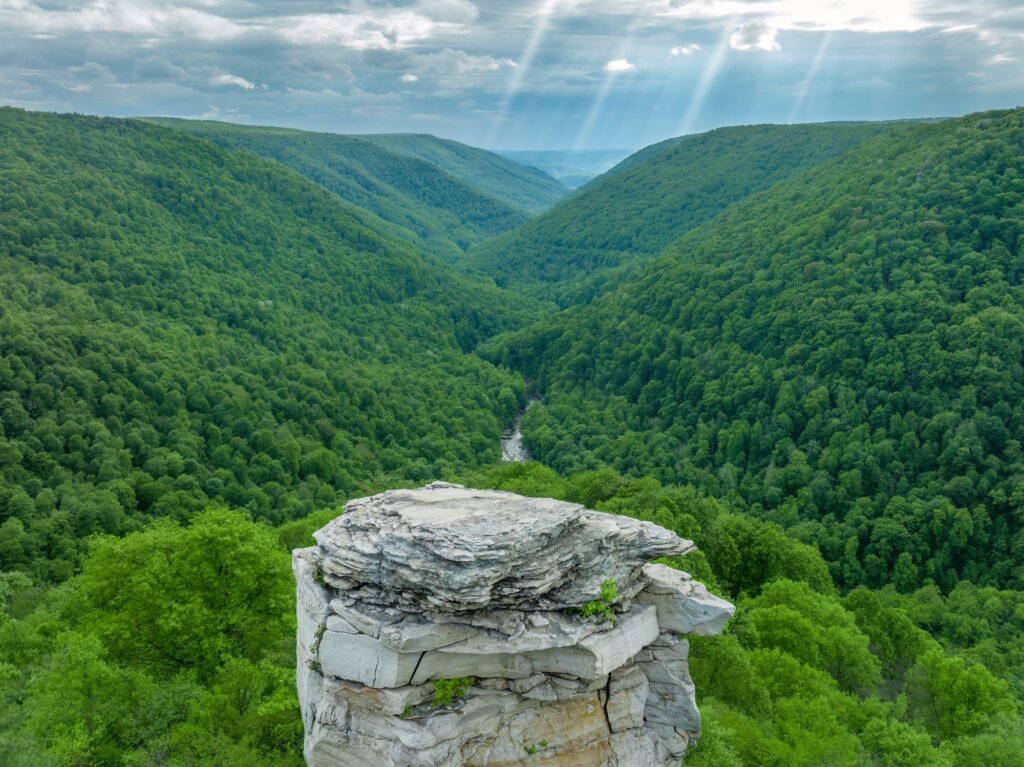
- New River Gorge. Fayetteville and the national park. Outdoor towns with tourism jobs, steep land and real flood exposure along the rivers.
- Greater Elkins. The high mountains of Randolph and Tucker counties. Ski country and long winters. Randolph County has the cheapest farmland in the highlands, about $2,800 an acre.
- Charleston area. The capital, the most services and the most hospitals, with cheap houses in the hills around it.
Outside the program, the cheapest place to move is the middle of the state. Calhoun, Braxton, Roane and Gilmer counties have the lowest farmland values in West Virginia, around $1,800 to $2,100 an acre. They are also the counties farthest from interstates, hospitals and fiber. If you are moving to West Virginia for the price, that is the trade you are making.
The honest pros and cons of moving to West Virginia
What you gain
The cheapest houses with land in the East, a low property tax on the home you live in, no state tax on Social Security, four real seasons and some of the best rivers and forests in the country within a short drive.
What you give up
Distance. Many rural areas are an hour or more from a large hospital or a big store. Internet is unreliable in the hollows, jobs are thin outside the bigger towns, and 22.5 percent of residents are already 65 or older.
What catches newcomers
Water and paperwork. First Street rates 28 percent of West Virginia homes at substantial flood risk, the third highest share in the country. And the coal, oil and gas under rural land are often owned by someone else.
The shrinking population cuts both ways. It is why houses are cheap and why neighbors are glad to see you. It is also why some rural clinics, schools and stores have closed, and why a house you buy cheaply can take a long time to sell. Buy as if you will stay. If the minerals or the mine history worry you, read our guide to West Virginia mineral rights before you make an offer.
Before moving to West Virginia: a checklist
- Visit in February, not October. Drive the road to the house after snow and after heavy rain. A county road up a hollow is a different place in winter.
- Time the drive to an emergency room, to a hospital that admits patients and, if it matters to you, to a maternity ward. Services are cut long before buildings close.
- Check the internet at the exact address. Ask the neighbors what they actually get, and whether fiber is scheduled under the state’s broadband program.
- Look up the flood zone on the West Virginia Flood Tool and get a flood insurance quote before you agree a price.
- Ask who owns the minerals and whether there is a mine underneath. Keep the mine subsidence coverage on your insurance in coal country.
- Plan the paperwork. Switch your driver’s license and title and register your vehicles soon after you arrive; the state DMV lists the current deadlines. Pay the vehicle tax on time to keep the credit.
- Budget the tax for how you will use the place. Class II if you live there, Class III if it is a second home outside town, and the homestead exemption after two years if you are 65 or older.
Thinking about moving to West Virginia? See what a house with land costs now
We publish real West Virginia listings with the county numbers, the flood zone and the access checked. Leave your details and the next West Virginia list reaches you before it goes public.
Common questions about moving to West Virginia
Is it cheaper to live in West Virginia?
Yes, mainly because of housing. West Virginia scored 87.0 on MERIC’s cost of living index for the second quarter of 2026, fourth lowest in the country, against a US average of 100. Housing scored 69.9, while groceries, utilities and transportation were close to the national average. The median home value is $162,600, against $332,700 nationally.
What is the downside to living in West Virginia?
Distance and services are the main downsides. Many rural areas are an hour or more from a large hospital or store, internet is unreliable in the hills, and jobs are thin outside larger towns. Flood risk is high, with 28 percent of homes at substantial risk, and the minerals under rural land are often owned by someone else.
Does West Virginia pay you to move there?
Yes, if you work remotely. The Ascend WV program pays $12,000 over two years to remote workers who move to one of six host areas: the Eastern Panhandle, Morgantown, the Greenbrier Valley, the New River Gorge, Greater Elkins and the Charleston area. It also includes free coworking space and outdoor recreation worth more than $2,500.
Is West Virginia a good place to retire?
For many retirees it is affordable. Since January 1, 2026 West Virginia no longer taxes Social Security benefits, there is no estate or inheritance tax, and homeowners 65 or older get a $20,000 homestead exemption after two years of residency. The trade-off is distance to specialist care, so check the drive to a hospital first.
Is West Virginia losing population?
Yes, slowly. The Census Bureau estimated 1,766,147 residents on July 1, 2025, down 1.5 percent since the 2020 census, and 22.5 percent of residents are 65 or older. Growth is concentrated in the Eastern Panhandle and around Morgantown. Elsewhere the decline keeps house prices low but has closed some rural schools, clinics and stores.
Do you pay taxes on your car in West Virginia?
Yes. West Virginia counties tax vehicles every year as personal property, which surprises many people moving to the state. Since 2024 West Virginia refunds that tax through a refundable state income tax credit, but only for vehicle property tax paid on time. Ask the county assessor how your vehicles will be assessed when you register them.
Keep reading
- How to buy land in West Virginia – what an acre is worth in all 55 counties, and the six checks the state asks of you.
- West Virginia mineral rights – what you own, what you do not, and how to find out before you buy.
- Cheap houses in West Virginia – ten real homes with land, with the census check on each one.
- The best states to homestead – where West Virginia lands once land, tax and rain are scored together.
Before you move, the important part
American Home Opportunities is a publisher. We are not a real estate broker, relocation service, tax preparer, attorney or financial advisor, and nothing on this page is legal, tax or financial advice.
Cost of living figures come from the Missouri Economic Research and Information Center, second quarter 2026. Population, age, home value, homeownership, income and broadband figures come from the Census Bureau’s QuickFacts and American Community Survey 2020–2024. Tax rates come from the Tax Foundation and the West Virginia State Tax Department (2025 average levies by class, W. Va. Code §§ 11-3-1 and 11-8-5). Ascend WV terms come from the program’s website, October 2026. Flood risk comes from the First Street Foundation; land values from the USDA Census of Agriculture 2022. Programs and tax rules change; check the current terms before you rely on them.
Any price we quote for a property is an asking price at the time of writing, not a sale price. Verify everything with the county assessor, the state agencies and licensed professionals before you commit money. Page published October 2026.