
Homesteading in South Carolina: Land, Title and Farm Tax (2026)
Homesteading in South Carolina means something specific here, and it is worth starting with the words. If you want a few acres to live on, a garden, some chickens or a couple of steers, you are homesteading. The state’s “homestead exemption” is something else: a property tax break for owners 65 and older. Both matter, and this guide covers both. It also covers what most homesteading guides leave out, because it is a South Carolina problem more than almost anywhere else: heirs’ property, land owned by a whole family on paper, which can turn a cheap rural tract into a lawsuit. These are the steps in the order we would take them.
Homesteading in South Carolina: the numbers in short
1. Pick your region
For homesteading in South Carolina the map is simple: the farther you get from the Interstate 85 corridor and the big coastal cities, the cheaper the ground. The 2022 USDA Census of Agriculture puts the Upstate at $6,248 an acre and the Pee Dee, the farm and pine country of the northeast, at $2,952. The eight counties under $3,000 an acre, Lee, Marlboro, Dillon, Darlington, Marion, Williamsburg, Georgetown and Allendale, average $2,828. Our guide to how to buy land in South Carolina breaks down all 46 counties.
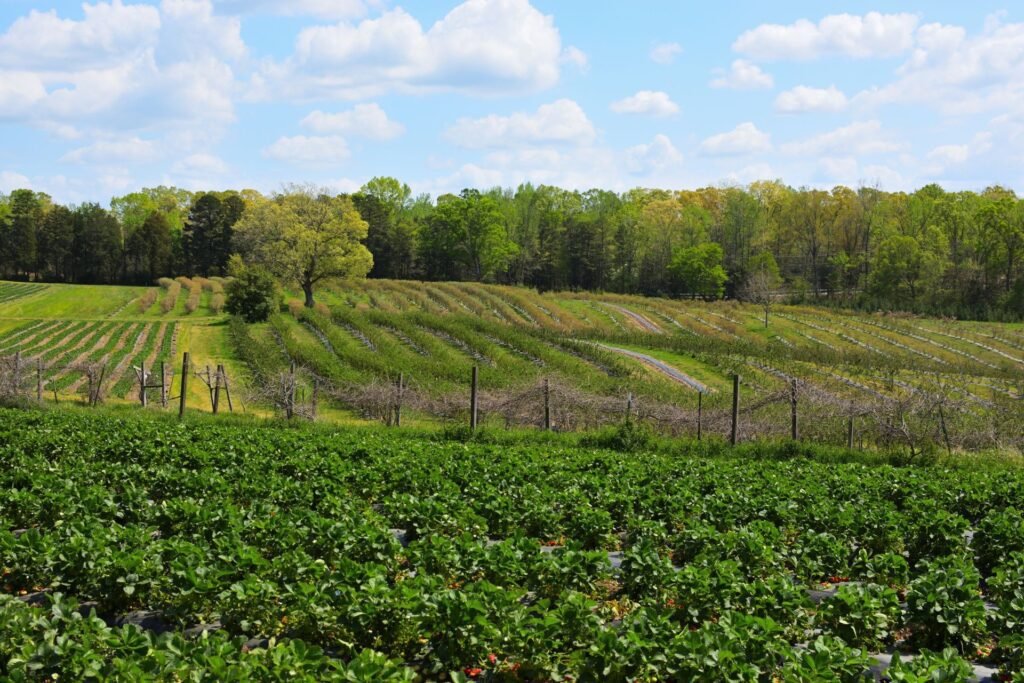
Flat, open ground is the Pee Dee’s strength for a homestead: it is easy to fence, plow and build on, and its farms are large, close to 400 acres each on average. The Upstate is the opposite, small farms averaging about 110 acres, rolling land and more buyers. Orangeburg County, in the Savannah River region, has more land in farms than any other county, 230,111 acres at $3,291 an acre, and is worth a look for anyone who wants farm country between Columbia and Charleston.
2. Size the land for the farm-use tax
South Carolina taxes qualifying farmland on what its soil can produce rather than on its market value, and assesses it at 4 percent of that use value for individuals and family partnerships. The thresholds are firm, under S.C. Code 12-43-232: a timber tract must be at least 5 acres, and other farmland at least 10 acres, though contiguous tracts with identical owners can be added together, even across a public road. Below the minimum, a tract qualifies only if it produced at least $1,000 of gross farm income in three of the previous five years, and a new owner of a non-timber tract under 10 acres can qualify by meeting that same test in three of the first five years. If at least half of a tract qualifies, the whole tract is classed as agricultural, as long as no other for-profit business runs on it.
Three rules trip up new owners. First, farm-use status does not come with the deed: each new owner must apply to the county assessor by the first penalty date of the first year claimed. Second, the house is taxed separately. Your legal residence and up to five contiguous acres around it are assessed at 4 percent of market value, with no school operating levy, and only once you apply. Third, the rollback: if farm land changes to another use, such as being split into lots, the owner pays the difference between the farm and market tax for the year of the change and the three years before it, and must report the change within six months or pay a penalty of half a percent a month.
None of this is the “homestead exemption.” That is a separate break: after a full year as a South Carolina legal resident, an owner who is 65 or older, totally and permanently disabled or legally blind can exempt the first $50,000 of the home’s value; apply with the county auditor. Our guide to moving to South Carolina walks through the rest of the tax picture for retirees.
3. Read the title for heirs’ property
Heirs’ property is land owned by a group of relatives as tenants in common, usually because an owner died without a will and the title passed to every heir in fractional shares, then to their heirs, and so on. South Carolina law gives it a precise meaning: co-owned land with no written agreement among all the owners on how to divide it, where at least one owner inherited from a relative and relatives hold at least 20 percent of the interests or make up at least 20 percent of the owners. After a few generations a single farm can have dozens of owners, many of whom have never seen it.
Nobody knows how much there is. The Legislature’s Heirs’ Property Study Committee reported in 2022 that no data quantifies it statewide. The best estimates, from a 2023 brief by the Southern Rural Development Center and the USDA Forest Service, put South Carolina at 16,779 to 41,584 likely heirs’ parcels covering 162,803 to 414,784 acres, worth $930 million to $3.04 billion. The committee also heard testimony that forced partition sales have been especially harmful to Gullah Geechee families, descendants of West and Central Africans enslaved on the coast’s rice, Sea Island cotton and indigo plantations, whose cultural heritage corridor Congress designated in 2006.
For a buyer, the rule is simple: one heir can sell only an undivided share, not the tract. Buy that share and you become a co-owner with every other heir, with no right to fence off “your” part and every chance of being pulled into a partition suit; ask your closing attorney to confirm how a title insurer will treat it. The warning signs are visible before you make an offer: a tax bill still mailed in a dead owner’s name, “heirs of” or “estate of” in the owner field, a deed chain that ends with an owner whose estate was never probated, many names on the deed, family members living on the land who are not on it, and a seller who offers only a quitclaim deed. The nonprofit Center for Heirs’ Property Preservation has resolved 452 titles since it was founded in 2005, which shows the problem can be fixed, by the family, with lawyers, before a sale. If the family wants to keep farming instead, the 2018 Farm Bill lets heirs’ property operators get a USDA farm number with alternative documents and created a relending program to help heirs clear title, as farmers.gov explains.
4. Know how partition and tax sales work
In 2016 South Carolina adopted the Uniform Partition of Heirs Property Act, now S.C. Code 15-61-310 and following, to stop the old pattern in which one co-owner, or an outsider who bought one share, forced a quick courthouse sale of the whole family farm. When a court finds the land is heirs’ property, it now orders an appraisal by a disinterested licensed appraiser, valuing the land as if one person owned it all. The co-owners who did not ask for a sale can then buy out the ones who did, at the appraised value times their share. The court must prefer dividing the land itself unless that would badly hurt the owners as a group, weighing how long the family has owned it, its ancestral value and who has paid the taxes. If a sale is still needed, the default is an open-market sale through a licensed broker at no less than the appraised value.
Tax sales are the other door into cheap land, and the other trap. When taxes go unpaid, the county sells the property at public auction, paid in full that day. The owner, a grantee or a mortgage or judgment creditor then has 12 months to redeem, by paying the taxes, penalties and costs plus interest on the winning bid of 3 percent in the first three months, 6 percent in the next three, 9 percent and then 12 percent (S.C. Code 12-51-90). If nobody redeems, the tax collector issues a tax title, and any amount bid above the taxes belongs to the former owner. A suit to recover the land must be brought within two years of the sale. So a tax deed is a start on a title, not a finished one, and a buyer may need a quiet title action before a title insurer will cover it; nobody publishes what that costs, and it can take months to years when many heirs must be found.
The seller is one of several heirs.
Stop and ask the attorney to search the title. Buy only when every heir signs the deed or a court has cleared the title. A share bought from one heir is a lawsuit you paid for.
The tax bill is still in a dead owner’s name.
Common, and not always fatal. Ask whether the estate was probated and who the personal representative is. If it never was, the family may have to open probate or go to court before anyone can sell.
The land is being sold by a master-in-equity.
That is a court-ordered sale, often a foreclosure or a partition. Read the court order, and budget for the deed recording fee: on a master-in-equity deed the buyer pays it, not the seller.
You are bidding at a county tax sale.
Treat the bid as money you may not see used for a year. Expect the owner may redeem, and do not build, clear or move in until the redemption year has passed and an attorney says the title is insurable.
5. Plan the water and the septic
Most rural homesteads in South Carolina drink well water, and the state has made drilling one straightforward. A private well is covered by a statewide general permit: you or your driller file a notice of intent with the Department of Environmental Services, which responds within 48 hours or the well is deemed approved, and the driller gives 48 hours’ notice before starting. Use a licensed driller. The setbacks shape where everything else goes: at least 75 feet from a septic tank and drain field, 50 feet from barns, animal lots and surface water, and 100 feet from lagoons and chemical or fuel storage. On a 2-acre homestead with a chicken run and a goat pen, draw those circles before you place the house.
Septic comes before building. Without public sewer, the county will not issue a building permit for a house or a manufactured home until DES issues a septic permit. The site evaluation costs $150, and the soil work can be done by DES staff or by a licensed professional soil classifier you hire, which is often faster. The application needs a plat or deed with the lot size, flagged property lines and a staked house and drain field area; the permit lasts five years, and DES gives final approval to operate after inspection. Make any offer conditional on a passing evaluation, particularly on low, wet coastal-plain ground.
6. Build to code and secure the road
Unlike some rural states, South Carolina has mandatory building codes in every county and city. Local governments must enforce the codes adopted by the state Building Codes Council, which since January 1, 2023 means the 2021 International Residential Code with South Carolina changes; a move to the 2024 codes was still pending before the Legislature in 2026. Zoning, by contrast, is a county matter, so ask the county planning office whether you can live in a camper while you build and how many animals the zoning allows.
Manufactured homes are common on rural homesteads, and the paperwork matters. Once the wheels, axles and towing hitch are removed and the home is installed to county rules, the owner can retire its vehicle title under S.C. Code 56-19-510, so the home is treated as part of the land. Ask whether that was done on any used home you buy. Finally, the road: a track across a neighbor’s land is not access unless it is recorded. South Carolina grants an easement by necessity only when the two tracts were once owned together, were later split, and the access is truly necessary, so get a written, recorded easement and a survey before you close.
7. Plan for storms, distance and the internet
A homestead in South Carolina has to be built for hurricane season. Forty-three tropical cyclones made landfall on the coast from 1851 to 2020, four of them major, and the centers of 139 have tracked into the state, which ranks sixth in the nation in federal flood insurance policies. Look the parcel up on FEMA’s flood maps, keep the house, the well and the drain field out of low ground, and get flood and homeowners insurance quotes before you make an offer.
Distance is the other cost of cheap land. Four rural hospitals have closed in South Carolina since 2005, three of them in counties among the cheaper half of the census: Bamberg, Marlboro and Fairfield. And broadband is still arriving: the state’s federal plan would connect its last 20,480 unserved locations, 48.7 percent of them by low-earth-orbit satellite rather than fiber, according to the NTIA’s summary, which is still subject to review. Check the exact address with providers before you count on it.
Before you make an offer on a South Carolina homestead
- Have a South Carolina attorney search the title back far enough to see every inheritance, and refuse any deal where only some heirs will sign.
- Look up the tax record for a dead owner’s name, “heirs of” or “estate of,” and any years of unpaid taxes or tax-sale history.
- Confirm the acreage and use against the farm-use thresholds of 5 acres of timber or 10 of other farmland, and ask whether a rollback is pending.
- Order the septic site evaluation and sketch the well, drain field, barn and animal pens with the required distances before you commit.
- Get a survey and a recorded easement if the land does not front a public road.
- Pull flood and homeowners insurance quotes, and drive to the nearest emergency room from the gate.
Get the next batch of South Carolina listings first
We check the census value, the flood map and the road in before a South Carolina homestead makes our list. Leave your details and the next list reaches you before it goes public.
Keep reading
- How to buy land in South Carolina – what an acre costs in all 46 counties and the six checks to run before you buy.
- Moving to South Carolina – the cost of living, taxes for retirees and your first weeks after the move.
- 10 dirt cheap farmhouses in South Carolina with land – from 6.24 acres in Chesterfield to a lakefront auction near Abbeville.
- The best states to homestead – land, tax and rain scored together.
- All our rural property guides, state by state.
Common questions about homesteading in South Carolina
Can you homestead in South Carolina?
Yes, but by the book. Building codes apply in every South Carolina county and city, currently the 2021 International Residential Code with state changes, and a home without public sewer needs a state septic permit before the county will issue a building permit. In return, land in farm use is taxed at 4 percent of a low use value, and the home you live in at 4 percent of market value.
How many acres do you need for agricultural use in South Carolina?
Five acres for a timber tract and 10 acres for other farmland, and contiguous tracts with the same owners can be combined. A smaller tract qualifies only with at least $1,000 of gross farm income in three of the previous five years; a new owner of a non-timber tract under 10 acres can qualify by meeting that test in three of the first five years. Each new owner must apply to the county assessor.
What is the homestead exemption in South Carolina?
It is a property tax break, not a homesteading law. Owners who are 65 or older, totally and permanently disabled or legally blind can exempt the first $50,000 of the fair market value of their legal residence, if they have been South Carolina legal residents for at least one year by December 31 of the year before. Apply with the county auditor.
What is rollback tax in South Carolina?
When land taxed as agricultural changes to another use, the owner owes rollback taxes: the difference between the farm-use tax and the market-value tax for the year of the change and the three tax years before it, four years in all. The change must be reported within six months, and failing to report it carries a penalty of half a percent a month.
Can you buy heirs’ property in South Carolina?
You can buy it safely only when every heir signs or a court clears the title. One heir can sell just an undivided share, which makes the buyer a co-owner with all the other heirs and open to a partition suit. Under South Carolina’s 2016 heirs’ property act, the other heirs can buy out a co-owner who asks for a sale, at the court-appraised value.
How long do you have to redeem a tax sale property in South Carolina?
Twelve months from the sale. The owner, a grantee or a mortgage or judgment creditor can redeem by paying the taxes and costs plus interest on the bid of 3 percent in months one to three, 6, 9 and then 12 percent by quarter. A suit to recover the land must be brought within two years of the sale, so a fresh tax deed is not clean title on day one.
Do you need a permit to drill a well in South Carolina?
A new private well is covered by a statewide general permit. You or your driller file a notice of intent with the Department of Environmental Services, which responds within 48 hours or the well is deemed approved. The well must sit at least 75 feet from a septic tank and drain field and 50 feet from barns, animal lots and surface water. Use a licensed driller.
Sources and the important part
Farmland values come from the USDA Census of Agriculture 2022, South Carolina, Table 8. Legal references are to S.C. Code 12-43-220, 12-43-230 and 12-43-232 (agricultural use, legal residence and rollback), 12-37-250 (homestead exemption), 15-61-310 to 15-61-400 (Uniform Partition of Heirs Property Act, Act 153 of 2016), 12-51-40 to 12-51-160 (tax sales and redemption), 12-24-20 (deed recording fee on master-in-equity deeds), 56-19-510 (manufactured home titles) and 6-9-50 (building codes), DES Regulation 61-56 (septic) and Regulations 61-44 and 61-71 (wells), and Kennedy v. Bedenbaugh (S.C. 2002) on easements by necessity. Heirs’ property estimates come from the Southern Rural Development Center and USDA Forest Service brief of June 2023 and the Heirs’ Property Study Committee report of December 2022; the Center for Heirs’ Property Preservation figures from its website; the USDA heirs’ property programs from farmers.gov; the Gullah Geechee corridor from the National Park Service; hurricane and flood figures from SCDNR and the State Climatology Office; hospital closures from the UNC Sheps Center; broadband figures from the NTIA. No official source publishes the cost or length of a quiet title action in South Carolina, and we do not quote one.
American Home Opportunities is a publisher. We are not a real estate broker, agent, lender, appraiser, attorney, tax or financial advisor, and nothing on this page is legal, tax or financial advice. Heirs’ property and tax-sale titles are specialist work; have a South Carolina real estate attorney review the title before you commit money, and verify every rule with the county and the agency named. Page published October 2026.