
How to Buy Land in Montana: Prices, Water and Taxes
How to buy land in Montana, all 56 counties: why the eastern plains cost a tenth of the Flathead, how water rights pass at closing, the seven-month homestead tax rule, and the checks to run on access, septic, wells and wildfire.
How to buy land in Montana: the cheap half is the half nobody pictures
If you are working out how to buy land in Montana, start by putting the postcard away. The 2022 Census of Agriculture counts every farm and ranch in all 56 Montana counties and puts the average value of farmland and its buildings at $1,297 an acre. The USDA’s 2026 survey puts Montana farm real estate at $1,260, just 28 percent of the national $4,500, and Montana pasture, at $940 an acre, costs less than half the US average. By the federal government’s own numbers, Montana is one of the cheapest places in the country to own an acre.
The catch is that the cheap Montana and the famous Montana are different places. The valleys of the northwest, around Kalispell and the Bitterroot, are the most expensive farmland in the state: Flathead County averages $9,225 an acre and Ravalli County $9,096, seven times the state figure. East of the mountains, the plains that roll from the Missouri Breaks to the Dakota line hold half of Montana’s farmland at $938 an acre. So the first decision when buying land in Montana is not the county. It is which side of the mountains you want to wake up on, and how far you are willing to drive for groceries, a hardware store and a hospital.
On the Montana homes we covered, the land was 5.1% of the price
We checked the census against the ten properties in our list of homes with land for sale in Montana, priced from $395,000 in Polaris down to $39,900 in Glendive. The Glendive house sits on a leased lot, so there is no land to value. For the other nine we multiplied the acreage by its county’s census value and compared the result with the asking price. On average the ground underneath came to 5.1 percent of what the seller was asking. The highest share was 15.3 percent, on 18.5 acres outside Helmville in Powell County, asking $215,000. The lowest was 0.8 percent, on a third of an acre in Westby, in Sheridan County in the far northeast corner of the state. Even 40 acres outside Circle in McCone County, asking $350,000, carried only about $42,200 of census-value land, or 12.1 percent.
That is the arithmetic of a state where land is this cheap. At $1,000 to $2,000 an acre, five acres add $5,000 to $10,000 to the price of a house, so what you see on a Montana listing is almost all house: the roof, the furnace, the well and the insulation that gets you through January. Judge a Montana property by the house, the water right and the road in, not by the price per acre.
Buying land in Montana: the numbers in short
Montana land prices by region: what an acre actually costs
We pulled all 56 Montana counties from the census and grouped them into the five regions people actually shop in, from the mountain valleys of the west to the short-grass plains of the east. Each average is weighted by the acres in farms, so a county with a lot of ranch land counts for more than one with a little. The last column names the cheapest county inside each region.
| Region | Farmland value per acre USDA, 2022 census | Land in farms | Cheapest county in the region |
|---|---|---|---|
| Northwest (Flathead, Missoula, Bitterroot) | $3,185 | 1,969,744 acres 7 of 56 counties | Sanders, $1,180 |
| Southwest mountain valleys | $2,291 | 6,211,866 acres 11 counties | Lewis and Clark, $1,762 |
| Central (Billings to Lewistown) | $1,386 | 8,227,979 acres 8 counties | Wheatland, $1,197 |
| Hi-Line and Golden Triangle | $1,276 | 12,338,909 acres 9 counties | Blaine, $849 |
| Eastern plains | $938 | 28,852,822 acres 21 counties | Big Horn, $649 |
| Montana, all counties | $1,297 | 57,601,320 acres 56 counties | Big Horn, $649 |
Why the census average flatters Montana, and how to read it
Montana ranches are enormous, and that shapes the number. The 24,266 farms in the census average about 2,374 acres each. In Garfield County, around Jordan, the average is about 9,770 acres; in Ravalli County, in the Bitterroot, it is about 134 acres spread across 1,400 farms. Because the census figure includes the buildings, a house and barn on a 10,000-acre ranch barely move the per-acre value, while the same buildings on a small Bitterroot place push it up sharply. That is a large part of why the northwest looks so expensive and the plains so cheap.
So use the census as a floor for big acreage and a rough guide for small tracts. A 10- or 20-acre homesite usually costs more per acre than a working ranch in the same county, because the buyer is paying for the road, the power line and the house site, not for grass. What the census does tell you, reliably, is the relative price of each county and region, and that is the comparison that matters when you decide where to look.
Where the cheapest land in Montana is, and the honest reason it is cheap
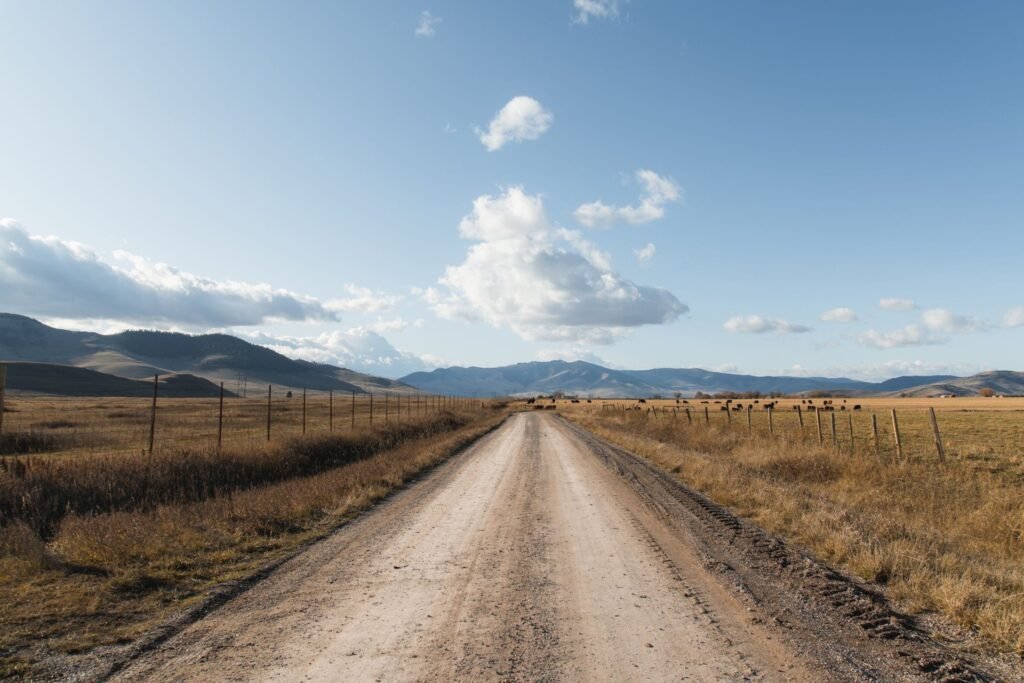
The ten cheapest counties in Montana are Big Horn ($649 an acre), Garfield ($672), Rosebud ($716), Carter ($753), Prairie ($762), Blaine ($849), Wibaux ($934), Powder River ($957), Golden Valley ($977) and Dawson ($981). Nine of them are on the eastern plains; Blaine, around Chinook, is on the Hi-Line. Together they average $780 an acre across 16.7 million acres of farms and ranches, about 29 percent of all the farmland in the state. This is not a handful of odd parcels. It is most of the map east of Billings.
The reasons are scale, dryness and distance. These are ranching counties: the average operation in Garfield County covers about 9,770 acres and in Big Horn about 8,767, because dry short-grass range carries few cattle per acre. Where the plains are farmed, water sets the price: the USDA values non-irrigated Montana cropland at $1,070 an acre against $4,500 for irrigated ground. Montana as a whole averages 7.4 people per square mile, and on the plains your nearest neighbor can be miles away. None of that makes the land bad. It makes it priced for ranchers and for people who want room, quiet and a big sky, and who are ready to plan around wind, drought and long winter drives.
If you want cheap land within reach of a real town, look at the counties built around a county seat on a main road. Dawson County, at $981 an acre, has Glendive on Interstate 94; Custer, at $1,017, has Miles City on the same highway; Hill, at $1,066, has Havre on U.S. 2 along the Hi-Line. Those towns have the stores, the schools and the services of a regional center, and the census price a few miles out is still under the state average. That is where we would start if you want Montana land prices without Montana isolation.
The cheap corner of the northwest
The northwest average hides two very different markets. Flathead ($9,225) and Ravalli ($9,096), the counties of Kalispell and Hamilton, are the two most expensive in Montana, but together they hold only 0.6 percent of the state’s farmland. Sanders County, along the Clark Fork around Thompson Falls, averages $1,180 an acre, below the state average and close to plains counties such as Valley ($1,152), and Lake County, in the Mission Valley around Polson and Ronan, averages $2,120. Those two hold 62 percent of the region’s farmland, and without Flathead and Ravalli the northwest averages about $1,900. If you want trees, rivers and mountains, start in Sanders and Lake, and check the water before anything else: the Bitterroot’s Rye Creek is Montana’s only permanent stream depletion zone, where household wells face tighter limits.
What to check before you buy land in Montana
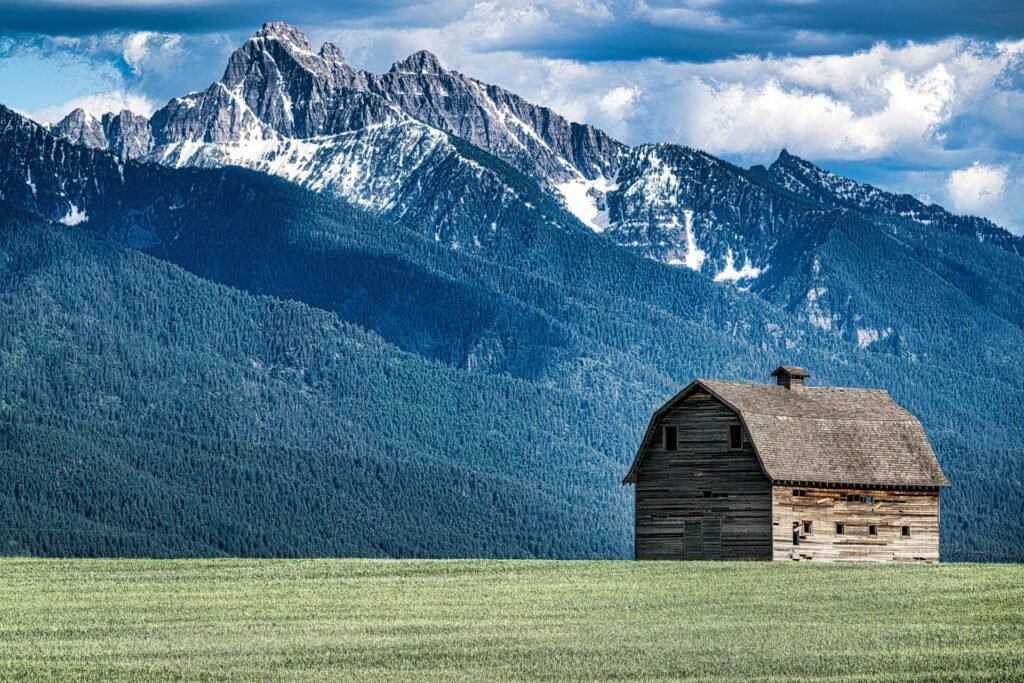
If you are learning how to buy land in Montana from another state, these are the six checks specific to it, in the order we would run them. Montana is a western water state, and that shapes the first two: water is a separate property right with its own records and its own paperwork at closing, and since January 2026 even a household well needs a filing with the state before you use it.
The third and fourth decide whether you can build and how you get there: how the parcel was created, whether the state and county will approve a septic system on it, and whether the road in is a recorded right or a neighbor’s courtesy. The last two decide how you will live there: a plan for wildfire and winter, and a clear idea of what the county enforces, from building codes to fences in open range country.
A listing photo shows grass, a barn and mountains. It does not show a priority date, a sanitary restriction or a missing easement, and on a cheap parcel any one of those can cost more than the land. Most of them can be checked from a desk with the parcel’s geocode, using the state’s Montana Cadastral map, the DNRC water right database and the county clerk and recorder, long before you pay for an inspection.
1. Find out what water right, if any, comes with the land
2. Plan the well, and file before you use it
3. Learn how the parcel was created, and whether it can be built on
4. Confirm the road in is yours to use
5. Plan for wildfire, winter and the insurance quote
6. Ask the county what it enforces, and fence livestock out
We check the census value, the flood map and the access before a Montana home makes our list
Every property we feature is run against its county’s farmland value, its flood zone and its road in before it reaches the channel. Leave your email and you get the next list, with those checks already done.
What it costs to own rural land in Montana
If you buy land in Montana, the tax picture is unusual. There is no state sales tax and no estate or inheritance tax, according to the Tax Foundation, although resort communities may vote a local resort tax of up to 3 percent, plus up to 1 percent more for infrastructure, on lodging, restaurants and luxuries. The income tax is 4.7 percent on the first $47,500 of taxable income for a single filer, or $95,000 for a married couple filing jointly, and 5.65 percent above that in 2026, with the top rate falling to 5.4 percent in 2027. The Tax Foundation puts the effective property tax rate on owner-occupied homes at 0.61 percent.
Property tax runs on a two-step formula. Market value times a tax rate gives the taxable value; taxable value times the local mills, divided by 1,000, gives the tax. In 2026 the rate on a house depends on whether it is your homestead. A primary residence pays marginal rates, like income tax brackets: 0.76 percent on the first $378,000 of value, 0.90 percent up to $756,000, 1.10 percent up to about $1.5 million and 1.90 percent above that. A second home, a short-term rental or a vacant residential lot pays 1.90 percent on the whole value, two and a half times the homestead rate, and a house on qualifying farm or ranch land that is not your homestead pays 1.35 percent. Homes and farmland are reappraised every two years.
The arithmetic, with one county’s real levy, and what it leaves out
Take Dawson County, around Glendive on the eastern plains, where the county levied 144.25 mills for fiscal year 2026, according to the Montana Association of Counties’ summary for the Legislature. Add the 101 mills that the state sets for schools and the university system, and a $200,000 house that is your homestead has a taxable value of $1,520 and pays about $373 on those two layers. The same house as a second home has a taxable value of $3,800 and pays about $932. This is a partial, illustrative calculation: it leaves out the local school district, fire district and other district mills, which usually make up a large share of a real bill, and it pairs the county’s tax-year-2025 levy with the 2026 rates. The full bill will be higher. Ask the county treasurer for the total levy in the parcel’s district before you make an offer.
The seven-month rule, farm land and senior credits
The homestead rate is not automatic for a newcomer. To qualify, you must have owned and lived in the home at least seven months of the year, claim it as your only homestead and be current on Montana property taxes, and you apply between December 1 and March 1; a late application counts for the following tax year. A buyer who moves in partway through the year may not meet the seven months that year, which could leave the house at the higher non-homestead rate at first. Ask the Department of Revenue how the rule applies to your closing date before you build your budget.
Farm and ranch land is valued on what it can produce, not on what it sells for, and taxed at 2.05 percent of that productive value. A tract of 160 contiguous acres or more qualifies automatically. Between 20 and 160 acres, the land must be actively farmed and produce at least $1,500 a year in gross agricultural income, or for grazing land carry stock worth that much; smaller tracts face narrower tests. The trap is the middle: 20 to 160 acres that fail the test become nonqualified agricultural land, taxed at seven times the farm rate, 14.35 percent of a grazing value. One acre under the house on farm land is valued as the best class of farm land on the place, and the house itself is taxed as a home.
Older owners have two possible breaks. The Elderly Homeowner/Renter Credit is a refundable credit of up to $1,150 for filers 62 or older who have lived in Montana at least nine months of the year, owned or rented a Montana home for at least six months and have household income under $45,000. The Property Tax Assistance Program cuts the tax by 30, 50 or 80 percent on the first $418,000 of market value, depending on income; ask the Department of Revenue for the current income limits. Our guide to moving to Montana covers how the state taxes Social Security and pensions.
Closing, broadband and the drive to a hospital
A Montana closing carries one step most buyers have never seen: the water. The realty transfer certificate discloses whether water rights exist and transfer, the Form 608 fee is normally paid at closing, and the deed, not the form, is the legal document that transfers the right. Budget for a survey on any parcel carved out of a larger tract, and if the house is a manufactured home, ask whether it has been converted to real property: that requires removing the running gear, a permanent foundation on land the owner holds, a recorded statement of intent and the title surrendered to the county treasurer, and lenders treat the two cases very differently.
Internet and health care are the weak points of remote Montana. The state’s federal broadband plan, approved in December 2025, puts $629 million toward 68,498 unserved locations, and 63.7 percent of them will be served by low-earth-orbit satellite, 21.0 percent by fiber and 15.3 percent by fixed wireless; builders have four years. Check the exact address before you trust a provider’s map. The University of North Carolina’s Sheps Center has recorded no rural hospital closures or conversions in Montana since 2005, against 197 nationally, but Montana State University economists, citing Sheps data, report that most of the state’s 55 rural hospitals have lost services. Find the nearest emergency room and the nearest hospital that admits patients, and drive the route in winter before you commit.
Why the price per acre on a listing site is not the price of land
Search online for land for sale and you will see averages that bear no resemblance to the census. In October 2026 LandSearch showed 4,824 Montana listings asking an average of $18,524 an acre, about 14 times the census value of farmland, and its listings covered about 280,705 acres, less than half of 1 percent of the state’s farmland. A listing-site average divides asking prices, cabins and houses included, by acres, and the small parcels near Bozeman, Kalispell and Missoula carry most of their price in location and improvements. Compare price per acre only between parcels of similar size in the same county.
Cheap land and homes we have covered in Montana
Every list we have published for people looking to buy land in Montana, with the county data behind each property. Asking prices are from the date of each list and many of these homes have since sold.
Montana guides
Step-by-step guides for buying land and living in Montana, with the state’s own rules and the numbers behind them.
Keep exploring before you settle on Montana
Montana gives you some of the cheapest farmland in the country on the plains and some of the most expensive in its mountain valleys, with water rules unlike anything east of the Rockies. These are worth a look while you are still deciding how to buy land in Montana, and whether Montana is the right state at all.
- Homes with land for sale in Montana – ten real homes from Polaris to Glendive, with the census value of the land under each one.
- Moving to Montana – the real cost of living, taxes for retirees, winter and your first 60 days.
- Montana water rights – what passes with the land, the new well notice and how to check a parcel before you offer.
- Why cheap rural homes don’t sell, and how to buy one anyway – the financing and inspection traps behind the lowest prices.
- The cheapest states to buy land in America – where Montana sits against the Dakotas and Wyoming, measured with the same federal survey.
- The best states to homestead – land, tax and climate scored together.
- Rural property guides, the Rural Property Field Guide and how the AHO Score works – every guide we publish, the checks we run, and how a property earns a place on our lists.
Get the next batch of Montana listings first
We keep coming back to Montana, because a house on real acreage east of the mountains still costs a fraction of what the postcard valleys ask. Leave your details and the next Montana list reaches you before it goes public.
Common questions about how to buy land in Montana
How much is an acre of land in Montana?
Montana farmland and farm buildings averaged $1,297 an acre in the 2022 USDA Census of Agriculture, and farm real estate averaged $1,260 in the USDA’s 2026 survey, about 28 percent of the national $4,500. Pasture averaged $940, non-irrigated cropland $1,070 and irrigated cropland $4,500. By county the census runs from $649 an acre in Big Horn County to $9,225 in Flathead County.
Where is the cheapest land in Montana?
On the eastern plains. Nine of the ten cheapest counties in the 2022 USDA census are there, led by Big Horn at $649 an acre, Garfield at $672, Rosebud at $716 and Carter at $753, and the 21 plains counties together average $938 an acre across 28.9 million acres, half the state’s farmland. West of the Continental Divide, Sanders County is the cheapest at $1,180.
Do water rights come with land in Montana?
Usually. Under MCA 85-2-403, a water right passes with the land when it is sold unless the deed specifically exempts it, and it keeps its original priority date. The buyer files Form 608 with the DNRC, which costs $100 for the first right plus $20 for each additional right, up to $600, and the county will not record the deed without a certification that the form and fee are filed or in escrow.
Do you need a permit to drill a well in Montana?
Not a full water permit for a household well that uses 35 gallons a minute or less and no more than 10 acre-feet a year. But since January 1, 2026 you must file a Notice of Intent, Form 602I, with a $400 fee, and have it authorized before you use water from an exempt well, then file a notice of completion within 60 days of putting the water to use.
How are property taxes calculated in Montana?
Market value times a tax rate gives the taxable value, and taxable value times the local mills, divided by 1,000, gives the tax. In 2026 a homestead pays 0.76 percent on the first $378,000 of value, with higher marginal rates above that, while second homes and vacant residential lots pay 1.90 percent. To qualify as a homestead you must own and live in the home at least seven months of the year.
Does Montana have a building code for rural homes?
The state building code does not apply to homes with fewer than five dwelling units, or to any farm or ranch building, unless the local government adopts it (MCA 50-60-102). An electrical permit is still required statewide, and a utility may not connect power without one. An owner may wire their own home without an electrician’s license, but still needs a homeowner permit.
Can you split land in Montana?
Any division that creates a parcel under 160 acres is a subdivision under MCA 76-3-103 and normally goes through county review. A few divisions are exempt, such as one gift or sale per county to each immediate family member, or a division for agricultural use only under a covenant, but they still need a survey, and parcels under 20 acres also face state sanitation review.
Before you buy, the important part
American Home Opportunities is a publisher. We are not a real estate broker, agent, lender, appraiser, attorney or financial advisor, and nothing on this page is legal, tax or financial advice.
County farmland values come from the USDA Census of Agriculture 2022, Montana, Table 8, and measure farmland and the buildings on working farms and ranches rather than asking prices for small parcels; the regions are our own grouping of all 56 counties, weighted by land in farms. State farm real estate, cropland and pasture values come from the USDA NASS Land Values 2026 Summary; the two surveys measure different things and are not a time series. The effective property tax rate and the sales and estate tax facts come from the Tax Foundation; income tax brackets from the Montana Department of Revenue. The worked tax example uses Dawson County’s fiscal year 2026 county levy from the Montana Association of Counties’ summary for the Revenue Interim Committee and the state mills reported by the Legislative Fiscal Division; it is partial and leaves out school district and other district levies. Wildfire figures come from NOAA’s State Climate Summary for Montana and from Headwaters Economics; broadband figures from the NTIA’s BEAD summary for Montana; hospital figures from the UNC Sheps Center and Montana State University. Listing-site prices come from LandSearch, October 2026.
Legal references are to MCA 15-6-134 (class 4 rates), 15-6-402 and 15-6-405 (homestead eligibility and application), 15-6-133, 15-7-202 and 15-7-206 (agricultural land), 15-7-111 (reappraisal), 15-1-116 (manufactured homes as real property), 76-3-103 and 76-3-207 (subdivisions and exempt divisions), 76-4-102 (sanitation in subdivisions), 85-2-306 (exempt wells), 85-2-401 and 85-2-403 (prior appropriation and transfer with the land), 85-2-424 and 85-2-426 (water right transfers at closing), 70-30-102 (eminent domain for private roads), 81-4-215 (open range), 50-60-102 and 50-60-605 (building codes and electrical permits) and 7-6-1503 and 7-6-1504 (resort taxes), plus ARM 36.12.103 (water right fees) and the DNRC’s 2026 exempt well rules under HB 681. Senior credits come from the Montana Department of Revenue.
Any price we quote for a property is an asking price at the time of writing, not a sale price. Rural land carries risks this page can introduce but not resolve for your parcel, including water rights and wells, septic suitability and sanitary restrictions, legal access, wildfire, winter roads, surveys, easements, title, repairs, insurance and financing. Verify everything with the county treasurer and clerk and recorder, the county sanitarian, the DNRC, the Department of Revenue, a Montana title company or attorney and licensed professionals before you commit money. Page published October 2026.