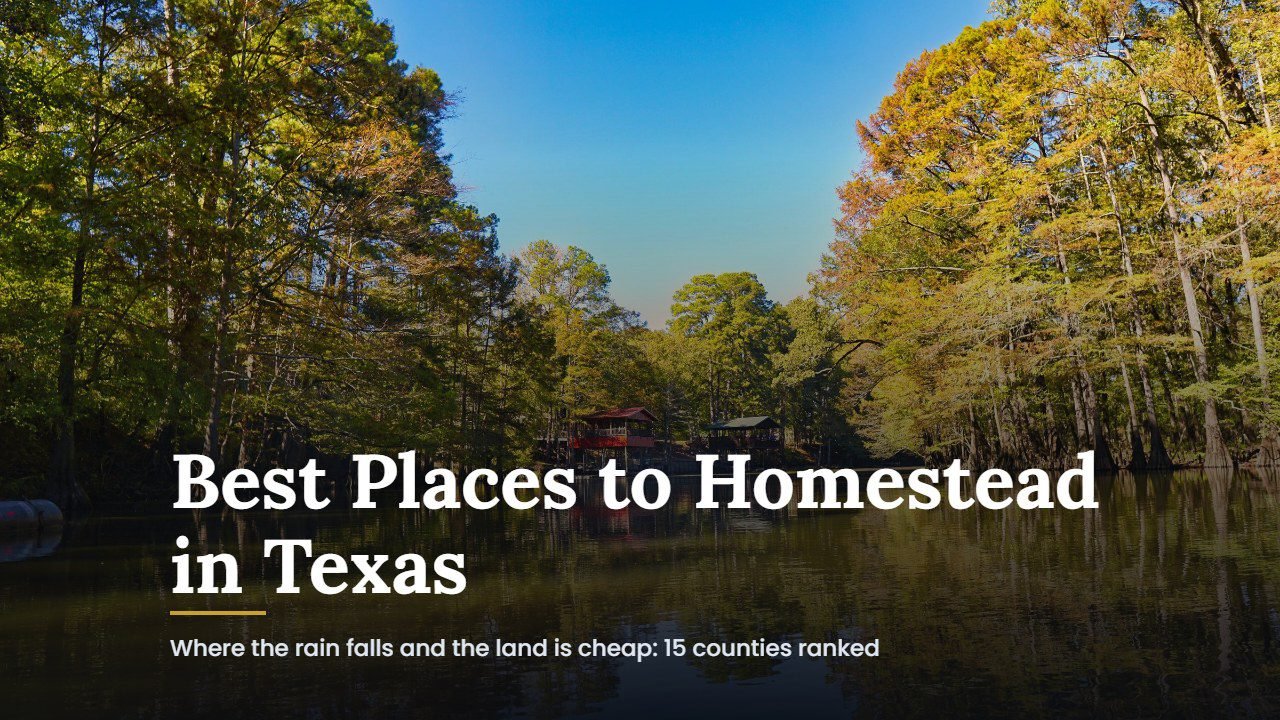
Best Places to Homestead in Texas: 15 Counties Where Rain and Land Prices Line Up
The best places to homestead in Texas are in the northeast and east of the state, in counties like Marion, Cass, Red River, Panola and Shelby, where 48 to 54 inches of rain fall in an average year and farmland averages $2,200 to $3,600 an acre. Out west, land is cheaper, but the rain is less than half.
Homesteading is about producing some of your own food, water and fuel, and in Texas the factor that decides most of that is rain. So we ranked all 254 Texas counties on two things a homesteader can measure: how much rain falls, including in the worst drought year, and what the land costs. We used 30 years of county rainfall from NOAA and the USDA’s latest county land values. The result is a short list of the best places to homestead in Texas, and it is not where most “best places” articles point.
Best places to homestead in Texas: the numbers in short
Rain against price: how Texas splits in four
Texas gets drier by about an inch of rain for every 15 miles you drive west. Land prices do not follow the same line. They peak in the band that holds Dallas, Austin and San Antonio, and drop again on both sides. That creates an odd result for a homesteader: in the wet eastern third of the state, land costs a little less than in the drier middle.
Rain against price
The wettest band of Texas costs less per acre than the middle
Average yearly rain, 1991–2020
Farmland value per acre, 2022
Median of the counties in each band, by the longitude of the county center. Rain: NOAA NCEI Climate at a Glance. Land: USDA NASS 2022 Census of Agriculture. Processed by American Home Opportunities.
| Band of counties | Counties | Median yearly rain | Median farmland value per acre |
|---|---|---|---|
| East of the 96th meridian (Tyler, Nacogdoches, Texarkana, Beaumont) | 50 | 50.0 in | $4,371 |
| 96th to 98th (Dallas–Fort Worth, Waco, Austin, Houston west) | 59 | 38.0 in | $4,484 |
| 98th to 100th (Hill Country, Abilene, Wichita Falls, San Antonio west) | 62 | 27.6 in | $2,523 |
| West of the 100th (Panhandle, Permian Basin, Big Bend) | 83 | 19.3 in | $1,428 |
West of the 100th meridian, an acre costs a third of what it costs in the east, but a garden, an orchard or a few cows there depend on a well and irrigation. In the east, the rain does most of that work for free. For a homestead, that difference usually outweighs the price of the land.
The 15 best counties to homestead in Texas
To make our list of the best places to homestead in Texas, a county needed at least 40 inches of rain in an average year and at least 24 inches in its driest year since 1991, the kind of margin that keeps a pond full and pasture alive through a bad summer. We then sorted by land price and set aside four Gulf Coast counties (Jefferson, Chambers, Orange and Liberty) that pass on rain but carry hurricane and flood exposure most homesteaders would rather avoid.
| # | County | Region | Average rain | Driest year since 1991 | Farmland per acre |
|---|---|---|---|---|---|
| 1 | Marion | Northeast Texas, Caddo Lake | 50.1 in | 28.6 in | $2,245 |
| 2 | Limestone | Post Oak Savannah, Groesbeck | 40.4 in | 24.2 in | $2,658 |
| 3 | Panola | Deep East Texas, Carthage | 51.6 in | 30.6 in | $3,130 |
| 4 | Trinity | Piney Woods, Groveton | 50.0 in | 29.9 in | $3,266 |
| 5 | Titus | Northeast Texas, Mount Pleasant | 47.9 in | 25.4 in | $3,394 |
| 6 | Red River | Northeast Texas, Clarksville | 49.8 in | 27.8 in | $3,398 |
| 7 | Houston | Piney Woods, Crockett | 47.3 in | 27.8 in | $3,488 |
| 8 | Lamar | Northeast Texas, Paris | 47.7 in | 26.7 in | $3,557 |
| 9 | Cass | Northeast Texas, Linden | 50.3 in | 27.8 in | $3,571 |
| 10 | Shelby | Deep East Texas, Center | 54.2 in | 31.7 in | $3,584 |
| 11 | Bowie | Northeast Texas, Texarkana | 50.8 in | 28.5 in | $3,614 |
| 12 | Navarro | Blackland Prairie, Corsicana | 41.2 in | 24.6 in | $3,770 |
| 13 | Leon | Post Oak Savannah, Centerville | 43.3 in | 26.4 in | $3,776 |
| 14 | Anderson | East Texas, Palestine | 45.1 in | 27.1 in | $3,818 |
| 15 | Rusk | East Texas, Henderson | 49.1 in | 30.9 in | $3,819 |
Remember what the land figure is: an average over working farms, most of them large. A 10-acre homestead tract with a house, a pond or a paved road frontage will cost more per acre. The ranking between counties is what matters here, and it is stable: these are the places where an acre of rain-fed ground costs least in Texas.
The three homesteading regions behind the list
Northeast Texas
Marion, Cass, Bowie, Red River, Lamar and Titus, along the Red River and the Arkansas line. Rolling pasture, hardwoods, lakes and ponds, and about 50 inches of rain. Texarkana, Paris and Mount Pleasant cover hospitals and stores. The cheapest rain-fed land in the state.
Deep East Texas and the Piney Woods
Panola, Shelby, Rusk, Anderson, Houston and Trinity. The wettest counties on the list, with sandy loam that grows good gardens and plenty of timber. Expect to clear land, fight humidity and ticks, and stay out of the creek bottoms when you build.
The Post Oak Savannah
Limestone, Leon and Navarro, between Dallas and Houston along Interstate 45. Less rain than the far east, around 40 to 43 inches, but open grassland that suits cattle and goats, and an easier drive to two big metros.
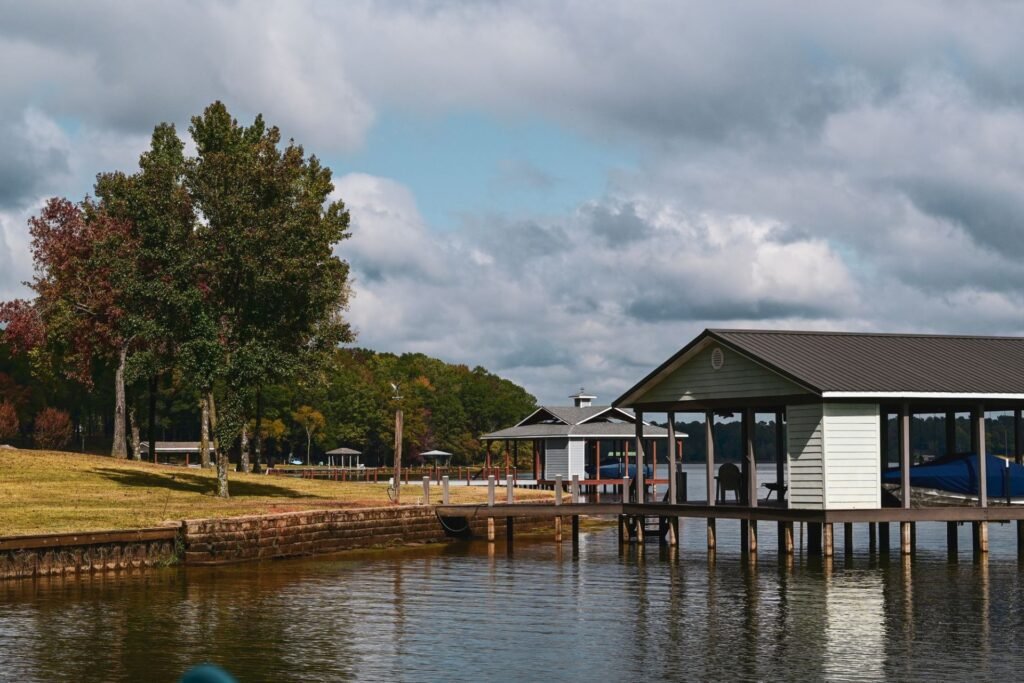
We go county by county through the first two regions in our guide to the best counties in East Texas for homesteading, including towns, hospitals and what land is selling for.
What about the Hill Country?
The Hill Country is the place most people picture when they think of the best places to homestead in Texas, and it is beautiful. As a homestead, it is a harder bet. Gillespie County, around Fredericksburg, gets 30 inches of rain in an average year and fell to 13 inches in its driest year since 1991; farmland there averages $3,993 an acre. Marion County gets 50 inches, never fell below 28, and costs $2,245. Kerr County: 29 inches and $3,597. The soil in the Hill Country is often thin over limestone, and wells can be deep and expensive.

That does not rule it out. Ranching, goats, wildlife management and rainwater collection all work there, and many homesteaders choose it for the scenery and the community. Just budget for water storage and a well, and treat the garden as something you will irrigate.
Texas rules that help a homesteader
Beyond rain and price, Texas has a few rules that make small-scale self-sufficiency easier than in most states.
- Agricultural valuation. Land used for grazing, crops, beekeeping or wildlife management can be taxed on what it produces, not its market value, which can cut the bill on the acreage to a few dollars an acre. Our guide to the agricultural exemption in Texas explains the rules.
- Your own well. A house or livestock well on more than 10 acres that pumps under 25,000 gallons a day is exempt from groundwater district permits.
- Rainwater harvesting. Collecting rain is legal and encouraged in Texas, and rainwater harvesting equipment is exempt from state sales tax.
- Homestead protection. A rural homestead of up to 200 acres for a family, or 100 for a single adult, is protected from most creditors under the Texas Property Code.
One word of warning: in Texas, “homestead” also means the property tax exemption on your primary residence. Searching for homestead rules will turn up mostly tax pages. The exemption is worth filing for once you live on the land, and it takes $140,000 off the home’s value for school taxes. For everything else about buying, start with our guide to buying land in Texas.
Find Texas land for your homestead
We publish new Texas listings with land as we find them, with the county numbers already checked. Tell us your budget and timeline, and the next list reaches you first.
Keep reading
- Best counties in East Texas for homesteading: towns, hospitals and land prices, county by county.
- Buying land in Texas: water, minerals, access and where land costs least.
- Barndominium cost in Texas: what it costs to build, and what the land adds, county by county.
- Best states to homestead: how Texas compares with the rest of the country.
Common questions about the best places to homestead in Texas
Where is the best place to homestead in Texas?
Northeast and Deep East Texas. Counties like Marion, Cass, Red River, Panola and Shelby get 48 to 54 inches of rain a year and stayed above 25 inches even in the driest year since 1991, while farmland averages $2,200 to $3,600 an acre, according to NOAA and USDA data.
What is the cheapest place to buy homestead land in Texas?
The cheapest land is in West Texas and the Panhandle, around $1,000 to $1,500 an acre, but it gets under 20 inches of rain. Among counties with enough rain for a garden and pasture without irrigation, Marion County is cheapest, at an average of $2,245 an acre, followed by Limestone at $2,658.
Is East Texas good for homesteading?
Yes, it is the strongest region in the state for it. East of the 96th meridian, Texas counties get a median of 50 inches of rain a year, more than twice the far west, and farmland costs slightly less than in the band around Dallas and Austin. The trade-offs are humidity, ticks and flood-prone creek bottoms.
Is the Texas Hill Country good for homesteading?
It can be, but water is the challenge. Gillespie and Kerr counties average 29 to 30 inches of rain and dropped to 12 to 13 inches in their driest years since 1991, with thin soil over limestone. Land also costs more than in Northeast Texas. Plan on a well, rainwater storage and irrigating the garden.
How many acres do you need to homestead in Texas?
Many homesteaders aim for at least 10 acres. Above that size, a house or livestock well pumping under 25,000 gallons a day is exempt from groundwater district permits, and it leaves room for a garden, an orchard, a pond and a few animals. Qualifying for agricultural valuation usually takes more, set county by county.
Does Texas have good homesteading laws?
Yes. Texas offers agricultural valuation on productive land, exempts wells on more than 10 acres from district permits, encourages rainwater harvesting with a sales tax exemption on the equipment, and protects a rural homestead of up to 200 acres for a family from most creditors.
Sources
- NOAA National Centers for Environmental Information, Climate at a Glance: County Time Series, annual precipitation for all 254 Texas counties, 1991–2020.
- USDA National Agricultural Statistics Service, 2022 Census of Agriculture, Texas county data: average estimated market value of land and buildings per acre.
- Texas Water Code section 36.117 (exempt wells); Texas Property Code section 41.002 (homestead protection); Texas Tax Code section 151.355 (rainwater harvesting equipment).
Before you act on any of this
American Home Opportunities is not a real estate broker, agent, lender, or financial or legal advisor. Rainfall averages and land values describe the past and change over time; county averages hide big differences between tracts. Visit the land, check the flood map and the soil, and work with licensed professionals in Texas before you buy. Rural property comes with its own checks: wells, septic systems, road access, surveys, easements, mineral rights, flood zones, repairs, insurance and financing.