Barndominium Cost in Texas: What It Really Takes to Build in 2026
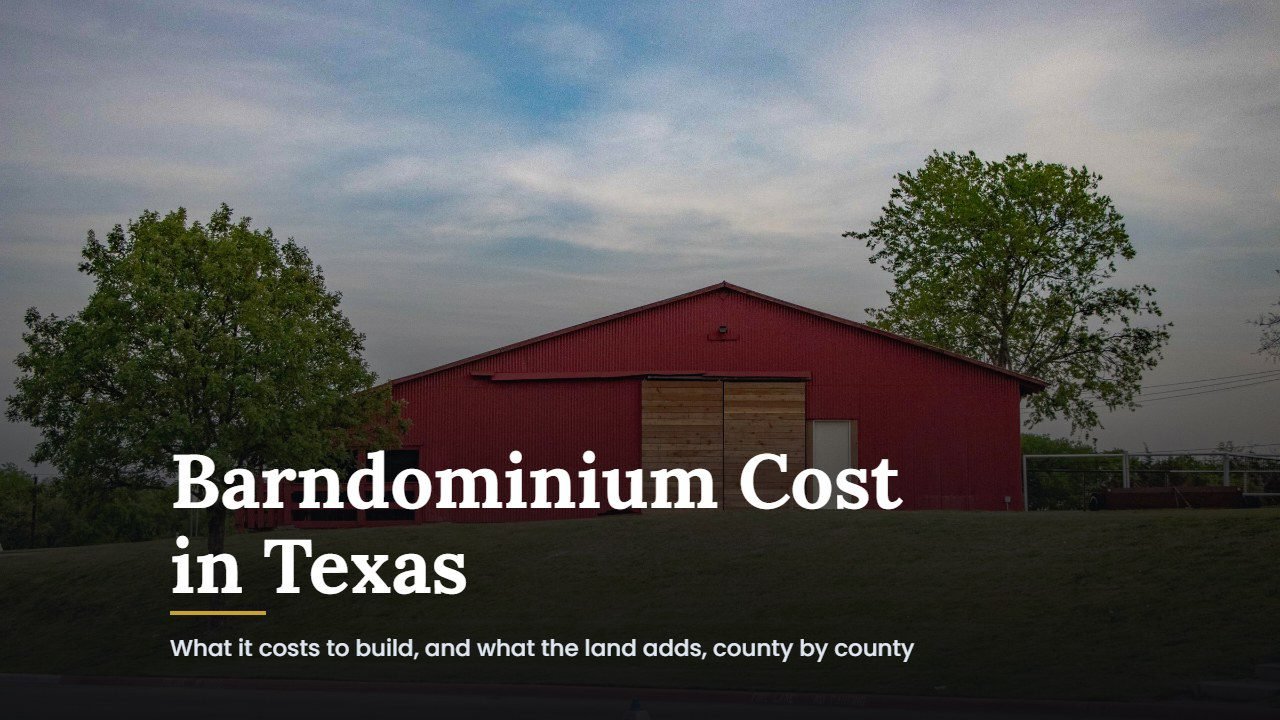
The barndominium cost in Texas runs from about $65 to $160 per square foot for a finished home, so a typical 2,000-square-foot build lands between $130,000 and $320,000 before land. The land is where Texas gets interesting: ten acres can add $10,000 in the Big Bend or $130,000 north of Dallas.
Texas is the barndominium state. The idea took off here, the builders are here, and lenders like Texas Farm Credit have whole programs for them. That also means a lot of the cost talk online is marketing. Below are the numbers we could actually source: what the building costs, what the land under it costs in fourteen Texas counties, and the Texas-specific bills that most cost guides skip, from clay soil and septic permits to windstorm insurance and property tax.
Barndominium cost in Texas: the numbers in short
What a barndominium costs to build in Texas
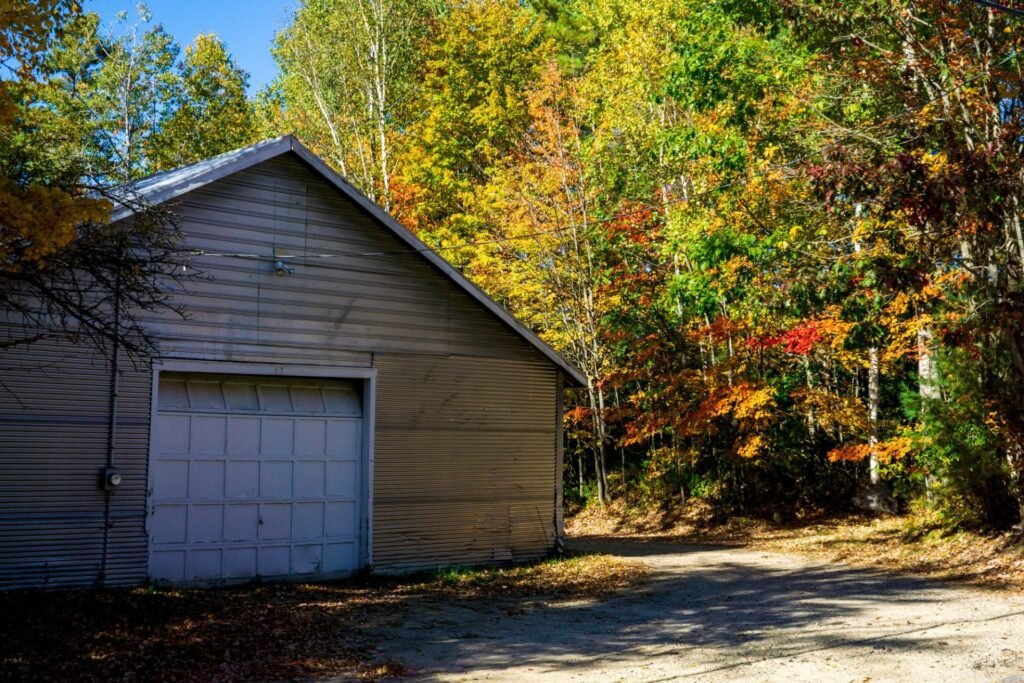
A barndominium is a steel or post-frame building with living space inside, often with a shop or garage under the same roof. The price depends far more on how much of it you finish than on the steel. Texas Farm Credit, one of the state’s Farm Credit lenders, puts the range at $30 to $50 per square foot for a kit and $65 to $160 per square foot for a standard finished build of about 2,000 square feet.
- Kit or shell: $30–$50/sq ft. The steel frame, roof and walls, put up on your slab. For 2,000 square feet, $60,000 to $100,000. It is not a house yet: no slab, insulation, plumbing, wiring or interior.
- Owner-finished: roughly $65–$100/sq ft. You hire the shell and the trades, and do much of the interior yourself. Possible on a tight budget, but slow, and harder to finance.
- Builder turnkey: up to $160/sq ft. A general contractor delivers a finished home. Upgrades like spray foam, wraparound porches and custom kitchens push it to the top of the range.
For context, the Census Bureau’s Survey of Construction put the median cost of a contractor-built conventional house in the West South Central region, which includes Texas, at $138 per square foot in 2024, lot not included. A turnkey barndominium at the top of the range costs more than that. The savings are real only if you keep the finishes simple or do part of the work yourself. Our national guide on how much it costs to build a barndominium breaks down where the money goes.
The land: same barndominium, very different total
Every barndominium cost guide we found says the same thing: land not included. In Texas, that leaves out the number that swings the barndominium cost the most. To show how much, we priced the same build, a 2,000-square-foot barndominium at $220,000, on ten acres in fourteen Texas counties, using the average value per acre of farmland from the USDA’s latest Census of Agriculture.
Same barndominium, different county
A 2,000 sq ft barndominium plus 10 acres, total cost
Barndominium ($220,000) 10 acres of land
Building at $110 per square foot. Land: USDA 2022 Census of Agriculture, average value per acre of farmland in each county. Processed by American Home Opportunities.
| County | Region | Land per acre | 10 acres | Barndominium + 10 acres | Land share of the total |
|---|---|---|---|---|---|
| Val Verde | Del Rio, Rio Grande | $1,000 | $10,000 | $230,000 | 4.3% |
| Presidio | Big Bend | $1,070 | $10,700 | $230,700 | 4.6% |
| Potter | Amarillo, Panhandle | $1,217 | $12,170 | $232,170 | 5.2% |
| Coleman | Central West Texas | $2,174 | $21,740 | $241,740 | 9.0% |
| Lubbock | South Plains | $2,673 | $26,730 | $246,730 | 10.8% |
| Kerr | Hill Country, Kerrville | $3,597 | $35,970 | $255,970 | 14.1% |
| Gillespie | Hill Country, Fredericksburg | $3,993 | $39,930 | $259,930 | 15.4% |
| Cherokee | East Texas, Jacksonville | $4,007 | $40,070 | $260,070 | 15.4% |
| Polk | Piney Woods, Livingston | $4,083 | $40,830 | $260,830 | 15.7% |
| Bell | Central Texas, Temple | $4,587 | $45,870 | $265,870 | 17.3% |
| Smith | East Texas, Tyler | $7,161 | $71,610 | $291,610 | 24.6% |
| Hays | Austin–San Antonio corridor | $11,177 | $111,770 | $331,770 | 33.7% |
| Collin | North of Dallas | $13,066 | $130,660 | $350,660 | 37.3% |
| Montgomery | North of Houston | $13,070 | $130,700 | $350,700 | 37.3% |
Read these as a floor, not a quote. The USDA figure is an average over working farms, most of them large. Small tracts of 5 to 20 acres, the size most people buy for a barndominium, sell for more per acre, especially within an hour of Dallas, Houston, Austin or San Antonio. Texas Farm Credit puts the average Texas acre at about $5,000. The ranking between counties, though, holds: west of the Hill Country the land almost disappears from the budget, and around the big metros it can become the biggest line.
That is why the cheapest barndominium in Texas is usually not the cheapest building. It is a modest building on cheap land. For where Texas land costs least and why, see our guide to buying land in Texas.
Texas costs most barndominium guides leave out
The building and the land are the two big numbers in any barndominium cost in Texas. These five are the ones that surprise Texas buyers after they have signed.
The slab on Texas clay
Most barndominiums sit on a concrete slab, and a large part of Texas, from the Blackland Prairie around Dallas and Austin to the Houston area, has expansive clay that swells when wet and shrinks when dry. A geotechnical soil test and an engineered slab cost more up front than a basic pour, but cracked slabs are one of the most expensive repairs in the state.
The septic permit and the lot size
Outside city sewer you need an on-site sewage facility, permitted by the Texas Commission on Environmental Quality or the county acting as its agent. In subdivisions, state rules require lots of at least half an acre with public water and at least one acre with a private well. Poor soils often mean an aerobic system, which needs regular maintenance.
Water: the 10-acre line
Under Texas Water Code section 36.117, a well for a home or livestock on a tract larger than 10 acres that pumps under 25,000 gallons a day is exempt from groundwater district permitting. On smaller tracts the district may require a permit. Either way, budget for drilling, a pump and a pressure tank, and ask neighbors how deep their wells go.
Wind on the coast
In the coastal counties, many private insurers will not cover wind, and the fallback is the Texas Windstorm Insurance Association. To qualify, new construction generally needs to be inspected and certified to the windstorm building code during the build. Plan that inspection before the walls go up, not after.
Getting power and a road to the pad
Cheap land is often cheap because the power line and the paved road are far away. Ask the electric cooperative for a line-extension estimate in writing before you buy, and price a driveway, a culvert and a caliche or gravel base to the building site. On big ranch tracts these can rival the cost of the slab.
Permits: what a Texas county can and cannot require
Inside city limits, a barndominium needs a building permit and has to pass the city’s zoning and code, and some cities restrict metal-sided homes. Outside city limits, in unincorporated county land, Texas counties have very limited building authority. In counties covered by Local Government Code chapter 233, subchapter F, a new house must meet the International Residential Code, but the law says the county cannot require prior approval before you build and cannot charge a fee to enforce the standard.
That does not mean no paperwork. You will still deal with the septic permit, a floodplain development permit if any part of the site is in a mapped flood zone, a driveway or culvert permit where you meet a county or state road, deed restrictions or HOA rules that may ban metal buildings, and the requirements of your lender and insurer, who often want engineer-stamped plans and inspections anyway.
Paying for it: barndominium loans in Texas
Many banks still treat barndominiums as unusual, mainly because appraisers struggle to find comparable sales. In Texas the Farm Credit associations fill that gap. Texas Farm Credit, for example, offers a one-time-close construction loan: one closing for the land and the build, with draws paid as construction moves forward, and stamped engineering plans before work begins.
Financing adds to the barndominium cost in Texas too. Expect a larger down payment than on a standard home, especially if you are buying the land in the same loan. Our guide to land loans in Texas compares what Farm Credit, banks and the Veterans Land Board ask for, and how much they put down on raw land.
Property tax and insurance: the costs that never stop
Texas has no state income tax, and it makes up for it with property tax. The average effective rate is 1.40%, the seventh highest in the country: about $3,500 a year on a $250,000 home before exemptions. Once the barndominium is your primary residence, file for the homestead exemption, which takes $140,000 off the home’s value for school taxes. If the land around it is grazed or farmed, an agricultural valuation can cut the tax on the acreage to a few dollars an acre; the house and its home site are still taxed normally. Our guide to the agricultural exemption in Texas explains how to qualify and keep it.

Insurance is the other recurring bill. The average Texas homeowners premium was $2,397 in 2022, about the price of an acre of Texas pasture in 2026, and rates have risen sharply since. Some carriers will not write a barndominium at all, and those that do may treat the shop side as a separate structure. See our guide to barndominium insurance before you choose a builder.
Before you buy land for a barndominium in Texas
- Read the deed restrictions. Many rural subdivisions ban metal buildings as homes, set minimum square footage or require brick fronts.
- Check the flood map. The FEMA Flood Map Service Center is free. A pad in the floodplain means a permit, an elevation certificate and higher insurance.
- Get a soil and septic evaluation. A site evaluator tells you what septic system the ground will take, and a soil test tells you what slab the clay needs.
- Price water, power and the road in writing. Ask local drillers about well depth, and get the electric cooperative’s line-extension quote.
- Talk to a lender and an insurer first. Find out what plans, inspections and down payment they require before you sign a land contract.
Find Texas land for your barndominium
We publish new Texas listings with land as we find them, with the county numbers already checked. Tell us your budget and timeline, and the next list reaches you first.
Keep reading
- Buying land in Texas: where land costs least, and the rules on water, minerals and access.
- How much does it cost to build a barndominium? The national cost guide, with land by state.
- Land loans in Texas: Farm Credit, banks and the Veterans Land Board compared.
- Agricultural exemption in Texas: how the ag valuation works and what it saves.
- Moving to Texas: what rural living really costs once you are there.
Common questions about barndominium cost in Texas
How much does it cost to build a barndominium in Texas?
A finished barndominium in Texas costs about $65 to $160 per square foot, according to Texas Farm Credit, so a 2,000-square-foot build runs roughly $130,000 to $320,000. Land is extra: ten acres averaged $10,000 in Val Verde County and $130,000 in Collin County in the USDA’s 2022 Census of Agriculture.
How much does a barndominium cost per square foot in Texas?
About $30 to $50 per square foot for a kit, meaning the steel shell and its assembly, and $65 to $160 per square foot for a finished home, according to Texas Farm Credit. The low end assumes simple finishes and owner labor; the high end is a builder turnkey home with upgrades.
Do you need a permit to build a barndominium in Texas?
Inside city limits, yes. In unincorporated county areas, Texas counties generally cannot require prior approval for a house, though some must apply the International Residential Code. You will still need a septic permit, a floodplain permit if the site is in a flood zone, and whatever your lender and insurer require.
Can you get a loan for a barndominium in Texas?
Yes. The Texas Farm Credit associations finance barndominiums with one-time-close construction loans that cover the land and the build, paying the builder in draws. Some banks and credit unions lend on them too. Expect stamped engineering plans, a larger down payment than for a standard house, and an appraisal that may come in low.
Is it cheaper to build a barndominium or a house in Texas?
Only with simple finishes. The Census Bureau put a contractor-built conventional house in Texas’s region at $138 per square foot in 2024, while finished barndominiums range from $65 to $160. A basic barndominium with some owner labor is cheaper; a turnkey one with upgrades can cost as much or more.
How much land do you need for a barndominium in Texas?
There is no statewide minimum, but practical rules set one. Lots in newer subdivisions using septic need at least half an acre with public water and one acre with a private well. A home or livestock well on more than 10 acres is exempt from groundwater district permits, which is why many buyers aim for 10 acres or more.
Sources
- Texas Farm Credit, Texas Barndominiums: cost per square foot, financing and construction notes.
- USDA National Agricultural Statistics Service, 2022 Census of Agriculture, Texas county data: average estimated market value of land and buildings per acre.
- U.S. Census Bureau, Survey of Construction 2024, median cost per square foot of contractor-built houses by region, as reported by NAHB.
- Texas Local Government Code, chapter 233, subchapter F, section 233.153.
- Texas Administrative Code, 30 TAC 285.4 (on-site sewage facility planning and lot sizes), and Texas Water Code section 36.117.
- Tax Foundation, Property Taxes by State and County, 2026, using 2024 data. Effective property tax rate on owner-occupied housing.
- NAIC, Dwelling Fire, Homeowners Owner-Occupied and Homeowners Tenant and Condominium/Cooperative Unit Owner’s Insurance Report, 2022 data; USDA NASS, Land Values 2026 Summary.
Before you act on any of this
American Home Opportunities is not a builder, real estate broker, agent, lender, insurer, or financial or legal advisor. Construction costs, land values, tax rates and insurance premiums change, and the figures here are ranges and averages, not quotes. Get written bids, check local rules with the county, the city and the groundwater district, and work with licensed professionals in Texas. Rural property comes with its own checks: wells, septic systems, road access, surveys, easements, mineral rights, flood zones, repairs, insurance and financing.